

TL;DR:
- Integrating PMS with OTAs via real-time, API-based channels prevents overbookings and automates rate updates across multiple platforms. It streamlines operations by reducing manual errors, saving staff hours, and enabling scalable multi-property management. Operational discipline and proper setup are essential to ensure effective, error-free synchronization at scale.
PMS and OTA integration is defined as the two-way, real-time data connection between a property management system and online travel agencies such as Airbnb, Booking.com, and Expedia, synchronising availability, rates, and reservations automatically across every channel. For short-term rental managers, this connection is not optional infrastructure. It is the operational foundation that prevents double bookings, removes manual data entry, and makes scaling across multiple listings viable. Understanding why integrate PMS with OTA, and how to do it well, is the single most consequential technical decision you will make as a property operator in 2026.
Why integrate PMS with OTA: the core mechanism explained
The technical term for this connection is channel management integration, and it works through application programming interfaces, or APIs, that allow your PMS and each OTA to exchange data without human intervention. When a guest books your property on Booking.com, that reservation is pushed back to your PMS within seconds, and your PMS immediately pushes updated availability to Airbnb, Vrbo, and every other connected channel. The process runs in both directions simultaneously, which is why the industry calls it bidirectional or two-way sync.
The speed of this exchange matters enormously. API connections block availability across channels within seconds, whereas iCal calendar feeds, an older and still widely used method, update every 15 to 30 minutes. That gap is long enough for two guests to book the same night on two different platforms, which is precisely the overbooking scenario that damages your reputation and triggers penalty fees from OTAs.
Most short-term rental operators do not connect their PMS directly to each OTA. Instead, they use a channel manager, a middleware layer that holds certified API connections to dozens of OTAs simultaneously and relays data between them and the PMS. Tools like RoomPriceGenie, Rentl, and similar platforms sit in this middleware role. The PMS remains the central record of truth, the channel manager handles the translation and routing, and each OTA receives only what it needs.
- A guest books on an OTA such as Airbnb.
- The OTA sends the booking to the channel manager via API.
- The channel manager forwards the reservation to the PMS and marks those dates as unavailable.
- The PMS pushes the updated availability back through the channel manager to all other connected OTAs.
- All channels reflect the correct inventory within seconds.
Pro Tip: When evaluating a channel manager, ask specifically about connection type and latency. A vendor that cannot confirm bidirectional API connections with sub-minute update speeds is not suitable for a property with high booking volume or short minimum stays.
What are the practical benefits of PMS and OTA integration?
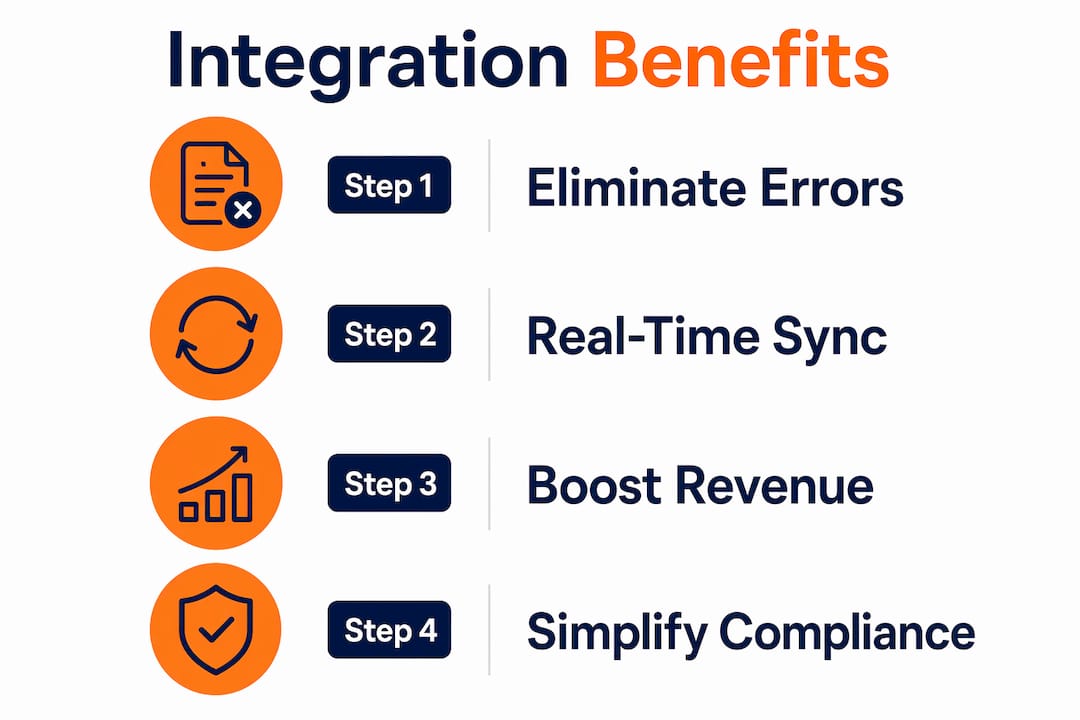
The benefits of PMS and OTA integration extend well beyond avoiding the occasional double booking. They compound across every area of your operation, from staff time to revenue per booking.
- Elimination of double bookings. Properties listing on multiple OTAs via channel managers experience up to 73% fewer overbooking incidents. Fewer overbookings means fewer guest compensation costs, fewer OTA penalty fees, and a cleaner review profile.
- Significant time savings. A 60-room property saved over 60 staff hours monthly by centralising OTA updates through a single integrated system. For a smaller operator managing five to ten listings, the equivalent saving still runs to several hours per week that would otherwise go on logging into each platform, adjusting calendars, and reconciling discrepancies.
- Centralised rate and inventory control. You set your pricing rules once in the PMS, and every connected OTA reflects them automatically. This makes dynamic pricing, where rates adjust based on demand, seasonality, or competitor activity, operationally practical. Without integration, applying dynamic pricing manually across six OTAs is a full-time task.
- Revenue growth through real-time inventory. Direct bookings increased 45% year-over-year for properties using real-time inventory management, with revenue per direct booking running 62% higher than OTA bookings. Accurate, live availability is the prerequisite for capturing that direct channel revenue.
- Reduced operational costs. Integration cuts operational expenses by 20 to 30% through automation across PMS, channel managers, booking engines, and housekeeping systems. That reduction comes from eliminating manual re-entry, reducing reconciliation errors, and freeing staff for guest-facing work.
- Scalability without proportional workload. A modern channel manager can manage 8 to 10 OTAs simultaneously without adding complexity for the operator. Adding a new OTA to your distribution mix takes minutes rather than days of setup.
The importance of integrating PMS and OTA becomes clearest when you consider the alternative: a property manager manually updating six platforms, twice a day, for ten listings. That is not a business model. It is a recipe for errors, burnout, and lost revenue.
What technical nuances determine whether integration actually works?
Not all integrations deliver equal results. The difference between a well-configured connection and a poorly configured one is the difference between a business that runs smoothly and one that spends every week troubleshooting booking errors.
Connection type and latency
Integration quality and latency are the principal factors separating viable operational systems from those perpetually troubleshooting booking errors. API and webhook-based connections update in near real time. Polling-based connections, where the system checks for changes at set intervals, introduce delays that cause what the industry calls rate drift: your OTA continues selling availability that your PMS has already closed. The result is a double booking even though you have an “integrated” system.

Property and room-type mapping
Incorrect mapping of property IDs and room types causes booking mismatches even when the API connection itself is fast and reliable. If your PMS identifies a studio apartment as “Unit 3A” but your Airbnb listing uses a different identifier, the sync will either fail silently or update the wrong listing. Mapping validation during initial setup is not optional. It is the step most operators skip and most regret.
| Integration factor | Risk if ignored | Best practice |
|---|---|---|
| Connection type | Slow updates cause overbookings | Use API or webhook connections only |
| Sync latency | Rate drift and ghost availability | Confirm sub-minute update speeds |
| Property mapping | Booking mismatches across channels | Validate all IDs during setup |
| Single source of truth | Conflicting rates across platforms | Set PMS as the sole rate authority |
| Audit frequency | Errors accumulate undetected | Review sync logs monthly |
Single source of truth
A clear single source of truth for rates and availability, almost always the PMS, is non-negotiable. When team members edit rates directly on Booking.com or Airbnb’s extranet rather than in the PMS, those changes create conflicts that the sync cannot resolve cleanly. Establish a firm operational rule: all rate and availability changes originate in the PMS, never on the OTA platform directly.
Pro Tip: Schedule a monthly audit of your channel manager’s sync logs. Look for failed pushes, delayed updates, and any rates that differ between your PMS and OTA listings. Catching drift early prevents it from becoming a guest complaint.
How to manage multiple short-term rental properties with PMS-OTA integration
Scaling from two properties to ten, or from ten to fifty, is where PMS and OTA integration moves from useful to indispensable. The operational model changes fundamentally once you have more listings than one person can monitor manually.
- Centralised multi-property management. A single PMS dashboard showing live availability, incoming bookings, and rate performance across all properties removes the need for property-by-property platform checks. Guestadmin’s real-time booking dashboard is one example of how centralised data visibility translates directly into faster, more confident operational decisions.
- Pooled inventory models. For operators managing multiple units within the same building or complex, pooled inventory allows the system to sell from a shared availability pool rather than fixed per-unit allocations. This reduces the risk of one unit sitting empty while another is overbooked.
- Automated inventory rules. You can configure rules that automatically close availability across all OTAs when a property falls below a minimum stay threshold, or open last-minute discounts when a gap appears in the calendar. These rules run without manual input, which is where the real time saving occurs at scale.
- Housekeeping and task automation. When a booking arrives via OTA and lands in the PMS, integrated housekeeping tools can automatically schedule a clean, assign a staff member, and send a confirmation. This removes a manual coordination step that, across ten properties, adds up to hours per week.
- Revenue management integration. Tools that connect vacation rental revenue optimisation logic directly to PMS and OTA data allow dynamic pricing to respond to real booking patterns rather than static seasonal rules. The result is higher average daily rates without manual rate adjustments.
For operators managing properties across multiple European markets, the compliance dimension adds another layer of value. Integrated systems that capture guest data at the point of booking and submit it automatically to the relevant authorities remove a significant administrative burden. You can read more about this in Guestadmin’s guide to syncing booking data for compliance.
Key takeaways
PMS and OTA integration works because bidirectional, API-based synchronisation eliminates the manual errors, rate drift, and overbooking risks that make multi-channel distribution unmanageable at scale.
| Point | Details |
|---|---|
| Use API connections, not iCal | API updates fire within seconds; iCal delays of 15 to 30 minutes create overbooking windows. |
| Set PMS as the single rate authority | All rate changes must originate in the PMS to prevent conflicting edits across OTAs. |
| Validate property mapping at setup | Incorrect room-type mapping causes booking mismatches regardless of connection speed. |
| Audit sync logs monthly | Regular checks catch rate drift and failed pushes before they become guest complaints. |
| Integration scales without proportional effort | A channel manager handles 8 to 10 OTAs simultaneously, making multi-property growth operationally viable. |
The integration decisions that actually matter in practice
I have reviewed a lot of integration setups across short-term rental portfolios, and the pattern is consistent: operators who struggle with overbookings and rate errors almost always have one of two problems. Either they are still relying on iCal feeds because the setup was easier, or they made the integration work technically but never established clear rules about who edits rates and where.
The second problem is subtler and more damaging. A well-configured API connection can be undermined entirely by one team member who logs into the Airbnb extranet and adjusts a price directly. That edit does not flow back to the PMS cleanly, and within days you have rate inconsistencies across channels that no automated system will resolve on its own.
My honest view is that the technology is largely solved. The API integrations available in hospitality today are reliable, fast, and accessible even for small operators. The gap is operational discipline: clear ownership of rate setting, documented procedures for adding new OTAs, and a monthly habit of checking that everything is still aligned. Operators who build those habits early scale without drama. Those who do not spend a disproportionate amount of time firefighting problems that should not exist.
One area worth watching in 2026 is the convergence of AI-powered dynamic pricing with real-time PMS and OTA data. Tools that adjust rates automatically based on live demand signals are becoming standard rather than premium. For that to work, the underlying integration must be fast and accurate. If your sync is slow or your mapping is wrong, the pricing engine is working with bad data, and bad data produces bad decisions at scale.
— Alex
How Guestadmin supports multi-property managers with PMS-OTA integration
Managing multiple short-term rental properties across European markets means dealing with compliance obligations on top of the operational complexity of channel management. Guestadmin centralises booking data from connected PMS and OTA platforms, automates guest data submission to government authorities, and gives you a single dashboard view across all properties.
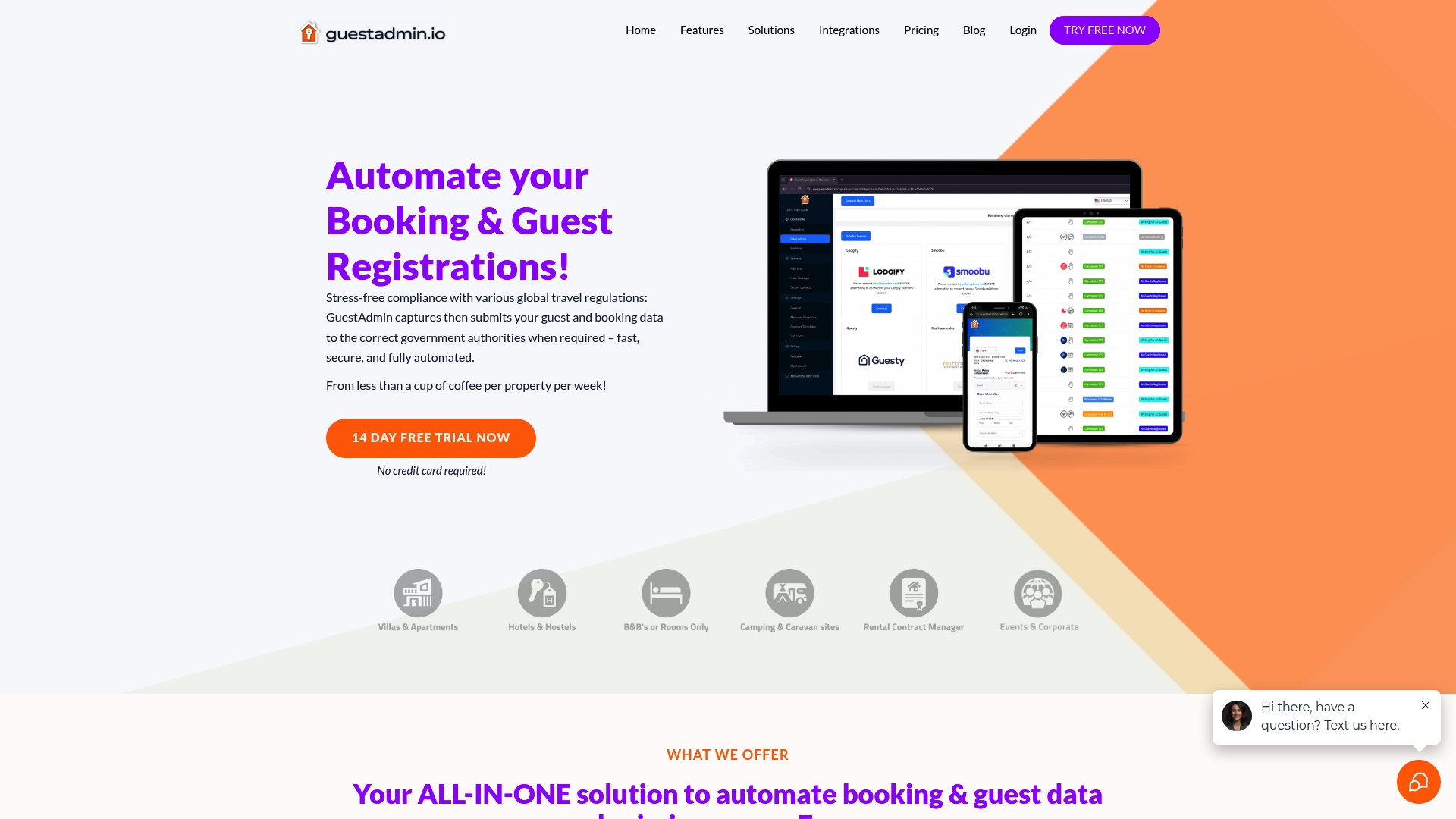
For property managers ready to move beyond manual processes, Guestadmin’s platform handles the compliance layer automatically, so your team focuses on guests rather than paperwork. Start with the multi-property management tips guide to see how integrated systems support both operational efficiency and regulatory compliance across your entire portfolio.
FAQ
What is PMS OTA integration?
PMS OTA integration is the two-way, API-based connection between a property management system and online travel agencies that synchronises availability, rates, and bookings in near real time across all connected channels.
How does PMS and OTA integration prevent double bookings?
When a booking arrives on one OTA, the PMS immediately pushes updated availability to all other connected channels via the channel manager. API connections complete this update within seconds, closing the window in which a second booking could occur.
What is the difference between API and iCal integration?
API connections update availability across channels within seconds, while iCal feeds refresh every 15 to 30 minutes. That delay is sufficient for overbookings to occur, making iCal unsuitable for properties with high booking frequency.
Why is the PMS the single source of truth for rates?
Editing rates directly on OTA platforms creates conflicts that the sync cannot resolve cleanly. Setting the PMS as the sole origin for all rate and availability changes prevents drift and keeps every channel consistent.
How many OTAs can a channel manager handle simultaneously?
Modern channel managers handle 8 to 10 OTAs simultaneously without adding operational complexity, making them the standard architecture for multi-channel short-term rental distribution.