

TL;DR:
- GDPR governs how hospitality operators handle guest data, requiring documented lawful bases, timely responses, signed vendor agreements, and automated retention practices. Small operators can achieve compliance through operational discipline, clear procedures, and regular reviews, rather than expensive legal tools. Addressing CCTV signage and marketing consent reduces the most common complaints and enhances overall data protection efforts.
The General Data Protection Regulation (GDPR) is the EU’s primary legal framework governing how organisations collect, store, and process personal data, and it applies fully to every hospitality operator handling guest information, including short-term rental hosts across Europe. GDPR in hospitality explained simply means understanding that your property management system (PMS), booking engine, channel manager, and marketing tools all process personal data that falls under this regulation. Enforcement fines for independent hotels under 100 rooms range between €5,000 and €25,000, typically triggered by operational lapses rather than malicious breaches. Getting compliance right is not about expensive legal counsel. It is about building clear data workflows and documented procedures into your daily operations.
What are the lawful bases for processing guest data under GDPR?
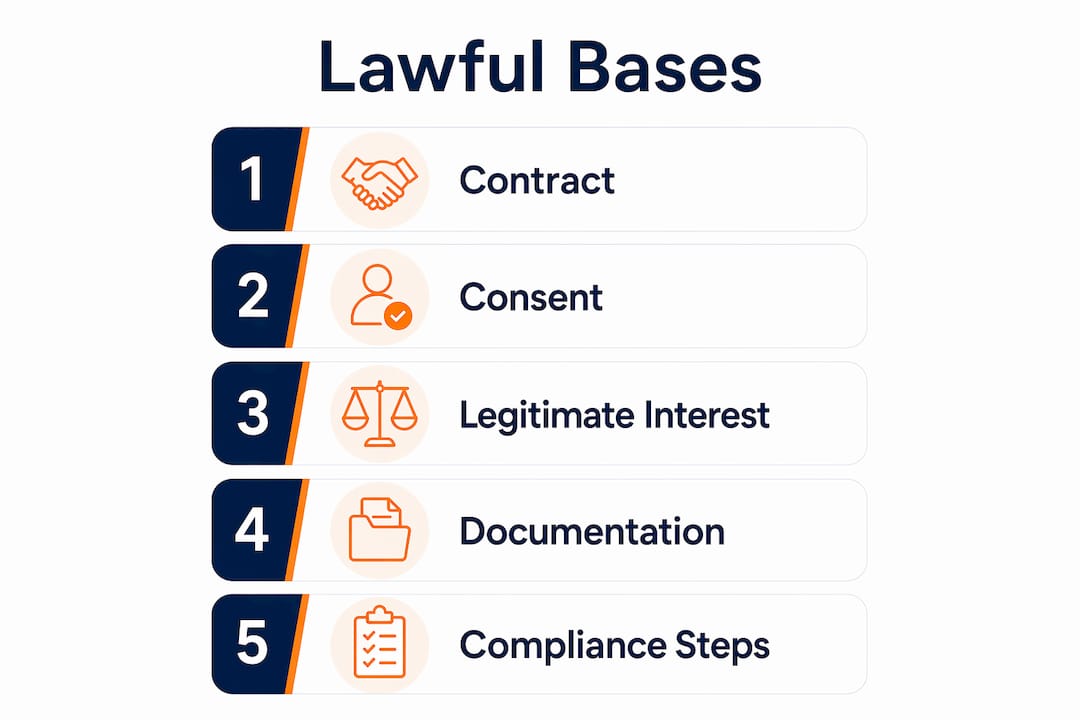
GDPR Article 6 defines six lawful bases for processing personal data, and hospitality operators rely primarily on three of them. Understanding which basis applies to each data type is the foundation of any GDPR compliance guide for hospitality.

Contract performance (Article 6(1)(b)) covers the vast majority of operational guest data. When a guest books a stay, you are legally entitled to collect their name, contact details, payment information, and booking dates because processing that data is necessary to fulfil the contract. Most hospitality data is processed under contract performance, and operators do not need to invent new justifications for standard operational data. The critical step is documenting this basis in your records of processing activities.
Consent (Article 6(1)(a)) applies when you want to send marketing emails, newsletters, or promotional offers. Consent must be freely given, specific, and verifiable. A pre-ticked box on a booking form does not qualify. You need a clear opt-in mechanism and a record of when and how each guest consented.
Legitimate interest (Article 6(1)(f)) can apply in narrower circumstances, such as fraud prevention or security monitoring, but it requires a documented balancing test showing your interest does not override the guest’s rights.
| Data type | Typical lawful basis |
|---|---|
| Name, address, booking dates | Contract performance |
| Payment card details | Contract performance |
| Marketing email preferences | Consent |
| CCTV footage | Legitimate interest |
| Dietary or accessibility needs | Explicit consent or contract |
| Loyalty programme data | Consent |
Pro Tip: Document your lawful basis for every data category before you collect a single record. A simple spreadsheet listing data type, purpose, and basis is sufficient for most small operators and will satisfy a regulator’s first request.
How should hospitality operators handle data subject rights requests?
Guests hold specific rights under GDPR, and your obligation to respond is both strict and time-limited. Guests have rights including access, rectification, erasure, and portability, with a firm 30-day window to respond to any request. Missing that deadline triggers regulatory complaints, which is the most common route to enforcement action for small properties.
The four rights most relevant to hospitality operators are:
- Right of access. A guest can ask for a copy of all personal data you hold about them. Your response must cover every system where their data lives, including your PMS, CRM, email marketing platform, and any review tools.
- Right to rectification. If a guest believes their data is inaccurate, you must correct it promptly across all connected systems.
- Right to erasure. A guest can request deletion of their data when it is no longer needed for the original purpose. Deleting a guest record in one system is not enough. Erasure must cascade to every integrated platform where that data resides.
- Right to portability. Guests can request their data in a structured, machine-readable format such as a CSV file.
The operational challenge is that most short-term rental operators use four or more connected platforms. A single erasure request may require action in a PMS, a channel manager, an email marketing tool, and a review platform simultaneously. Manual processes fail under this pressure.
Pro Tip: Create a dedicated email address such as [email protected] for data subject requests. Log every request in a simple tracker with the date received, deadline, and actions taken. This record protects you if a complaint is ever filed.
Automating erasure and portability workflows across integrated systems is the most reliable way to meet the 30-day deadline consistently. Platforms that connect your PMS to downstream tools via APIs can trigger deletion across all systems from a single action, removing the risk of human error.
What vendor agreements must hospitality operators maintain?
GDPR Article 28 requires a signed Data Processing Agreement (DPA) with every third party that processes guest data on your behalf. A DPA is a legally binding contract that defines what data is shared, how it is used, and what security measures the vendor maintains. Hospitality operators must maintain signed DPAs with every vendor processing guest data, and the primary risk is failing to document these agreements rather than vendors lacking capability.
The vendor categories requiring DPAs in a typical short-term rental operation include:
- Property management systems such as Guesty, Lodgify, or Hostaway
- Channel managers connecting to Airbnb, Booking.com, and Vrbo
- Online travel agencies (OTAs) where guest data is transmitted at the point of booking
- Email marketing platforms such as Mailchimp or Brevo
- Wi-Fi providers that log guest device data
- Payment processors handling card and transaction data
- Review management tools that store guest feedback linked to personal data
Most established SaaS vendors in hospitality provide DPAs on request or publish them in their terms of service. The problem is that many operators never formally sign or retrieve these documents. A practical compliance approach for independent operators centres on documenting existing data protection practices rather than investing in expensive enterprise tooling.
Build a simple vendor register listing each supplier, the data they process, and the date you received their signed DPA. Review it annually and whenever you onboard a new technology partner. This single document demonstrates due diligence to any regulator.
How to manage data retention for guest information in short-term rentals
GDPR Article 5(1)(e) requires that personal data is kept no longer than necessary for the purpose for which it was collected. This principle, known as storage limitation, is one of the most commonly violated in hospitality because operators default to keeping everything indefinitely.
Data retention policies must comply with GDPR’s minimal retention mandate, with practical policies such as deleting dietary or accessibility data within 30 days post-checkout unless the guest has opted into a stored profile. Sensitive preference data carries the highest risk if retained without purpose.
The table below summarises a practical retention schedule for short-term rental operators:
| Data category | Lawful basis | Typical retention period |
|---|---|---|
| Booking and contract records | Contract performance | 7 years (financial records) |
| Guest contact details | Contract performance | Duration of stay plus 12 months |
| Dietary or accessibility data | Consent or contract | 30 days post-checkout |
| Marketing consent records | Consent | Until withdrawal plus 3 years |
| CCTV footage | Legitimate interest | 30 days unless incident recorded |
| Payment transaction data | Legal obligation | 7 years |
Automated deletion triggers are the most reliable way to enforce these schedules. A manual promise to delete data is not a retention policy. Automated triggers for deletion reduce risk significantly without operational impact, and most modern PMS platforms support scheduled data purges or can be configured via API to do so.
CCTV and direct marketing are the most frequent sources of GDPR complaints in hospitality. Placing clear signage at every camera and collecting verifiable opt-in consent for marketing are low-cost measures that significantly reduce complaint risk. These two areas alone account for a disproportionate share of regulatory attention, so addressing them first delivers the highest compliance return.
For operators managing guest data across EU rentals, the most practical approach is to build retention rules directly into your booking workflow rather than treating deletion as a separate administrative task.
Key takeaways
GDPR compliance in hospitality is an operational discipline built on documented lawful bases, timely responses to guest rights requests, signed vendor agreements, and automated data retention, not a one-off legal exercise.
| Point | Details |
|---|---|
| Document lawful bases | Record the Article 6 basis for every data category before collection begins. |
| Meet the 30-day deadline | Log every data subject request on receipt and automate cross-system responses where possible. |
| Sign all vendor DPAs | Maintain a register of signed agreements with every third-party processor, including OTAs and email tools. |
| Automate data deletion | Use scheduled purges or API triggers to enforce retention limits rather than relying on manual processes. |
| Prioritise CCTV and marketing | Address signage and opt-in consent in these two areas first, as they generate the most regulatory complaints. |
What GDPR compliance in hospitality actually looks like in practice
GDPR is consistently framed as a legal problem. After working with hospitality operators across Europe, I am convinced it is primarily a data architecture problem. The operators who struggle most are not those who lack legal knowledge. They are the ones whose guest data sits in five disconnected systems with no clear owner and no deletion workflow.
The good news is that compliance for small to mid-size properties can be achieved through documented procedures and operational discipline without expensive tools. A privacy notice, a breach response plan, a vendor register, and a request log are the four documents that matter most. None of them require a solicitor to produce.
What I find operators consistently overlook is the cascade problem. They delete a guest from their PMS and consider the job done. But that guest’s data still lives in their email marketing platform, their review tool, and possibly their channel manager’s database. Compliance requires cascading erasure to every connected system, and that is where manual processes break down under volume.
My practical recommendation is a quarterly compliance review rather than an annual panic. Spend 90 minutes every three months checking your vendor register, reviewing any requests received, and confirming your retention triggers are firing correctly. That rhythm catches problems before they become complaints.
— Alex
How Guestadmin supports GDPR compliance for short-term rental operators
Managing GDPR obligations across multiple properties and platforms is where administrative burden compounds quickly. Guestadmin is built specifically for European short-term rental operators who need to capture, process, and archive guest data in a way that satisfies both regulatory authorities and GDPR requirements simultaneously.
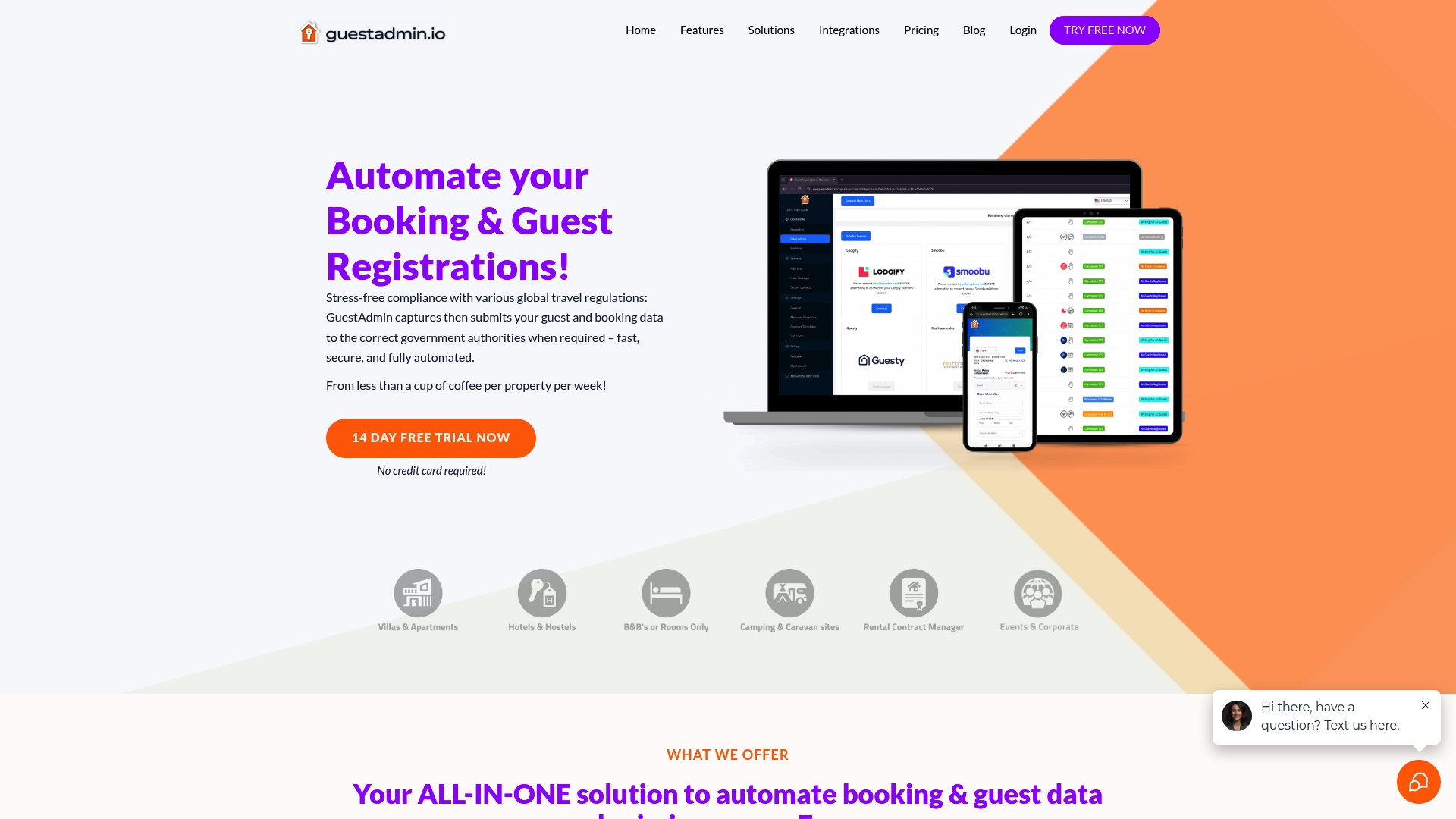
Guestadmin automates guest data archiving, integrates with leading PMS and OTA platforms via API, and provides secure, auditable access to booking records from any device. For operators managing several properties, the multi-property compliance workflow removes the need to check each system individually. The platform also supports timely government data submissions within 24 hours, reducing the risk of both regulatory and GDPR breaches in a single workflow. For a full overview of what hospitality compliance requires in 2026, Guestadmin’s resource centre is a practical starting point.
FAQ
What is GDPR and does it apply to short-term rentals?
GDPR is the EU’s data protection regulation and applies to any operator processing personal data of EU residents, including short-term rental hosts. If you collect guest names, contact details, or payment information, GDPR applies to your operation.
What lawful basis covers standard guest booking data?
Contract performance under Article 6(1)(b) covers operational data such as names, booking dates, and payment details. Marketing communications require separate, explicit consent under Article 6(1)(a).
How long do I have to respond to a guest data request?
The deadline is 30 days from the date of receipt for all data subject requests, including access, erasure, and portability. Failure to meet this deadline triggers regulatory complaints and potential enforcement action.
Do I need a Data Processing Agreement with Airbnb or Booking.com?
Yes. Online travel agencies process guest personal data on your behalf and require a signed DPA under GDPR Article 28. Most major OTAs publish their DPA terms within their platform agreements, but you should confirm and retain a copy.
What are the most common GDPR complaints in hospitality?
CCTV and direct marketing generate the most frequent GDPR complaints in hospitality. Proper camera signage and verifiable opt-in consent for marketing emails address both issues at low cost.