

TL;DR:
- Automated data submission transfers data programmatically from source systems to reporting platforms, reducing manual errors.
- It improves data quality, cuts costs, and enhances scalability, especially for compliance-critical sectors like hospitality and finance.
Automated data submission is defined as the programmatic transfer of data from source systems to reporting or regulatory platforms without any manual input. This process reduces errors and speeds up reports by removing human handling from routine data transfers. For property managers, finance teams, and compliance officers across Europe, this distinction matters enormously. Manual processes cannot keep pace with the volume, frequency, and accuracy that modern regulations demand. Understanding automated data submission is the first step towards building a compliance process that actually holds up under scrutiny.
What is automated data submission and how does it work?
Automated data submission covers the full cycle from data capture through to delivery at a regulatory or reporting destination. The process typically runs in five stages: capture, validation, transformation, routing, and storage. Each stage can be handled by a different technology, or by a single platform that integrates all five.

Three core technologies power most automated submission systems today. APIs (Application Programming Interfaces) connect source systems directly to destination platforms, passing data in real time without any user action. Robotic Process Automation (RPA) uses software to mimic human actions inside existing interfaces, filling forms and clicking buttons automatically. Intelligent Document Processing (IDP) applies AI and OCR to handle semi-structured and unstructured data such as scanned documents, email attachments, and handwritten notes, going well beyond what a spreadsheet can manage.
The choice between these approaches matters. Hard-coded API integrations offer greater stability than UI-based RPA for complex, high-volume regulatory submissions. RPA can break when a software interface changes by even a few pixels, causing silent failures at exactly the wrong moment.
Automation can also run on two timing models. Real-time triggers fire the moment a qualifying event occurs, such as a guest checking in or a booking being confirmed. Scheduled batch processing collects data over a set period and submits it in one consolidated transfer, which suits monthly regulatory reports or end-of-day reconciliations.
| Method | Best suited for | Key strength | Key risk |
|---|---|---|---|
| API integration | High-volume, real-time submissions | Stable, direct connection | Requires developer setup |
| RPA | Legacy systems without APIs | No code changes to source system | Breaks on interface updates |
| IDP | Unstructured or scanned documents | Handles varied data formats | Needs AI training and tuning |
| Batch processing | Periodic regulatory reports | Efficient for large data sets | Delay between event and submission |
Pro Tip: Before selecting a technology, map every data source your business uses. If any source lacks an API, factor in the additional fragility that RPA introduces before committing to it for compliance-critical workflows.
What are the benefits of automated data submission over manual entry?
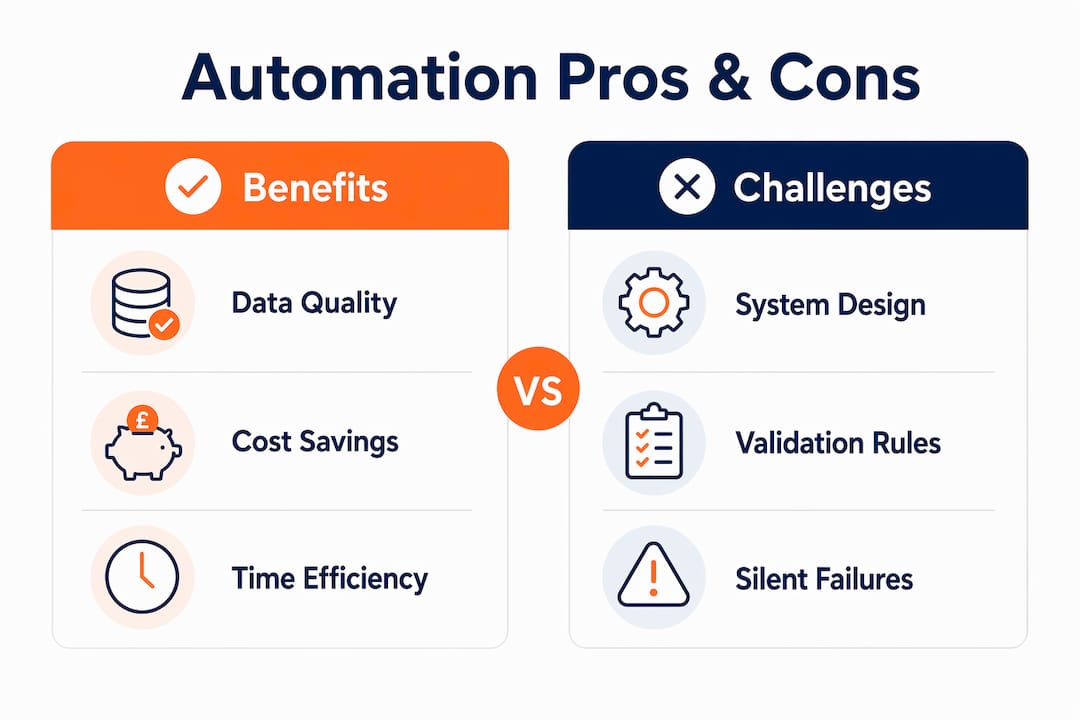
The primary benefit of automated data processing is improved data quality, not simply speed. Consistent validation rules applied at every submission catch errors that a tired or pressured employee would miss. That reliability compounds over time, building a data record that regulators and auditors can trust.
The cost argument is equally clear. Manual data entry errors cost organisations £12.9 million annually on average. That figure covers correction time, resubmissions, regulatory penalties, and reputational damage. Automation eliminates most of that exposure at the source.
Time savings are just as significant. Employees currently spend 20–40% of their working hours on repetitive data tasks. Automated processing handles the same documents in seconds rather than hours. That freed capacity goes towards work that actually requires human judgement.
Scalability is the third major advantage. The automated data processing sector is expected to grow at 30% CAGR between 2023 and 2027, driven by the need to handle increasing data volumes without adding headcount. A manual process that works for ten properties collapses under the weight of fifty. An automated system scales without proportional cost increases.
Key benefits at a glance:
- Error reduction: Validation rules catch mistakes before data reaches the destination.
- Cost savings: Fewer corrections, penalties, and resubmissions.
- Time efficiency: Submissions that took hours complete in seconds.
- Scalability: Volume growth does not require equivalent staff growth.
- Compliance consistency: Standard protocols apply equally to every submission.
- Audit readiness: Automated logs create a clear, timestamped record of every transfer.
For property managers handling guest data compliance across multiple European jurisdictions, these benefits are not abstract. They translate directly into fewer fines, faster reporting, and less administrative burden per property.
What challenges arise in automated data submission quality assurance?
Automation does not eliminate risk. It shifts risk from human error to system design. The most common failure mode is a poorly defined ruleset that allows bad data to pass validation and reach a regulatory destination unchallenged.
Many automation failures result directly from a lack of clear rules and triggers for valid data. When the system does not know what “wrong” looks like, it cannot flag it. The result is a submission that appears successful but contains corrupted or incomplete records.
Silent failures are the most dangerous outcome. A fire-and-forget automation submits data and moves on, with no mechanism to detect that the receiving system rejected the payload or that a field contained an impossible value. Embedded QA protocols including anomaly detection and redundancy checks are not optional extras. They are the difference between controlled automation and a compliance liability.
Manual exception handling must integrate into every automated workflow. When the system encounters data it cannot validate, it should pause and route that record to a human reviewer rather than proceeding or discarding it silently. This single design decision prevents the majority of data corruption incidents in regulatory submissions.
Practical QA measures that every automated submission system should include:
- Predefined validation rules covering every required field and acceptable value range.
- Anomaly detection that flags records deviating from historical patterns.
- Exception queues that hold unresolvable records for human review.
- Submission receipts that confirm the destination system accepted the data.
- Audit logs recording every transfer, validation result, and exception decision.
Pro Tip: Test your exception handling before going live, not after. Submit deliberately malformed records and confirm the system routes them to a reviewer rather than passing them through or dropping them silently.
Which industries and use cases benefit most from automated submission?
Automated submission applies wherever data must move from an operational system to an external authority on a defined schedule or trigger. The use cases span multiple sectors, but the compliance-driven ones carry the highest stakes.
Hospitality and short-term rentals represent one of the clearest applications. European regulations require property managers to submit guest identification data to local authorities, often within 24 hours of check-in. Doing this manually across multiple properties is not just slow. It is genuinely unmanageable at scale. Platforms like Guestadmin automate the full cycle: capturing guest data at check-in, validating it against regulatory requirements, and submitting it to the relevant authority without any manual step. Property managers can read more about automating guest data reporting to understand how this works in practice across different European jurisdictions.
Financial services use automated submission for regulatory reporting to bodies such as the European Banking Authority (EBA) and the Financial Conduct Authority (FCA). Submissions covering capital adequacy, transaction monitoring, and anti-money-laundering data run on fixed schedules and carry severe penalties for late or inaccurate filing.
Supply chain management relies on automated data entry to update inventory levels, shipment statuses, and supplier invoices across connected systems in real time. Manual updates introduce lag that disrupts procurement decisions.
| Industry | Data type submitted | Primary driver |
|---|---|---|
| Hospitality | Guest identification records | Regulatory compliance |
| Financial services | Capital and transaction reports | Regulatory compliance |
| Supply chain | Inventory and shipment data | Operational efficiency |
| Healthcare | Patient records and billing codes | Compliance and accuracy |
| Public sector | Tax and statistical returns | Statutory obligation |
The data types processed automatically range from structured database records through semi-structured formats like XML and JSON, to fully unstructured sources such as scanned passports and email confirmations. IDP technology handles all three, which is why it has become central to compliance-driven sectors where source documents arrive in inconsistent formats.
For property managers specifically, understanding hospitality compliance requirements is the foundation for knowing which data fields must be captured and submitted accurately every time.
Key takeaways
Automated data submission delivers compliance reliability and cost savings that manual processes cannot match, provided the system is built with clear validation rules and embedded quality controls.
| Point | Details |
|---|---|
| Core definition | Automated data submission transfers data programmatically, removing manual input from the process. |
| Technology choice matters | API integrations are more stable than RPA for high-volume regulatory submissions. |
| Quality over speed | Consistent validation rules improve data quality more reliably than human review under pressure. |
| QA is non-negotiable | Exception handling and anomaly detection must be built in, not added later. |
| Compliance drives adoption | Sectors with strict reporting obligations gain the most from automated submission systems. |
Why most businesses get automation wrong before they get it right
Having worked with property managers and compliance teams across Europe, I have noticed a consistent pattern. Businesses invest in automation to solve a speed problem, then discover six months later that they have a quality problem instead. The system is fast. The data is wrong.
The mistake is almost always the same. Teams deploy automation before they have fully mapped their data rules. They know what fields need submitting. They have not decided what a valid value looks like for each one, what happens when a field is missing, or who reviews the exceptions. The automation runs, the submissions go out, and the errors accumulate quietly until a regulator or auditor surfaces them.
The businesses that get this right treat the rule definition phase as the most important part of the project, not a preliminary step to rush through. They spend time with the people who currently do the work manually, because those people know every edge case the system will eventually encounter.
My honest view is that AI-enhanced processing, as Guestadmin applies it to guest data, changes the equation significantly. It handles the unstructured inputs that trip up rule-based systems, such as passports in different formats or booking confirmations from different OTA platforms. But AI does not replace governance. The businesses winning at compliance automation are the ones combining capable technology with clear human accountability for exceptions. That combination is what makes automation genuinely reliable rather than just fast.
— Alex
Guestadmin’s approach to automated compliance reporting
Property managers operating across Europe face a specific version of this challenge. Guest data must reach local authorities accurately and on time, across jurisdictions with different requirements and formats.
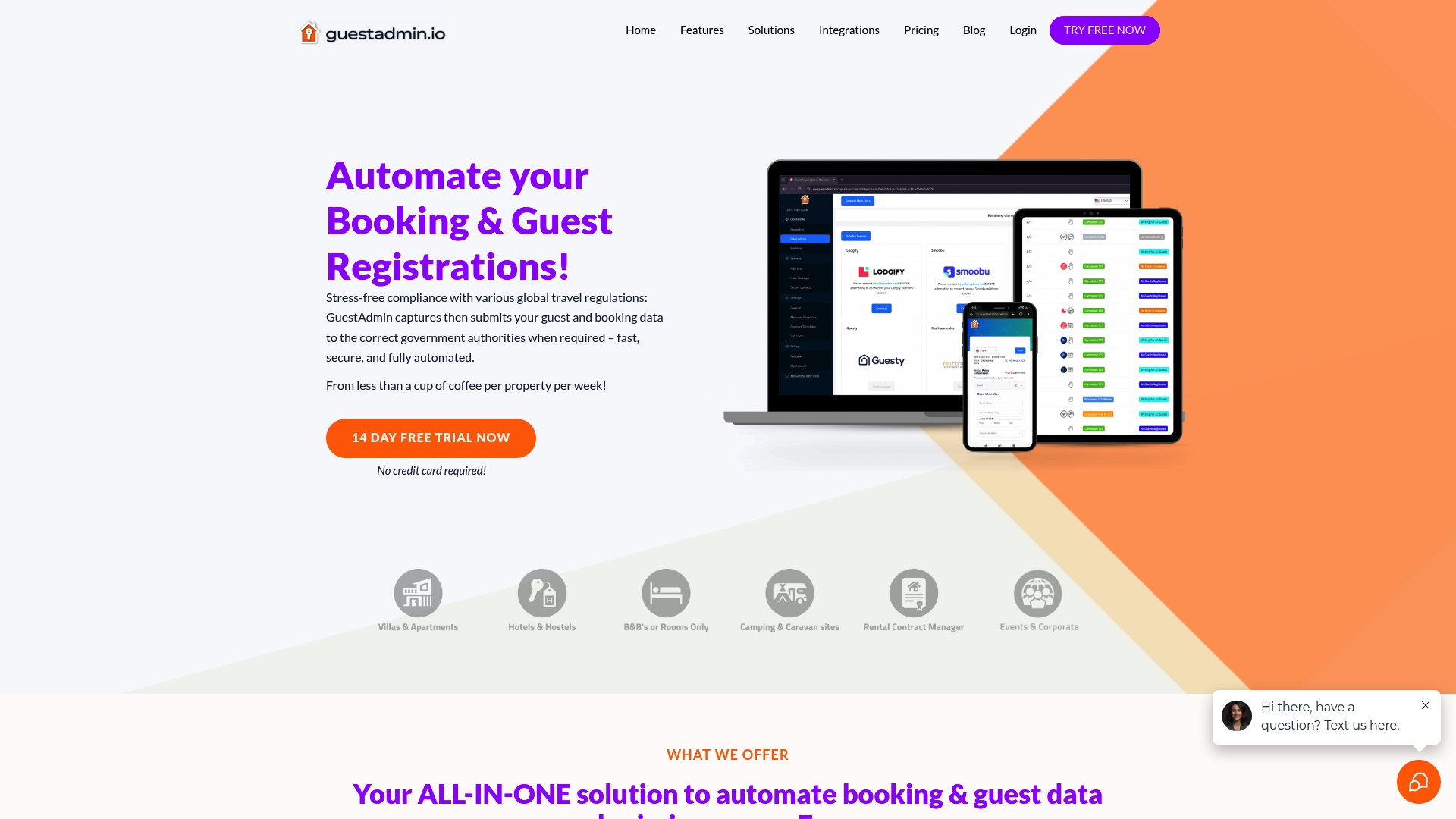
Guestadmin addresses this directly. The platform captures guest identification data at check-in, validates it against the relevant regulatory requirements for each jurisdiction, and submits it automatically, typically within 24 hours. It integrates with major PMS and OTA platforms via APIs and webhooks, removing the need to re-enter data that already exists in your booking system. For managers handling multiple properties, the multi-property management tools give a single view of submission status across every location. GDPR-compliant data handling and secure archiving are built into the platform, not bolted on. If you manage short-term rentals in Europe and want to understand the software options available for automating guest data compliance, Guestadmin is worth examining closely.
FAQ
What is automated data submission in simple terms?
Automated data submission is the process of transferring data from one system to another without any manual input. Software handles the capture, validation, and delivery automatically.
How does automated data submission reduce compliance risk?
Consistent validation rules catch errors before data reaches a regulatory authority, and audit logs create a timestamped record of every submission. Both features reduce the risk of penalties from inaccurate or late filings.
What is the difference between RPA and API-based submission?
RPA mimics human actions inside a software interface and can break when that interface changes. API-based submission connects systems directly at the data level and is significantly more stable for high-volume regulatory workflows.
Why do automated data submission systems sometimes fail?
The most common cause is a lack of clearly defined validation rules before deployment. Without predefined criteria for valid data, the system cannot detect or flag incorrect records before they are submitted.
Which data types can automated submission systems handle?
Modern systems using Intelligent Document Processing handle structured data such as database records, semi-structured formats such as XML and JSON, and unstructured sources such as scanned passports and email attachments.