

TL;DR:
- GDPR in hospitality regulates how businesses handle guest personal data, requiring strict compliance. Hotels and related services must document lawful processing, sign vendor agreements, and automate data deletion to avoid penalties and protect guest trust. Ongoing operational discipline is essential for maintaining compliance and gaining a competitive advantage.
GDPR in hospitality is the regulatory framework that governs how accommodation businesses collect, store, process, and protect the personal data of their guests. The General Data Protection Regulation applies to every hotel, short-term rental, restaurant, and property management company that handles EU residents’ data, regardless of where the business is physically located. Non-compliance carries fines up to €20 million or 4% of global annual turnover. Understanding what GDPR requires in practice is the first step towards protecting your guests, your reputation, and your business.
What is GDPR in hospitality and what data does it cover?
GDPR in hospitality regulates every piece of personal information a guest shares with your business, from the moment they make a booking to long after they check out. Personal data includes names, passport numbers, payment card details, email addresses, phone numbers, dietary preferences, and health information. It also covers behavioural data collected through your website, such as cookies and browsing history. The scope is broader than most property owners initially expect.

Data enters your systems at multiple touchpoints. Reservations made through online travel agencies such as Booking.com or Airbnb, direct website bookings, loyalty programme sign-ups, and on-site check-in processes all generate personal data that GDPR regulates. Each touchpoint requires a documented lawful basis for processing. Without one, the data collection is unlawful regardless of how securely you store it.
The distinction between operational and marketing data matters enormously. Processing a guest’s name and payment details to fulfil a booking relies on contractual necessity as its lawful basis. Sending that same guest a promotional newsletter requires separate, freely given consent. Mixing these two bases, or assuming one covers the other, is one of the most common compliance errors in the sector. Your guest data processing guide should document each activity separately.
Property Management Systems (PMS), Customer Relationship Management (CRM) platforms, and channel managers all hold personal data. Each system is a potential compliance risk if it lacks proper controls. Understanding where data lives across your technology stack is not optional. It is the foundation of every other compliance obligation.
What are the core GDPR compliance requirements for hospitality businesses?
GDPR places specific, enforceable obligations on hospitality businesses. Meeting them requires both legal understanding and operational discipline. The core requirements are:
- Establish a lawful basis for every processing activity. Contractual necessity, consent, and legitimate interests are the three bases most relevant to hospitality. Each must be documented before processing begins.
- Maintain a Record of Processing Activities (RoPA). This is a written inventory of every data processing activity your business conducts, including its purpose, lawful basis, data categories, and retention period. Regulators can request it at any time.
- Sign Data Processing Agreements (DPAs) with all third-party vendors. DPAs are mandatory under Article 28 of GDPR for every supplier that processes guest data on your behalf, including your PMS provider, payment processor, and email marketing platform.
- Respond to data subject requests within 30 days. Guests have the right to access, rectify, and erase their personal data. Your business must have a clear process for handling these requests on time.
- Report significant data breaches within 72 hours. Failure to meet this deadline is itself a punishable violation, separate from the breach itself.
- Appoint a Data Protection Officer (DPO) where appropriate. Businesses processing large volumes of guest data or using surveillance technology such as CCTV are strongly advised to appoint a DPO as an independent point of contact for guests and regulators.
- Implement retention and deletion workflows. Data must not be kept longer than necessary. Different data categories carry different retention requirements: invoice data may be retained for 5–10 years under tax law, while marketing consents must be deleted far sooner.
Pro Tip: Draft your RoPA as a living document rather than a one-off exercise. Review it every time you onboard a new vendor, launch a new marketing channel, or change your booking process.
How does data flow architecture affect GDPR compliance?
GDPR compliance is primarily a data-flow architecture challenge, not a legal paperwork exercise. A privacy notice on your website does not make you compliant if your PMS, CRM, and channel manager are not synchronised with your deletion and retention workflows. The regulation requires that guest rights are enforceable in practice, not just in policy documents.
The table below illustrates where compliance gaps most commonly appear across a typical hospitality technology stack.
| System | Common compliance gap | Required action |
|---|---|---|
| PMS (e.g. Opera, Mews) | No automated deletion after retention period | Configure retention rules per data category |
| CRM | Marketing consents not linked to suppression lists | Sync consent records with email platform |
| Channel manager | Guest data received without a signed DPA | Sign DPAs with every connected OTA and channel |
| Payment processor | Card data stored beyond transaction need | Apply tokenisation and confirm PCI-DSS alignment |
| Website analytics | Cookies fired before consent is captured | Implement a compliant consent management platform |
A failure to integrate automated deletion workflows across these systems leaves guest rights unenforceable in practice. A guest who requests erasure under Article 17 expects their data to be removed from every system, not just the one your front desk team can access. Manual deletion across five or six platforms is error-prone and time-consuming.
Pro Tip: Map your data flows before you write a single policy. Draw a diagram showing every system that receives or sends guest data, and mark which ones have signed DPAs. The gaps will be immediately visible.
Automating your Records of Processing Activities reduces the risk of compliance failures significantly. When your RoPA updates automatically as data moves between systems, you have an accurate picture of your obligations at all times. This is particularly valuable during a regulatory audit or a data subject request, when accuracy and speed both matter.
What practical steps can hospitality businesses take to achieve GDPR compliance?
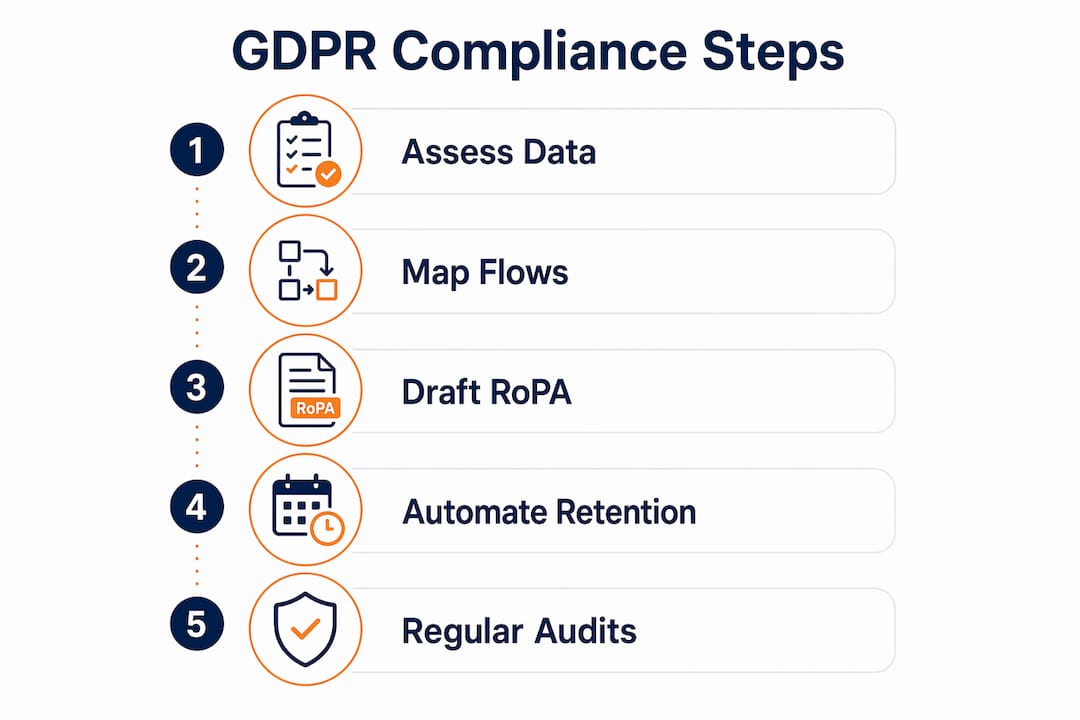
Achieving GDPR compliance in hospitality is a structured process. The following steps give you a clear path from audit to ongoing management.
- Conduct a data audit. List every type of personal data your business collects, where it is stored, who can access it, and how long you keep it. This audit forms the basis of your RoPA.
- Document your lawful bases. For each processing activity identified in your audit, record the specific lawful basis. Do not assume one basis covers multiple activities.
- Sign DPAs with all vendors. Review every supplier contract. If a vendor processes guest data on your behalf and there is no signed DPA, request one immediately. This includes your PMS provider, booking engine, payment gateway, and marketing platform.
- Build a data subject request process. Create a documented workflow for handling access, rectification, and erasure requests. Assign responsibility to a named individual and set internal deadlines shorter than the 30-day legal limit to allow for review.
- Set up breach detection and notification protocols. Define what constitutes a reportable breach, who is responsible for assessing it, and how you will notify your supervisory authority within 72 hours. Test this process at least once a year.
- Train your staff. Front desk teams, reservations staff, and housekeeping all handle personal data. Regular training reduces the risk of accidental breaches and ensures your policies are followed consistently.
- Use compliance automation tools. Platforms that automate guest data collection, archiving, and deletion reduce the manual workload and the risk of human error. Guestadmin, for example, automates guest data compliance across multiple properties, integrating with PMS and OTA platforms to keep records accurate and up to date.
Pro Tip: Run a quarterly internal audit rather than waiting for an annual review. Regulations, vendors, and your own data practices change frequently. Quarterly checks catch problems before they become violations.
What are the consequences of GDPR non-compliance in hospitality?
The financial penalties for GDPR non-compliance are significant and actively enforced. Regulators across Europe have issued 83 fines in the hospitality sector totalling €22.6 million as of 2026. That figure reflects enforcement from 15 countries and shows that regulators treat hospitality as a priority sector.
Enforcement is rising. Fines and investigations in hospitality continue to increase year on year, signalling that regulators are actively monitoring the sector rather than waiting for complaints.
The most common violations leading to fines are late breach notifications, unsigned DPAs with third-party vendors, and inadequate data retention policies. These are not obscure technical failures. They are operational gaps that a structured compliance programme would prevent. Size is not a defence. Small boutique hotels and large chains face the same obligations, and regulators have fined businesses of all sizes.
Reputational damage compounds the financial risk. A publicised data breach or regulatory investigation reduces guest trust in ways that are difficult to recover from. Guests share sensitive information, including passport details and payment data, based on an expectation of responsible handling. Losing that trust affects bookings, reviews, and long-term revenue. GDPR applies to any hotel processing EU residents’ data, including non-EU properties that actively market to European guests through localised websites or advertising. Geographic distance from Europe does not remove the obligation.
Key takeaways
GDPR compliance in hospitality requires documented lawful bases, signed vendor agreements, automated retention workflows, and tested breach notification processes across every system that holds guest data.
| Point | Details |
|---|---|
| GDPR scope is broad | Any business handling EU guest data must comply, regardless of where the property is located. |
| Lawful bases must be documented | Each processing activity needs its own documented basis; contractual necessity and consent are not interchangeable. |
| Vendor DPAs are mandatory | Every third-party supplier processing guest data requires a signed Data Processing Agreement under Article 28. |
| Breach notification is time-critical | Significant breaches must be reported to the supervisory authority within 72 hours of discovery. |
| Automation reduces risk | Integrating deletion and retention workflows across PMS, CRM, and channel managers makes guest rights enforceable in practice. |
Why GDPR compliance is an operational discipline, not a legal formality
Having worked alongside hospitality businesses across Europe for years, the pattern I see most often is this: a property owner reads about GDPR, adds a privacy notice to their website, and considers the matter closed. That approach misses the point entirely.
GDPR is not a document. It is a set of obligations that run through every system, every vendor relationship, and every staff interaction that involves guest data. A privacy notice tells guests what you do with their data. It does not make what you do lawful. The real compliance work happens in your technology stack, your vendor contracts, and your internal processes.
The geographic scope catches many operators off guard. A villa rental in Portugal that markets to German guests through a localised website is subject to GDPR. A holiday apartment in Thailand that takes bookings from French tourists through a European OTA is subject to GDPR. The regulation follows the data subject, not the property address.
The businesses that handle this well treat compliance as an ongoing operational discipline. They review their RoPA quarterly, audit their vendor DPAs annually, and test their breach notification process before they need it. They also see a commercial benefit: guests who trust that their data is handled responsibly are more likely to book directly and return. GDPR compliance, done properly, is a competitive advantage as much as a legal obligation.
— Alex
How Guestadmin helps property owners stay GDPR compliant
Managing GDPR compliance across multiple properties, vendors, and booking platforms is genuinely complex. Guestadmin is built specifically for property owners and managers in the European short-term rental market who need to meet these obligations without adding significant administrative burden.

Guestadmin automates guest data collection, archiving, and submission to government authorities, with integrations across leading PMS and OTA platforms. Its step-by-step compliance automation guides property owners through the process of building GDPR-compliant workflows, from data capture through to secure deletion. For property managers handling multiple properties, the platform’s multi-property dashboard keeps compliance records accurate and accessible from any device. If you want to reduce the manual workload and the risk of costly violations, Guestadmin gives you the tools to do it efficiently.
FAQ
What does GDPR mean for hotels and accommodation providers?
GDPR requires hotels and accommodation providers to collect, store, and process guest personal data lawfully, transparently, and securely. Businesses must document their lawful basis for each processing activity and respond to guest data requests within 30 days.
Does GDPR apply to non-EU hotels?
Yes. GDPR applies to any property that processes the personal data of EU residents, including non-EU hotels that actively market to European guests through localised websites or advertising.
What are the fines for GDPR non-compliance in hospitality?
Fines can reach €20 million or 4% of global annual turnover, whichever is higher. Regulators have already issued 83 fines in the hospitality sector totalling €22.6 million across 15 countries.
What is a Data Processing Agreement and why does it matter?
A Data Processing Agreement is a mandatory contract under Article 28 of GDPR between your business and any third-party supplier that processes guest data on your behalf. Without a signed DPA, the data sharing arrangement is unlawful.
How quickly must a data breach be reported under GDPR?
Significant data breaches must be reported to the relevant supervisory authority within 72 hours of discovery. Failing to meet this deadline is itself a punishable violation under GDPR.