

TL;DR:
- Insights in accommodation management transform raw PMS data into actionable intelligence that enhances revenue, operations, and guest experience.
- Using real-time BI platforms enables proactive decision-making, operational efficiency, and faster guest issue resolution, leading to higher satisfaction and profitability.
Insights in accommodation management are defined as the transformation of raw data from property management systems (PMS) into actionable intelligence that drives decisions across revenue, operations, and guest experience. The industry term for this discipline is business intelligence (BI), and in 2026 it has become the operational backbone of high-performing hospitality businesses. Platforms like Mews BI and tools from Shiji Group now give property owners and managers access to metrics including Average Daily Rate (ADR), occupancy, RevPAR, and guest satisfaction benchmarks in real time. Understanding how to use these signals is no longer a competitive advantage. It is a baseline requirement for running a profitable, well-reviewed property.
How do insights enhance operational efficiency in accommodation management?
Operational intelligence extends well beyond revenue reporting. Labour, energy, insurance, and vendor costs are all measurable cost drivers that, when analysed together, reveal exactly where margin is leaking and why. This is the distinction between a revenue dashboard and true operational intelligence: one tells you what happened, the other tells you what to do about it.
The practical impact is significant. Labour costs per occupied room rose 12.8% in 2025 while RevPAR declined, a combination that erodes profitability faster than most managers realise until it is too late. Benchmarking your labour cost per occupied room against comparable properties, or against your own portfolio average, surfaces these margin leaks before they compound. The same logic applies to energy consumption tracked against occupancy levels.
Real-time monitoring changes the speed of tactical decisions. When a dashboard flags that housekeeping hours are running 18% above the property average on low-occupancy days, a manager can act within hours rather than discovering the problem in a monthly report three weeks later. This responsiveness is what separates operationally intelligent properties from those that are perpetually reacting to problems already baked into the accounts.
Key areas where operational insights drive efficiency gains include:
- Labour scheduling: Aligning staffing levels with predicted occupancy rather than fixed rotas
- Energy management: Tracking consumption per occupied room to identify waste patterns
- Vendor cost control: Benchmarking supplier invoices against portfolio norms to detect overcharging
- Maintenance prioritisation: Using occupancy forecasts to schedule preventive work during low-demand periods
- Channel cost analysis: Monitoring OTA commission rates against direct booking conversion to optimise distribution spend
Pro Tip: Integrate data from your PMS, energy management system, and HR scheduling tool into a single BI layer. Cross-departmental data in one view reveals correlations, such as the link between high turnover rates and elevated labour costs per room, that siloed reports will never show.
What impact do insights have on guest experience and satisfaction?
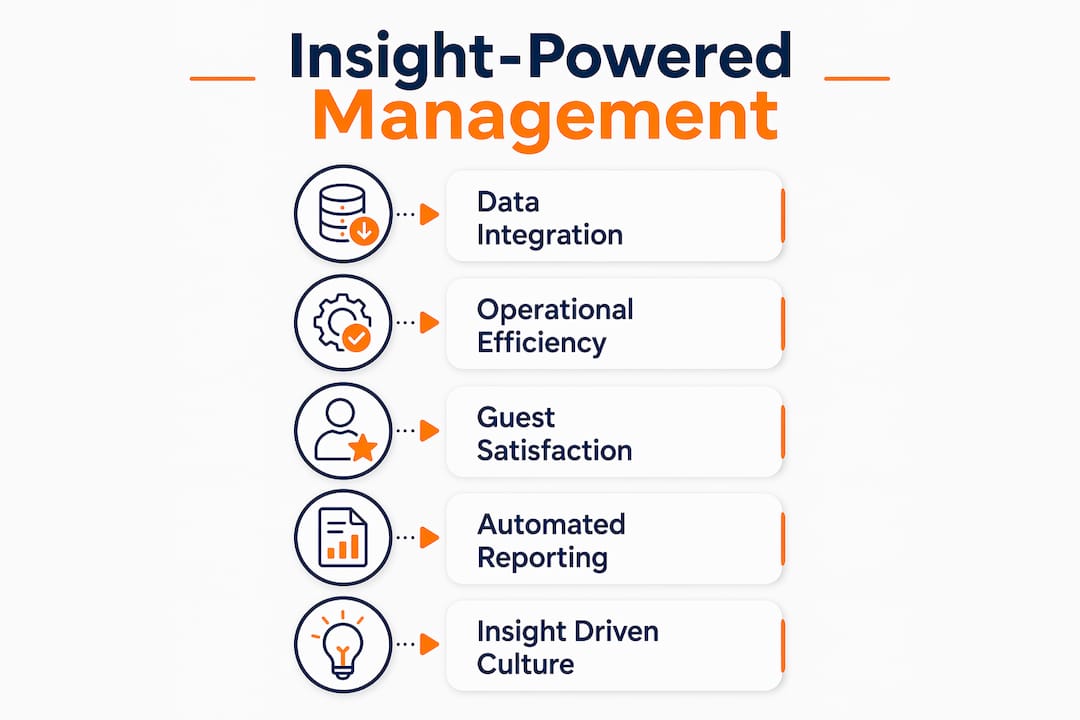
Guest experience data, when properly structured, is one of the most direct levers a property manager has for improving reputation and repeat bookings. Analysis of 127 million guest mentions from Shiji’s Guest Experience Benchmark Report 2026 identifies value, cleanliness, and food and beverage as the primary satisfaction drivers across hotel categories globally. Knowing which of these dimensions your property underperforms on is the starting point for targeted service improvement.

Response time is a measurable proxy for service quality. Hotel response times globally dropped to 3.5 days in 2026, and properties that respond faster consistently achieve higher satisfaction scores and stronger review ratings. This is not coincidental. Guests interpret a prompt response to a complaint or query as evidence that the property takes service seriously, even when the underlying issue cannot be fully resolved.
Digital-first guest interactions are now a baseline expectation rather than a premium feature. Contactless technology and personalised digital communication are core infrastructure in 2026, and the data generated by these touchpoints feeds directly into guest experience analytics. A property that tracks digital check-in completion rates, pre-arrival message open rates, and in-stay service request volumes has a far richer picture of the guest journey than one relying solely on post-stay reviews.
Guest experience metrics commonly tracked and improved with insights include:
- Net Promoter Score (NPS): Measures likelihood of recommendation and tracks loyalty trends over time
- Review response rate and speed: Directly linked to reputation score improvements on platforms like Booking.com and Google
- Cleanliness and value scores: Granular departmental benchmarks from review analysis tools
- Digital check-in completion rate: Indicates friction in the pre-arrival guest journey
- Service request resolution time: An internal SLA metric that correlates with in-stay satisfaction
- Repeat guest rate: The ultimate measure of whether experience improvements are translating into loyalty
Guest experience insight is most effective when it is operationally specific, routed into service recovery workflows with measurable service-level agreements rather than filed away in a quarterly report.
How do modern insight platforms differ from traditional reporting?
Traditional reporting in accommodation management means exporting CSV files from a PMS, pasting data into spreadsheets, and producing a backward-looking summary that reaches the decision-maker days after the period it covers. BI platforms act as a translation layer that standardises PMS data and presents it so that revenue, sales, and marketing teams can read and act on it without requiring a data analyst in the room.
The shift in 2026 goes further than automation. Agentic AI in hospitality autonomously detects revenue opportunities from billions of data points, ranks them by impact, and delivers recommendations with user-defined guardrails that keep human managers in strategic control. Tools like Revenue Agent do not just report that occupancy dropped on a specific date set. They recommend a rate adjustment, explain the reasoning, and wait for manager approval before acting.
Pro Tip: When evaluating a BI platform, test whether it can schedule automated reports to department heads without manual intervention. If your team still needs to pull data manually each week, the platform is not yet functioning as an intelligence layer.
| Feature | Traditional reporting | Modern insights platform |
|---|---|---|
| Data delivery | Manual CSV exports, periodic | Automated, real-time dashboards |
| Interpretation | Analyst or manager required | AI-powered plain-language summaries |
| Decision speed | Days to weeks after the fact | Same-day or real-time alerting |
| Team access | Restricted to finance or revenue | Self-serve access across departments |
| Cost visibility | Revenue metrics only | Labour, energy, and vendor costs included |
| Accountability | Report filed, action optional | Scorecards linked to staff performance |
Self-serve analytics and scheduled reporting allow property teams to spot trends without waiting for a central analyst to produce a report. This changes the decision cadence across the whole organisation, not just at the top.
What strategies help property owners embed an insight-driven culture?
Knowing that insights matter and actually building a team that uses them daily are two different challenges. Analytics becomes most valuable when paired with accountability, transparency, and alignment with organisational values. Without those three elements, even the best BI platform produces reports that nobody acts on.
Real-time scorecards engage staff by showing how their actions influence outcomes. When a front-of-house team can see that their upselling efforts moved the ADR needle by a measurable amount, the data becomes motivating rather than threatening. Pairing scorecards with coaching sessions and regular discussion forums keeps the human element central to what is otherwise a technical process.
For multi-property operators, cross-portfolio benchmarking on cost and revenue metrics identifies systemic margin leaks that are invisible at the individual property level. A single property with high energy costs per occupied room might be explained by its age or location. Three properties in the same portfolio showing the same pattern points to a procurement or operational process issue that can be fixed at scale.
Steps to embed an insight-driven culture within your property management team:
- Define your core KPI set. Agree on five to eight metrics that matter most to your business model, covering both revenue and cost sides.
- Build shared dashboards. Give every department head access to the metrics relevant to their area, not just the general manager.
- Set a weekly review cadence. A 30-minute weekly data review meeting creates accountability without overwhelming the team.
- Link performance to incentives. Connect measurable KPIs to staff recognition or bonus structures to make data personally relevant.
- Coach, do not just report. Use data reviews as coaching conversations, not performance tribunals. Teams that feel safe with data use it more honestly.
- Benchmark externally. Use rental management intelligence systems to compare your property against anonymised industry peers, not just your own historical performance.
Why most properties are still reporting, not deciding
There is a pattern I see repeatedly in accommodation management: a property invests in a BI tool, builds a dashboard, and then continues making decisions the same way it always did. The dashboard becomes wallpaper. The common failure mode is what I call reporting without translation. Data is extracted, formatted, and distributed, but nobody has redesigned the workflow so that a specific insight triggers a specific decision by a specific person within a specific timeframe.
The properties that get the most from their data do one thing differently. They treat every insight as a question: who acts on this, and by when? A drop in cleanliness scores is not just a metric to note. It is a trigger for the housekeeping manager to review staffing levels and product quality before the next review cycle closes.
For multi-property operators, the scale advantage is real but underused. Anonymised benchmarking across labour, energy, and insurance versus occupancy turns portfolio size into an analytical asset. Most operators I speak with are not doing this systematically. They are comparing this month to last month at a single property, which tells you almost nothing about whether your cost structure is competitive.
My honest view is that AI-powered tools like agentic analytics are genuinely useful, but only after the human decision culture is in place. Automation accelerates good habits. It does not create them. Build the accountability framework first, then let the technology do the heavy lifting.
— Alex
How Guestadmin supports insight-driven property management
Property managers who want to act on data need systems that connect compliance, booking, and guest information in one place without adding manual work.
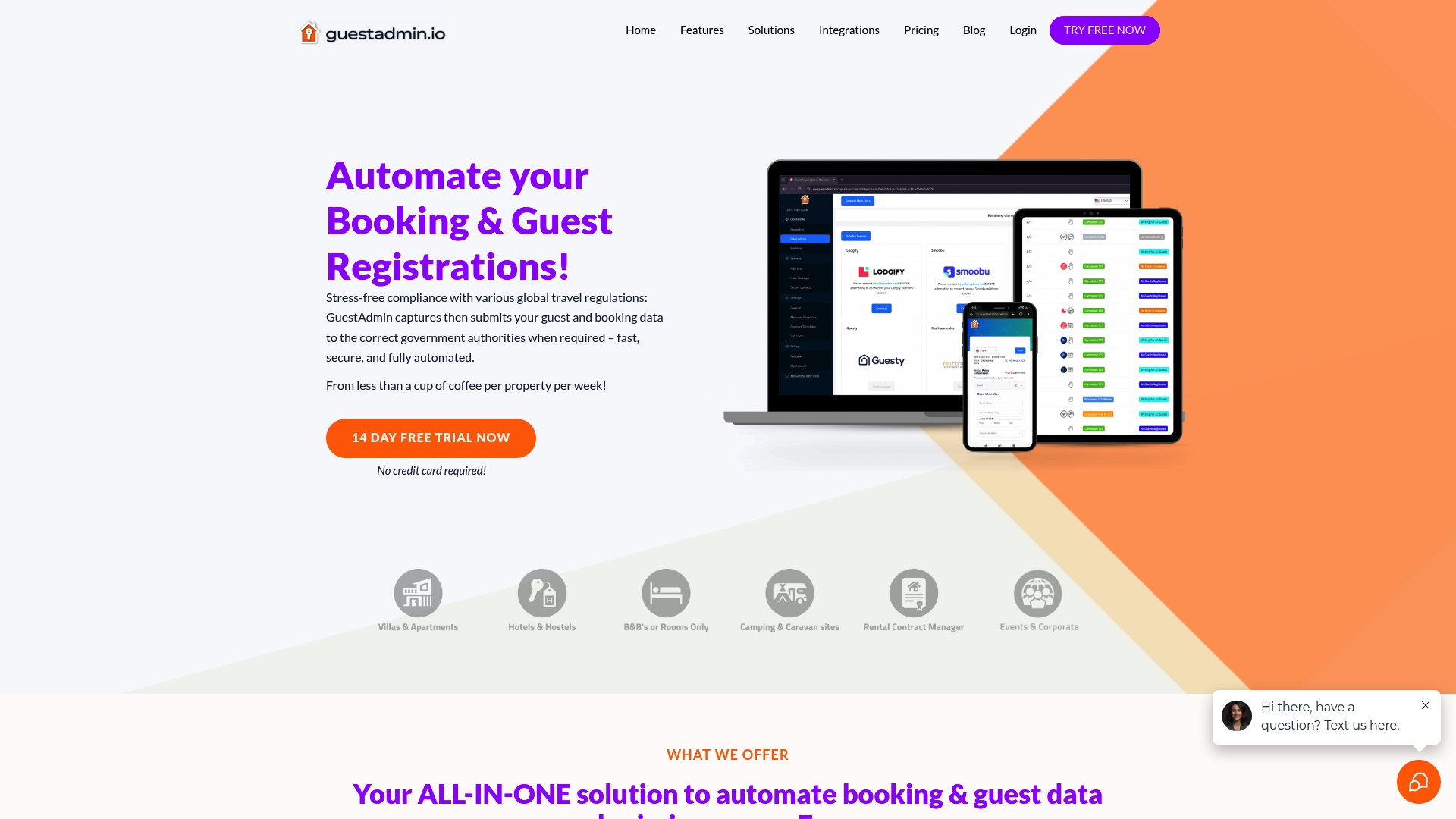
Guestadmin gives property owners and managers a real-time booking dashboard, automated guest data processing, and GDPR-compliant archiving across multiple properties. The platform integrates with leading PMS and OTA platforms, so your booking and compliance data flows automatically without manual exports. For managers comparing their options, the top property management software comparison covers the leading BI and compliance platforms available in 2026. Guestadmin is built specifically for the European short-term rental market, where regulatory requirements and guest data obligations make integrated insights not just useful, but necessary.
FAQ
What is the role of insights in accommodation management?
Insights in accommodation management convert raw PMS data into actionable intelligence covering revenue metrics, cost drivers, and guest satisfaction signals. They enable property managers to make faster, evidence-based decisions rather than reacting to problems after the fact.
Which metrics matter most for accommodation management insights?
ADR, occupancy, RevPAR, labour cost per occupied room, and guest satisfaction scores are the core metrics. Modern BI platforms also track energy consumption, channel mix, and review response rates to give a complete operational picture.
How do AI-powered platforms improve on traditional reporting?
AI platforms like Mews BI and Revenue Agent automate data interpretation, deliver plain-language summaries, and flag specific actions rather than producing static reports. This reduces the time between a data signal and a management decision from days to hours.
How can small property owners benefit from data insights?
Even single-property owners benefit from tracking a small KPI set covering occupancy, ADR, and guest review scores. Platforms with self-serve dashboards and booking analytics tools make this accessible without a dedicated analyst.
What is the biggest mistake managers make with accommodation data?
The most common mistake is collecting data without redesigning workflows so that specific insights trigger specific decisions. Data that is reviewed but not acted on within a defined timeframe delivers no operational benefit.
Key takeaways
Insights in accommodation management deliver measurable value only when they are operationally specific, shared across teams, and linked to clear accountability frameworks.
| Point | Details |
|---|---|
| Define operational intelligence | Go beyond revenue metrics to track labour, energy, and vendor costs against occupancy for full margin visibility. |
| Act on guest feedback fast | Global response times dropped to 3.5 days in 2026; properties that respond faster earn stronger satisfaction scores. |
| Replace manual exports with BI | Automated dashboards and AI summaries cut decision time from days to hours across all departments. |
| Build accountability into data use | Shared scorecards linked to performance incentives make insights motivating rather than purely informational. |
| Use portfolio scale for benchmarking | Multi-property operators should benchmark costs anonymously across their portfolio to identify systemic issues invisible at single-property level. |