

TL;DR:
- Managing guest data in European short-term rentals involves balancing legal registration requirements with GDPR compliance to ensure guest satisfaction. Property managers must collect, store, and delete data responsibly by understanding jurisdiction-specific rules, securing proper agreements, and automating retention protocols. Implementing digital collection methods and maintaining ongoing compliance processes help maintain data accuracy while enhancing guest trust.
Managing guest data in European short-term rentals means satisfying two demands at once. You need accurate records to meet legal registration requirements, and you need to collect that data without breaching GDPR or frustrating your guests. Knowing how to collect guest data compliantly, what to keep, how long to keep it, and how to delete it safely is the foundation of any well-run property operation. This guide walks you through the practical steps, from the legal basis for each data type to the tools that make the whole process manageable.
Key takeaways
| Point | Details |
|---|---|
| Separate data by legal basis | Collect operational data under contract performance and marketing data only with explicit consent. |
| Use digital collection methods | Pre-arrival forms and online check-in produce cleaner records and reduce manual errors. |
| Apply jurisdiction-specific retention | Retention periods vary by country, so tag data by jurisdiction and automate deletion accordingly. |
| Sign DPAs with every vendor | Any third party processing guest data must have a Data Processing Agreement in place under GDPR Article 28. |
| Audit your processes regularly | Maintain a live Record of Processing Activities and review it at least annually to stay compliant. |
How to collect guest data: legal foundations first
Before you build any form or workflow, you need to understand why you are collecting each piece of information. Under GDPR, every data point you gather must be tied to a specific, documented lawful basis. The two most relevant for property managers are contract performance and explicit consent.
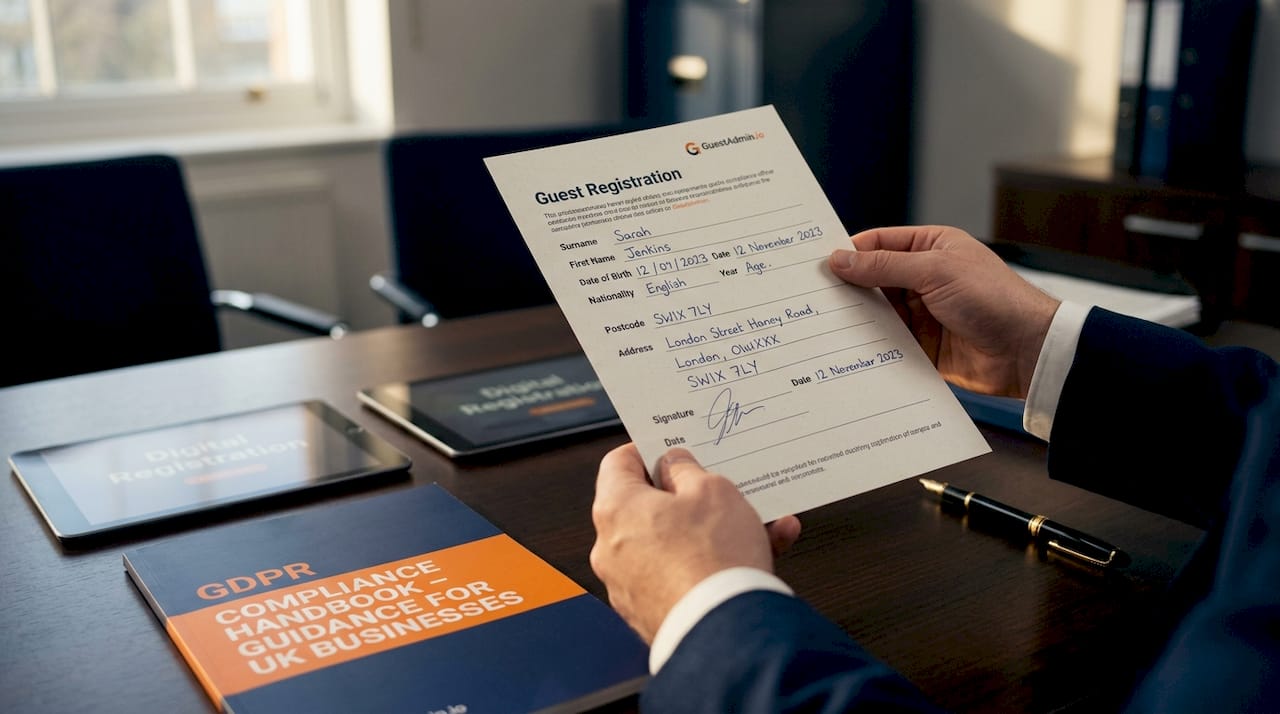
Operational data covers everything you need to fulfil a booking and comply with local law: full name, date of birth, nationality, passport or ID number, arrival and departure dates. Operational data sits under the contract performance basis, which means you do not need separate consent to collect it. You do, however, need to tell guests what you are collecting and why, so a clear privacy notice is non-negotiable.
Marketing data is a different matter entirely. Preferences, email opt-ins, and feedback survey responses require explicit consent from guests. This consent must be freely given, specific, informed, and unambiguous. It cannot be bundled with your booking terms as a condition of the reservation.
Beyond GDPR, European countries impose their own registration requirements on top:
- Spain: The SES.HOSPEDAJES system requires guest identity data to be uploaded within 24 hours of arrival, including full name, nationality, document number, and support document type.
- Germany: The Meldeschein is completed on arrival and held at the property, with no mandatory digital portal as of 2026.
- Portugal, Italy, and France each have their own portals and deadlines, some requiring nightly uploads and others weekly batches.
The practical implication is clear. Your registration form must capture country-specific fields, and you must design forms by jurisdiction rather than using one generic template for every property.
Pro Tip: Create two clearly separated sections on any guest form: one for mandatory registration fields and one for optional marketing preferences. Never pre-tick the marketing box.
Practical methods for gathering guest information
Knowing what to collect is one thing. Actually collecting it accurately, at scale, and without burdening your front-of-house team is another challenge. These are the methods that work in practice.
-
Pre-arrival digital forms. Send a branded online form 24 to 48 hours before check-in. Guests complete their own details, which eliminates transcription errors from your side. Digital pre-arrival forms yield cleaner records than manual entry and give guests a professional first impression of your property.
-
Online check-in workflows. Integrated with your property management system (PMS), online check-in lets guests verify their booking, upload an ID document, and confirm their arrival time before they arrive. The data flows directly into your records without a team member having to type anything.
-
Branded Wi-Fi splash pages. If you offer Wi-Fi at your property, a captive portal that requires guests to enter their name and email address to connect is a legitimate and low-friction collection method. Because guests initiate the process themselves, data quality tends to be higher. Wi-Fi portals are also a natural place to present a marketing opt-in, with the consent checkbox clearly separated from the access button.
-
PMS and OTA integrations. Data that arrives through booking channels such as Airbnb or Booking.com is often partial. It typically includes name and contact details but not the passport number or date of birth you need for police registration. A PMS integration that automatically flags incomplete guest profiles and triggers a pre-arrival form to fill the gap removes this from your manual to-do list.
-
In-person check-in as a fallback. Some guests will not complete digital forms in advance. Have a tablet-based form ready at check-in so the guest still enters their own data rather than reading it aloud to a staff member who types it in. This keeps records accurate and the process consistent.
Pro Tip: If you manage properties across multiple countries, use a registration method guide to match your collection workflow to each jurisdiction, rather than applying the same process everywhere and hoping it fits.
Managing and securing guest data after collection
Collecting data is only half the work. What you do with it afterwards determines your actual compliance risk. The core principle under GDPR is data minimisation: collect only what is necessary for the stated purpose, and delete it when that purpose expires.
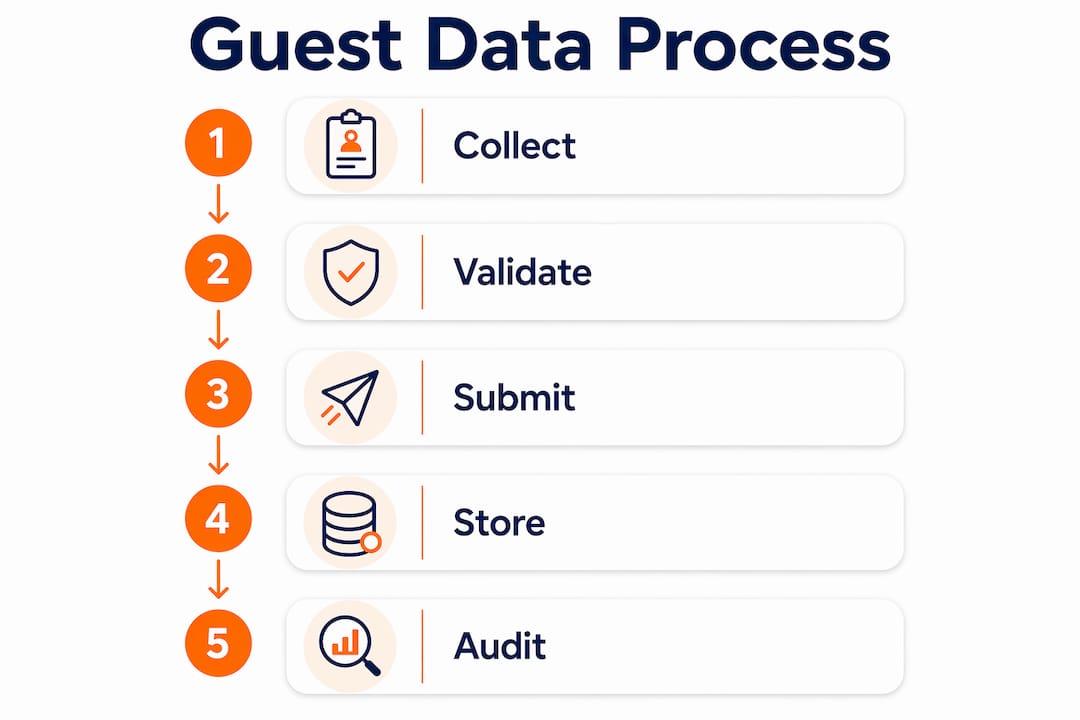
Different purposes carry different retention periods, and they do not all align neatly:
| Data type | Retention basis | Typical retention period |
|---|---|---|
| Police or tax registration records | Local legal obligation | 1 year (Germany) to 3 years (Spain) |
| Booking and payment records | Tax and accounting law | 5 to 7 years depending on jurisdiction |
| Marketing consent records | Consent documentation | Duration of consent plus 1 year |
| Guest preference notes | Legitimate interest or consent | Reviewed annually; delete if inactive |
The most common GDPR violation property managers face is not a data breach. It is simply keeping data indefinitely after the lawful retention period has passed. This happens because deletion is manual, easy to forget, and no one owns the process.
The practical fixes are straightforward:
- Create a data inventory. List every category of guest data you hold, where it is stored, the legal basis, and the retention period. Even a well-maintained spreadsheet is better than nothing.
- Automate deletion. Set calendar reminders or, better, use a platform that automates data deletion once the retention period expires across all connected systems, including your inbox and cloud storage.
- Deduplicate regularly. Duplicate profiles arise when guests book through different channels using slightly different contact details. Continuous data cleansing is needed to prevent conflicting records and maintain data quality.
- Control access. Limit who on your team can view full guest profiles, particularly passport data and payment details. Role-based access controls reduce internal risk.
For a step-by-step approach to retention, the guest records archive guide from Guestadmin explains how to set GDPR-aligned periods for each data category.
Common pitfalls in guest data collection
Even property managers who understand the rules make predictable mistakes. Recognising these early saves you from enforcement action and the significant fines that come with it.
- Mixing operational and marketing consents. Sending a single email that handles both a booking confirmation and a newsletter opt-in, without distinguishing between the two, is a consent management failure. Systems must track consent status separately and log every withdrawal event.
- Over-collecting data. Asking for dietary requirements, room preferences, and loyalty programme history when a guest has not opted into any marketing programme means you are holding data with no valid basis. Collect what the law requires and nothing more unless consent is in place.
- Inconsistent registrations across jurisdictions. A property manager running apartments in both Barcelona and Berlin faces two different registration regimes with different fields, deadlines, and portals. Using one standard form for both will result in incomplete submissions somewhere.
- Missing Data Processing Agreements. Under GDPR Article 28, DPAs are mandatory with every third party that processes guest data on your behalf. This includes your PMS provider, channel manager, payment processor, and even your email marketing tool. Most providers have standard DPAs ready to sign, but you need to actually request and sign them.
- No process for data subject requests. Guests have the right to access their data, correct it, or request erasure. Without a documented process, you will struggle to respond within the 30-day legal deadline.
Compliance is not a one-time setup. It is an ongoing operational discipline that requires the same attention as your booking calendar.
Verifying compliance and optimising your workflows
Once your collection methods and retention policies are in place, you need a way to verify they are working and to catch gaps before a regulator does.
The starting point is a Record of Processing Activities (RoPA). This is a living document that maps every data processing activity across your operation: what data you collect, who you share it with, the lawful basis, and the retention period. GDPR requires organisations with more than 250 employees to maintain one formally, but smaller operations benefit from it too. Treat it as your compliance audit trail.
| Compliance task | Manual approach | Automated approach |
|---|---|---|
| Guest registration submission | Log in to country portal, enter data manually | PMS integration submits data automatically within 24 hours |
| Retention period enforcement | Calendar reminders for annual reviews | Platform flags and deletes expired records |
| Consent tracking | Spreadsheet with opt-in dates | CRM records consent timestamp and withdrawal |
| DPA management | Folder of signed PDFs | Vendor management log with renewal alerts |
Beyond documentation, regular audits matter. Review your RoPA every six months. Check that every vendor handling guest data has a signed DPA. Test your data subject request process by simulating an access or erasure request.
Pro Tip: If you manage multiple properties, a compliance guide that covers all your jurisdictions in one place is significantly more reliable than managing each property’s obligations separately.
For GDPR-specific obligations in the short-term rental sector, Guestadmin’s GDPR compliance guide provides a practical breakdown of what applies to your operation and how to document it correctly.
My take on getting this right in Europe
I’ve worked with property managers across a dozen European jurisdictions, and the mistake I see most often is not ignorance. It is assuming that a solution designed for one country scales cleanly to the next.
A manager who gets their Spanish compliance right tends to assume the same form and workflow will satisfy German requirements. It rarely does. Spain’s SES.HOSPEDAJES portal, Germany’s paper-based Meldeschein, and Portugal’s SEF online system are three entirely different beasts. What I’ve found actually works is building a fields-by-jurisdiction matrix before you set up any form. Map the required fields for each country you operate in, then build your collection process around the strictest requirements, with conditional fields for others.
The second thing I see overlooked consistently is vendor management. Property managers will spend hours perfecting their check-in form and then share that same guest data with a channel manager, a cleaning app, and a keybox provider, none of which have signed DPAs. Your liability does not stop at your own systems. It extends to everyone who touches your guests’ data.
Finally, I’d encourage you to think about guest experience and compliance as complementary rather than competing. A clean digital check-in that takes two minutes builds trust. Guests who feel their information is handled professionally are more likely to leave positive reviews and book directly next time. Compliance, done well, is good hospitality.
— Alex
How Guestadmin simplifies guest data management
Managing guest data across multiple European jurisdictions, each with its own registration portal, deadline, and retention rule, is genuinely complex. Guestadmin is built specifically for this challenge.

The platform automates the capture, validation, and submission of guest registration data to the relevant government authorities, with AI-powered processing and submissions completed within 24 hours. It integrates with leading PMS and OTA platforms so your data flows in without manual re-entry. Retention periods are managed automatically, and all data is stored in a GDPR-compliant environment accessible from any device.
For property managers overseeing multiple properties, multi-property management tips and Guestadmin’s centralised dashboard mean you can monitor compliance status across your entire portfolio in one view. No more logging into separate portals or maintaining multiple spreadsheets. To see how it fits your operation, explore short-term rental compliance on the Guestadmin platform.
FAQ
What data must I collect from guests by law?
The required fields vary by country, but typically include full name, date of birth, nationality, and passport or ID number. Local registration laws such as Spain’s SES.HOSPEDAJES system may specify additional fields and submission deadlines.
Do I need guest consent to collect booking data?
No. Operational booking data is collected under the contract performance lawful basis under GDPR, which means no separate consent is needed. Consent is only required for optional marketing communications and preferences.
How long should I keep guest data?
Retention periods depend on the purpose and jurisdiction. Police registration records in Spain must be held for three years, while Germany requires one year followed by destruction. Tax and accounting records typically require five to seven years regardless of location.
What is a Data Processing Agreement and do I need one?
A Data Processing Agreement is a contract between you and any third party that processes guest data on your behalf. Under GDPR Article 28, these are mandatory with every relevant vendor, including your PMS provider, channel manager, and payment processor.
How do I handle a guest request to delete their data?
You must respond within 30 days. Check whether any legal obligation, such as a tax retention requirement, prevents immediate deletion. Where no such obligation exists, delete the data from all systems, including backups and connected platforms, and confirm the action in writing to the guest.
2 Comments
What is guest data reporting: a guide for property managers
[…] sets the baseline for guest data processing across Europe, but sector-specific tourism laws add a second layer of obligation. In several […]
How to Submit Traveller Records Without Delays - Guest Registration Services
[…] simplest way to reduce errors is to request mandatory information before the guest arrives. Asking for details during online check-in gives guests time to provide […]