

TL;DR:
- Guest onboarding automation uses software to streamline guest data collection, verification, and compliance without manual work. It enhances operational efficiency, guest satisfaction, and legal compliance in regulated European markets. Proper implementation requires focusing on full workflow coverage, compliance readiness, and ongoing monitoring to ensure smooth operations.
Guest onboarding automation is the systematic use of software to collect guest data, verify identities, manage compliance submissions, and coordinate arrival logistics without manual intervention. For property owners and managers across Europe, this process sits at the intersection of guest experience and regulatory obligation. Platforms such as Guestadmin, GuestIntro, Nowistay, and Hostfully have made it possible to handle everything from booking confirmation through to check-in access codes without a single manual step. The result is fewer administrative errors, faster guest processing, and a measurable reduction in the time your team spends on repetitive paperwork.
What is guest onboarding automation in hospitality?
Guest onboarding automation is the industry term for software-driven workflows that replace manual guest registration, data collection, and compliance tasks in short-term rental and hotel operations. Where a property manager once sent individual emails, chased ID documents, and manually filed guest data with local authorities, automation handles each of these steps through pre-configured triggers and integrations.
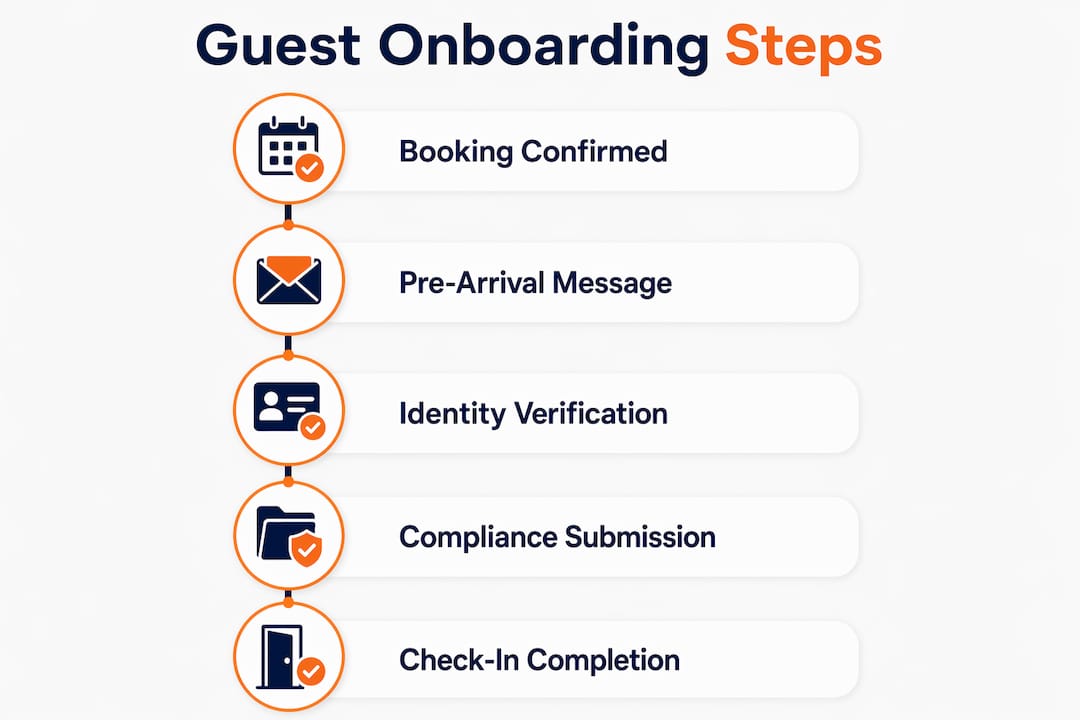
The process begins the moment a booking is confirmed. From that point, the system takes over: sending pre-arrival communications, requesting identity documents, collecting signed rental agreements, issuing access credentials, and in many jurisdictions, submitting guest data directly to government authorities. Regulatory compliance layers are the real bottleneck in guest onboarding, and automating ID collection and rental agreements prevents the late-night issues that plague manually managed properties.

The distinction between generic customer onboarding and guest onboarding automation is worth noting. Generic onboarding tools focus on user activation inside a software product. Guest onboarding automation is purpose-built for hospitality: it accounts for local travel regulations, multi-language guests, short booking windows, and the physical handover of a property. That specificity is what makes it a distinct category.
What are the main steps in automating the guest onboarding process?
A well-configured guest onboarding automation workflow covers six distinct phases, each triggered automatically by the previous one.
-
Booking confirmation trigger. The moment a reservation is confirmed on any connected OTA or PMS, the system creates a guest record and initiates the onboarding sequence. No manual input is required from your team.
-
Pre-arrival communication. Timed messages go out automatically with property information, house rules, and requests for required documents. Automated check-in messaging sequences reduce guest anxiety and prevent common operational errors by ensuring guests arrive prepared.
-
Identity verification and document collection. The system requests a valid ID and, where required, a signed rental agreement. Automation tools collect verified IDs, signed agreements, arrival times, and damage deposit authorisations without any manual chasing.
-
Compliance data submission. In countries such as Spain, Italy, Portugal, and France, property managers are legally required to submit guest registration data to national authorities. Automated guest registration systems integrate directly with national authority platforms to submit this data and enable access credentials once registration is confirmed.
-
Access code issuance. Smart lock integrations allow the system to generate and send a unique access code only after all required documents are received and compliance steps are complete. This removes the need for physical key handovers entirely.
-
Cleaning and turnover coordination. Every booking can trigger automated cleaning missions with photo verification, coordinated around guest arrival and departure times. This reduces operational errors and speeds property turnover without additional management effort.
Each phase connects to the next through logic rules you define once and rarely need to revisit. The system handles exceptions, such as a missing document or an unconfirmed arrival time, by pausing the sequence and alerting your team rather than proceeding with incomplete information.
What are the key benefits of guest onboarding automation?
The benefits of guest onboarding automation fall into three categories: operational efficiency, guest satisfaction, and compliance reliability.
Operational efficiency is the most immediately visible gain. Comprehensive guest journey automation can save property managers over 20 hours of work per week. For a manager running ten or more properties, that figure represents the difference between a sustainable operation and a constant state of reactive firefighting.
Guest satisfaction improves because the onboarding experience becomes consistent and friction-free. A smooth digital onboarding process significantly improves guest satisfaction and leads to positive reviews that drive future bookings. This creates what Hostfully describes as a reputation loop: better onboarding produces better reviews, which produce more bookings, which justify further investment in the process.
Compliance reliability is the benefit that carries the highest financial stakes. Manual data submission to government authorities is error-prone and time-sensitive. Automation removes both risks by submitting data within defined windows, every time, without depending on a team member remembering to do it.
Additional benefits include:
- Reduced guest friction through faster, clearer pre-arrival communication
- Fewer manual errors in document collection and data entry
- Consistent application of house rules and damage deposit processes
- AI-powered automation frees hospitality staff to focus on relationship building rather than administrative tasks
- Scalability across multiple properties without proportional increases in staffing
“The most effective onboarding automation removes repetitive paperwork while preserving personal guest contact for relationship building.” — GuestIntro
Which tools support guest onboarding automation?
Several platforms have built specific features for automating the guest onboarding process in short-term rentals and hotels. The table below summarises the key capabilities of four widely used tools.
| Tool | AI messaging | ID verification | Compliance submission | Smart lock integration | Language localisation |
|---|---|---|---|---|---|
| GuestIntro | Yes | Yes | No | Limited | Yes |
| Nowistay | Yes | Yes | No | Yes | Yes |
| Hostfully | Yes | Yes | No | Yes | Yes |
| JobelHome | No | Yes | Yes | Yes | Limited |
| Guestadmin | Yes | Yes | Yes | Yes | Yes |
AI chatbots can answer guest queries in under 30 seconds across 90 or more languages using property-specific information. This matters for European property managers whose guests arrive from dozens of different countries and expect communication in their own language.
Compliance submission is the feature that separates general guest communication tools from purpose-built onboarding platforms. GuestIntro, Nowistay, and Hostfully excel at pre-arrival communication and document collection, but they do not submit data to national authorities. For property managers operating in regulated European markets, this gap requires either a separate compliance tool or a platform such as Guestadmin or JobelHome that covers the full workflow. You can explore how AI supports broader automation decisions in short-term rental operations beyond onboarding alone.
How to implement guest onboarding automation effectively
Implementing automation without a clear plan produces unreliable results. Follow these steps to build a workflow that holds up under real operating conditions.
-
Audit your current process. Map every manual step your team currently performs between booking confirmation and guest check-in. Identify which steps are repetitive, which carry compliance risk, and which require human judgement. This audit tells you exactly where automation adds the most value.
-
Choose a platform that fits your compliance context. If you operate in a jurisdiction that requires guest data submission to authorities, select a tool with built-in compliance functionality. Retrofitting compliance onto a communication-only tool creates more work, not less.
-
Define your automation rules clearly. Specify exactly what triggers each step, what information is required before the sequence advances, and what happens when a guest does not respond within a set window. Vague rules produce inconsistent outcomes.
-
Test edge cases before going live. Automation workflows must be tested comprehensively with edge cases such as expired documents and missing information before launch. An untested workflow that rejects a valid guest or submits incomplete compliance data creates more problems than it solves.
-
Monitor onboarding metrics after launch. Track completion rates for each step in the sequence. If guests consistently fail to submit their ID at a particular stage, the trigger message needs revision. Onboarding automation is not set-and-forget; it requires active monitoring to maintain efficiency and compliance accuracy.
-
Keep human oversight on exceptions. Automation handles the standard case well. Exceptions, such as a guest with an unusual document type or a booking with a non-standard arrival arrangement, still benefit from a human review. Build an alert system that flags these cases rather than letting the workflow stall silently.
Pro Tip: Run your first automated onboarding sequence on a test booking before applying it to live reservations. This lets you verify that every trigger fires correctly, every message reads well in all configured languages, and every compliance submission reaches its destination.
Key takeaways
Guest onboarding automation delivers the greatest value when it covers the full workflow from booking confirmation through compliance submission, not just pre-arrival messaging.
| Point | Details |
|---|---|
| Full-workflow coverage matters | Automation that stops at messaging leaves compliance gaps that carry legal and financial risk. |
| Time savings are substantial | Automating the complete guest journey can recover over 20 hours of management time per week. |
| Compliance is the critical layer | In regulated European markets, automated data submission to authorities is a non-negotiable feature. |
| Test before going live | Edge cases such as expired IDs must be tested in advance to prevent guest rejections or compliance failures. |
| Monitoring is ongoing | Active review of onboarding metrics after launch maintains accuracy and prevents silent workflow failures. |
Why compliance is the part most property managers underestimate
Having worked closely with property managers across multiple European markets, the pattern I see most often is this: operators invest in a polished guest communication tool, automate their pre-arrival messages beautifully, and then discover six months later that their compliance submissions have been incomplete or late. The communication layer gets the attention because it is visible to guests. The compliance layer gets ignored because it is invisible until something goes wrong.
The uncomfortable truth about guest onboarding automation is that the guest experience component is the easier half. Timed messages, digital contracts, and smart lock codes are well-solved problems. Regulatory compliance is not. Every European jurisdiction has different submission windows, different data fields, and different authority systems. A tool that works perfectly in Portugal may submit the wrong data format in Spain.
My recommendation is to start your platform evaluation with the compliance question, not the communication question. Ask specifically: which authorities does this platform submit to, in what format, and within what timeframe? If the vendor cannot answer that question with specifics, the tool is not ready for regulated markets. The guest experience features can be refined over time. A compliance failure can result in fines that dwarf the cost of the software itself.
The other thing I would flag is the temptation to automate everything immediately. The property managers who get the best results from automation are those who automate one phase at a time, verify it works, and then extend the workflow. Gradual implementation with human oversight on exceptions is not a sign of caution. It is the professional approach.
— Alex
How Guestadmin simplifies guest onboarding and compliance
Guestadmin is built specifically for property owners and managers who need more than a messaging tool. The platform automates the complete guest onboarding workflow, from booking confirmation through to compliant guest data submission to European government authorities, within 24 hours of each booking. It integrates with major PMS and OTA platforms via API and webhooks, supports multi-property management from a single dashboard, and processes guest data in a GDPR-compliant environment.
For property managers evaluating their options, Guestadmin’s property management software comparison covers the leading platforms side by side, so you can assess which tool fits your compliance context and operational scale. If you are ready to see the platform in action, you can book a demo and walk through the full onboarding workflow with your own property setup.
FAQ
What is guest onboarding automation?
Guest onboarding automation is the use of software to handle guest registration, identity verification, compliance data submission, and arrival coordination automatically after a booking is confirmed. It removes the need for manual communication and paperwork between booking and check-in.
How much time can automation save property managers?
Automating the complete guest journey from booking to checkout can save property managers over 20 hours of work per week, according to Nowistay’s 2026 guide. The exact saving depends on the number of properties managed and the complexity of the compliance requirements in each jurisdiction.
Do all guest onboarding tools handle compliance submissions?
No. Many popular tools such as GuestIntro, Nowistay, and Hostfully focus on guest communication and document collection but do not submit data to national authorities. Property managers in regulated European markets need a platform with built-in compliance submission functionality, such as Guestadmin or JobelHome.
What edge cases should I test before going live?
Test expired identity documents, missing guest information, non-standard booking arrangements, and guests who do not respond within the expected window. Unaddressed edge cases can cause incorrect guest rejections or incomplete compliance submissions that create legal exposure.
How does automation affect the guest experience?
A well-configured onboarding automation workflow produces faster, clearer pre-arrival communication, consistent document collection, and frictionless access to the property. This directly improves guest satisfaction and generates positive reviews that support future booking growth.