

TL;DR:
- Proper guest data reporting involves collecting specific personal and stay-related details, submitting them within statutory deadlines, and securely archiving acknowledgment receipts. Using automated platforms with OCR and system integrations minimizes errors and ensures timely compliance, reducing regulatory risk. Consistent compliance requires built workflows, staff training, and adherence to retention schedules, avoiding manual errors and missed deadlines.
Reporting guest data is the legal obligation to collect prescribed personal details from guests, submit them to the relevant government authority within a statutory deadline, and retain records for a defined period. For property owners and managers across Europe, this process sits at the intersection of hospitality operations and regulatory compliance. Get it wrong and you face fines, sanctions, or failed audits. Get it right and you protect your business, your guests, and your licence to operate. This guide covers the exact fields required, the tools available, and the step-by-step workflow to keep your guest registration obligations fully met in 2026.
What guest information must you collect and report?
Guest data reporting, also known as traveller registration or guest registration, requires collecting a defined set of personal and stay-related details before or at check-in. The specific fields vary by country, but a core set appears across most European jurisdictions.
Mandatory fields common across Europe:
- Full legal name and date of birth
- Nationality and country of residence
- Identity document type, number, and expiry date
- Check-in and check-out dates
- Number of guests in the party
- Signature or digital consent (where required)
Country-specific requirements go further. Spain’s SES.HOSPEDAJES portal requires up to 18 separate data fields per guest, including the relationship between travellers in a group. Italy’s Alloggiati Web and Portugal’s SIBA system each have their own field requirements and submission windows. This means a property manager operating across multiple countries must maintain separate data collection workflows for each jurisdiction.
Retention periods are equally important. Ontario’s 2026 requirements mandate that accommodation providers keep a guest register, including name, primary residence, phone number, vehicle information, and billing address, for six years after the fiscal year of the stay. European jurisdictions typically require between two and five years. Treating retention as an afterthought is a compliance risk. A regulator can request records from three years ago, and if you cannot produce them, the submission itself counts for nothing.
Pro Tip: Set a calendar reminder at the start of each fiscal year to review your data retention schedule. Delete records that have passed their legal retention window to stay GDPR-compliant, and archive those still within it securely.
| Country | Portal | Submission Deadline | Retention Period |
|---|---|---|---|
| Spain | SES.HOSPEDAJES | Within 24 hours of check-in | 3 years |
| Italy | Alloggiati Web | Within 24 hours of arrival | 5 years |
| Portugal | SIBA | 3 business days (foreign guests) | 5 years |
| Germany | Local authority | Hold and show on request | Varies by state |
Which tools help you collect and submit guest data?
The tools you use to collect and submit guest information determine how accurate, timely, and auditable your records are. The choice broadly falls into three categories: official government portals, check-in apps with optical character recognition (OCR), and integrated property management platforms.

Official portals such as SES.HOSPEDAJES in Spain and Alloggiati Web in Italy are the direct submission channels. You log in, enter guest details manually or via file upload, and receive an electronic acknowledgement. They are free to use but require manual data entry, which increases the risk of errors and delays, particularly during busy check-in periods or late-night arrivals.
Check-in apps with OCR technology address this directly. Apps that scan guest IDs extract data automatically from passports and national identity cards, reducing transcription mistakes and speeding up the collection process. Guests upload a photo of their document securely, the app parses the relevant fields, and the data is pre-populated for submission. This approach also supports GDPR compliance by minimising how long raw document images are stored.
Integrated platforms go a step further by connecting your property management system (PMS), online travel agency (OTA) bookings, and government portals into a single workflow. Platforms like Revinate and Cendyn demonstrate how consolidated guest data architecture creates a single, accurate customer record by linking PMS, CRM, and booking engine data. For compliance purposes, this means fewer duplicate entries and a cleaner audit trail.
Pro Tip: If you manage properties in more than one country, use a platform that supports API integrations with multiple government portals. Switching between separate portals for Spain, Italy, and Portugal manually is a reliable way to miss a deadline.
| Method | Speed | Error Risk | Audit Trail | Cost |
|---|---|---|---|---|
| Manual portal entry | Slow | High | Basic | Free |
| OCR check-in app | Fast | Low | Good | Subscription |
| Integrated PMS platform | Fastest | Very low | Full | Subscription |
How do you submit guest data accurately, step by step?
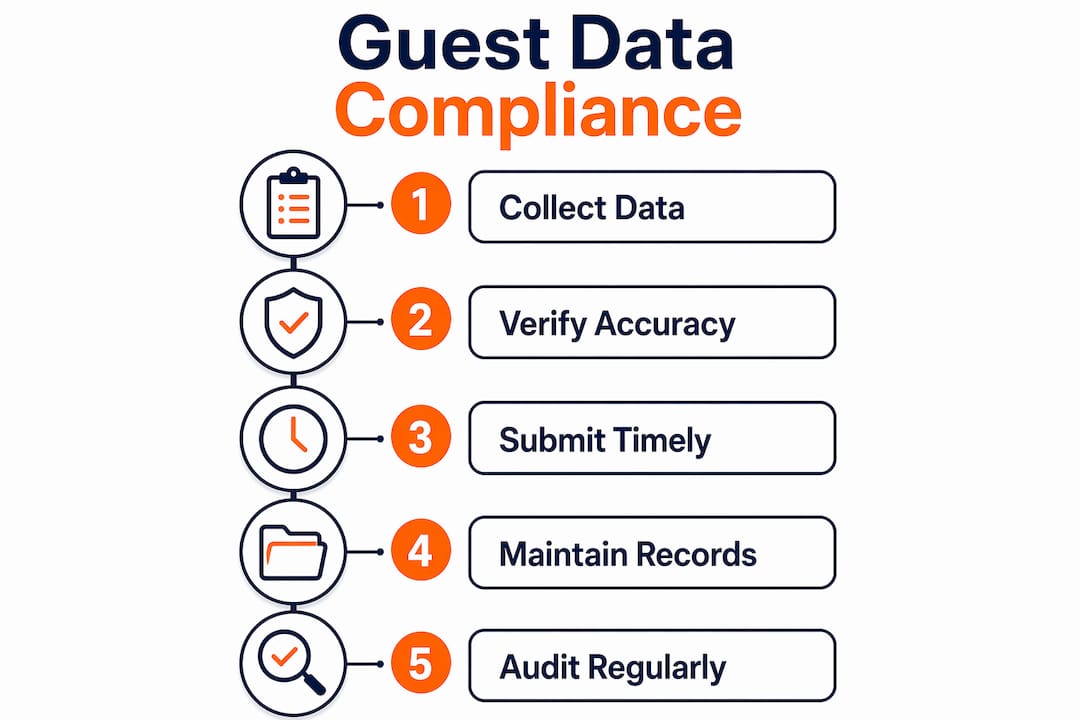
Accurate guest data submission follows a clear sequence. Skipping any step creates gaps that regulators will find during an audit. Here is the process that works reliably across European jurisdictions.
-
Collect guest identity and stay details before or at check-in. Request a valid government-issued photo ID from every adult guest. Record the document type, number, and expiry date alongside the stay dates. Digital check-in forms sent in advance of arrival reduce pressure at the front desk and give guests time to upload documents correctly.
-
Verify the data before submission. Cross-check the name on the booking against the identity document. Confirm the check-in date matches the actual arrival. A mismatch between booking data and submitted data is a common audit flag.
-
Submit within the statutory deadline. In Spain, data must reach SES.HOSPEDAJES within 24 hours of check-in. Italy’s Alloggiati Web and Portugal’s SIBA system each have their own windows. Late-night arrivals are a known risk point. If a guest checks in at 23:00, the 24-hour clock starts immediately. Build your submission workflow to handle this automatically rather than relying on staff to remember.
-
Download and archive the electronic receipt immediately. The acknowledgement document, known in Spain as the acuse de recibo, is your proof of submission. Archive it linked directly to the original guest record so that if a regulator requests evidence, you can produce both the data and the confirmation in seconds. Storing receipts in a separate folder with no link to the guest record forces you to reconstruct the connection later, which wastes time and introduces doubt.
-
Maintain records according to your jurisdiction’s retention schedule. Label archived records with the property name, guest name, and check-in date. Review your archive annually to delete records past their retention window and confirm those within it remain accessible.
Pro Tip: Treat the electronic receipt as part of the guest record, not a separate admin task. If your system does not automatically attach the acknowledgement to the booking, create a naming convention that makes the link obvious, for example: [PropertyCode][GuestSurname][CheckInDate]_receipt.
What mistakes most often derail guest data compliance?
Late and incomplete submissions are the most frequent compliance failures for short-term rental operators across Europe. Most arise from predictable, avoidable causes.
- Late check-ins triggering missed deadlines. A guest who arrives at midnight still triggers the 24-hour submission window. Without an automated system, a tired member of staff is unlikely to log in and submit at 00:15.
- Incomplete data fields. Guests sometimes provide a booking name that differs from their passport. Staff accept it without checking. The submitted record then fails validation or creates a discrepancy during audit.
- Orphaned submission receipts. The acknowledgement is downloaded, saved to a desktop, and never linked to the guest record. Six months later, no one can find it.
- Manual re-entry errors. Typing a passport number incorrectly is easy. Manual data entry into government portals multiplies this risk across every booking.
- Undertrained staff. A new team member who does not know the submission deadline for your jurisdiction is a compliance liability from day one.
“Framing guest data reporting as part of broader data governance, including minimum required fields, retention schedules, and audit trails, is the clearest path to consistent compliance.” This perspective, supported by Ontario’s 2026 guidance, applies equally to European operators.
The fix for most of these problems is the same: remove the human dependency from time-sensitive steps. Automated submission systems handle late-night arrivals, pre-validate fields before submission, and attach receipts to records without staff intervention. Staff training remains necessary, but it should cover exception handling rather than routine tasks.
Key takeaways
Accurate guest data reporting requires collecting the right fields, submitting them within statutory deadlines, and archiving receipts directly alongside the original guest record.
| Point | Details |
|---|---|
| Collect mandatory fields at check-in | Name, document number, nationality, and stay dates are required across most European jurisdictions. |
| Know your country’s deadline | Spain and Italy require submission within 24 hours of arrival; Portugal allows 3 business days for foreign guests. |
| Archive receipts with records | Link the electronic acknowledgement to the guest record immediately to satisfy audit requirements. |
| Automate time-sensitive steps | Manual portal entry increases error risk; OCR apps and integrated platforms reduce it significantly. |
| Apply retention schedules | Keep records for the legally required period, typically 2–6 years, then delete to maintain GDPR compliance. |
Why compliance workflows need to be built, not bolted on
Having worked with property managers across Europe for years, the pattern I see most often is this: operators treat guest data reporting as a task to complete rather than a system to build. They log into SES.HOSPEDAJES or Alloggiati Web after each check-in, type in the details, download the receipt, and consider it done. That works until it does not. A late arrival, a staff absence, a busy weekend with six simultaneous check-ins. Then the deadline passes and the fine arrives.
The operators who stay consistently compliant are the ones who have removed themselves from the critical path. They use platforms that connect directly to government portals, pre-validate data before submission, and generate an automatic audit trail. They do not rely on memory or goodwill.
There is also a privacy dimension that gets overlooked. Collecting passport data and storing it insecurely is a GDPR breach waiting to happen. The data security practices you apply to guest records are not separate from compliance. They are part of it. A regulator investigating a missed submission may also ask how you store the data you did submit.
My honest recommendation: invest in a system that handles submission and archiving together, train your team on exceptions rather than routine steps, and review your retention schedule once a year. The administrative burden of compliance is real, but it is far smaller than the cost of getting it wrong.
— Alex
How Guestadmin makes guest data reporting manageable
Managing guest data compliance across multiple properties and jurisdictions does not have to mean juggling separate portals, spreadsheets, and manual receipts.

Guestadmin connects directly to government portals including SES.HOSPEDAJES and Alloggiati Web, submits guest data automatically within the required deadline, and archives electronic receipts alongside each booking record. The platform supports multi-property management, integrates with leading PMS and OTA platforms, and processes data within 24 hours. For property managers operating across Europe, it replaces a fragmented manual process with a single, auditable workflow. Explore Guestadmin’s multi-property compliance tools or visit guestadmin.io to see how automated guest registration works in practice.
FAQ
What data fields are required when reporting guest information in europe?
Most European jurisdictions require full name, nationality, identity document type and number, and check-in and check-out dates. Country-specific portals such as Spain’s SES.HOSPEDAJES may require up to 18 fields per guest.
How long must guest records be kept after a stay?
Retention periods vary by country, typically ranging from 2–6 years. Ontario’s 2026 rules require six years from the end of the fiscal year; most European countries require between three and five years.
What happens if you miss a guest data submission deadline?
Missing a submission deadline exposes property managers to fines and regulatory sanctions. In Spain, the 24-hour window begins at check-in, meaning late-night arrivals must still be submitted promptly.
Is manual portal entry sufficient for compliance?
Manual entry is legally sufficient but operationally risky. It increases the likelihood of transcription errors and missed deadlines. Automated platforms with OCR and direct portal integration reduce both risks significantly.
Does GDPR apply to guest data submitted to government authorities?
GDPR applies to how you collect, store, and process guest data before and after submission. You must collect only the minimum required fields, store data securely, and delete records once the retention period expires.