

Managing short-term rentals across Europe means navigating a complex web of digital compliance requirements coming into force in 2026. EU Regulation 2024/1028 mandates digital property registration for all 27 member states, introducing strict guest data submission deadlines and hefty penalties for non-compliance. Property owners and managers face the challenge of collecting accurate guest information, submitting it to multiple government portals, and maintaining secure records whilst juggling day-to-day operations. This guide walks you through the practical steps to streamline your guest registration process, leverage automation to reduce errors, and ensure you meet every regulatory requirement without drowning in administrative work.
Table of Contents
- Key takeaways
- Understanding the 2026 EU guest registration requirements
- Preparing for efficient guest data collection and submission
- Executing automated guest registration workflows
- Verifying compliance and managing risks
- Streamline guest registration with automation solutions
- What are the key questions about guest registration in 2026?
Key Takeaways
| Point | Details |
|---|---|
| Digital property registration | EU Regulation 2024/1028 requires digital property registration across all member states from 20 May 2026, with a unique identification number displayed on listings. |
| Guest data deadlines | Submission windows vary by country, commonly within 24 hours of check in, with Italy enforcing a six hour deadline. |
| Penalties for non compliance | Non compliance can trigger fines from €1,000 up to over €50,000, plus risk of delisting and business shutdowns. |
| Automation benefits | Automation reduces manual data handling and errors while speeding submissions. |
Understanding the 2026 EU guest registration requirements
The regulatory landscape for short-term rentals has transformed dramatically. EU Regulation 2024/1028 mandates digital property registration across all 27 member states from May 20, 2026. This means every property owner must register their accommodation and obtain a unique identification number before accepting bookings. You’ll need to display this registration number prominently on all online listings, including Airbnb, Booking.com, and your direct booking website.
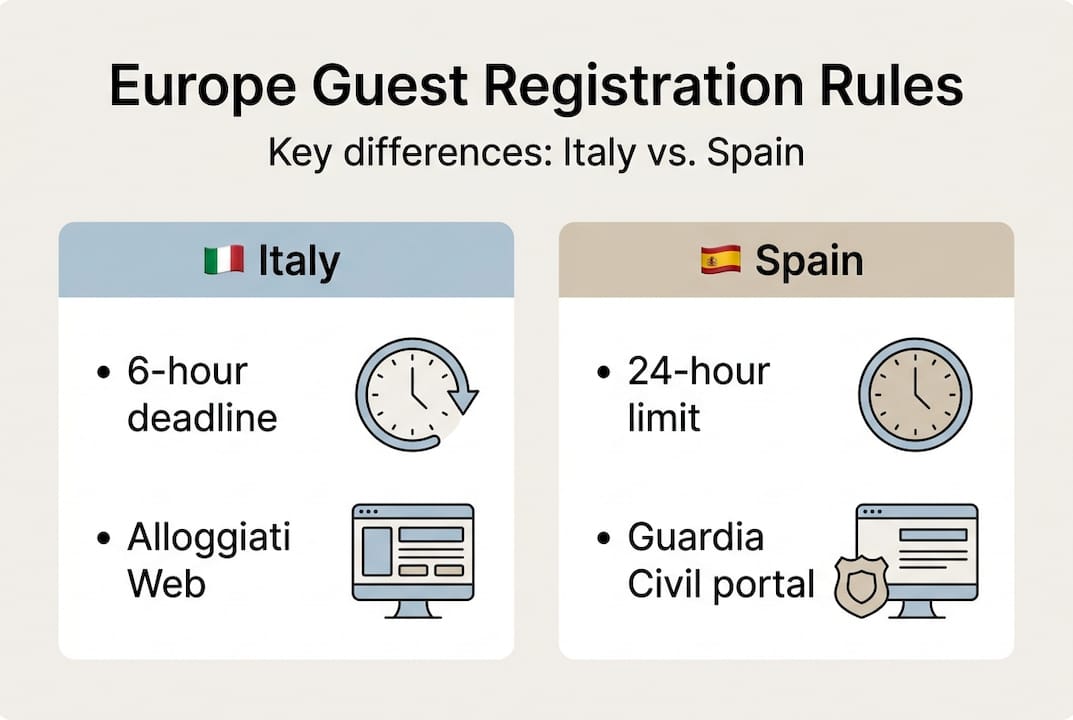
Guest data reporting operates on tight deadlines that vary by jurisdiction. Most countries require submission within 24 hours of guest check-in, but Italy enforces a strict 6-hour window through its Alloggiati Web portal. Spain uses SES.Hospedajes, France relies on its own national system, and Portugal has distinct requirements. Each country maintains separate portals with different interfaces, data formats, and submission protocols.
The mandatory guest information you must collect includes full legal name exactly as it appears on identification documents, date of birth, nationality, government-issued ID number (passport or national identity card), contact details including email and phone number, and arrival and departure dates. Some jurisdictions require additional fields such as country of residence, purpose of visit, or vehicle registration numbers. Missing or inaccurate data triggers automatic rejection from government systems, creating compliance gaps that expose you to penalties.
Financial consequences for non-compliance are substantial. Fines start at €1,000 for minor infractions but escalate rapidly. Repeated violations or systematic failures can result in penalties exceeding €50,000, forced delisting from major booking platforms, and in extreme cases, business shutdowns. Tax authorities increasingly cross-reference guest registration data with income declarations, making accurate reporting essential for both compliance and financial integrity.
Country-specific nuances add complexity. Italy’s stringent 6-hour deadline leaves little margin for error. Spain requires submission through regional portals that vary by autonomous community. Germany mandates tourist tax collection alongside guest registration. Understanding these jurisdictional differences is critical for multi-property operators working across borders. The 2026 rental compliance guide provides detailed breakdowns of requirements by country.
Preparing for efficient guest data collection and submission
Successful compliance starts with systematic preparation before guests arrive. Create standardised digital forms that capture all mandatory fields in a consistent format. Your forms should mirror the exact data requirements of each government portal you’ll submit to, reducing the need for manual reformatting later. Include dropdown menus for nationality and ID document type to minimise spelling errors and ensure data consistency.
Guest identity verification procedures must align with local legal requirements whilst remaining practical for your operations. Some jurisdictions accept digital copies of identification documents, whilst others require physical inspection. Establish clear protocols for your team or cleaning staff to verify guest identities at check-in. For remote check-ins, implement secure digital verification tools that capture high-quality document images and match them against guest booking information.
Internal deadline management prevents last-minute scrambles and missed submissions. Guest registration requires submitting details electronically within 24 hours, but smart operators set internal deadlines 6-12 hours earlier. This buffer accommodates technical issues, missing information, or guest delays in providing documents. For Italian properties with 6-hour windows, aim for 3-hour internal targets to maintain a safety margin.
Data retention obligations extend well beyond guest departure. GDPR requires maintaining guest records for legitimate business and legal purposes, typically 2-6 years depending on jurisdiction and tax requirements. Implement secure, encrypted storage systems that protect sensitive personal information whilst allowing authorised access for audits or legal requests. Regular backups prevent data loss that could compromise your ability to demonstrate compliance.

Staff training transforms compliance from a burden into a routine process. Designate a compliance officer or lead team member responsible for overseeing guest registration workflows. Train all staff who interact with guests on data collection procedures, privacy obligations, and escalation protocols for problems. Document your processes in clear standard operating procedures that new team members can follow easily. The 2026 compliance checklist helps structure your training programme.
Pro Tip: Run monthly compliance audits on a sample of your guest registrations to catch systematic errors before they accumulate. Check for missing fields, formatting inconsistencies, or submission delays that indicate process weaknesses.
Executing automated guest registration workflows
Automation transforms guest registration from a time-consuming manual task into a seamless background process. Modern platforms like GuestAdmin, Chekin, and VillaCheckIn integrate directly with your property management system and major OTAs to capture booking data automatically. When a new reservation arrives, these systems extract guest information, send automated requests for missing data, and prepare submissions without human intervention.
The efficiency gains are substantial. Automation tools reduce manual processing time by 40-60%, freeing your team to focus on guest experience rather than paperwork. Error rates drop by over 50% because automated systems validate data against government requirements before submission, flagging issues like invalid ID numbers or missing mandatory fields. Timely submissions become the default rather than a constant stress point.
Integration capabilities determine how smoothly automation fits into your existing operations. Leading platforms connect with property management systems such as Guesty, Hostaway, and Lodgify, pulling booking data automatically as reservations are made. OTA integrations with Airbnb, Booking.com, and Vrbo capture guest information directly from these channels. API connections enable custom workflows tailored to your specific operational needs. The automated guest management solutions page explores integration options in detail.
Workflow testing before the May 2026 deadline prevents costly surprises. Set up your automation platform and run test submissions through each government portal you’ll use. Verify that data flows correctly from your PMS, that automated validation catches errors, and that submissions reach authorities successfully. Test different scenarios including last-minute bookings, group reservations, and guests with complex ID documents. Document any issues and work with your platform provider to resolve them.
Automated validation prevents the most common submission errors. Systems check that names match ID documents, that dates of birth produce valid ages, that ID numbers conform to country-specific formats, and that all mandatory fields contain data. When validation fails, automated workflows notify guests via email or SMS to provide corrected information. This proactive approach eliminates the frantic follow-up calls that plague manual processes.
| Feature | Manual process | Automated process |
|---|---|---|
| Time per guest | 15-20 minutes | 2-3 minutes |
| Error rate | 12-18% | 3-5% |
| Missed deadlines | 8-15% | Under 1% |
| Staff training time | 4-6 hours | 1-2 hours |
| Multi-property scaling | Very difficult | Seamless |
Pro Tip: Choose automation platforms that support multiple countries if you operate across borders. Single-platform solutions simplify management and reduce the learning curve for your team compared to juggling separate systems for each jurisdiction. Review property management software options to find the right fit.
Verifying compliance and managing risks
Ongoing monitoring ensures your compliance efforts deliver results. Establish weekly audits of submitted guest data to confirm that all required registrations reached government authorities on time. Most portals provide submission receipts or confirmation numbers that serve as proof of compliance. Download and archive these confirmations systematically, organising them by property and date for easy retrieval during inspections.
Detailed logging creates an audit trail that protects you if questions arise. Record the exact timestamp when guest data was collected, when it was validated, and when it was submitted to authorities. Note any errors encountered and how they were resolved. This documentation demonstrates good faith compliance efforts even if occasional technical issues cause delays. Store logs securely alongside guest records for the full retention period.
Post-submission errors require immediate attention. If you discover that guest data was incomplete or incorrect after submission, contact the relevant authority promptly to file corrections. Most jurisdictions provide amendment procedures, though some impose additional administrative fees. Document the error, the correction process, and the resolution to show proactive compliance management. Regular audits help catch these issues quickly before they compound.
The legal and financial risks of non-compliance extend beyond immediate fines. Non-compliance can lead to penalties up to €50,000, but the operational consequences can be equally damaging. Major OTAs may delist properties that fail to display valid registration numbers or accumulate compliance violations. Local authorities can suspend operating licences, forcing temporary or permanent business closures. Tax audits become more likely when guest registration data doesn’t align with reported income.
“Compliance is not just about avoiding fines. It’s about building trust with guests, authorities, and booking platforms. Properties with strong compliance records gain competitive advantages through verified listings and reduced regulatory scrutiny.”
Data security and GDPR compliance form the foundation of responsible guest registration. Guest information contains sensitive personal data that must be protected against unauthorised access, breaches, or misuse. Implement encryption for data in transit and at rest. Restrict access to guest records based on legitimate business needs. Train staff on privacy obligations and the consequences of data breaches. The data security and privacy practices guide provides comprehensive security frameworks.
Proactive risk management involves staying informed about regulatory changes. Subscribe to updates from tourism authorities in jurisdictions where you operate. Join property management associations that monitor compliance developments. Review your processes quarterly to identify weaknesses before they cause problems. Consider professional compliance audits for larger operations to gain independent verification of your systems.
Follow these verification steps systematically:
- Download submission confirmations immediately after each guest registration
- Reconcile submitted data against your booking records weekly
- Archive all compliance documentation in secure, backed-up storage
- Review error logs monthly to identify patterns requiring process improvements
- Conduct quarterly compliance assessments covering all properties and jurisdictions
- Update procedures promptly when regulations change or new requirements emerge
Streamline guest registration with automation solutions
Navigating the complex landscape of EU guest registration requirements demands robust systems that work reliably across multiple jurisdictions. Specialised automation platforms eliminate the manual burden of data collection, validation, and submission whilst ensuring you meet every deadline and regulatory requirement. These solutions integrate seamlessly with your existing property management systems and OTA channels, creating unified workflows that scale effortlessly whether you manage two properties or two hundred.

Modern multi-property management solutions provide centralised dashboards that give you complete visibility across your portfolio. Monitor submission status, track compliance metrics, and identify issues before they escalate into penalties. AI-powered data processing validates guest information automatically, catching errors that would otherwise trigger rejections from government portals. The time savings compound quickly, with operators reporting 40-60% reductions in administrative workload after implementing automation.
The right platform transforms compliance from a constant worry into a background process that runs smoothly without daily intervention. Automated guest management solutions handle the technical complexity of connecting to multiple government systems whilst you focus on delivering exceptional guest experiences. As regulations continue evolving, platforms that update automatically ensure you remain compliant without manual system changes. Explore how automation in rentals compliance can simplify your operations and protect your business.
What are the key questions about guest registration in 2026?
What is the deadline for submitting guest data under EU regulations?
Most EU member states require guest data submission within 24 hours of check-in, though Italy enforces a stricter 6-hour deadline. Some countries calculate deadlines from the moment of booking rather than arrival. Always verify specific requirements for each jurisdiction where you operate to avoid penalties.
How do guest registration requirements differ between Italy and Spain?
Italy requires submission through the Alloggiati Web portal within 6 hours of guest arrival and includes detailed accommodation classification data. Spain uses regional SES.Hospedajes portals that vary by autonomous community, with 24-hour deadlines and additional tourist tax reporting. Both countries mandate unique property registration numbers displayed on all listings.
What penalties apply for failing to register guests properly?
Penalties start at €1,000 for minor violations but escalate to €50,000 or more for systematic non-compliance. Additional consequences include delisting from major OTAs, suspension of operating licences, and increased scrutiny from tax authorities. Repeated violations can result in permanent business closures in some jurisdictions.
Can automated tools really reduce guest registration errors?
Automated systems reduce errors by over 50% compared to manual processes by validating data against government requirements before submission. They check ID number formats, verify mandatory fields are complete, and flag inconsistencies between booking data and guest information. This proactive validation prevents rejections that would otherwise require time-consuming corrections.
How does GDPR affect guest registration data storage?
GDPR requires that guest data be collected only for legitimate purposes, stored securely with encryption, and retained only as long as legally necessary (typically 2-6 years for tax and compliance purposes). You must implement access controls, maintain audit logs, and provide guests with rights to access or delete their data upon request. Breaches can result in fines up to 4% of annual turnover.
22 Comments
finasteride for hair loss
finasteride for hair loss
finasteride for hair loss
Government reporting for rentals: compliance made simple
[…] guest registration differences between countries is essential for any manager operating across borders. The table below summarises […]
lasix 40 mg
lasix 40 mg
lasix 40 mg
lasix water pill 40 mg
lasix water pill 40 mg
lasix water pill 40 mg
zydena 100 mg
zydena 100 mg
zydena 100 mg
How to sync booking data for short-term rental compliance
[…] Subscribe to industry newsletters, follow your national tourism authority, and review your guest registration compliance processes at least twice a […]
viagra medicine name
viagra medicine name
viagra medicine name
cenforce tablet uses
cenforce tablet uses
cenforce tablet uses
Choose the right guest registration method for your rentals
[…] fit (does it accommodate the specific portal or authority for your property’s location?). Use the EU guest registration guide to map your obligations by country before making any […]
levitra generic goodrx
levitra generic goodrx
levitra generic goodrx
Streamline property onboarding for rental compliance
[…] property operators digitally register their properties and submit guest data through approved Single Digital Entry Points (SDEPs). These are centralised national portals where authorities collect and verify rental […]
mesalamine knee pain
mesalamine knee pain
mesalamine knee pain
semaglutide vs tirzepatide chemical structure
semaglutide vs tirzepatide chemical structure
semaglutide vs tirzepatide chemical structure
orlistat kidney
orlistat kidney
orlistat kidney
semaglutid piller usa
semaglutid piller usa
semaglutid piller usa
ivermectin pharmacokinetic profile
ivermectin pharmacokinetic profile
ivermectin pharmacokinetic profile
sildenafil onset delay with food
sildenafil onset delay with food
sildenafil onset delay with food
sildenafil nitric oxide pathway
sildenafil nitric oxide pathway
sildenafil nitric oxide pathway
sildenafil trusted sources
sildenafil trusted sources
sildenafil trusted sources
sildenafil logistics price impact
sildenafil logistics price impact
sildenafil logistics price impact
avanafil food timing effects
avanafil food timing effects
avanafil food timing effects
vardenafil hearing contraindications
vardenafil hearing contraindications
vardenafil hearing contraindications