

Managing short-term rentals across European cities can quickly become overwhelming when every guest check-in means another set of compliance documents to file and more regulatory rules to decipher. Increasingly strict data laws introduced by the European Union require precise reporting and transparency, turning routine guest registrations into administrative hurdles for property managers. By embracing automation in guest data processing, you can simplify complex workflows, reduce errors, and relieve your team from repetitive manual tasks while maintaining confidence in regulatory submission.
Table of Contents
- Defining Automation In Short-Term Rentals
- Key Automation Types And Solutions
- EU Data Laws And Compliance Demands
- How Automation Streamlines Data Handling
- Risks, Liabilities, And Common Pitfalls
Key Takeaways
| Point | Details |
|---|---|
| Embrace Automation Solutions | Implementing automation in short-term rentals significantly reduces administrative burdens and ensures compliance with local regulations. |
| Invest in Integration Capabilities | Selecting tools with robust integration capabilities enhances operational efficiency and minimises manual data entry. |
| Adapt to Regulatory Changes | Developing a comprehensive data management system is essential for maintaining compliance with evolving EU regulations. |
| Manage Automation Risks | Maintain a risk management strategy that includes regular audits and human oversight to balance efficiency with personal guest interactions. |
Defining Automation in Short-Term Rentals
Automation in short-term rentals represents a transformative technological approach that systematically reduces manual administrative tasks through intelligent digital solutions. These digital systems streamline complex processes like guest registration, compliance documentation, and regulatory reporting by leveraging software technologies that can capture, process, and submit information with minimal human intervention.
At its core, rental automation encompasses several critical technological capabilities:
- Data Capture: Automatic extraction of guest information from booking platforms
- Regulatory Compliance: Real-time verification against local government requirements
- Digital Submission: Instant electronic filing of guest registration documents
- Record Management: Secure archiving and tracking of all guest-related documentation
Property managers increasingly recognise the significance of automation, especially when navigating complex regulatory landscapes. property management compliance best practices demonstrate how technological solutions can dramatically reduce administrative burdens while maintaining legal standards.
The technological infrastructure supporting rental automation integrates multiple systems, including property management platforms, booking engines, and government reporting interfaces. These interconnected technologies enable seamless data flow, reducing human error and ensuring consistent, accurate reporting across multiple properties.
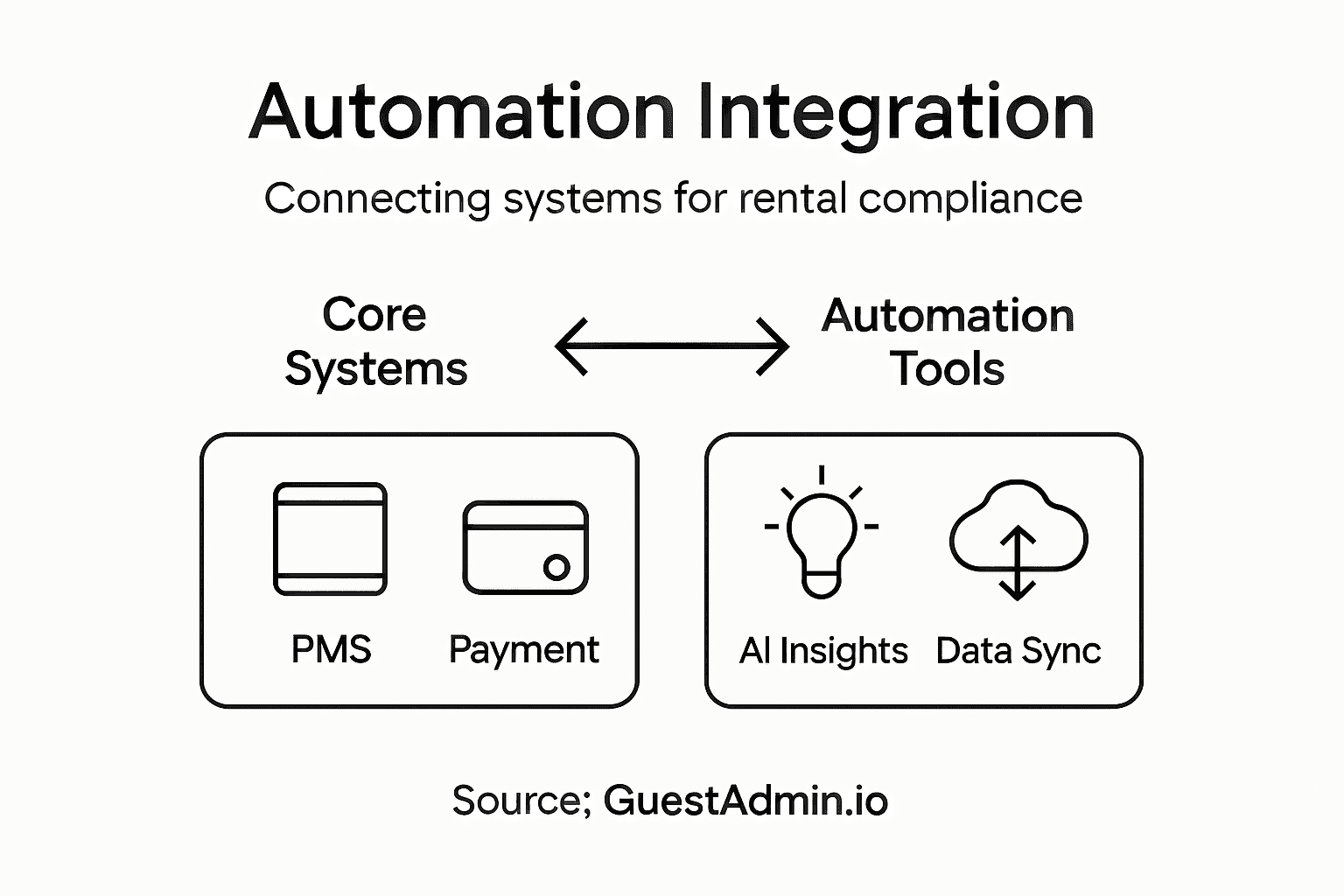
Pro tip: Invest in automation solutions that offer comprehensive integration capabilities to maximise efficiency and minimise manual data entry.
Key Automation Types and Solutions
The landscape of rental automation encompasses a sophisticated array of technological solutions designed to transform operational efficiency for property managers. AI-driven rental management tools have revolutionised how short-term rental businesses streamline their administrative processes, offering unprecedented levels of operational intelligence and performance optimisation.
Key automation types in short-term rentals include several critical technological domains:
- Pricing Automation: Intelligent algorithms that dynamically adjust rental rates based on market demand
- Communication Systems: Automatic messaging platforms for guest interactions
- Booking Management: Seamless integration with multiple reservation platforms
- Compliance Reporting: Automated documentation and regulatory submission
- Smart Home Integration: Remote monitoring and control of property amenities
These technological solutions address multiple operational challenges simultaneously. Workload automation tools provide comprehensive support by integrating task scheduling, guest communication, and property management system functionalities, enabling hosts to scale their operations with minimal manual intervention.
The most advanced automation solutions leverage artificial intelligence and machine learning to provide predictive insights, allowing property managers to make data-driven decisions about pricing, availability, and guest experience management. These systems continuously learn and adapt, offering increasingly sophisticated operational recommendations.
Pro tip: Select automation tools that offer robust integration capabilities and demonstrate flexibility across multiple property management platforms.
EU Data Laws and Compliance Demands
The European Union has developed increasingly sophisticated regulatory frameworks to address the complex landscape of short-term rental data management and transparency. New EU transparency regulations759356_EN.pdf) are designed to create a more accountable and regulated short-term rental marketplace across member states, with stringent requirements for data reporting and accountability.
Key compliance demands for short-term rental operators include:
- Data Transparency: Comprehensive reporting of booking and guest information
- Privacy Protection: Strict adherence to GDPR data protection principles
- Licensing Compliance: Accurate documentation for local regulatory authorities
- Market Monitoring: Supporting sustainable tourism and housing accessibility
- Platform Accountability: Mandatory data sharing with regulatory bodies
The regulatory landscape requires hosts and platforms to navigate complex legal requirements that balance data transparency with individual privacy protections. EU rules on rental transparency emphasise the need for granular yet responsible data management, ensuring that regulatory authorities can effectively monitor and manage short-term rental markets.
These evolving regulations represent a significant shift towards more structured and accountable short-term rental ecosystems, compelling property managers to implement robust digital compliance strategies that can adapt to changing legal frameworks.
The following table summarises key EU compliance demands relevant to short-term rental automation:
| Compliance Area | Required Action | Impact on Property Managers |
|---|---|---|
| Data Transparency | Detailed reporting | Builds regulatory trust |
| Privacy Protection | GDPR adherence | Ensures guest data confidentiality |
| Licensing Compliance | Valid documentation submission | Avoids legal penalties |
| Platform Accountability | Mandatory authority sharing | Boosts market transparency |
Pro tip: Develop a comprehensive data management system that can automatically adjust to changing EU regulatory requirements and maintain real-time compliance.
How Automation Streamlines Data Handling
Data-driven policy frameworks are transforming how short-term rental information is collected, processed, and reported. Automation technologies enable property managers to capture, organise, and submit complex regulatory data with unprecedented precision and efficiency, dramatically reducing manual administrative workload.
Key automation capabilities for data handling include:
- Real-time Data Capture: Instant extraction of booking and guest information
- Intelligent Processing: AI-powered categorisation and validation of rental data
- Compliance Mapping: Automatic alignment with regional regulatory requirements
- Secure Data Storage: Encrypted archiving of sensitive guest information
- Rapid Reporting: Automated submission to relevant authorities
Advanced automation technologies go beyond simple data collection. AI transformation of rental operations enable sophisticated analysis of booking trends, communication patterns, and operational insights that were previously impossible to generate manually.
The integration of machine learning and automated systems represents a fundamental shift in how rental data is managed, providing property managers with tools that not only ensure compliance but also generate actionable business intelligence.

Here’s a comparison of how automation enhances data handling versus traditional manual processes:
| Aspect | Automated Systems | Manual Processes |
|---|---|---|
| Accuracy | High, reduces human error | Prone to mistakes |
| Speed | Instantaneous data processing | Often slow and time-consuming |
| Scalability | Easily manages multiple properties | Challenging beyond a few rentals |
| Compliance Adaptation | Real-time regulatory updates | Requires manual monitoring |
| Security | Encrypted digital storage | Risk of physical data loss |
Pro tip: Invest in automation solutions that offer comprehensive integration capabilities and multi-layered data validation to ensure maximum regulatory compliance.
Risks, Liabilities, and Common Pitfalls
Automation risks in rental management represent a complex landscape where technological efficiency must be carefully balanced against potential operational vulnerabilities. Property managers must navigate a nuanced terrain of technological integration that demands strategic oversight and continuous monitoring.
Key risks and potential pitfalls include:
- Data Privacy Vulnerabilities: Potential breaches of guest personal information
- System Integration Failures: Workflow disruptions from incompatible technologies
- Compliance Inconsistencies: Automated systems that misinterpret regulatory requirements
- Technical Malfunctions: Unexpected errors causing booking or reporting issues
- Loss of Personal Touch: Reduced human interaction in guest experiences
The most significant challenge lies in maintaining a delicate balance between technological efficiency and human judgment. Ethical considerations in rental automation underscore the importance of implementing automated systems that complement rather than completely replace human decision-making processes.
Successful implementation requires a proactive approach that includes regular system audits, continuous staff training, and maintaining flexible technological infrastructure capable of adapting to evolving regulatory landscapes and operational requirements.
Pro tip: Develop a comprehensive risk management strategy that includes regular technological assessments and maintains a human oversight mechanism for all automated systems.
Simplify Compliance with Smart Automation Solutions
Managing compliance in the fast-evolving European short-term rental market is challenging due to complex data handling, regulatory transparency, and strict GDPR rules. This article highlights how automation can reduce manual workload, improve accuracy, and ensure real-time regulatory adherence while safeguarding guest data privacy. Property managers face risks in system integration and compliance consistency but also gain tremendous benefits from AI-powered insights and seamless reporting.
Discover how Stratus Archives – Guest Registration Services address these critical challenges by delivering a fully integrated platform tailored for property owners and management companies. With features like AI-powered data processing, multi-property dashboards, and GDPR-compliant secure submissions, GuestAdmin.io transforms regulatory complexity into effortless compliance.
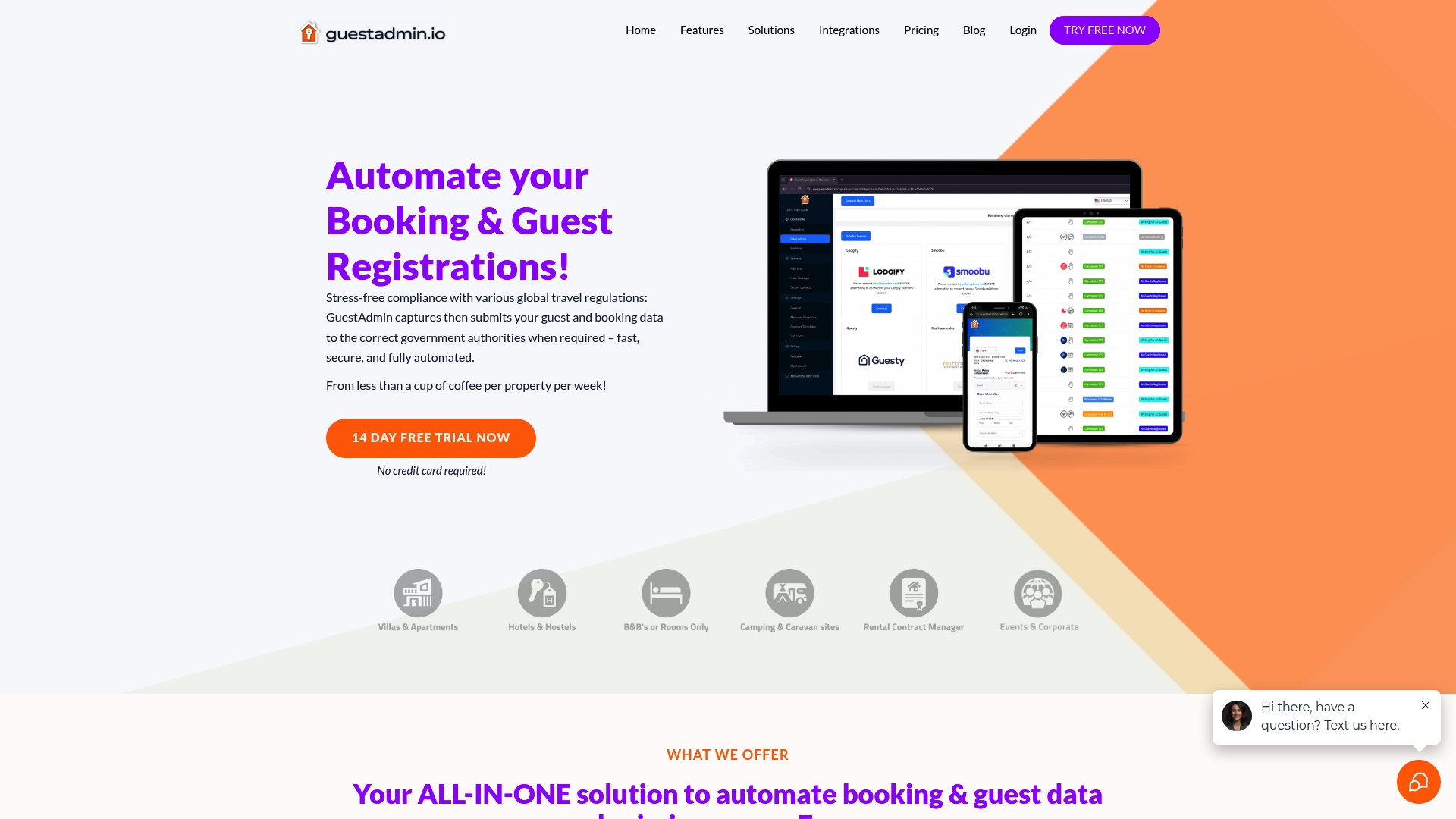
Take control of your rental compliance now. Visit GuestAdmin.io to streamline guest registration, automate regulatory reporting, and protect your business with cutting-edge technology. Explore more insights on automation and compliance through our Uncategorized Archives – Guest Registration Services and make your compliance effortless today.
Frequently Asked Questions
What is automation in short-term rentals?
Automation in short-term rentals involves using digital solutions to reduce manual administrative tasks, streamline processes such as guest registration, regulatory compliance, and reporting, allowing for efficient management of property operations.
How does automation help with regulatory compliance in rental management?
Automation ensures regulatory compliance by providing real-time verification against local laws, automating the submission of required documentation, and enabling secure archiving and tracking of all relevant records.
What are the key benefits of using automated systems in property management?
Automated systems enhance accuracy in data handling, speed up processes by enabling instantaneous data capture and reporting, and improve scalability, making it easier to manage multiple properties efficiently.
What risks are associated with implementing automation in rentals?
Potential risks include data privacy vulnerabilities, integration failures between different systems, compliance inconsistencies, technical malfunctions, and a loss of personal touch in guest interactions. Regular audits and oversight can help mitigate these risks.
2 Comments
4 Property Automation Examples Cut Compliance Work by 30%
[…] Consider these evaluation criteria when assessing automation in rentals compliance: […]
Guest data compliance checklist for EU rentals
[…] Automating compliance reduces human error and accelerates response times for DSARs and breach notifications. For operators managing more than two or three properties, manual processes simply cannot keep pace with the volume of guest data moving through the system. The 2026 registration number requirements make this even more pressing. Automation is not a luxury at this point. It is the only realistic path to consistent compliance. […]