

Operating short-term rentals across Europe means navigating a complex web of legal requirements that vary dramatically between countries and cities. Many European cities require guest data reporting within 24 hours to avoid substantial fines. This guide walks you through the essential compliance obligations, common pitfalls, and practical solutions to confidently manage your properties whilst meeting all legal demands.
Table of Contents
- Introduction To Legal Compliance For Short-Term Rentals In Europe
- Key Legal Requirements For Short-Term Rentals
- Common Misconceptions And Legal Pitfalls
- Conceptual Framework: The Three Pillars Of Compliance
- Technology Solutions To Streamline Compliance
- Penalties, Legal Risks, And Enforcement Variations
- Practical Steps To Achieve And Maintain Compliance
- Streamline Your Rental Compliance With Guest Registration Services
- Frequently Asked Questions
Key takeaways
| Point | Details |
|---|---|
| Compliance complexity | Legal requirements span guest data collection, electronic reporting, licensing, and GDPR adherence across diverse European jurisdictions. |
| High stakes | Non-compliance risks fines from €1,000 to over €50,000, plus operational shutdowns and reputational damage. |
| Technology advantage | Automated solutions reduce compliance workload by up to 60%, eliminating manual errors and accelerating submissions. |
| Local variations | Enforcement intensity and specific rules differ widely between countries and cities, requiring tailored approaches. |
| Ongoing vigilance | Regular monitoring of evolving regulations ensures your properties remain compliant as laws change. |
Introduction to legal compliance for short-term rentals in Europe
Europe’s short-term rental market has exploded over the past decade, with millions of properties now listed across platforms like Airbnb, Booking.com, and Vrbo. This rapid growth has prompted governments and municipalities to implement strict regulations designed to balance tourism benefits with housing availability, tax collection, and public safety concerns. Property owners and managers now face a patchwork of legal frameworks that change not just between countries, but often between cities within the same nation.
The scope of compliance extends far beyond simply registering your property. You must collect specific guest identity data, submit electronic reports to government authorities within tight deadlines, maintain secure data archives for years, and ensure every step respects GDPR privacy rules. Automating booking compliance has become essential for property managers handling multiple locations.
Consequences of non-compliance are severe and growing. Authorities across Europe have intensified enforcement, conducting regular audits and imposing substantial financial penalties on properties that fail to meet reporting deadlines or registration requirements. Beyond fines, you risk having your rental licence revoked, facing legal action from local councils, or dealing with negative publicity that damages your reputation. Insurance coverage may also be voided if you operate outside legal boundaries.
Managing compliance becomes exponentially more challenging when you operate properties across multiple jurisdictions. Each city may demand different data formats, use separate submission portals, and enforce unique operational restrictions. Keeping track of varying deadlines, understanding local language requirements, and maintaining consistent data quality across your portfolio requires systematic processes that many property owners struggle to implement manually.
Key legal requirements for short-term rentals
Guest identity data collection forms the foundation of compliance across Europe. Authorities require you to capture full names, dates of birth, nationality, passport or ID numbers, and arrival/departure dates for every guest. Some jurisdictions demand additional details like vehicle registration numbers, profession, or permanent addresses. 70% of European jurisdictions require electronic guest data submission beyond physical forms, making digital systems essential rather than optional.
Licensing and registration requirements vary dramatically by location:
- Barcelona mandates a tourist licence number displayed in all advertisements, with strict limits on new licences issued in central districts.
- Berlin requires registration numbers and caps rental days at 90 per year for entire flats unless you obtain special permits.
- Paris enforces primary residence rules, limiting entire home rentals to 120 days annually and requiring registration numbers in listings.
- London applies the 90-day rule for entire properties without planning permission, though individual room rentals face fewer restrictions.
- Rome demands specific identification codes for each property, with penalties for unlisted operations.
Guest registration requirements in the UK differ from continental Europe, but still demand careful attention. Understanding your property owner responsibilities across the EU prevents costly mistakes.
Operational restrictions extend beyond data collection. Many cities impose day caps limiting how many nights per year you can rent your property. Zoning laws may prohibit short-term rentals in certain residential areas entirely. Noise regulations, waste management requirements, and safety standards like fire alarms and emergency exits add layers of compliance obligations. Some jurisdictions require you to display emergency contact information prominently or maintain liability insurance meeting minimum coverage thresholds.

| Compliance Area | Typical Requirements | Retention Period |
|---|---|---|
| Guest identity data | Full name, DOB, nationality, ID number | 2-6 years |
| Booking records | Check-in/out dates, property address, payment details | 5-7 years |
| Tax documentation | Tourist tax receipts, income records | 6-10 years |
| Registration certificates | Licence numbers, permit copies | Duration of operation |
Data retention periods mandate secure storage of guest information long after their stay ends. Most European countries require you to archive guest data for at least two years, with some extending this to six years or more. These archives must remain accessible for government inspections whilst protecting guest privacy through encryption and access controls.
Pro Tip: Create a compliance calendar tracking submission deadlines, licence renewal dates, and regulatory review schedules for each property. Set reminders two weeks before critical dates to avoid last-minute scrambles.
Common misconceptions and legal pitfalls
Many property owners mistakenly believe that collecting guest information in a physical guest book satisfies legal requirements. This outdated approach fails in most European jurisdictions that now mandate electronic submission to government portals. Paper records create data entry delays, increase error rates, and leave you unable to meet the 24-hour reporting deadlines many cities enforce. Relying solely on physical forms is a compliance failure waiting to be discovered during an audit.
Underestimating GDPR’s impact represents another critical mistake. The General Data Protection Regulation governs how you collect, store, and process all guest personal data across the European Union. Neglecting GDPR requirements leads to improper data handling, a frequent compliance failure that carries separate penalties from local rental regulations. You must obtain proper consent, implement appropriate security measures, respect data minimisation principles, and honour guest rights to access or delete their information.
Key GDPR pitfalls include:
- Collecting more guest data than legally required for compliance purposes
- Storing guest information on unsecured devices or unencrypted cloud storage
- Sharing guest data with third parties without proper legal basis
- Failing to implement data breach notification procedures
- Retaining guest records beyond legally mandated periods
Enforcement intensity varies dramatically between locations, creating a false sense of security for some operators. Whilst certain cities conduct regular audits and impose fines aggressively, others take a more lenient approach or focus enforcement on larger operators. This inconsistency tempts some property owners to neglect compliance in areas with historically lax enforcement. However, regulatory priorities shift quickly, and cities frequently launch crackdown campaigns targeting previously overlooked violations. Building robust compliance processes protects you regardless of current enforcement trends.
Understanding your property owner responsibilities in the EU prevents these common mistakes. Legal insights on compliance from specialist solicitors provide valuable guidance for navigating complex regulations.
Pro Tip: Document your compliance processes in writing, including how you collect consent, secure data, and submit reports. This documentation proves your good faith efforts if questions arise during inspections.
Conceptual framework: the three pillars of compliance
Organising compliance obligations into three distinct pillars simplifies complex legal demands and helps you build systematic processes. This framework ensures you address every critical area whilst avoiding redundant efforts.
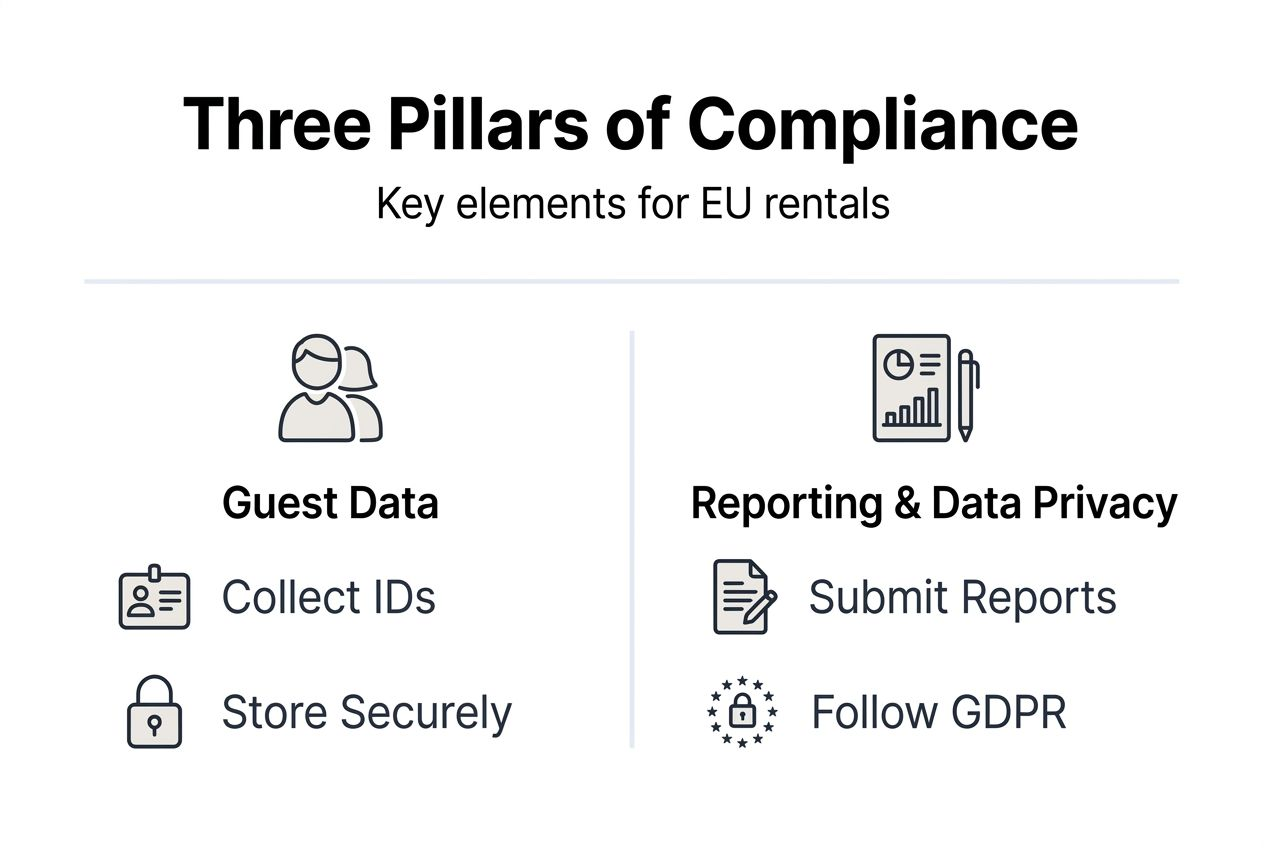
Pillar 1: Guest data collection and secure storage encompasses all activities related to capturing accurate guest information and maintaining it safely. You must implement systems that gather required identity details at booking or check-in, verify data accuracy, and store records in encrypted, access-controlled databases. This pillar includes choosing appropriate technology platforms, training staff on data collection procedures, and establishing backup systems to prevent data loss.
Pillar 2: Timely regulatory reporting obligations covers your duty to submit guest data to government authorities within prescribed deadlines. Most European jurisdictions require electronic submissions through specific portals, each with unique formatting requirements and authentication procedures. This pillar demands you understand which authorities govern each property location, register for necessary portal access, and establish workflows ensuring data reaches authorities before deadlines expire.
Pillar 3: Data privacy and GDPR compliance management addresses how you handle guest personal information throughout its lifecycle. You must obtain proper consent, implement security measures protecting against unauthorised access, respect guest rights to access or deletion, and dispose of data appropriately once retention periods expire. This pillar intersects with the other two, ensuring your data collection and reporting activities remain lawful under privacy regulations.
| Pillar | Primary Focus | Key Outcomes |
|---|---|---|
| Guest data collection | Accurate capture and secure storage | Complete, verified records ready for reporting |
| Regulatory reporting | Timely electronic submissions | Authorities receive required data before deadlines |
| Data privacy | GDPR compliance and guest rights | Lawful processing with appropriate safeguards |
Applying this three-pillar model helps you audit your current compliance status. Assess each pillar independently, identifying gaps in your processes. You might excel at data collection but struggle with timely reporting, or maintain strong privacy practices whilst lacking secure storage infrastructure. Targeted improvements in weak pillars strengthen your overall compliance posture. Effective compliance workflows for property managers integrate all three pillars seamlessly.
Technology solutions to streamline compliance
Modern SaaS platforms transform compliance from a manual burden into an automated workflow that runs smoothly in the background. Automated guest data capture eliminates tedious form filling by pulling information directly from booking confirmations sent by online travel agencies or property management systems. When guests book through Airbnb, Booking.com, or your direct booking website, integrated systems extract required identity details and format them correctly for regulatory submissions.
Integration advantages extend across your entire technology stack. Leading compliance platforms connect with popular property management systems like Guesty, Hostaway, and Lodgify, plus major OTAs including Airbnb, Booking.com, and Expedia. These integrations create seamless data flows, ensuring every booking automatically triggers compliance processes without manual intervention. You avoid duplicate data entry, reduce errors from transcription mistakes, and maintain a single source of truth for all property and guest information.
Key benefits of automated compliance solutions:
- Real-time data processing ensuring submissions meet 24-hour deadlines
- Multi-jurisdictional support handling different portal requirements simultaneously
- Automated error checking validating data completeness before submission
- Secure cloud storage with GDPR-compliant encryption and access controls
- Audit trails documenting every submission for regulatory inspections
Automation can save property managers up to 60% of time spent on compliance tasks, freeing you to focus on guest experience and business growth. Error rates plummet when systems handle data formatting and submission automatically. You eliminate the risk of forgetting deadlines or mixing up submission portals between different cities.
Property management SaaS for hospitality offers comprehensive solutions integrating compliance with broader operational needs. Automation in rental compliance across Europe has become the industry standard for professional operators managing multiple properties.
Pro Tip: When evaluating compliance automation platforms, prioritise those offering API integrations with your existing property management system. Seamless data synchronisation prevents the headaches of maintaining separate systems.
Penalties, legal risks, and enforcement variations
Financial penalties for compliance failures vary dramatically across Europe. Fines for non-compliance range from €1,000 to over €50,000 depending on jurisdiction and violation severity. Italian cities like Florence impose fines up to €5,000 for missing guest data submissions, whilst Spanish regions can levy penalties exceeding €40,000 for operating without proper licences. Germany enforces fines up to €50,000 in some states for violations of registration requirements. These penalties multiply if you operate multiple non-compliant properties simultaneously.
Enforcement intensity differs markedly between locations and time periods. Barcelona and Amsterdam conduct aggressive compliance audits, regularly checking online listings against registered properties and imposing penalties swiftly. Paris employs dedicated teams monitoring platforms for unlicensed rentals, with enforcement actions taken within days of discovering violations. Other cities take more reactive approaches, investigating only after neighbour complaints or random spot checks. However, enforcement trends shift rapidly as political priorities change, making past leniency no guarantee of future tolerance.
Risks beyond direct fines include:
- Licence revocation forcing you to cease operations immediately
- Legal orders requiring removal of your listings from all booking platforms
- Potential criminal charges in jurisdictions treating serious violations as offences
- Reputational damage affecting future bookings and business relationships
- Voided insurance coverage leaving you personally liable for incidents
Operational shutdown represents the most severe consequence. When authorities revoke your rental licence or issue cease-and-desist orders, you must cancel existing bookings, refund guests, and stop accepting new reservations. This disruption damages your revenue stream, creates administrative chaos handling cancellations, and may trigger contractual penalties with property management companies or booking platforms. Recovery requires lengthy appeals processes or reapplying for licences, during which your property sits idle.
Understanding your property owner responsibilities in EU rentals helps you assess risks specific to your locations and take preventive action before enforcement actions occur.
Practical steps to achieve and maintain compliance
Building robust compliance starts with thoroughly understanding the specific regulations governing each property location. Research local council websites, contact tourism offices, and consult specialist solicitors familiar with short-term rental law in your jurisdictions. Document every requirement including registration procedures, data submission formats, reporting deadlines, and operational restrictions. Create location-specific compliance checklists ensuring nothing gets overlooked as you implement processes.
Implementing automated systems for data capture and submission eliminates manual bottlenecks:
- Choose a compliance platform offering integrations with your property management system and booking channels.
- Connect your accounts authorising data flows between platforms through secure API connections.
- Configure submission settings for each property location, mapping to appropriate government portals.
- Test workflows thoroughly using sample bookings before going live with real guest data.
- Monitor submission logs regularly ensuring every booking triggers successful regulatory reports.
Secure archival of guest information requires implementing proper data protection measures. Store guest records in encrypted databases with restricted access limited to authorised personnel only. Implement backup systems preventing data loss from technical failures. Establish retention policies automatically deleting records once legal retention periods expire, respecting GDPR data minimisation principles. Document your security measures and data handling procedures for regulatory inspections.
Regular monitoring keeps you ahead of regulatory changes that could affect your properties. Subscribe to local government newsletters, join property owner associations, and set up Google alerts for news about short-term rental regulations in your operating cities. Quarterly compliance reviews ensure your processes remain aligned with current requirements. When regulations change, update your systems promptly rather than waiting for enforcement actions.
Training staff and property managers ensures consistent compliance execution across your portfolio. Provide clear written procedures covering data collection, system access, and escalation protocols when issues arise. Conduct regular refresher training as regulations evolve. Multi-property management workflow compliance requires coordination across teams handling different locations.
Pro Tip: Designate a compliance officer responsible for monitoring regulatory changes and coordinating updates across your properties. This single point of accountability prevents compliance gaps when responsibilities are diffuse.
Streamline your rental compliance with Guest Registration Services
Managing legal compliance across multiple European jurisdictions demands systematic processes and reliable technology. GuestAdmin automates guest data capture from your bookings, processes information intelligently, and submits reports to government authorities within 24-hour deadlines. Our platform integrates seamlessly with popular property management systems and OTAs, eliminating manual data entry whilst ensuring accuracy.

We handle the complexity of multi-jurisdictional compliance, supporting diverse portal requirements across European cities without you needing to learn each system. Our GDPR-compliant infrastructure secures guest data with encryption and controlled access, automatically archiving records according to local retention rules. Real-time dashboards give you visibility into submission status, upcoming deadlines, and compliance metrics across your entire property portfolio. Whether you manage a single rental or hundreds of properties, our automated workflows reduce your compliance workload whilst eliminating the risk of missed deadlines or incorrect submissions.
Explore how automated booking compliance transforms your operations, or learn about specific guest registration requirements in UK short-term rentals. Master your property owner responsibilities across EU rentals with technology designed specifically for the European short-term rental market.
Frequently asked questions
What are the main legal obligations for short-term rental compliance in Europe?
You must collect accurate guest identity data including full names, dates of birth, nationality, and ID numbers. Most jurisdictions require registering or licensing your property with local authorities before accepting guests. Electronic submission of guest data to government portals typically must occur within 24 hours of check-in, with records archived securely for 2-6 years.
How does GDPR affect guest data handling for rentals?
GDPR mandates lawful, transparent processing and secure storage of all guest personal information. You must obtain proper consent for data collection, implement encryption and access controls protecting against unauthorised use, and respect retention limits by deleting data once legal requirements expire. Board-level responsibility for GDPR extends throughout your organisation, making comprehensive data protection essential.
What penalties can I face for failing to comply with rental laws?
Financial fines range from €1,000 to over €50,000 depending on your jurisdiction and violation severity. Beyond monetary penalties, authorities may revoke your rental licence, order immediate cessation of operations, or remove your listings from booking platforms. Serious or repeated violations can trigger criminal charges in some locations, whilst reputational damage affects future bookings and business relationships.
How can automation help with compliance management?
Automation enables real-time guest data capture directly from booking confirmations, eliminating manual form filling and data entry errors. Automated systems save property managers up to 60% of time spent on compliance tasks by handling submissions to multiple government portals simultaneously. You gain confidence that deadlines are met consistently whilst freeing resources to focus on guest experience and business development.
14 Comments
Unlock efficiency with dashboards in short-term rentals
[…] regulatory landscape drives dashboard adoption more than any other factor. Dashboards provide real-time centralisation of booking and guest compliance data essential for the E…, where regulations vary dramatically between jurisdictions. Property managers in Barcelona face […]
How APIs streamline rental compliance in Europe 2026
[…] rentals across multiple European locations multiplies compliance complexity exponentially. Sophisticated APIs map data schemas to region-specific regulations for automated multi-jurisdiction reporting. This centralised […]
Streamline your rentals with API integration for managers
[…] that compliance extends beyond initial registration to ongoing monthly reporting obligations. Your 2026 EU rental compliance guide should include provisions for automated data transmission that maintains compliance without […]
Streamline your multi-property management process for 2026
[…] Travel regulations compound these challenges by requiring property managers to collect, process, and submit guest data to local authorities within tight timeframes. Some regions demand real-time reporting within 24 hours of check-in, whilst others allow weekly or monthly batch submissions. Data requirements vary dramatically, from basic identification details to comprehensive passport scans and travel documentation. Understanding these regional differences forms the foundation for effective legal compliance for rentals in Europe. […]
Guest registration guide for short-term rentals in Europe
[…] jurisdictional differences is critical for multi-property operators working across borders. The 2026 rental compliance guide provides detailed breakdowns of requirements by […]
Why data security matters in short-term rentals
[…] documents, payment credentials, and increasingly data from smart locks or thermostats. GDPR mandates secure processing with fines reaching 4% of turnover alongside local penalties ranging from €1,000 to €50,000 per […]
Property owner compliance essentials: streamline Europe 2026
[…] EU compliance guide breaks down these requirements by country, which is worth reviewing before you assume your current […]
Navigate short-term rental regulations in Europe: 2026 guide
[…] is. Those decisions remain entirely with city and national governments. You can read more in our EU compliance guide and review your owner responsibilities before diving into local […]
Booking data management: best practices for rental compliance
[…] core guest data fields required by law across most European jurisdictions […]
Short-term rental registration guide for Europe 2026
[…] a thorough review of your obligations, the legal rental compliance guide covers the 2026 landscape in […]
Real examples of property compliance for short-term rentals
[…] data collection: Capture the right fields at check-in. The required guest data includes full name, date of birth, nationality, ID or passport number, and check-in and check-out […]
Why hospitality SaaS is essential for compliance success
[…] a thorough overview of your obligations across different countries, the Europe rental compliance guide is an excellent starting point. If you are still unclear on what rental registration in 2026 […]
Legal compliance for European short-term rental owners
[…] automatically on their behalf, often find themselves facing fines or sudden delisting. Our legal compliance guide Europe offers a detailed breakdown of what each obligation means in practice, and our short-term rental […]
Your essential short-term rental compliance checklist for Europe
[…] Legal compliance for rentals in Europe: your 2026 guide […]