

Managing compliance across Europe’s fragmented short-term rental regulations drains time and invites costly penalties. Manual guest registration and data submission increase error risks, especially when overseeing multiple properties under diverse local rules. Automation streamlines these tasks, ensuring timely regulatory submissions and legal adherence. This guide walks you through implementing automated booking compliance to reduce workload and secure your rental business.
Table of Contents
- Understanding EU Regulation 2024/1028 And Its Impact On Short-Term Rentals
- Prerequisites For Automating Booking Compliance In Short-Term Rentals
- Step-By-Step Process To Automate Booking Compliance
- Common Mistakes And Troubleshooting Automation Failures
- Expected Outcomes, Performance Metrics, And Compliance Benefits
- Simplify Compliance With GuestAdmin’s Automated Solutions
- Frequently Asked Questions
Key takeaways
| Point | Details |
|---|---|
| EU Regulation 2024/1028 mandates digital registration | Starting May 2026, all hosts must register digitally and display unique numbers on listings. |
| Effective automation demands PMS integration and GDPR compliance | Seamless API connections with property management systems and strict data privacy policies are non-negotiable. |
| Step-by-step automation covers registration through secure retention | Automate each stage from initial registration, API integration, AI verification, submission, to compliant archiving. |
| Common failures stem from incomplete data and delayed verification | Validation checks and automated API monitoring prevent suspensions and financial penalties. |
| Successful automation cuts admin tasks by 40% and errors by 50%+ | Real-time dashboards and reliable workflows deliver measurable efficiency gains and risk reduction. |
Understanding EU Regulation 2024/1028 and its impact on short-term rentals
The EU Regulation (EU) 2024/1028 reshapes compliance for property managers across Europe. Starting May 20, 2026, all short-term rental hosts must complete digital registration and obtain unique registration numbers displayed prominently on every listing. This framework requires interoperable systems enabling monthly or more frequent data sharing with local authorities.
Key obligations include:
- Hosts must register through official digital platforms accessible to the public.
- Registration numbers become mandatory on all online listings and advertisements.
- Data must be shared monthly or quarterly depending on national requirements.
- Platforms must provide free or low-cost registration and enable digital document submission.
- Data retention up to 18 months after delisting must comply with GDPR standards.
These measures aim to standardise compliance whilst respecting local regulatory variations. Property managers operating across borders face complex overlapping requirements. Understanding guest registration requirements for UK rentals alongside broader EU mandates becomes essential. The regulation also empowers authorities to suspend listings for non-compliance, making automated adherence critical.
Pro Tip: Bookmark official EU Regulation 2024/1028 details for reference when configuring automation workflows to ensure alignment with legal updates.
Prerequisites for automating booking compliance in short-term rentals
Before launching automation, establish foundational infrastructure and knowledge. Effective automation requires access to PMS and OTA APIs, clear understanding of local registration requirements, GDPR-compliant data handling policies, and staff training plans. Missing any component undermines the entire system.
Essential prerequisites include:
- API access from your property management system and all OTA platforms you use for real-time booking data flow.
- Comprehensive knowledge of both EU-wide mandates and specific local registration rules in each jurisdiction where you operate.
- GDPR-compliant data privacy policies covering encryption, access controls, and deletion schedules.
- Staff training programmes covering automation workflows, troubleshooting, and compliance verification.
- Technical readiness including secure servers, backup systems, and audit trail capabilities.
Onboarding typically spans several weeks. Allocate time for API integration testing, staff familiarisation, and initial compliance verification. Contact GuestAdmin for onboarding support to accelerate setup and avoid common pitfalls.

Pro Tip: Map out all jurisdictions where you operate properties and document specific registration requirements for each before configuring automation rules to prevent gaps.
Thorough preparation prevents downstream failures. Review preparing for EU rental regulations to identify jurisdiction-specific nuances affecting your automation strategy.
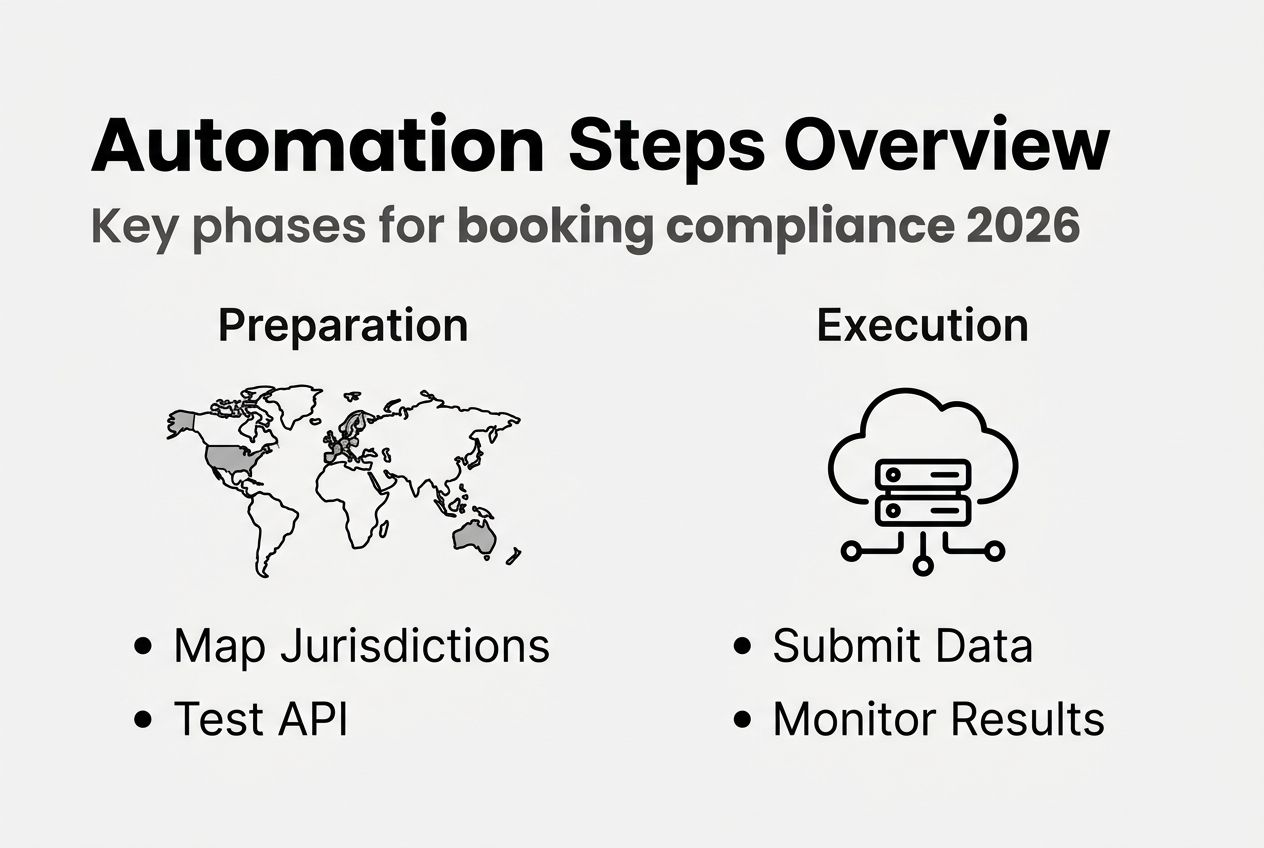
Step-by-step process to automate booking compliance
Implementing automated compliance follows a logical sequence from registration through ongoing monitoring. Each step builds on the previous, creating a seamless workflow that meets regulatory deadlines without manual intervention.
-
Set up digital registration on official portals. Register each property through the designated local authority platform to obtain unique registration numbers. Maintain a centralised database linking each property to its registration credentials and renewal dates.
-
Integrate PMS and OTA platforms via APIs. Automated compliance solutions integrating with PMS and OTA APIs expedite guest data collection and ensure verified submissions within 24 hours. Configure webhooks to capture booking confirmations in real time.
-
Deploy AI for identity verification and anomaly detection. Implement automated checks validating guest identity documents, flagging incomplete data, and detecting suspicious patterns. AI reduces human error whilst accelerating processing.
-
Automate data submission workflows. Schedule automatic transmission of booking data to relevant authorities within mandated timeframes. Configure retry logic for failed submissions and alert mechanisms for manual review when needed.
-
Maintain audit trails and GDPR-compliant archiving. Store all submission records with timestamps, confirmation receipts, and guest data in encrypted, access-controlled systems. Implement automatic deletion schedules meeting GDPR requirements.
Pro Tip: Test your entire workflow with dummy bookings before going live to identify integration gaps or timing issues that could delay real submissions.
Regular monitoring ensures continued compliance. Review the booking data submission process periodically to incorporate regulatory updates. Detailed implementation guidance appears in automation implementation steps covering technical configuration and common integration challenges.
Common mistakes and troubleshooting automation failures
Even well-designed automation encounters obstacles. Recognising failure patterns early prevents suspensions and penalties. Key failure points include incomplete guest information submission, delayed registration number verification, and lack of integration with local authority APIs, leading to registration suspensions or financial penalties.
Frequent pitfalls and solutions:
-
Incomplete or inaccurate guest data submissions occur when integration captures only partial booking information. Implement validation rules requiring all mandatory fields before accepting bookings. Configure alerts for missing data prompting immediate guest follow-up.
-
Registration number verification delays happen when manual checks slow down listing activation. Automate verification through authority APIs, triggering immediate alerts for expired or invalid numbers.
-
Missing integration with authorities creates submission gaps exposing you to enforcement actions. Ensure end-to-end connectivity from booking capture through final authority receipt confirmation.
-
Non-GDPR-compliant data handling invites substantial fines up to 4% of annual turnover. Implement encrypted storage, role-based access controls, and automatic deletion workflows aligned with legal retention limits.
-
Ignoring platform obligations to remove non-compliant listings escalates regulatory scrutiny. Monitor compliance dashboards daily and act immediately on any flagged issues.
Establishing robust error handling prevents most failures. Review improving compliance workflows for systematic troubleshooting approaches. Understanding common compliance errors helps anticipate issues before they disrupt operations.
Expected outcomes, performance metrics, and compliance benefits
Successful automation delivers quantifiable improvements across operational efficiency, compliance accuracy, and cost management. Implementing automated booking compliance solutions can reduce manual administrative tasks by up to 40%, freeing significant time for strategic property management activities.
Key performance indicators:
| Metric | Manual Process | Automated Process |
|---|---|---|
| Time per booking submission | 15-20 minutes | 2-3 minutes |
| Compliance error rate | 8-12% | 2-4% |
| Submission deadline adherence | 75-85% | 98-100% |
| Staff hours per month (10 properties) | 40-50 hours | 20-25 hours |
| Penalty risk exposure | High | Minimal |
Measurable benefits include:
- Compliance error rates drop by over 50% through automated validation and AI-powered verification, virtually eliminating human oversight mistakes.
- Data submissions occur reliably within 24 hours of booking confirmation, consistently meeting regulatory deadlines without manual intervention.
- Real-time dashboards provide instant operational visibility, enabling proactive management and rapid response to compliance issues.
- Significant cost savings emerge across multi-property portfolios through reduced administrative labour and eliminated penalty risks.
- Enhanced guest experience results from streamlined check-in processes and faster booking confirmations.
Document your baseline metrics before automation launch to demonstrate ROI. Explore automation benefits in rentals for industry benchmarks and automation case studies showing real-world implementations. Detailed performance benchmarks for compliance automation help set realistic expectations and measure success.
Simplify compliance with GuestAdmin’s automated solutions
Navigating Europe’s complex compliance landscape demands purpose-built automation. GuestAdmin offers comprehensive solutions specifically designed for property managers handling multiple rentals across diverse jurisdictions. Our platform integrates seamlessly with leading PMS and OTA systems, automating guest registration and regulatory reporting whilst maintaining GDPR-compliant data management.
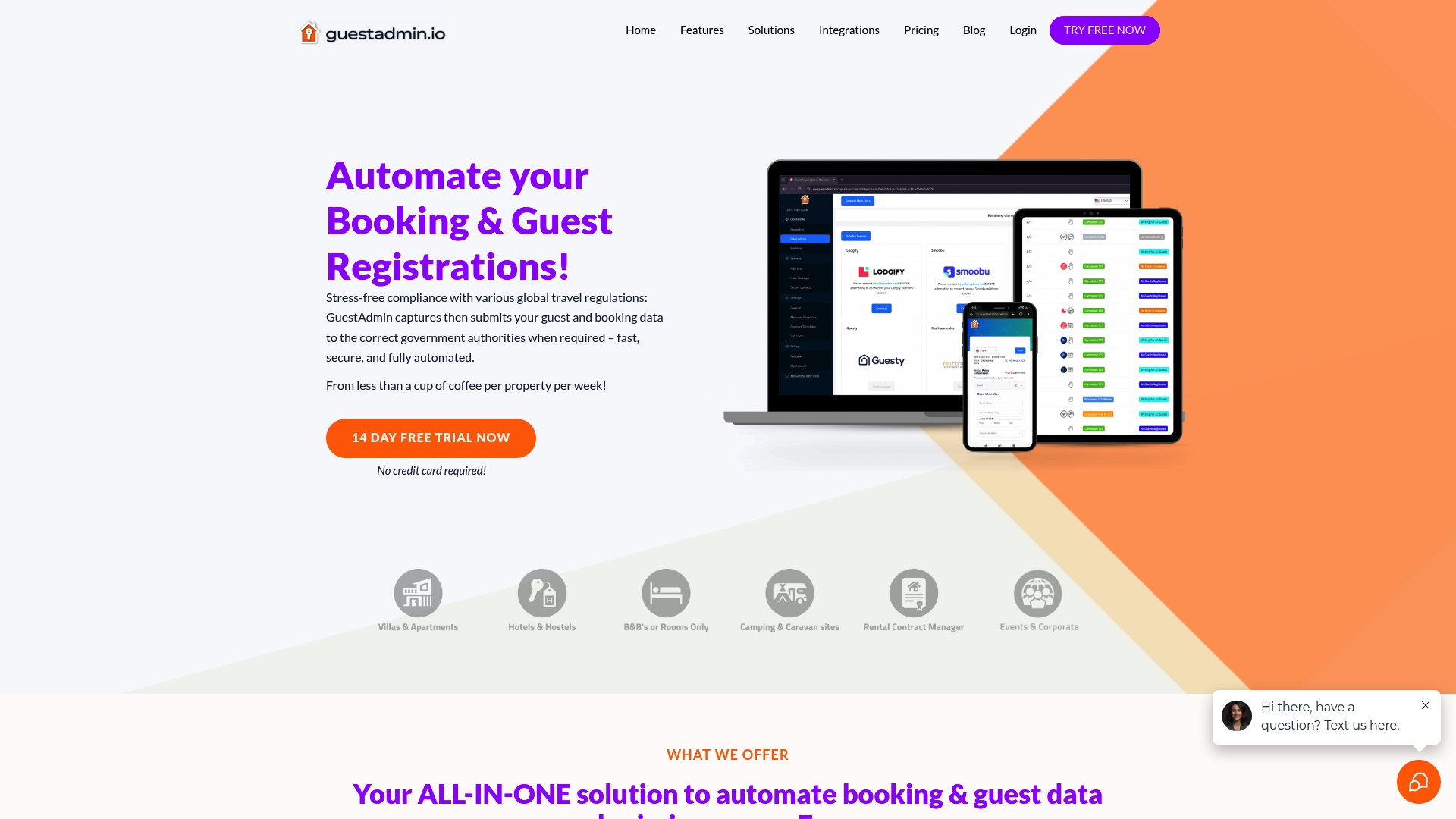
GuestAdmin reduces compliance workload by handling the entire workflow from booking capture through authority submission and audit trail maintenance. Our AI-powered verification ensures accurate, timely submissions within 24 hours of booking confirmation. Real-time dashboards provide instant visibility across your entire portfolio. Whether managing ten properties or hundreds, GuestAdmin scales effortlessly whilst ensuring legal adherence in every jurisdiction. Discover how multi-property management explained simplifies operations and explore our property management SaaS for compliance to transform your compliance approach.
Frequently asked questions
What are the main deadlines for submitting booking data under EU Regulation 2024/1028?
Booking data must be submitted within 24 hours of confirmation to local authorities under EU mandates. Monthly or quarterly ongoing data sharing depends on specific national regulations and platform agreements. Timely submissions prevent fines and listing suspensions.
How can property managers ensure GDPR compliance whilst automating booking registrations?
Store all personal data encrypted with access restricted to authorised personnel only. Implement automatic deletion within 18 months after property deregistration as required. Train staff on GDPR requirements and conduct regular compliance audits to verify adherence.
What common errors should be avoided to prevent automation failures?
Incomplete or inaccurate guest data submissions must be prevented through validation tools requiring all mandatory fields. Delayed registration number verification requires automated API checks providing instant status updates. Ensure full integration with authority systems to avoid submission disruptions and maintain GDPR-compliant data security preventing legal penalties.
Can automation handle multiple properties across different European countries?
Yes, modern automation platforms manage multi-property portfolios across diverse jurisdictions by configuring jurisdiction-specific rules and submission protocols. Centralised dashboards provide unified visibility whilst ensuring each property complies with local requirements. Scalability becomes straightforward as you expand operations.
What happens if automated submissions fail due to technical issues?
Robust automation includes retry logic attempting resubmission automatically when initial attempts fail. Alert systems notify administrators immediately of persistent failures requiring manual intervention. Audit trails document all attempts, providing evidence of good faith compliance efforts if authorities question submission timing.
9 Comments
Legal compliance for rentals in Europe: your 2026 guide - Guest Registration Services
[…] navigating a complex web of legal requirements that vary dramatically between countries and cities. Many European cities require guest data reporting within 24 hours to avoid substantial fines. This guide walks you through the essential compliance obligations, […]
Automate guest management for effortless rental compliance
[…] how to automate booking compliance across different European markets with platform-specific […]
Streamline booking workflows for rental compliance 2026
[…] shifted significantly with the introduction of EU Regulation 2024/1028. This regulation requires digital registration, unique property IDs, real-time data submission, and monthly SDEP (Single Digital Entry Point) reports. SDEP refers to the centralised EU system […]
Why use dashboards in rentals to simplify management
[…] booking data and submitting it to relevant authorities without manual intervention. You’ll automate booking compliance for short-term rentals in 2026 whilst gaining visibility into every aspect of your operation. Whether you’re managing three […]
What is government reporting for rentals: a guide for property owners
[…] automated booking compliance solutions transforms reporting from a constant administrative burden into a background process requiring […]
Short-term rental terminology: your guide to EU compliance
[…] and synchronise data updates across all platforms whenever any detail changes. Tools that support automating booking compliance can significantly reduce the manual effort […]
Optimise booking data workflows for secure, compliant rentals
[…] Automate booking compliance for short-term rentals 2026 […]
How to sync booking data for short-term rental compliance
[…] 3: Run a test sync Before going live, test with dummy bookings to confirm that all fields transfer correctly and no data is dropped. This is especially important […]
Automate guest compliance and protect your rental business
[…] gains are well documented. And if you are ready to look at specific solutions, reviewing how to automate short-term rental compliance in a structured way will help you make a confident, informed […]