

TL;DR:
- EU Regulation 2024/1028 mandates precise terminology and documentation for short-term rental compliance across Europe.
- Proper classification of property type and maintaining accurate registration numbers are crucial to avoid immediate listing removals and fines.
- Leveraging automation tools and understanding key compliance terms provide a competitive advantage and streamline operations.
Short-term rental compliance in Europe has moved far beyond local red tape. Under EU Regulation 2024/1028759356_EN.pdf), fines for non-compliance and rapid listing removals are now mandated across all 27 member states, meaning a single misunderstood term can cost you your listing overnight. Whether you manage one apartment in Lisbon or a portfolio across multiple cities, the language of compliance directly shapes what you must do, when you must do it, and how much risk you carry. This guide cuts through the jargon and gives you clear, actionable definitions so you can operate with confidence.
Table of Contents
- Why terminology matters for short-term rental compliance
- Key compliance terms defined under EU Regulation 2024/1028
- Comparing short-term rental types and their compliance obligations
- Guest registration processes and real-world pitfalls
- Understanding enforcement and your competitive advantage
- Why terminology is your hidden edge in short-term rentals
- Streamline compliance with expert tools
- Frequently asked questions
Key Takeaways
| Point | Details |
|---|---|
| Master compliance terms | Correctly using EU-regulated terminology is essential for legal rental operations and avoids costly mistakes. |
| Know your property type | Primary and secondary residences have different rules and registration needs in Europe. |
| Automate guest data reporting | Platforms now handle monthly data sharing, but you must keep guest records accurate and up-to-date. |
| Compliance gives you an edge | Listings that follow the rules gain platform trust, guest confidence, and avoid sudden delistings. |
Why terminology matters for short-term rental compliance
When regulators write rules, every word is deliberate. The difference between a “host” and a “platform,” or between a “primary residence” and a “secondary residence,” is not a matter of style. It determines which permits you need, how many nights you can rent, and whether your listing stays live.
The EU Regulation 2024/1028 compliance strategy now impacts data collection, sharing, and compliance procedures across all 27 EU member states. That means a misclassification in one country can cascade into reporting failures across your entire portfolio. Understanding short-term rental regulations in Europe is no longer optional for anyone earning income from short-term lets.
Here are the most common terminology-driven pitfalls operators face:
- Registering the wrong residence type: Declaring a secondary home as a primary residence to avoid stricter caps is a compliance breach that platforms now actively cross-check.
- Missing documentation: Some jurisdictions require proof of ownership, planning permission, or community consent before issuing a registration number.
- Incomplete guest records: Failing to capture all required guest identity fields is a reportable offence under the new framework.
- Listing mismatches: If your registration number on a platform does not match local authority records, your listing can be suspended immediately.
“Compliant operations now hold a competitive advantage759356_EN.pdf) via increased trust and listing prioritisation on major booking platforms.”
This is a meaningful shift. Operators who understand property management terminology and apply it correctly are not just avoiding fines. They are actively gaining ground on competitors who treat compliance as an afterthought.
Did you know? Properties with verified registration numbers are increasingly ranked higher by platforms such as Airbnb and Booking.com, as these platforms must demonstrate their own compliance with the regulation. Your paperwork is now a marketing asset.
Key compliance terms defined under EU Regulation 2024/1028
Let’s decode the terms that appear most frequently in compliance documents and platform policies, and explain what each one actually means for your day-to-day operation.
Hosts are legally defined under EU Regulation 2024/1028 and must register, with platforms obliged to cross-check unique registration numbers against official records. This is no longer a voluntary process.
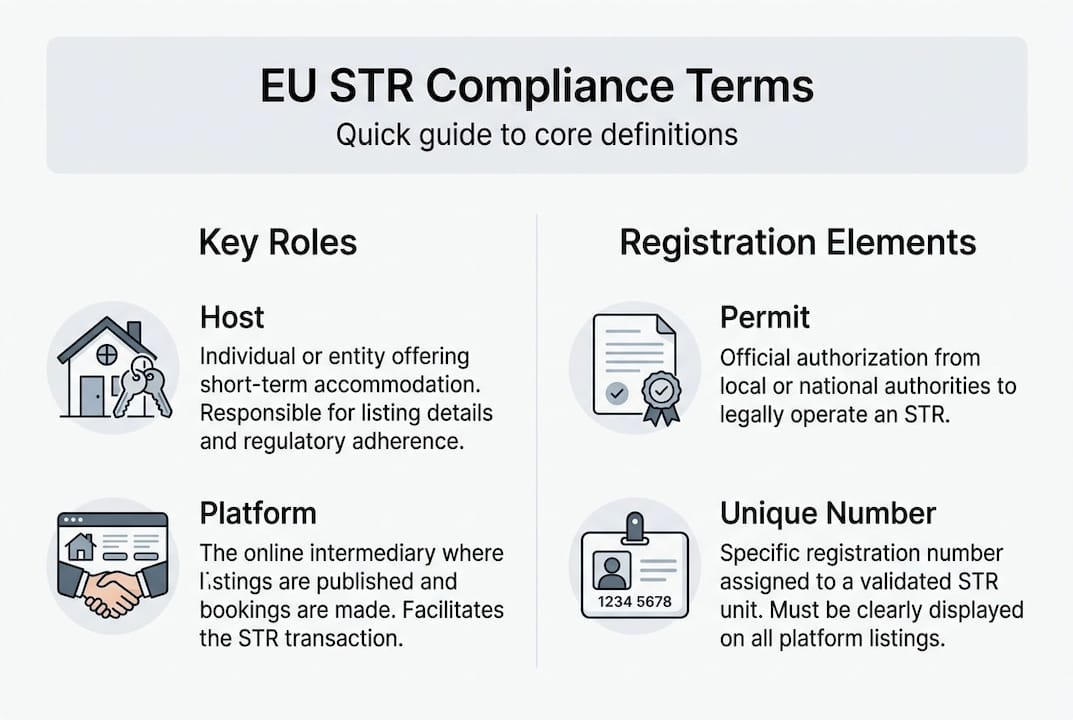
| Term | Definition | Example |
|---|---|---|
| Host | Any individual or entity offering a short-term rental property | A private landlord in Barcelona or a property management company in Paris |
| Platform | An online marketplace facilitating STR bookings | Airbnb, Booking.com, Vrbo |
| Listing | A property advertised on a platform for short-term rental | A single apartment unit with its own page and pricing |
| Unique registration number | An official ID issued by a local authority for a specific rental property | SIRET number in France; local licence number in Spain |
| Primary residence | The property where the host lives for the majority of the year | A host’s main home, rented out while they travel |
| Secondary residence | A property not used as the host’s main home | A holiday villa or investment flat |
| Night cap | The maximum number of nights a property can be rented per year | 90 nights in London; 120 nights in Paris and Brussels |
| Permit | An official authorisation to operate a short-term rental | Required for secondary residences in most EU cities |
| SDEP | Single Digital Entry Point: the EU portal through which platforms submit monthly rental data | Platforms report host identity, nights rented, and guest counts here |
Always check your UK guest registration requirements and your local authority’s portal for jurisdiction-specific variations. Some regions layer additional requirements on top of the EU baseline, particularly in tourist-heavy areas.
Pro Tip: If ownership of a property changes hands, the registration does not automatically transfer. In Spain and France, new owners must initiate a fresh registration process. Failing to do so means operating without a valid licence from day one of ownership.
Comparing short-term rental types and their compliance obligations
Not all short-term rentals are treated equally under the law. Key STR types759356_EN.pdf) include professional entire-property rentals, primary residence lets, and partial sharing arrangements, each carrying different regulatory expectations.

| Rental type | Permit required | Night cap | Community approval | Typical markets |
|---|---|---|---|---|
| Professional secondary property | Yes, in most EU cities | Varies; often unlimited with permit | Sometimes required | Spain, Portugal, Italy |
| Primary residence (entire) | Rarely, but registration needed | 90 to 120 nights typically | Not usually | UK, France, Belgium |
| Shared room (partial) | Rarely | Often uncapped | Not usually | All EU markets |
Night caps vary significantly: Paris and Brussels enforce a 120-night annual limit, London applies a 90-night cap, and secondary homes across Spain now require community approval or permits under the 2025 reforms. Spain’s post-2025 rules introduced a neighbour veto right, meaning residents in a building can collectively block new short-term rental licences.
If you are reclassifying a property, follow this checklist to stay on the right side of the law:
- Confirm the new property type with your local authority.
- Check whether your existing registration number remains valid or must be reissued.
- Update your listing on all platforms to reflect the correct classification.
- Verify whether a new permit or community consent is required.
- Update your guest registration records to match the new property status.
For further detail on government reporting for property owners, including what data must be submitted and when, consult your national authority’s guidance alongside the EU baseline.
Guest registration processes and real-world pitfalls
Guest registration is where terminology meets daily operations. Getting it wrong is one of the most common and costly mistakes short-term rental operators make.
Platforms must collect property data, display registration numbers, and share monthly rental activity including nights rented, guest counts, and host identity via the SDEP. This monthly reporting cycle is automatic on the platform side, but only if your listing data is accurate and complete.
Required guest data typically includes:
- Full name and identity document number (passport or national ID)
- Country of residence and nationality
- Arrival and departure dates
- Number of rental nights
- Your property’s unique registration number
Common errors that trigger compliance failures include:
- Out-of-date registration numbers listed on platforms after a renewal or ownership change
- Platform listing mismatches where the address or property type does not match official records
- Skipped data fields during guest check-in, leaving identity records incomplete
- Late updates when local rules change mid-season and operators do not adjust their processes
Pro Tip: Multi-property operators must treat each unit as a separate compliance entity. A valid registration for one flat does not cover another in the same building. Keep a compliance tracker for every unit, and synchronise data updates across all platforms whenever any detail changes. Tools that support automating booking compliance can significantly reduce the manual effort involved.
Understanding enforcement and your competitive advantage
Enforcement under the new EU framework is faster and more automated than anything the short-term rental sector has seen before.
“Digital platforms are required to delist non-compliant properties within 48 to 10 hours by law, making enforcement immediate and highly visible.”
The consequences of non-compliance are not theoretical. They are operational and financial:
- Immediate delisting from all major booking platforms
- Fines issued by local or national authorities
- Blocked guest bookings during any active investigation
- Loss of guest trust and negative reviews from disrupted stays
- Difficulty reapplying for registration after a compliance breach
However, there is a positive side to this enforcement environment. Operators who maintain clean, verified listings gain a real competitive edge. Platforms actively prioritise compliant listings in search results, and guests increasingly look for properties displaying valid registration numbers as a trust signal.
Local authorities still retain control over specific rules, such as night caps and permit conditions. But the harmonised EU definitions make it far simpler to expand operations across borders, because the core terminology and reporting structure are consistent. Good booking data management and the right compliance tools for property managers are now essential infrastructure, not optional extras.
Why terminology is your hidden edge in short-term rentals
Most operators approach compliance as a cost. They see registration forms, permit fees, and data reporting as friction that slows them down. That framing is understandable, but it is also the reason many operators are losing ground to those who think differently.
Mastering property management language is not just about avoiding fines. It is about understanding the rules well enough to use them strategically. Compliant operators with verified listings are being rewarded with higher visibility, stronger guest trust, and access to markets that are increasingly closing to unregistered properties.
The EU’s harmonised framework is actually an opportunity for operators who take the time to understand it. Cross-border expansion becomes more achievable when the compliance language is consistent. Guests feel more confident booking verified properties. And as enforcement tightens, the gap between compliant and non-compliant operators will only widen. The operators who win the next phase of European short-term rentals will be those who treat terminology not as bureaucracy, but as a competitive toolkit.
Streamline compliance with expert tools
Understanding compliance terminology is the first step. Putting it into practice efficiently is where the real work begins.
GuestAdmin.io automates the compliance workload for property owners and managers across Europe, from capturing accurate guest data to submitting reports to the relevant authorities. No more juggling portals, spreadsheets, and paperwork. Whether you need to understand rental compliance in full, get clarity on government reporting for rentals, or access practical compliance tips for managers, GuestAdmin.io gives you the tools and guidance to stay compliant, stay listed, and stay ahead.
Frequently asked questions
What is a unique registration number and how do I get one?
A unique registration number is an official EU-accepted identifier for your rental property. You obtain it through your local authority’s registration portal if your area requires registration under EU Regulation 2024/1028. Hosts must display759356_EN.pdf) this number on all platform listings, and platforms are legally required to verify its validity.
What happens if I do not comply with short-term rental registration?
Your listing can be removed from all major platforms within hours and you may face fines or local enforcement action. Platforms must delist non-compliant properties rapidly by law, making the consequences immediate rather than gradual.
Do all property types need to be registered for short-term rental?
Most do, but the specific requirements depend on whether your property is a primary or secondary residence and where it is located. Primary and secondary residences are regulated differently across the EU, with distinct caps and permit systems applying to each type.
What is the SDEP and do I have to submit data there myself?
The SDEP (Single Digital Entry Point) is the EU portal through which booking platforms submit your monthly rental activity data. Platforms submit activity data including host identity, property details, nights rented, and guest counts directly to the SDEP. Hosts do not submit data there personally.
How can I simplify guest registration and compliance?
Using dedicated compliance tools and automated guest registration services removes the manual burden and reduces the risk of errors. Platforms such as GuestAdmin.io are built specifically to handle these processes efficiently, keeping all your data accurate and submissions timely.
8 Comments
Understanding booking data regulations for secure rentals
[…] SDEPs, and property managers need to ensure their own records align. Familiarising yourself with EU compliance terminology is a good starting […]
Short-term rental registration guide for Europe 2026
[…] a clearer picture of EU compliance terminology and how specific terms apply to your situation, it is worth reviewing the official definitions […]
Short-term rental tips: streamline compliance and boost bookings
[…] yourself with EU compliance terminology is an important first step, especially as member states interpret and enforce the regulation […]
Real examples of property compliance for short-term rentals
[…] a clear understanding of the terminology behind these rules, review the definitions for common rules and the broader compliance terminology used across European […]
GDPR compliance guide for short-term rental managers
[…] Short-term rental terminology: your guide to EU compliance […]
Master data privacy in hospitality for smooth EU compliance
[…] the EU compliance terminology guide is a practical starting point for ensuring you understand what you are accountable for, in plain […]
How AI streamlines compliance for short-term rentals
[…] EU compliance terminology is the first practical step for anyone new to these regulations. The regulation introduces several […]
Industry terminology in guest management explained
[…] will not match the booking reference, which can trigger a rejection from the authority portal. The short-term rental terminology guide from GuestAdmin covers how these distinctions play out specifically in European regulatory […]