

TL;DR:
- European short-term rental reporting mandates timely guest data submission to authorities.
- EU Regulation 2024/1028 introduces standardized digital registration and monthly platform reporting by 2026.
- Automated compliance systems are essential to meet deadlines, reduce errors, and future-proof operations.
Failing to file a single guest report on time can cost you hundreds of euros in fines, trigger suspension from booking platforms, or in some European countries, lead to criminal penalties. For property owners and managers operating in the short-term rental market, government reporting is not an optional administrative task. It is a legal obligation tied directly to guest safety, local taxation, and tourism oversight. This guide explains exactly what government reporting requires, how deadlines and processes differ across Europe, what the new EU-wide regulation means for your operation, and how you can build a reliable compliance workflow without drowning in paperwork.
Table of Contents
- What is government reporting in short-term rentals?
- Country-by-country deadlines and processes
- EU Regulation 2024/1028: How European rules change the game
- Practical steps for effortless compliance in 2026
- Why tech-first compliance is now essential: Our perspective
- Save time and stay compliant with automated guest registration
- Frequently asked questions
Key Takeaways
| Point | Details |
|---|---|
| Non-compliance is costly | Missing reporting deadlines can lead to severe fines or delisting by rental platforms. |
| Deadlines vary by country | Italy, Spain, France, and Portugal all enforce different timelines and platforms for submission. |
| EU rules standardise processes | From 2026, Regulation 2024/1028 will unify data requirements and introduce digital reporting for all hosts. |
| Automation reduces errors | Using tech tools can cut compliance work by up to 30% and minimise risky mistakes. |
| Spain adds annual filing | Besides immediate guest reports, Spain requires a February summary from all rentals. |
What is government reporting in short-term rentals?
Government reporting in short-term rentals refers to the legal requirement for property owners and managers to collect specific guest identity data and submit it to the relevant national or local authorities. This is not a voluntary measure. Across Europe, government reporting obligations are enforced by law, and failure to comply carries real consequences.
To define government reporting clearly: it is the structured process by which a host or property manager captures, verifies, and transmits guest data to a designated government portal within a set timeframe after check-in. As noted in guidance for property owners, guest identity data must be collected and submitted promptly and accurately, enforced by law.
The data typically required includes:
- Full legal name of each guest
- Date of birth
- Nationality and country of residence
- Passport or national ID number
- Dates of arrival and departure
- Property address
Authorities use this data for several purposes. Public safety agencies rely on it to track population movement and identify persons of interest. Tax authorities use it to verify that rental income is being declared correctly. Local tourism bodies use aggregated data to manage visitor flows and allocate resources.
Compliance is not just about avoiding fines. It is about operating a legitimate, trusted business in a regulated market.
The consequences of non-compliance vary by country but are consistently serious. Fines can range from a few hundred euros to several thousand per infraction. Repeated violations may lead to your property being delisted from major booking platforms such as Airbnb or Booking.com. In certain jurisdictions, such as Italy and Spain, persistent non-compliance can result in criminal liability for the property owner or manager.
Understanding rental compliance in Europe means recognising that the rules are not uniform. Each country has its own portal, its own deadline, and its own data requirements. What counts as timely in France may be far too late in Italy. This variation is precisely what makes a structured approach so important.
Country-by-country deadlines and processes
But what does compliance look like in practice? Here is how deadlines and requirements compare across Europe.
Understanding guest registration differences between countries is essential for any manager operating across borders. The table below summarises the key requirements in four major European markets.
| Country | Reporting deadline | Platform used | Key data required | Penalty for non-compliance |
|---|---|---|---|---|
| Italy | Within 6 hours of check-in | Alloggiati Web (Police) | Full name, DOB, nationality, ID number | Fines up to €1,032; criminal liability |
| Spain | Within 24 hours of check-in | SES.HOSPEDAJES | Full name, DOB, nationality, ID number | Fines up to €30,000 in some regions |
| France | Before arrival | Préfecture portal | Name, nationality, stay dates | Fines and potential platform suspension |
| Portugal | Within 24 hours of check-in | SEF/AIMA portal | Full name, DOB, nationality, ID number | Fines and licence suspension |
As submission deadlines vary significantly: Italy requires reporting within 6 hours, Spain within 24 hours plus annual reporting, France before arrival, and Portugal within 24 hours.

Spain stands out for having a dual reporting obligation. Beyond the standard per-guest check-in report, Spain’s annual obligation requires hosts to submit an anonymised annual report each February via the Land Registry. This report covers total activity for the previous year, including dates of occupation, number of guests per stay, and the purpose of each visit. It is a unique requirement that catches many operators off guard.
For managers overseeing property owner responsibilities across multiple countries, the variation in portals, formats, and deadlines creates significant administrative pressure. Missing one country’s deadline while managing another’s annual report is a realistic risk without a structured system.
Pro Tip: Set up automated calendar reminders for each country’s reporting deadlines, and evaluate software that integrates directly with national portals. For multi-country portfolios, a single platform that handles all submissions in one place is far more reliable than managing separate logins and spreadsheets.
EU Regulation 2024/1028: How European rules change the game
Beyond differing national rules, one crucial regulation soon changes everything for European rentals.
EU Regulation 2024/1028759356_EN.pdf), effective 20 May 2026, harmonises data reporting and introduces digital requirements for all rental platforms operating across EU member states. This is the most significant shift in short-term rental regulation in years, and it affects every host and manager operating in Europe.
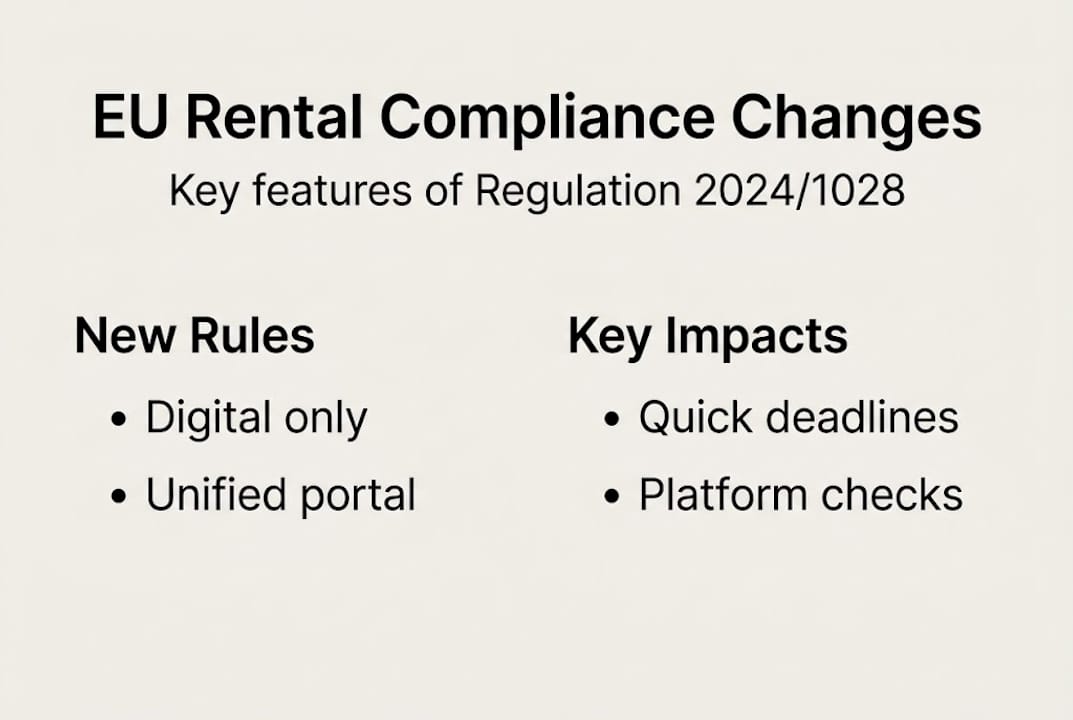
Here is what the regulation introduces:
| Element | What it means for hosts |
|---|---|
| Registration numbers | Every short-term rental unit must obtain a unique registration number from national authorities |
| Single Digital Entry Points (SDEP) | Each member state must create a centralised digital portal for registration and reporting |
| Platform responsibilities | OTAs and booking platforms must verify registration numbers and share data with authorities |
| Monthly data submissions | Platforms must report activity data monthly, including address, host ID, nights booked, and guest counts |
For hosts and managers, the practical steps under the new regime are as follows:
- Register each property with your national authority to obtain a unique registration number
- Display that registration number on all listings across booking platforms
- Ensure your guest data collection process captures all required fields before check-in
- Confirm that your booking platform is compliant and submitting monthly activity data on your behalf
- Keep records of all submissions for a minimum of two years for audit purposes
The regulation also places new duties on platforms. If a listing lacks a valid registration number, platforms are required to remove it. This means that non-compliance is no longer just a risk of a fine. It is a risk of losing your listing entirely.
Familiarise yourself with 2026 European regulations now, before enforcement begins. Building automated compliance workflows into your operation ahead of the deadline will save significant time and stress.
Practical steps for effortless compliance in 2026
With regulations converging and platforms enforcing new checks, here is how you can stay a step ahead.
The most common reason hosts fall foul of reporting rules is not ignorance. It is poor process. A guest checks in late, data gets recorded on a sticky note, and the submission window closes before anyone notices. As guidance for property owners confirms, missing deadlines can cause platform suspension or fines, and automation with templates is strongly recommended.
Follow this checklist to build a reliable compliance workflow:
- Set up a digital guest registration form that captures all required fields at the point of booking or check-in
- Integrate your property management system with national reporting portals where possible
- Configure automated deadline alerts for each country you operate in, based on check-in time
- Assign clear responsibility within your team for reviewing and submitting reports
- Archive all submissions securely, with timestamps, for a minimum of two years
- Audit your process quarterly to catch any gaps before they become fines
Automation makes a measurable difference. Platforms that automate reporting processes can reduce compliance workload by up to 30%, freeing your team to focus on guest experience rather than form-filling.
For those managing multiple properties, the ability to streamline guest data collection across a portfolio from a single dashboard is not a luxury. It is a practical necessity. Manual processes simply do not scale.
Pro Tip: When evaluating compliance software, prioritise solutions that sync directly with national portals, support multi-country reporting, and provide a clear audit trail. A system that sends you a confirmation receipt for every submission is worth its weight in avoided fines.
Statistic to note: Automation can cut compliance work by up to 30%, meaning a manager handling 20 properties could reclaim several hours each week that would otherwise be spent on manual data entry and submission.
Why tech-first compliance is now essential: Our perspective
Stepping back, what is the real lesson for European hosts and managers?
Manual compliance was already fragile before 2026. Now, with EU Regulation 2024/1028 adding registration numbers, digital portals, and platform-level enforcement, it is simply not viable for most operations. The hosts who will struggle most are not those who misunderstand the rules. They are the ones who understand them perfectly but rely on spreadsheets and memory to stay on top of them.
Most fines do not result from wilful non-compliance. They result from a guest checking in at midnight, a team member forgetting to log the data, or a portal going down at the wrong moment. These are process failures, not knowledge failures. Automation for compliance eliminates the majority of these risks by removing the human dependency from time-sensitive tasks.
Adopting a tech-first approach is also a form of future-proofing. Regulations will continue to evolve. Countries will add requirements, tighten deadlines, and introduce new data fields. A platform that updates automatically to reflect regulatory changes protects you from surprises in a way that a manually maintained spreadsheet never can. Moving early is not just efficient. It is genuinely protective.
Save time and stay compliant with automated guest registration
Ready to make compliance straightforward in your operation?
GuestAdmin is built specifically for property owners and managers who need to meet government reporting requirements across Europe without the administrative burden. No more juggling separate portals, chasing guests for ID documents, or worrying about missed deadlines.
With tools for multi-property reporting, automated deadline reminders, and secure digital submissions, GuestAdmin turns a complex obligation into a managed, repeatable process. Explore our guide to compliance made simple or learn more about our automated registration solutions to see how straightforward compliant guest management can be.
Frequently asked questions
What guest data do I need to report for rental compliance?
You must collect and report each guest’s full name, date of birth, nationality, ID number, and booking dates via your national portal. Guest identity data is required in all European reporting regimes without exception.
What happens if I file guest reports late or incorrectly?
Late or inaccurate reporting can result in fines, property delisting from platforms, or legal action depending on your country. Non-compliance penalties include severe fines and potential delisting across European jurisdictions.
How does EU Regulation 2024/1028 affect rental compliance?
This regulation standardises how short-term rentals must be registered and reported across the EU, requiring digital registration numbers and regular data sharing by hosts and platforms. New EU rules759356_EN.pdf) harmonise reporting procedures and demand monthly platform data submissions from May 2026.
Is automation necessary for staying compliant in 2026?
While not legally mandatory, automation is strongly recommended to ensure deadlines are met and errors are avoided. Automation reduces compliance workload by up to 30% and significantly lowers the risk of costly mistakes.
What is unique about guest reporting in Spain?
Spain requires both prompt per-guest check-in reporting within 24 hours and a separate annual anonymised report submitted each February covering total property activity for the previous year.
Recommended
- What is government reporting for rentals: a guide for property owners
- Why choose SaaS for rentals: Effortless compliance & automation
- Top tips for short-term rental managers to stay compliant
- Short-term rental compliance explained: avoid fines and save time
- P35 Reports – What are they and when do I need one?
One Comment
GDPR for short-term rentals: Guest data compliance guide
[…] for short-term rental operators provides a structured way to audit your current practices, and our compliance guide makes the process far more […]