

TL;DR:
- EU regulation requires hosts to register properties, display registration numbers, and submit data monthly.
- Local rules vary significantly; some cities have strict caps, bans, and hefty fines for non-compliance.
- Automating structures and centralized record-keeping turn compliance into a business advantage.
Short-term rental regulations across Europe have tightened considerably, and the numbers are stark. Enforcement of local rules has reduced STR supply by 18–30% in major EU cities, leaving many property owners scrambling to understand what they can and cannot do. Layers of city permits, national caps, and an incoming EU-wide data framework mean that staying compliant now requires genuine effort and organisation. This guide cuts through the confusion, explaining the key rules at every level, the most common mistakes operators make, and the practical steps you can take to keep your properties legal and profitable in 2026.
Table of Contents
- Understanding the new EU framework for short-term rentals
- Key city and country rules: A comparative overview
- Common pitfalls and enforcement: What to watch out for
- Steps to achieve sustainable compliance and operational efficiency
- Critical nuances: Primary vs secondary homes, edge rules, and tax
- Why compliance is a competitive advantage, not just a burden
- How to simplify your rental compliance journey
- Frequently asked questions
Key Takeaways
| Point | Details |
|---|---|
| EU-wide standards | A new EU framework mandates registration, platform data sharing, and standard compliance steps from May 2026. |
| Local rules dominate | City or regional laws determine legality, day caps, fines, neighbour approvals, and tax obligations. |
| Guest data and automation | Guest ID reporting and registration display are critical; automation reduces risk of error and missed deadlines. |
| Primary vs secondary nuances | Secondary homes often require permits or face bans, while primary residences usually have day limits and simpler processes. |
| Compliance as advantage | Proper, tech-driven compliance helps you operate legally, avoid fines, and build a more resilient rental business. |
Understanding the new EU framework for short-term rentals
Now that you understand the regulatory pressures, let’s look at the framework shaping every region in Europe.
Regulation (EU) 2024/1028, which takes full effect in May 2026, establishes a unified data layer across all EU member states. It does not replace local laws. Instead, it creates consistent standards for how host and booking data must be collected, verified, and shared. Platforms, property owners, and property management companies (PMCs) all carry obligations under this framework.
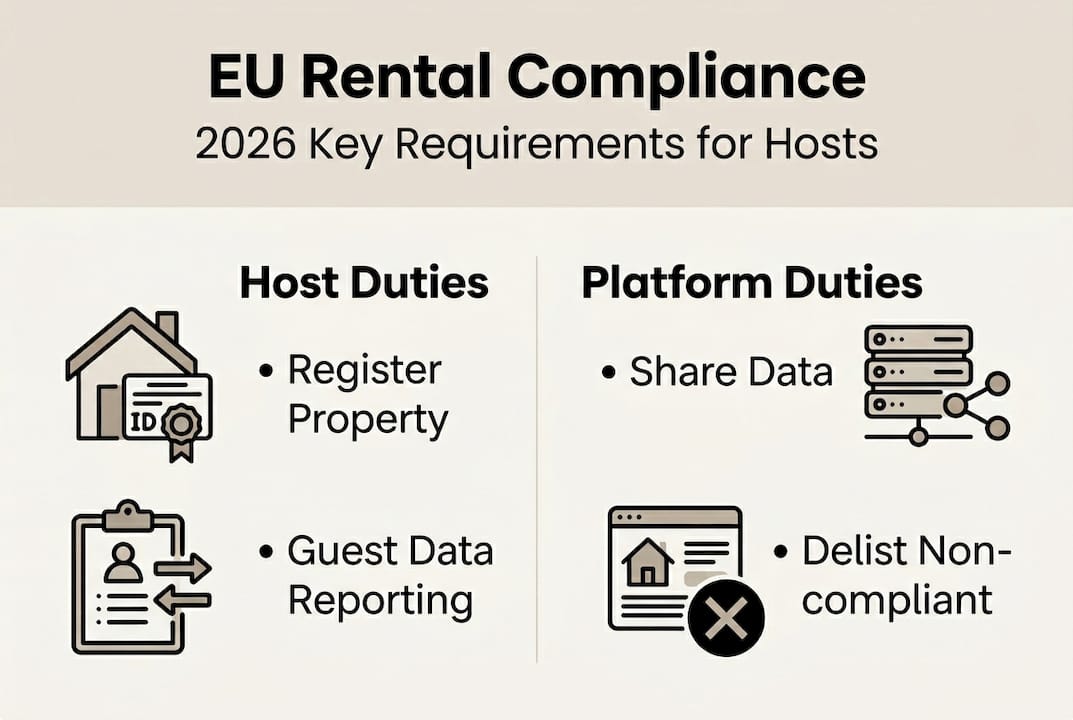
The core mechanics work as follows. Every host must obtain a registration number from their local authority. Platforms are then required to collect and share host and booking data and display that registration number on every listing. The data shared includes the host’s identity, the property address, the registration number, the number of nights let, and the number of guests per stay. This information is submitted monthly to a Single Digital Entry Point (SDEP), which is the centralised EU portal that national authorities use to access and monitor activity.
If a listing is found to be non-compliant, authorities can instruct platforms to remove it. Platforms must act on those instructions rapidly. The SDEP mechanism also allows cross-border data sharing, so regulators in one country can flag issues originating in another.
What the EU regulation does not do is tell you how many nights you can rent, whether you need a permit, or what your tourist tax rate is. Those decisions remain entirely with city and national governments. You can read more in our EU compliance guide and review your owner responsibilities before diving into local rules.
Pro Tip: Always map your local city and national rules first, then layer EU-level data and registration requirements on top. Reversing that order leads to gaps.
| EU requirement | Who is responsible | Deadline or frequency |
|---|---|---|
| Obtain registration number | Property owner / PMC | Before listing |
| Display registration number | Platform | On all listings |
| Collect host and booking data | Platform | Per booking |
| Submit data to SDEP | Platform | Monthly |
| Act on removal orders | Platform | Within hours |
For a broader compliance strategy overview, it is worth reviewing how the regulation interacts with your specific market.
Key city and country rules: A comparative overview
While the EU sets a compliance base, legal specifics can change dramatically from city to city.
Local rules are where most operators feel the real pressure. Each city sets its own permit requirements, day caps, and fine structures. Understanding these differences is essential before you list a single property.

| City | Primary home cap | Secondary home | Permit required | Max fine |
|---|---|---|---|---|
| Paris | 120 nights/year | Generally banned | Yes | €10,000–€50,000 |
| Amsterdam | 30 nights/year | Banned in most areas | Yes | Up to €10,000+ |
| Berlin | Primary only | Banned without exemption | Yes | Up to €500,000 |
| Vienna | 90 nights/year | Restricted | Yes | €1,500–€10,000 |
| Barcelona | New licences frozen | Secondary banned | Yes | Up to €600,000 |
The distinction between a primary residence and a secondary home is critical. In Paris, you may rent your primary home for up to 120 nights per year without a commercial permit. Rent a secondary property without authorisation and you face fines of €10,000 to €50,000. Amsterdam has reduced its cap to just 30 nights annually and bans short-term letting of secondary homes in most districts entirely.
Barcelona is arguably the most restrictive major destination right now. The city froze the issuance of new tourist flat licences, meaning that if you do not already hold one, you cannot legally operate a new short-term rental there. Berlin similarly restricts letting to primary residences only, with secondary home rentals banned unless a specific exemption applies.
Enforcement methods vary too. Cities use algorithmic monitoring of OTA platforms, anonymous tip-off systems, and direct inspections. Advertising a property without a valid registration number is itself an offence in most jurisdictions. Use our local compliance checklist to map your obligations city by city, and refer to the full legal overview for detailed country-level guidance.
Common pitfalls and enforcement: What to watch out for
Understanding the law is key, but in practice these errors disqualify many properties each year.
Even experienced operators make avoidable mistakes. Here are the five most common:
- Exceeding local night caps. Platforms now automatically block bookings once a cap is reached, but manual bookings or off-platform arrangements can still push you over the limit.
- Missing or expired registration numbers. Registration must be renewed in many cities. An expired number is treated the same as no number at all.
- Outdated guest records. Failing to update guest ID data in real time creates gaps that authorities can identify during audits.
- Not displaying the registration number. Every listing, on every platform, must show the valid registration number. Omitting it is an offence in its own right.
- Contracts that do not reflect current rules. Rental agreements must be updated whenever local regulations change, including clauses on permitted nights and guest reporting.
On enforcement speed: platforms must comply with removal orders within 10 hours of an authority request for serious violations. That means a non-compliant listing can disappear from Airbnb or Booking.com with almost no warning, taking your revenue with it.
“Tenant neighbours can now veto 60–100% of new rental licences in some regions, giving communities direct power to limit short-term letting in residential buildings.”
Guest ID reporting is another area where errors accumulate. Most EU jurisdictions require guest passport or ID data to be submitted to local police or immigration authorities within 24 hours of check-in. Manual processes are prone to delay. Automated guest management tools reduce this risk significantly by capturing and submitting data as part of the check-in flow. You can also explore property management SaaS options designed specifically for this purpose.
Pro Tip: Run a data audit at least quarterly. Pull internal system reports and cross-check registration numbers, night counts, and guest records against your actual bookings. Gaps are far easier to fix before an inspector arrives.
For further compliance tips relevant to active operators, reviewing your processes regularly pays dividends.
Steps to achieve sustainable compliance and operational efficiency
With the traps clear, here’s a streamlined path to turn compliance from a headache into routine.
A structured methodology makes compliance manageable, even across multiple properties. Follow these steps:
- Map your regulations. Identify every rule that applies: city cap, national permit, EU data requirement, tourist tax obligation.
- Obtain and display registration numbers. Apply for registration in each jurisdiction and ensure every listing shows the correct number before going live.
- Audit your nights. Set up calendar alerts or automated counters so you know exactly how many nights each property has been let in the current year.
- Automate guest reporting. Use integrated tools to capture ID data at check-in and submit it to authorities within the required window.
- Keep contracts updated. Review rental agreements at least twice a year and after any regulatory change.
- Monitor SDEP submissions. Confirm that your platform or PMS is submitting the correct data to the SDEP each month.
Professional operators thrive by combining technology with regular audits and clear internal processes. The tools that make the biggest difference include:
- PMS platforms with built-in OTA integration and night-count tracking
- Automated guest registration and ID verification tools
- Compliance dashboards showing registration status across all properties
- Calendar cap tools that block bookings automatically at the permitted limit
For multi-property portfolios, centralised record-keeping is essential. A single source of truth for registration numbers, guest records, and submission logs means you can respond to an authority query within hours rather than days. Explore automation and compliance strategies and review software for compliance to find the right tools for your portfolio size.
Pro Tip: Centralise all compliance records in one system. Random authority checks are becoming more frequent, and having everything in one place protects you immediately.
For guidance on government reporting requirements, a dedicated walkthrough explains exactly what data must go where and when.
Critical nuances: Primary vs secondary homes, edge rules, and tax
Digging deeper, these advanced issues create further complexity for active operators.
The primary versus secondary home distinction is not just about night caps. In several countries, secondary home rentals often require permits or are outright banned, and tourist tax obligations differ accordingly. Tourist taxes typically range from €1 to €5 per guest per night, though rates vary by city and property category. Flat tax rates on rental income also differ: Portugal applies a 25% flat rate for non-residents, Italy offers a 21% flat tax on short-term income, and France uses a micro-BIC regime with a 50% allowance.
Key nuances to keep in mind:
- Neighbour approval requirements. In some Spanish and French cities, residents in the same building can collectively block a new rental licence. Approval thresholds range from 60% to 100% of co-owners.
- Zoning bans in historic centres. Cities including Florence, Venice, and parts of Lisbon restrict or ban new short-term rentals in designated heritage zones entirely.
- Licence expiry. Many permits must be renewed annually. Letting on an expired licence carries the same penalties as operating without one.
- Minimum stay requirements. Some jurisdictions impose minimum stays of two or more nights to discourage party bookings, which affects your listing settings.
- Data parity obligations. Your PMS must deliver identical booking data to both OTAs and authorities. Discrepancies between what platforms report and what you submit can trigger audits.
For practical automation examples that address these nuances, and for the complete picture, the full 2026 compliance guide covers country-specific tax and permit rules in detail.
Why compliance is a competitive advantage, not just a burden
Most operators view regulation as a cost. We think that framing is worth challenging.
When cities tighten rules and enforcement becomes consistent, a predictable thing happens: the least-prepared operators exit the market. Supply shrinks. The properties that remain, operated by owners who have invested in proper registration, accurate reporting, and reliable systems, face less competition and can command stronger rates. Regulation, in this sense, rewards professionalism.
Operators who centralise and automate their compliance tasks also report something less obvious: they spend less time on administration and more time improving the guest experience. No more juggling portals, spreadsheets, and paperwork. When your systems handle night-count tracking, guest ID submission, and SDEP data automatically, you recover hours every week.
The most profitable short-term rental operators we see are not those who try to work around the rules. They are the ones who treat regulation as structure, build their operations around it, and use hospitality compliance software to make that structure effortless. Predictable income, fewer late-night scrambles for paperwork, and a business that can scale without legal risk. That is the real return on compliance investment.
How to simplify your rental compliance journey
Ready to move from regulation overwhelm to operational simplicity? Here are resources to help.
GuestAdmin.io is built specifically for property owners and managers navigating the European short-term rental compliance landscape. From automated guest reporting to pre-built compliance checklists, the platform removes the manual effort from every regulatory requirement.

Explore our time-saving compliance tips to see how operators like you are cutting admin time significantly. Learn how automated guest registration works in practice, and download our property compliance checklist to audit your current setup against 2026 requirements. Whether you manage one property or one hundred, GuestAdmin.io gives you the tools to stay compliant, stay listed, and stay profitable.
Frequently asked questions
What are the minimum requirements to legally host short-term rentals in the EU from 2026?
You must obtain a local registration number, ensure guest reporting within 24 hours, and comply with any city or national permit and cap requirements. EU-wide data collection and registration are mandatory as of May 2026.
Do I need different registration numbers for each city or property?
Yes, each city typically issues a unique registration ID per property, and you must display it on all listings and platforms. Cities including Paris, Amsterdam, Berlin, and Vienna require unique numbers for every individual unit.
What are the main penalties for non-compliance?
Fines range from €1,500 to €50,000 or more per breach, and platforms can delist your property on very short notice. Paris fines reach €10,000–€50,000, with delisting possible within 10 to 48 hours of an authority order.
How do platforms like Airbnb or Booking.com help with compliance?
Platforms automatically block bookings once local night caps are reached, display registration numbers on listings, and share activity data with authorities monthly. They collect and display registration and booking data as part of their EU regulatory obligations.
Is guest ID reporting mandatory everywhere?
In over 70% of EU countries, guest ID or passport data must be reported to authorities within 24 hours of check-in. Always verify the specific requirement in your local jurisdiction, as deadlines and submission methods vary.
9 Comments
Why automate hotel compliance: Boost efficiency, cut risks
[…] the kind of operational credibility that regulators and guests increasingly expect. And with compliance regulations 2026 evolving rapidly, being audit-ready is no longer optional. It is a competitive […]
APIs in property tech: compliance and efficiency in 2026
[…] timeline creates genuine operational risk for managers with properties in multiple countries, as navigating EU rental regulations requires tracking different deadlines and technical standards […]
Essential types of rental compliance for short-term lets
[…] for short-term rentals is not one-size-fits-all. Local regulations dominate the types of rules you face, meaning a property manager in Lisbon operates under a very different […]
Streamline property admin: unlock efficiency for rental compliance
[…] us start with compliance. Failure to comply with EU regulations can result in substantial fines and legal complications. Across EU member states, short-term rental […]
Understanding booking data regulations for secure rentals
[…] the full 2026 rental rules guide to understand how these changes apply to your specific […]
Automate guest compliance and protect your rental business
[…] streamlining enforcement and making it far harder to operate outside the rules. If you are navigating 2026 EU rental rules for the first time, the volume of requirements can feel […]
How to Reserve Holiday Homes in Europe: Smart Tips – Wild Foodz by Hotel Entree Brugge
[…] space, since hosts who mention these details usually take child safety seriously. Also, check the rental regulations guide Europe before booking, as short-term rental rules vary significantly across countries and […]
Master data privacy in hospitality for smooth EU compliance
[…] 2026 to understand exactly what your registration record must include. For a broader overview of navigating 2026 regulations, it is worth reviewing the full scope of changes before your next audit […]
European rental regulation guide for property owners
[…] Authorities no longer need a complaint. They have the data. The property managers who treat STR compliance as a continuous process rather than a periodic task will find that the new framework actually […]