

Short-term rentals now account for nearly one-quarter of all tourist accommodation supply across the European Union. Many property owners mistakenly believe a simple listing agreement suffices for legal operation. Starting 2026, EU-wide regulations alongside strict local rules demand mandatory property registration, real-time guest data reporting, and comprehensive safety compliance before you can legally rent.
Table of Contents
- EU-Wide Regulatory Framework For Property Owner Responsibilities
- Local Variations In Compliance And Operational Rules
- Guest Data Collection And Reporting Mechanisms
- Safety And Quality Compliance Responsibilities
- Leveraging Automation To Simplify Compliance
- Consequences Of Non-Compliance And Penalties
- Conclusion And Practical Steps For Property Owners
- Streamline Your Short-Term Rental Compliance With GuestAdmin.io
- Frequently Asked Questions
Key takeaways
| Point | Details |
|---|---|
| EU Regulation 2024/1028 mandates registration | All short-term rental properties must register and obtain unique identification numbers before accepting bookings. |
| Guest data submission within 24 hours | Property owners must digitally report guest identity and booking details within 24 hours of check-in. |
| Local rules add complexity | Major cities impose night caps, safety inspections, and licensing fees beyond EU requirements. |
| Safety certifications are mandatory | Fire, gas, and electrical compliance checks must be current for legal rental operation. |
| Automation reduces compliance risks | Technology platforms streamline guest registration and reporting, preventing costly penalties. |
EU-wide regulatory framework for property owner responsibilities
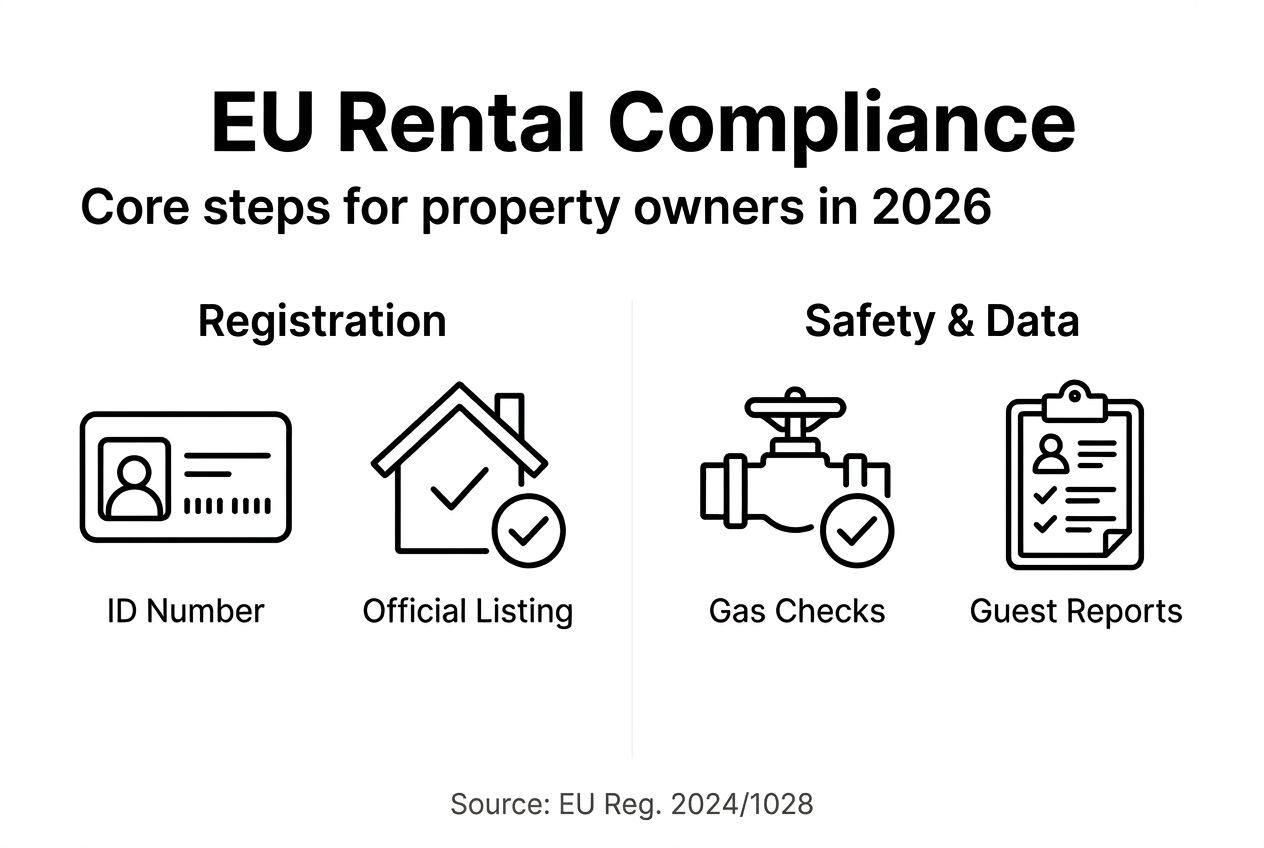
The European Union introduced Regulation 2024/1028 mandating unique property identification numbers and 24-hour guest data submission across all 27 member states. This framework establishes baseline compliance obligations every property owner must meet regardless of location. Understanding these core requirements helps you build a solid foundation before tackling local variations.
Your first responsibility involves registering each rental property with designated national or local authorities before creating any online listing. Registration requires displaying your unique number on all booking platforms to ensure transparency. Without this identifier, major platforms cannot legally host your property.
Submitting guest data digitally within 24 hours of check-in represents your second critical obligation. This tight deadline applies universally across Europe, requiring efficient systems to capture and transmit information promptly. The full text of EU Regulation 2024/1028 outlines specific data fields and submission protocols you must follow.
Key EU-wide obligations include:
- Obtaining a unique property identification number before listing
- Displaying registration numbers prominently on all booking platforms
- Collecting complete guest identity and booking information at check-in
- Submitting digital reports to authorities within 24 hours
- Maintaining accurate records for regulatory audits
Pro Tip: Complete your property registration at least two months before your intended listing date to account for processing delays and potential documentation requests from authorities.
These EU-wide rules create a consistent baseline, but individual jurisdictions layer additional requirements that significantly impact your operations. Property owners managing rentals across multiple cities must navigate this complex regulatory patchwork carefully. Similar frameworks exist in other markets, as seen with UK short-term rental laws introducing comparable registration systems.
Local variations in compliance and operational rules
Beyond EU-wide mandates, individual cities and countries enforce additional restrictions that create a complex compliance landscape. Amsterdam, Barcelona, London, and Paris impose night caps ranging from 30 to 90 days annually, require safety inspections, and charge licensing fees. These local variations demand careful research before you start operations.
Night caps limit how many days per year you can rent your property on short-term contracts. Some cities permit just 30 nights annually, whilst others allow up to 90 nights. Exceeding these limits triggers immediate penalties and potential delisting from booking platforms. Tracking your rental nights accurately becomes essential for compliance.
| City | Annual Night Cap | Safety Inspection | Licensing Fee |
|---|---|---|---|
| Amsterdam | 30 nights | Mandatory | €150-€300 |
| Barcelona | 31 nights | Mandatory | €200-€400 |
| London | 90 nights | Required | £100-£200 |
| Paris | 120 nights | Mandatory | €250-€500 |
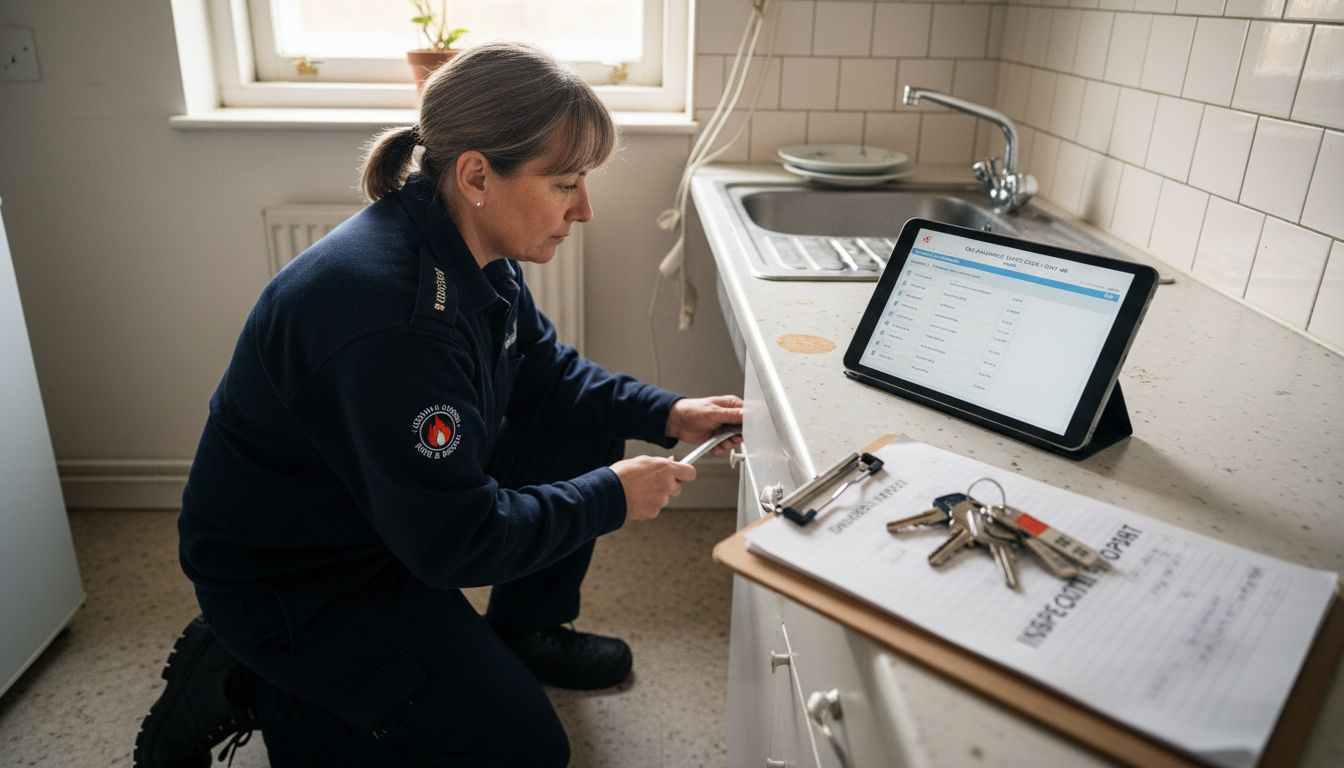
Local safety inspections verify fire alarms, gas systems, and electrical installations meet current standards before authorities issue operating permits. Some jurisdictions require annual renewals, whilst others mandate inspections every two years. Failing these checks blocks your registration entirely.
Licensing fees vary dramatically by location, with some cities charging modest annual amounts whilst others impose substantial upfront costs. Budget for these expenses when calculating your rental income projections. Many jurisdictions also require proof of property ownership or landlord consent letters if you lease the space.
Additional local requirements you may encounter:
- Proof of residential address for property owners
- Minimum property size or room count thresholds
- Mandatory insurance coverage at specified limits
- Neighbourhood consent procedures in residential zones
- Tax registration with local revenue authorities
Pro Tip: Subscribe to local authority newsletters and regulatory update services to receive immediate notification of rule changes that affect your rental operations.
Navigating these variations requires ongoing vigilance as cities frequently adjust their rules. Understanding UK short-term rental licensing requirements demonstrates how rapidly local frameworks evolve. Researching local short-term rental rules specific to your operating jurisdiction prevents costly surprises.
Guest data collection and reporting mechanisms
Collecting comprehensive guest information and submitting it within strict deadlines forms the operational core of your compliance responsibilities. Hosts must submit detailed guest data digitally within 24 hours of arrival, including identity verification and complete booking details. This rapid turnaround demands efficient systems to avoid penalties.
The 24-hour submission deadline starts from the moment your guest checks in, not from booking confirmation or arrival day. You cannot extend this window under any circumstances. Late submissions trigger automatic fines in most jurisdictions, with penalties increasing for repeat violations.
Required guest data typically includes:
- Full legal name matching government-issued identification
- Nationality and passport or national ID number
- Date of birth and residential address
- Check-in and check-out dates
- Number of guests in the booking party
- Contact information including email and phone number
Digital portals provided by local authorities serve as the primary submission channels for guest data. These secure platforms require authentication and encrypt sensitive personal information during transmission. Most systems provide confirmation receipts you should archive as proof of compliance.
Accuracy matters as much as timeliness when reporting guest information. Submitting incorrect data, even unintentionally, can trigger the same penalties as late filing. Double-checking entries before transmission saves you from enforcement actions. Some jurisdictions audit random submissions to verify data quality.
Pro Tip: Implement automated data capture tools that extract information directly from guest identification documents to eliminate manual entry errors and meet tight reporting deadlines consistently.
Manual data collection and entry creates significant error risks, especially for property owners managing multiple listings with frequent turnover. Technology solutions automate booking compliance by capturing guest information at reservation and transmitting it automatically. Understanding guest data reporting rules helps you design efficient workflows.
Safety and quality compliance responsibilities
Maintaining current safety certifications and meeting minimum quality standards represents your third major responsibility category. Fire, gas, and electrical safety inspections are mandatory for short-term rentals, alongside cleanliness and habitability benchmarks. Authorities will not register properties lacking these certifications.
Fire safety requirements typically include:
- Working smoke detectors in all bedrooms and common areas
- Fire extinguishers accessible on each floor
- Clear evacuation routes and posted emergency procedures
- Carbon monoxide detectors near sleeping areas
- Fire blankets in kitchens
Gas safety inspections verify that all gas appliances, pipework, and ventilation systems operate safely without leaks. Qualified engineers must perform these checks annually in most jurisdictions. You must provide guests with current gas safety certificates upon request.
Electrical system inspections examine wiring, outlets, circuit breakers, and appliances for hazards. Many cities require full electrical safety certificates valid for three to five years. Portable appliance testing for items like kettles and hairdryers may be mandatory.
Minimum quality standards address cleanliness, furniture condition, adequate heating and cooling, functional plumbing, and basic amenities. Some jurisdictions specify requirements like mattress quality, towel provisions, or kitchen equipment. Regular property maintenance ensures you consistently meet these benchmarks.
Documenting all inspections and certifications proves essential when authorities review your registration application or conduct compliance audits. Maintain organised files with:
- Current safety certificates from qualified inspectors
- Photographic evidence of safety equipment installation
- Maintenance logs for repairs and upgrades
- Guest feedback records demonstrating quality standards
- Insurance policy documentation
Certifications require periodic renewal, with timelines varying by inspection type and jurisdiction. Calendar these renewal dates well in advance to prevent lapses that could suspend your operating licence. Late renewals often require full re-inspection rather than simple renewal processing. Exploring property automation examples shows how technology tracks certification expiry dates automatically. Review short-term rental safety standards applicable to your specific location.
Leveraging automation to simplify compliance
Managing registration, guest reporting, and safety documentation manually creates substantial administrative burden and error risks. Automated platforms integrate with booking systems to capture guest data and submit reports in real time, significantly decreasing risks of errors and delays. Technology solutions transform compliance from a constant headache into a background process.
Modern compliance platforms offer features designed specifically for short-term rental property owners:
- Automatic guest data capture from booking confirmations
- Digital submission to multiple jurisdiction portals simultaneously
- Real-time compliance dashboards tracking submission status
- Automated alerts for upcoming certification renewals
- Integration with property management systems and booking platforms
- Secure archiving of guest records for regulatory audits
Real-time dashboards provide instant visibility into your compliance status across all properties. You can identify late submissions, missing data fields, or approaching deadlines at a glance. This centralised monitoring proves invaluable when managing multiple listings across different cities.
Integration capabilities connect compliance platforms with your existing property management software and booking channels. Data flows automatically between systems without manual intervention. When a guest books through Airbnb or Booking.com, their information transfers directly to compliance reporting tools.
Multi-jurisdiction support becomes critical for property managers operating across city or country boundaries. Platforms that understand regional variations automatically format and route submissions to the correct authority portals. This eliminates the need to learn multiple reporting interfaces.
Pro Tip: Choose automation platforms offering AI-powered data validation that flags potential errors before submission, preventing penalties from incorrect information whilst maintaining the 24-hour deadline.
Cloud-based accessibility lets you monitor compliance from any device, anywhere. Mobile apps enable on-the-go management for property owners who travel frequently. Secure authentication protects sensitive guest data whilst providing convenient access.
Exploring multi-property management workflow solutions demonstrates how technology scales compliance operations efficiently. Understanding automation in rentals compliance across Europe highlights platform capabilities. Evaluating property management SaaS solutions helps identify the best fit for your specific needs and property portfolio size.
Consequences of non-compliance and penalties
Neglecting your registration, reporting, or safety obligations triggers serious financial and operational consequences. Failing to comply results in fines, legal action, and removal from platforms such as Airbnb and Booking.com. These penalties can eliminate your rental income stream entirely whilst damaging your property’s long-term value.
Financial penalties vary significantly by jurisdiction but commonly start at several hundred euros for first offences. Repeated violations trigger escalating fines that can reach thousands of euros per incident. Some cities impose daily penalties for ongoing non-compliance, creating rapidly mounting costs.
De-platforming represents perhaps the most damaging consequence, as major booking platforms actively verify registration numbers and compliance status. When authorities notify platforms of violations, your listings disappear immediately. Restoring access requires proving full compliance, a process that can take months.
Legal enforcement actions beyond fines include:
- Formal enforcement notices requiring immediate compliance
- Court summons for persistent violations
- Injunctions preventing any rental activity
- Criminal charges in severe cases
- Property liens for unpaid penalty amounts
Non-compliance is the fastest route to losing your rental income stream.
Reputational damage extends beyond immediate penalties. Public enforcement registries in some jurisdictions list non-compliant properties, deterring future guests even after you achieve compliance. Negative publicity affects property values and makes refinancing or selling more difficult.
Insurance complications arise when you operate without proper registration or safety certifications. Policies may exclude coverage for incidents occurring during non-compliant rental periods. This exposes you to unlimited personal liability for guest injuries or property damage.
Tax authorities increasingly cross-reference rental registration databases with income reporting. Operating unregistered rentals often triggers tax audits and assessments for unreported income, adding substantial back taxes and interest to your penalty burden. Adopting compliance best practices prevents these cascading consequences. Understanding penalties for non-compliance in your jurisdiction helps you appreciate the risks.
Conclusion and practical steps for property owners
Navigating European short-term rental compliance demands understanding three responsibility pillars: registration obligations, guest data reporting, and safety standards. Success requires proactive planning, efficient systems, and ongoing regulatory monitoring. Following these practical steps positions you for compliant, profitable operations.
Your compliance roadmap:
- Register each property with local or national authorities at least two months before listing
- Display your unique registration numbers prominently on all booking platforms
- Implement automated guest data collection tools to meet 24-hour reporting deadlines
- Schedule and complete all required safety inspections before accepting reservations
- Maintain organised documentation of certifications, inspections, and submissions
- Subscribe to regulatory update services for your operating jurisdictions
- Review and update compliance processes quarterly as rules evolve
Pro Tip: Create a compliance calendar tracking registration renewals, safety inspection dates, and regulatory review deadlines to prevent lapses that could suspend your operations.
Starting compliance processes well before your intended listing date provides buffer time for unexpected delays or documentation requests. Authorities often take weeks to process registrations, and inspection availability can be limited during peak seasons. Early action prevents missed rental income.
Regular compliance reviews ensure your processes adapt to changing regulations. Set quarterly reminders to verify your registration status, review recent regulatory updates, and confirm all certifications remain current. This proactive approach costs far less than reactive penalty management.
Investing in quality automation tools pays dividends through reduced administrative time, eliminated manual errors, and consistent regulatory compliance. The modest platform costs pale compared to potential fines or lost rental income from de-platforming. Technology transforms compliance from a burden into a competitive advantage.
Streamline your short-term rental compliance with GuestAdmin.io
Meeting your European rental compliance responsibilities becomes effortless with the right technology partner. GuestAdmin.io automates guest data capture and compliance reporting across all EU jurisdictions, eliminating manual work whilst ensuring timely submissions.
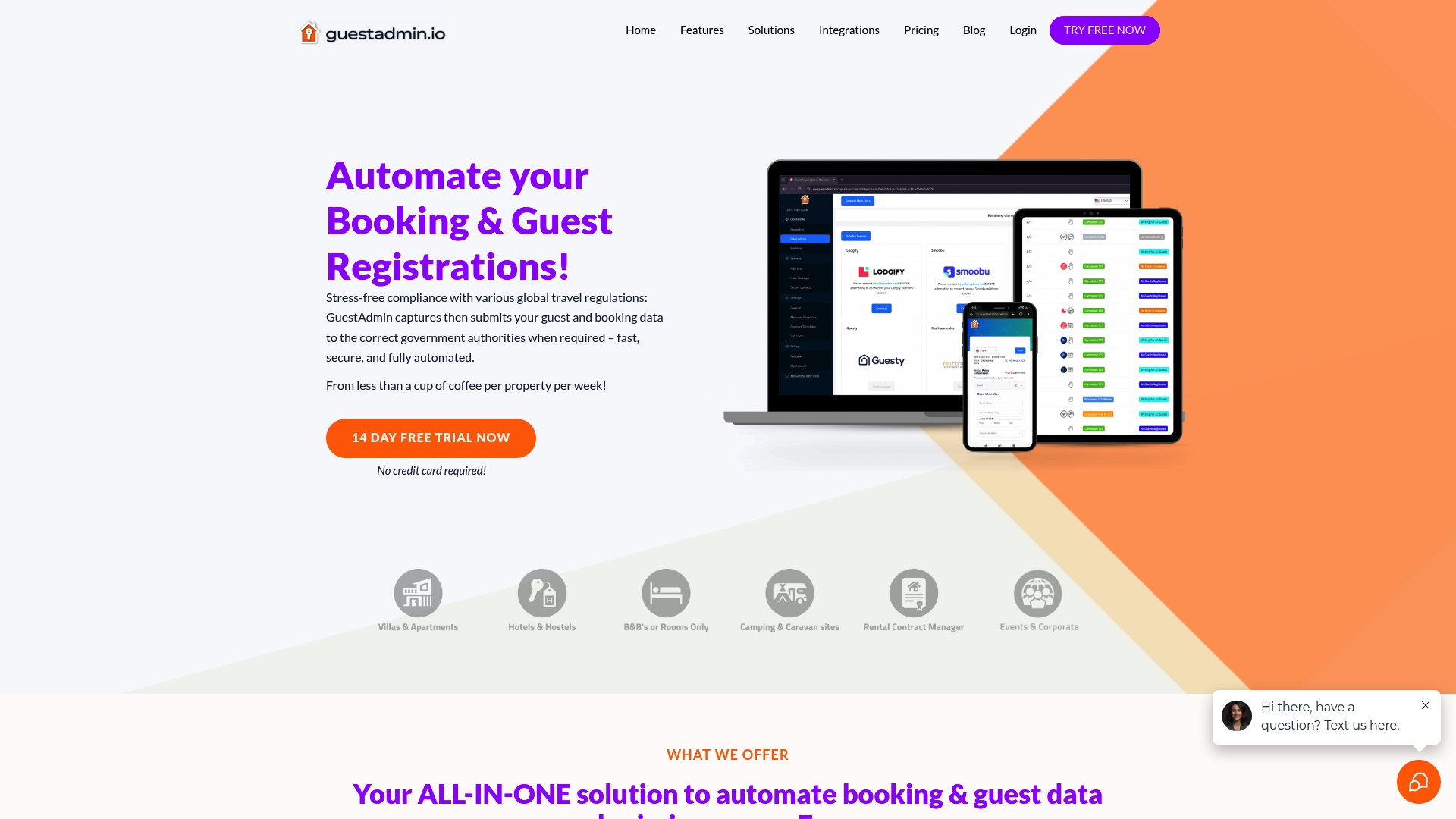
Our platform integrates seamlessly with your existing booking channels and property management systems. When guests book, their information flows automatically into compliance workflows. Built-in validation catches errors before submission, whilst real-time dashboards show exactly where each property stands.
Multi-property managers particularly benefit from our centralised compliance monitoring and automated reporting to multiple jurisdictions simultaneously. You gain complete visibility without learning dozens of different authority portals. Discover how GuestAdmin.io features simplify complex compliance requirements. Explore how we automate booking compliance for properties across Europe. Review our multi-property management workflow capabilities to see how we scale with your portfolio.
Frequently asked questions
What are the key registration requirements for short-term rental properties in Europe?
Property owners must register with designated local or national authorities and obtain a unique property identification number before creating any online listings. This registration number must display prominently on all booking platforms. The process typically requires proof of property ownership, valid safety certifications, and compliance with local zoning rules.
How do local regulations differ across major European cities?
Cities like Amsterdam, Barcelona, London, and Paris impose varying night caps limiting annual rental days from 30 to 120 nights. Each jurisdiction requires different safety certifications, charges distinct licensing fees, and enforces unique operational restrictions. Some cities mandate neighbourhood consent or proof of residential status, whilst others focus primarily on tax registration and safety compliance.
What are the penalties for failing to comply with short-term rental registration and reporting?
Penalties include substantial fines starting at several hundred euros and escalating with repeated violations. Authorities may issue enforcement notices, pursue legal action, or impose daily penalties for ongoing non-compliance. Major booking platforms remove non-compliant listings immediately, eliminating your rental income until you demonstrate full compliance.
Can technology platforms like GuestAdmin.io help with compliance?
Yes, automation tools capture guest information automatically from booking confirmations and submit required reports to authority portals within the 24-hour deadline. These platforms provide real-time compliance monitoring, automated certification renewal alerts, and multi-jurisdiction support. They reduce human errors and administrative burden significantly, especially for property owners managing multiple listings across different cities.
Recommended
- Automate booking compliance for short-term rentals 2026
- Property Management Data Security in Europe – Why It Matters
- Multi-Property Management Explained: Streamlining Compliance
- Italy’s short-term rental rules: What hosts need to know in 2025
- Cape Coral Property Management since 2017 | Home 24/7
- Ongediertebestrijding Vastgoed | VvE & Beheer
4 Comments
Why property managers need compliance tools in 2026
[…] are extensive, capturing guest information, booking durations, pricing, and occupancy patterns. Property owner responsibilities in EU rentals have expanded to include ongoing verification of compliance status with booking […]
Real examples of property compliance for short-term rentals
[…] can review the latest European rental rules and the full scope of owner compliance responsibilities to assess where your properties stand […]
How AI streamlines compliance for short-term rentals
[…] clear on owner responsibilities in 2026 means understanding that compliance is ongoing, not a one-time task. Monthly submissions, renewed […]
Guest data processing guide for European property owners
[…] Master property owner responsibilities for EU rentals 2026 […]