

TL;DR:
- From May 2026, EU Regulation 2024/1028 mandates platform validation and monthly reporting of guest registration data across all Member States, adding a compliance layer atop existing national rules. Hosts managing short-term rentals must navigate complex, country-specific registration deadlines and methods, requiring meticulous operational workflows to avoid costly fines. Automated, location-based submission tools like Guestadmin simplify multi-jurisdictional compliance by routing guest data correctly and ensuring consistent registration adherence.
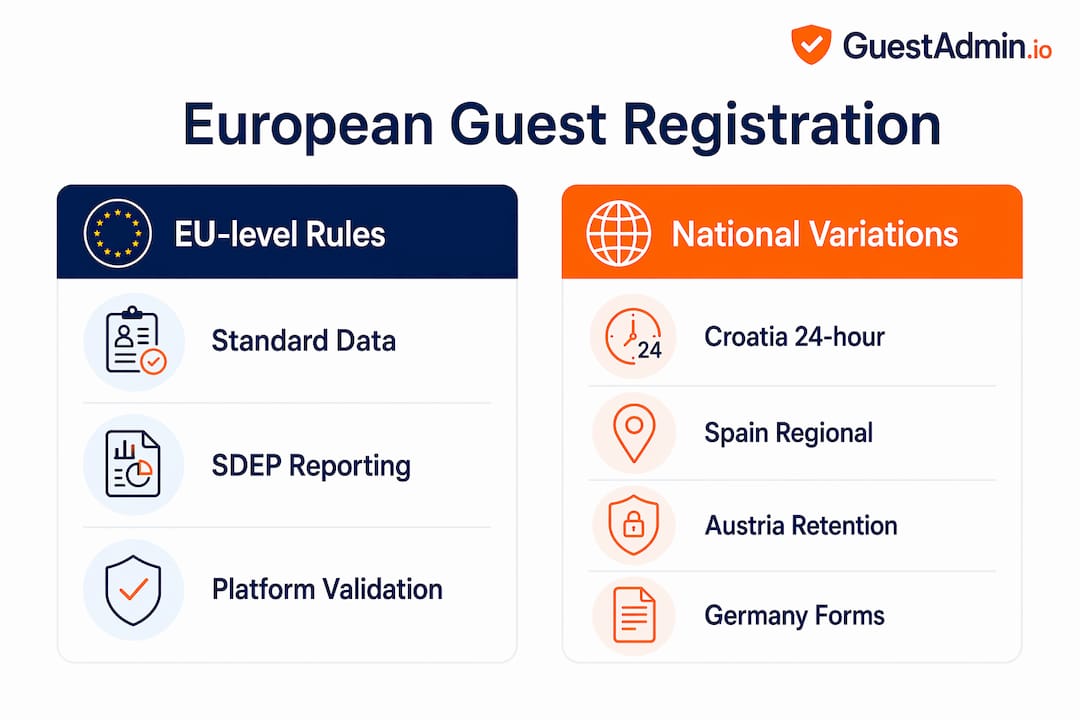
Guest registration laws in 2026 are defined by a dual compliance framework: EU Regulation 2024/1028, which creates a standardised digital reporting layer across all Member States, sits alongside existing national and local registration obligations that property owners and managers must continue to meet independently. From 20 May 2026, platforms such as Airbnb and Booking.com are legally required to collect, validate, and transmit guest registration data monthly to national authorities via the Single Digital Entry Point (SDEP). For property owners managing short-term rentals across Europe, this is not a simplification of existing rules. It is an additional layer on top of them.
What are the EU-level guest registration obligations in 2026?
EU Regulation 2024/1028 mandates standardised data collection and sharing via the Single Digital Entry Point from 20 May 2026. This means every short-term rental listing on a major platform must carry a valid registration number, and platforms must verify that number, display it publicly, and submit monthly activity reports to the relevant Member State authority. The regulation shifts significant compliance responsibility onto platforms, but hosts are not absolved. If your registration number is invalid or absent, your listing faces suspension.
The SDEP functions as a data gateway between platforms and national authorities. It does not replace national registration systems. Instead, it creates a parallel reporting obligation that feeds government data on occupancy, pricing, and guest volumes. For hosts, this means your data is now visible to tax authorities, tourism boards, and municipal governments simultaneously.
The EU-level guest registration framework coexists with local and national rules, creating dual compliance layers for every host operating in Europe. Managing both concurrently is the central operational challenge of 2026.
The practical impact on hosts breaks down as follows:
- You must obtain a valid registration number from your local or national authority before listing on any major platform.
- Your registration number must appear on your listing and remain valid throughout the booking period.
- Platforms will validate registration numbers against national databases; discrepancies trigger listing removal.
- Monthly data submissions by platforms mean your occupancy and guest data reaches authorities automatically, whether you report it separately or not.
How do guest registration laws vary across major European countries?
The EU framework sets the ceiling, but national systems set the daily operational rules. The differences between countries are significant, and misunderstanding them is the most common source of non-compliance for multi-property managers.
Croatia: eVisitor and the 24-hour rule
Croatia requires vacation rental operators to register guests in eVisitor within 24 hours of arrival and deregister within 24 hours of departure. This applies to every guest, including non-EU nationals who require additional data fields. Fines for failure to register range from €132 to €2,654 per violation. Critically, failure to deregister is treated as a separate offence with equivalent penalties. Many hosts focus on check-in registration and overlook the departure step entirely, which is where fines accumulate.

Spain: SES.Hospedajes and regional complexity
Spain mandates telematic submission of traveller data within 24 hours of check-in to the national system SES.Hospedajes. However, Catalonia and the Basque Country operate their own regional portals, and hosts in those territories must submit to the regional system rather than the national one. Regional portal differences within Spain mean that a single registration workflow cannot cover all Spanish properties. Non-compliance carries fines up to €30,000, with no exemptions for weekend check-ins or technical failures on the host’s side.
Austria: Gästeverzeichnis and seven-year retention
Austrian law requires hosts to maintain a Gästeverzeichnis (guest register) containing prescribed guest information. Records must be kept for seven years and must be accessible and exportable on request from authorities. Vienna permits digital workflows, including online signature capture, but the register is held by the host rather than transmitted routinely. Relying solely on Airbnb or Booking.com records to satisfy this obligation is insufficient. You must maintain your own exportable archive.
Germany: Meldeschein and ID requirements
Germany requires a signed Meldeschein (registration form) on arrival. Hosts must retain guest data for one year, after which records must be destroyed under data protection rules. Foreign guests must present valid ID, and Airbnb’s verified ID feature does not satisfy the legal requirement for a signed Meldeschein. This is a distinction that catches many hosts off guard, particularly those who assume platform-level identity verification covers their legal obligations.
| Country | Deadline | Key system | Retention period | Max fine |
|---|---|---|---|---|
| Croatia | 24 hours (arrival and departure) | eVisitor | Not specified | €2,654 per violation |
| Spain | 24 hours (check-in) | SES.Hospedajes / regional portals | Not specified | €30,000 |
| Austria | On arrival | Gästeverzeichnis | 7 years | Varies |
| Germany | On arrival | Meldeschein | 1 year | Varies |
Pro Tip: If you manage properties in both Catalonia and other Spanish regions, set up two separate submission workflows from the outset. Attempting to use SES.Hospedajes for Catalan properties is a compliance failure, regardless of whether the submission is technically accepted.
What are the biggest compliance challenges for hosts in 2026?
The most common failure mode in guest registration is not ignorance of the law. It is operational gaps during high-turnover periods. When a property has back-to-back bookings across a weekend, the 24-hour registration window in Croatia or Spain closes faster than manual processes allow. A single missed submission creates a fine that exceeds the revenue from the booking itself.
The two-step workflow that experienced operators use separates guest data capture from portal submission. Pre-arrival digital forms collect ID details, nationality, and travel document numbers before the guest arrives. On check-in confirmation, that data feeds directly into the relevant portal. This approach removes the dependency on the guest being present and cooperative at the moment of submission.
Multi-jurisdictional operators face a compounding problem. Hosts managing properties across different regions must implement routing logic that directs each guest record to the correct portal automatically. A property in Barcelona submits to the Catalan system; a property in Madrid submits to SES.Hospedajes; a property in Croatia submits to eVisitor. A single centralised submission tool without location-based routing creates false compliance, where data is submitted but to the wrong authority.
Key operational risks to address before 2026:
- Missing deregistration deadlines in Croatia, which are as legally significant as missing registration.
- Assuming platform-level ID verification satisfies national Meldeschein or Gästeverzeichnis requirements.
- Using a single portal for all Spanish properties without accounting for regional exceptions.
- Failing to maintain exportable guest records independently of OTA platform data.
Pro Tip: Audit your current check-in workflow against each country’s statutory deadline. If any step relies on a guest completing a form after arrival, you are already at risk of missing the window during a late check-in.
How will enforcement of 2026 guest laws affect property managers?
The enforcement environment post-2026 is materially different from previous years because non-adherence is increasingly detected via cross-checking platform data, tax records, and payment reporting under EU frameworks. Authorities no longer rely solely on inspections or complaints. The SDEP’s monthly data feeds give national tax and tourism authorities a real-time view of occupancy that can be compared directly against tax filings and tourist tax declarations.
Platforms now carry a verification and suspension duty tied to registration number validity. If your number expires, is flagged as invalid, or does not match the property address in the national database, your listing is removed without prior notice. For hosts generating primary income from short-term rentals, a listing suspension during peak season is a financial event, not merely an administrative inconvenience.
Municipal authorities in cities such as Barcelona, Amsterdam, and Vienna have invested in dedicated enforcement teams that cross-reference platform listings against local registration databases. The combination of automated platform checks and manual municipal inspections means that gaps in compliance are identified faster and at greater scale than at any point previously. The practical consequence is that the tolerance for administrative delay, which many hosts relied upon informally, no longer exists.
Key takeaways
Compliance with guest registration laws in 2026 requires managing both EU-level SDEP reporting obligations and country-specific registration systems simultaneously, with no single workflow covering all jurisdictions.
| Point | Details |
|---|---|
| EU Regulation 2024/1028 is live from May 2026 | Platforms must validate registration numbers and submit monthly data to national authorities via the SDEP. |
| National rules remain fully in force | Croatia, Spain, Austria, and Germany each operate distinct systems with separate deadlines, data fields, and retention rules. |
| Deregistration is a legal obligation | In Croatia, failing to deregister a departing guest carries the same fine as failing to register on arrival. |
| Routing logic is non-negotiable for multi-property operators | Spain alone has regional portals that differ from the national SES.Hospedajes system; one workflow does not cover all properties. |
| Platform ID verification is not a legal substitute | Airbnb’s verified ID feature does not satisfy Germany’s Meldeschein requirement or Austria’s Gästeverzeichnis obligation. |
Why I think most hosts are underestimating what 2026 actually demands
Having worked closely with property managers across Europe, I have noticed a consistent pattern: hosts who are broadly aware of the new EU regulation assume it replaces or simplifies their existing national obligations. It does not. EU Regulation 2024/1028 adds a layer. The eVisitor deadline in Croatia, the SES.Hospedajes submission in Spain, the Gästeverzeichnis in Austria. These all remain exactly as demanding as before.
The hosts who will struggle most in 2026 are not those who are unaware of the rules. They are the ones who have been managing compliance manually and assume their current process is good enough. A spreadsheet and a reminder calendar might have worked when you had two properties. With five or more, across two or more countries, the margin for error disappears entirely.
What I have seen work consistently is investing in a short-term rental registration guide early, before the season begins, and then building submission workflows around it rather than around the booking calendar. The hosts who treat compliance as a back-office task that follows the booking are the ones who miss windows. The ones who treat it as a pre-arrival step, triggered automatically, rarely do.
The other thing worth saying plainly: the fines are real, and they are not proportionate to the size of your operation. A €30,000 fine in Spain does not care whether you manage one property or fifty. Getting this right is not optional, and the cost of automation is a fraction of a single non-compliance penalty.
— Alex
How Guestadmin simplifies guest registration compliance in 2026

Managing guest registration across multiple European countries, each with its own portal, deadline, and data format, is exactly the problem Guestadmin was built to solve. The platform automates the capture, processing, and submission of guest data to the correct national authority within the required statutory window, including Croatia’s eVisitor, Spain’s SES.Hospedajes, and Austria’s Gästeverzeichnis. For property managers operating across jurisdictions, Guestadmin’s routing logic directs each guest record to the right portal automatically, removing the risk of false compliance. Explore Guestadmin’s vacation rental compliance services to see how automated registration works in practice for your portfolio.
FAQ
What is EU Regulation 2024/1028 and when does it apply?
EU Regulation 2024/1028 standardises short-term rental data collection and reporting across Member States, applying from 20 May 2026. It requires platforms to collect and validate registration numbers and submit monthly activity data to national authorities via the Single Digital Entry Point.
Do national guest registration rules still apply after May 2026?
Yes. National and local registration obligations in countries such as Croatia, Spain, Austria, and Germany remain fully in force alongside the EU framework. Hosts must comply with both sets of rules concurrently.
What happens if my registration number is invalid on a platform?
Under EU Regulation 2024/1028, platforms carry a duty to verify registration numbers and must suspend or remove listings where numbers are invalid or absent. Listing removal can occur without prior notice.
Is a 24-hour registration deadline standard across Europe?
No. Croatia and Spain both require registration within 24 hours of check-in, but other countries such as Germany and Austria require registration on arrival. Each country’s statutory deadline applies independently.
Can I use one registration workflow for all my European properties?
No. Multi-jurisdictional operators must implement location-based routing logic to submit guest data to the correct portal for each property. Even within Spain, Catalonia and the Basque Country use separate regional systems from the national SES.Hospedajes platform. A single workflow without routing creates false compliance.