

Managing short-term rentals across European countries means grappling with a complex web of compliance terms and local requirements. For many property managers, staying on top of shifting definitions and official language can feel overwhelming. Mastering the foundation of property management terminology is not just a legal necessity but key to avoiding costly mix-ups, ensuring accurate guest registration, and selecting tech that aligns with every country’s unique standards.
Table of Contents
- Defining Property Management Terminology
- Types of Short-Term Rental Arrangements
- Essential Compliance and Registration Terms
- Legal Obligations and Data Privacy Terms
- Tech Integration and Automation Terminology
Key Takeaways
| Point | Details |
|---|---|
| Understanding Terminology | Mastering specific property management terminology is essential to ensure compliance across various European jurisdictions. Misinterpreting terms can lead to significant reporting errors and regulatory violations. |
| Importance of Accurate Classification | Recognising the type of short-term rental arrangement directly influences regulatory obligations and compliance requirements. Each arrangement has unique challenges and requirements that must be adhered to. |
| Data Privacy Responsibilities | Property managers must comprehend their legal obligations regarding data handling, particularly under GDPR. Failing to meet these standards can result in fines and legal repercussions. |
| Leveraging Technology | Implementing automation tools can streamline compliance processes, reducing manual errors and enhancing regulatory accuracy. Understanding how these technologies integrate is crucial for effective operations. |
Defining Property Management Terminology
Property management operates within a precise language system. Understanding this terminology is non-negotiable for compliance, especially when managing short-term rentals across multiple European jurisdictions.
Why does terminology matter? Regulatory bodies use specific legal terms when defining requirements. Misinterpreting a single phrase could mean the difference between compliant reporting and regulatory violations.
The Core Terminology You Need
Short-term rental property management relies on several foundational terms that appear consistently in compliance documentation.
Guest registration refers to the formal process of capturing and recording guest information upon arrival. This typically includes name, contact details, identification type, and nationality. European regulations mandate this data collection within strict timeframes, often within 24 hours of check-in.
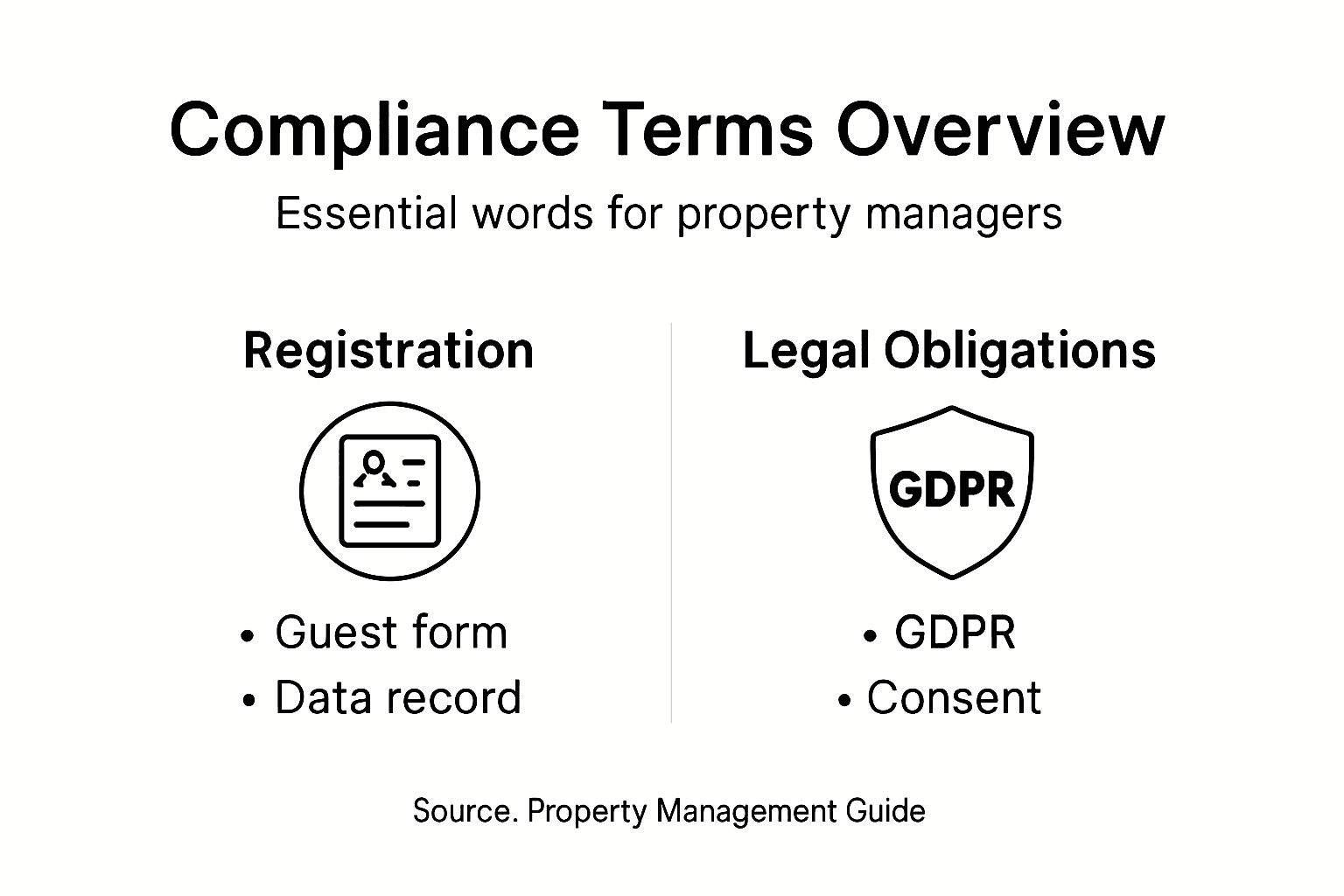
Travel regulations encompass the local laws governing short-term accommodation in specific jurisdictions. These vary dramatically across Europe. What’s compliant in Portugal differs from requirements in Austria or Spain. These regulations dictate who must be reported, what data must be submitted, and submission deadlines.
GDPR compliance (General Data Protection Regulation) governs how you collect, process, and store guest data. This applies across all European Union jurisdictions plus some additional countries. GDPR violations carry substantial fines and reputational damage.
Property registration is the initial documentation process where your accommodation becomes officially recognised for short-term rental operations. Many jurisdictions now require this before accepting guests.
Booking data encompasses all transaction information: check-in and check-out dates, booking source, payment details, and guest composition (number of adults, children, pets).
Other critical terms include:
- Tax identification – Your official tax number for reporting rental income
- Occupancy declarations – Formal statements about guest numbers and stay duration
- Data submission – Transmitting required information to relevant government authorities
- Archival requirements – Retaining guest records for specified periods (typically 5-10 years)
- Multi-property management – Overseeing several properties simultaneously across different jurisdictions
Terminology standardisation helps you navigate diverse regulatory environments efficiently and reduces the risk of misinterpretation that could create compliance gaps.
Why This Matters for Your Operations
Property managers juggling multiple properties across different countries face exponential complexity. Each jurisdiction uses slightly different terminology for similar concepts, creating confusion.
Accurate terminology understanding prevents costly errors. Regulatory bodies penalise misfilings based on misunderstood definitions. Your compliance documentation must match official language precisely.
Essential property management compliance concepts establish the baseline vocabulary you’ll encounter in official documents and regulatory communications.
Moving Forward
Build a personal reference document using the terminology covered here. When reviewing new regulatory requirements for any jurisdiction, cross-reference unfamiliar terms against this foundation. You’ll spot patterns and relationships between concepts that initially seemed disconnected.
Pro tip: Create a searchable terminology database for each jurisdiction where you operate, noting how local authorities define key terms—this prevents costly interpretation errors during compliance submissions.
Types of Short-Term Rental Arrangements
Short-term rental arrangements come in distinctly different formats, each with unique compliance requirements. Understanding which type you operate determines your regulatory obligations across European jurisdictions.
The arrangement type affects everything from registration deadlines to guest data requirements. Misclassifying your property could result in applying the wrong compliance rules entirely.
Main Arrangement Categories
Whole-property rentals involve letting an entire property to guests whilst the owner is absent. This includes houses, apartments, and villas rented out completely. The guest has exclusive access to all facilities during their stay.

Host-present rentals (also called room rentals or hosting) occur when the property owner or manager remains on-site alongside guests. Typically, guests rent individual rooms whilst sharing common areas with the host. This arrangement is common in cities across France, Spain, and Germany.
Corporate housing serves business travellers on temporary assignments. These arrangements frequently run weeks to months and often include furnished apartments with utilities included. Companies often negotiate preferential rates for extended stays.
Furnished sublets are properties rented to tenants for transitional periods—bridging stays whilst permanent housing is arranged, relocation periods, or study-abroad placements. These typically last weeks to several months.
Different regulatory frameworks across EU member states759356_EN.pdf) apply varying requirements based on arrangement type and duration.
Key differences between arrangement types include:
To clarify regulatory obligations, here is a quick comparison of main short-term rental arrangement types:
| Arrangement Type | Typical Duration | Key Compliance Challenge | Host/Owner Presence |
|---|---|---|---|
| Whole-property rental | Days to months | Immediate guest notification | Owner absent |
| Host-present rental | Days to weeks | Stricter fire safety checks | Owner on-site |
| Corporate housing | Weeks to months | Employer registration involvement | Host usually absent |
| Furnished sublet | Weeks to several months | Variable lease documentation | Host absent or present |
- Whole-property rentals – Owner absent, guests have full access, longer compliance documentation chains
- Host-present rentals – Owner on-site, shared spaces, often stricter fire safety requirements
- Corporate housing – Business-focused, longer average stays, employer involvement in registration
- Furnished sublets – Tenant-focused, variable durations, lease agreements required alongside guest data
Compliance Implications
Each arrangement type triggers different reporting obligations. Whole-property rentals typically require immediate guest notification submissions. Host-present rentals may have relaxed timeline requirements in some jurisdictions.
Duration matters significantly. Stays under 30 days often follow different rules than month-long arrangements. Your classification determines whether you apply short-stay or long-stay regulations.
Understanding your specific arrangement type prevents applying incorrect compliance deadlines and regulatory requirements that could result in substantial penalties.
Jurisdiction-Specific Variations
The United Kingdom, Italy, and the Netherlands each define arrangement types differently. What counts as a “whole-property” rental in one country may be classified differently elsewhere. Host-present rental registration requirements vary substantially between jurisdictions.
Always verify your specific arrangement classification against local regulatory guidance before implementing your compliance process.
Pro tip: Document your property’s arrangement type in your compliance system with supporting evidence (lease agreements, occupancy patterns, guest communication templates)—this protects you during regulatory audits by clearly demonstrating your classification was deliberate and accurate.
Essential Compliance and Registration Terms
Compliance terminology forms the backbone of your regulatory obligations. These specific terms appear repeatedly in government submissions, registration forms, and enforcement notices across European jurisdictions.
Misunderstanding a single term can trigger cascading compliance failures. You need precise definitions to navigate multi-country operations effectively.
Core Compliance Terms
Guest notification refers to the mandatory submission of guest information to local authorities. This typically occurs within 24 hours of check-in and includes name, nationality, identification numbers, and contact details. Timing requirements vary significantly by jurisdiction.
Data retention specifies how long you must keep guest records archived. Most European jurisdictions require 5-10 years of retention for compliance audits. This extends beyond active bookings to include historical guest information.
Regulatory submission is the formal process of transmitting required guest data to government bodies. This happens through designated channels—online portals, email systems, or automated API connections depending on jurisdiction requirements.
Compliance deadline marks the absolute cutoff for submitting required information. Missing deadlines results in penalties regardless of submission quality. Understanding fair housing laws and licensing standards by jurisdiction helps you identify all applicable deadlines.
Property licensing is your official authorisation to operate short-term rentals. Some jurisdictions require advance licensing; others implement registration-based systems. Licensing status directly affects your ability to accept bookings legally.
Additional critical terms include:
- Occupancy verification – Confirming actual guest presence matches declared information
- Identification documentation – Guest passports, national IDs, or travel documents required for submission
- Booking reconciliation – Matching guest data with actual check-in records to prevent discrepancies
- Tax registration number – Your official identifier for revenue reporting purposes
- Guest onboarding – The complete process of collecting, verifying, and submitting guest information
Registration-Specific Terms
Initial registration occurs when you first list a property for short-term rental operations. This establishes your legal status within the jurisdiction. Some countries require pre-listing approval; others allow concurrent registration.
Ongoing registration refers to continuous compliance with guest notification requirements throughout your operation. Each new booking triggers fresh registration obligations.
Registration renewal applies in jurisdictions requiring periodic licence updates. Annual or multi-year renewals demand verification that your property meets current standards.
Precise compliance terminology ensures you apply the correct procedures, meet appropriate deadlines, and avoid penalties from misinterpreted requirements across different jurisdictions.
Real-World Application
You’re managing properties in three countries simultaneously. Each uses different terminology for similar concepts. One requires “guest notification” within 24 hours, another demands “occupant declaration” within 48 hours, and a third specifies “accommodation registration” before arrival.
Without understanding these terminological distinctions, you’ll apply incorrect procedures. Your automated guest registration services must account for jurisdiction-specific terminology and timings.
Pro tip: Create a compliance terminology glossary specific to each jurisdiction you operate in, cross-referencing official government terms with your internal processes—this bridges the gap between regulatory language and your operational procedures.
Legal Obligations and Data Privacy Terms
Data protection laws form the legal foundation of guest information handling. These terms define your obligations when collecting, storing, and transmitting guest data across European jurisdictions.
Ignoring data privacy terminology exposes you to substantial fines and legal liability. Understanding these terms is non-negotiable for compliant operations.
Core Legal Obligation Terms
Data controller refers to the entity determining why and how guest data is processed. As a property manager, you are typically the data controller responsible for compliance decisions.
Data processor handles data on your behalf—hosting providers, payment processors, or compliance automation platforms. Processors must follow your instructions and maintain data security standards.
Lawful basis is the legal justification for processing guest information. Common bases include contract fulfilment (guest bookings), legal obligation (regulatory reporting), and legitimate interest (fraud prevention).
Consent occurs when guests explicitly agree to data processing. Some jurisdictions require active consent; others allow consent through booking acceptance. General Data Protection Regulation requirements mandate clear, freely given consent for processing beyond regulatory requirements.
Data subject rights are protections granted to individuals whose data you hold. These include the right to access, correct, delete, and object to processing. You must respond to data subject requests within 30 days.
Additional critical legal terms include:
- Legitimate interest – Business purposes justifying data processing beyond basic requirements
- Data breach notification – Mandatory reporting to authorities when unauthorised access occurs
- Data Processing Agreement – Contracts defining responsibilities between controllers and processors
- Privacy notice – Required disclosure explaining how you collect and use guest data
- Retention period – Specified duration for keeping data before deletion
Data Privacy-Specific Terms
GDPR compliance demands fair, transparent, lawful data processing. Data protection standards apply across the UK and European Union, establishing consistent rules for handling personal information.
Pseudonymisation removes identifying details from data to reduce privacy risks. This allows analysis without exposing identities directly.
Data minimisation means collecting only data you actually need for stated purposes. Requesting unnecessary information violates this principle and increases liability.
Privacy by design requires building data protection into your systems from inception, not adding it afterwards. Your compliance platform should incorporate privacy protections throughout.
For reference, here’s a summary of core legal and data privacy responsibilities for property managers:
| Responsibility | Applies To | Example Requirement |
|---|---|---|
| Data controller | Property manager | Decides how guest data is used |
| Lawful basis | All data processing | Contract, legal obligation, interest |
| Consent management | Guest onboarding | Explicit agreement from guests |
| Data subject rights | All guests | Respond to data access requests |
| Breach notification | All jurisdictions | Report unauthorised access swiftly |
Legal obligations and data privacy terms create the framework protecting guest information whilst enabling compliant regulatory reporting across jurisdictions.
Your Compliance Responsibility
You hold substantial legal responsibility for guest data security. Breaches, unauthorised processing, or failure to honour data subject rights trigger enforcement actions and fines.
Property managers operating across multiple European countries face compounded complexity. Each jurisdiction enforces data protection differently whilst maintaining baseline GDPR standards.
Pro tip: Maintain a data mapping document identifying what guest information you collect, where it flows (regulatory submissions, payment processors, archival), and retention periods—this demonstrates intentional, lawful processing during audits and protects you against unintentional violations.
Tech Integration and Automation Terminology
Technology integration transforms property management from manual processes into streamlined, compliant operations. Understanding automation terminology helps you evaluate tools and implement solutions that genuinely reduce your compliance burden.
Misunderstanding how technology works in your compliance workflow leads to poor tool selection and ineffective implementation.
Core Automation Terminology
Automation refers to technology performing repetitive tasks without manual intervention. In compliance contexts, this means capturing guest data once and automatically submitting it to multiple jurisdictions simultaneously.
Workflow automation connects sequential steps together. Guest data submission workflow automation captures information at check-in, validates it, and submits it to authorities within 24 hours—all without your involvement.
Integration means connecting different systems to share data seamlessly. Your property management system integrates with compliance platforms, which then integrate with government submission portals.
API connection (Application Programming Interface) allows systems to communicate directly using secure data channels. Technology-driven strategies enable real-time data synchronisation across multiple platforms without manual data entry.
Webhook sends automatic notifications when specific events occur. A webhook triggers guest data submission when check-in is confirmed in your booking system.
Other critical automation terms include:
- Data synchronisation – Automatic updating across multiple systems simultaneously
- Error detection – Automated identification of incomplete or incorrect guest information
- Scheduled submission – Pre-set timing for automatic regulatory reporting
- Batch processing – Sending multiple guest records in consolidated submissions
- Real-time processing – Immediate data handling without queues or delays
Compliance-Specific Technology Terms
Artificial intelligence analyses patterns in guest data to identify compliance risks before submission. AI catches data inconsistencies that manual review might miss.
Machine learning improves accuracy over time by learning from historical submissions. Systems become better at identifying which data fields require attention.
Data validation ensures submitted information meets regulatory requirements before transmission. Invalid submissions fail validation and prevent costly rejections.
Compliance dashboard provides visual oversight of submission status across all properties and jurisdictions. You see at a glance which submissions succeeded, which await processing, and which require attention.
Technology terminology reflects your ability to outsource compliance complexity—reducing manual work whilst maintaining regulatory accuracy across multiple jurisdictions simultaneously.
Real-World Application
You manage ten properties across five countries. Without automation, you manually collect guest data from each property, translate information into local language requirements, and submit separately to five different government portals.
With integrated automation, data flows from booking confirmation through validated submission automatically. Automation in rentals removes the middle steps entirely, compressing processes from hours to minutes.
Pro tip: When evaluating compliance tools, request demonstrations showing exactly how their automation works—specifically asking about API integrations, submission scheduling, and error handling to ensure the technology genuinely handles your compliance burden rather than simply adding another system to manage.
Simplify Compliance with Clear Property Management Terminology
Navigating complex property management terminology such as guest notification, GDPR compliance, and multi-property management can be overwhelming. The risk of costly compliance errors increases when juggling varied regulations across multiple European countries. Now you can transform those challenges into streamlined operations by harnessing automation designed specifically for hospitality professionals.
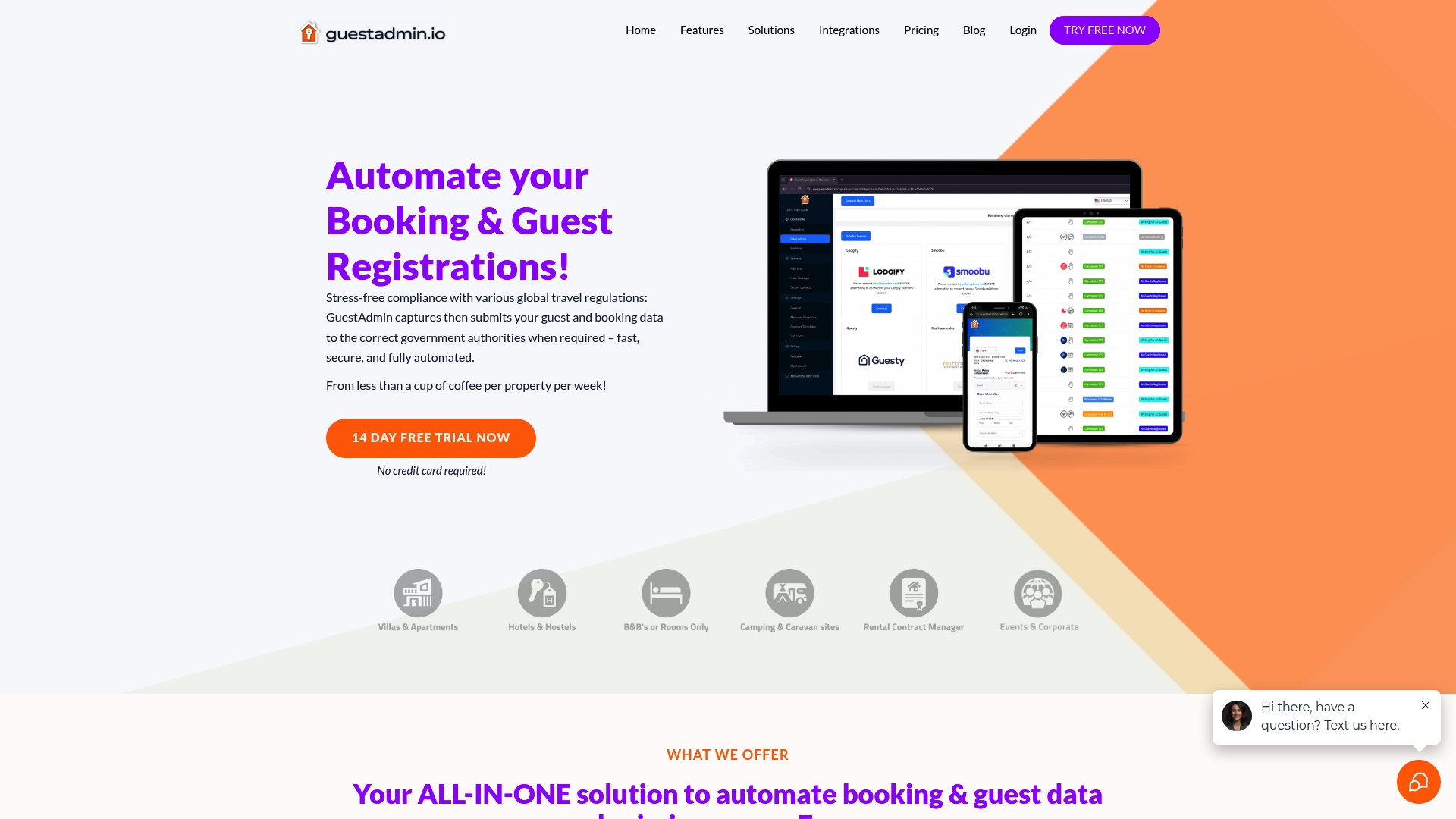
Unlock the power of GuestAdmin.io, a SaaS platform built to automate your compliance tasks including guest data capture, real-time reporting, and multi-jurisdiction submission within 24 hours. Stay confident knowing your property registrations, occupancy declarations, and data retention obligations are handled accurately while keeping GDPR standards front and centre. Discover how to reduce administrative burden and boost regulatory certainty by visiting GuestAdmin.io. Start simplifying your compliance today with solutions tailored for multi-property management and seamless integration across booking channels.
Frequently Asked Questions
What is guest registration in property management?
Guest registration is the formal process of capturing and recording guest information upon arrival, including their name, contact details, identification type, and nationality. This is required within strict timeframes as mandated by regulations.
What are travel regulations in the context of short-term rentals?
Travel regulations encompass the local laws governing short-term accommodation, which can vary dramatically across different jurisdictions. These regulations dictate who must be reported, what data needs to be submitted, and the deadlines for submission.
How does GDPR compliance affect property management?
GDPR compliance governs how property managers collect, process, and store guest data. It applies across European jurisdictions and violations can lead to substantial fines and reputational damage.
What are the different types of short-term rental arrangements?
The main types of short-term rental arrangements include whole-property rentals, host-present rentals, corporate housing, and furnished sublets. Each type has unique compliance requirements that affect registration deadlines and guest data obligations.
Recommended
- Multi-Property Management Explained: Streamlining Compliance
- Property Management SaaS – Streamlining Hospitality Compliance
- 7 Property Management Compliance Best Practices Explained
- Webhooks for Property Managers: Automating Compliance
- Drug Testing Terminology Explained: Compliance Matters
- Course Content Compliance: Why Accreditation Matters
One Comment
How to sync booking data for short-term rental compliance
[…] key compliance terms before you begin will save you significant time when configuring your systems. Terms like “data […]