

TL;DR:
- Booking dashboards centralize guest data, automate compliance reporting, and reduce errors significantly.
- They save property managers up to 60% of time monthly and help avoid costly fines.
- Dashboards support EU regulation compliance by automating data submission and enhancing operational visibility.
Managing short-term rental compliance across Europe has never been more demanding. Since EU Regulation 2024/1028 came into force, property managers face stricter reporting duties, tighter deadlines, and real consequences for missed submissions. Spreadsheets and manual data entry, once a workable stopgap, now create serious legal exposure. Booking dashboards change this picture entirely. They centralise guest data, automate submissions, and flag compliance risks before they become costly problems. This article explains what booking dashboards actually do, why they matter more than ever in 2026, and how tracking them systematically puts you in control of your regulatory obligations.
Table of Contents
- What are booking dashboards and why do they matter for compliance?
- The compliance edge: Automation, time savings, and error reduction
- Tracking dashboards for EU regulatory reporting: Features property managers need
- Mitigating risks: Data security, real-time alerts, and avoiding costly fines
- The overlooked value of tracking dashboards: Beyond mere compliance
- Streamline your compliance process with end-to-end dashboard solutions
- Frequently asked questions
Key Takeaways
| Point | Details |
|---|---|
| Centralised data for compliance | Tracking booking dashboards ensures all bookings, guest details, and occupancy data meet EU regulatory reporting requirements. |
| Automation saves time | Automated dashboards cut monthly compliance admin by up to 60%, freeing property managers to focus on guests. |
| Avoid fines and delisting | Real-time alerts and validation features lower the risk of costly penalties and keep listings active on OTAs. |
| Business visibility & future-proofing | Tracked dashboards not only solve compliance but also provide managers with operational oversight and readiness for changing regulations. |
What are booking dashboards and why do they matter for compliance?
A booking dashboard is a centralised, web-based interface that aggregates reservation, guest, and property data from multiple sources into one place. For property managers operating across Europe, it is the operational hub from which all compliance activity flows. Rather than logging into separate OTA portals or maintaining parallel spreadsheets, you see every active booking, guest status, and reporting deadline in a single view.
The core features that make dashboards genuinely useful for compliance include:
- Real-time data sync from connected OTAs and PMS platforms
- Automated guest data capture, including identification details and check-in timestamps
- Centralised reporting logs formatted for regulatory submission
- Alert systems for approaching deadlines or missing guest information
- Audit trails that support inspections and legal queries
Booking dashboards explained shows clearly why manual exports simply cannot keep pace. A CSV download from Airbnb tells you who booked. It does not validate ID formats, flag night cap breaches, or push structured data to national authorities. That gap is exactly where fines happen.
The EU STR rules introduced through EU Regulation 2024/1028 require platforms and hosts to share standardised accommodation data with national Single Digital Entry Points (SDEPs). Real-time booking dashboards cut compliance work by automating data collection and centralising critical booking and guest data for regulatory submissions. Meanwhile, booking dashboards for property managers integrate with major PMS and OTAs to support European compliance at scale.
| Manual logs | Dashboard tracking |
|---|---|
| Data entered by hand | Data captured automatically |
| Errors common | Validation built in |
| Submissions done manually | Submissions automated |
| No deadline alerts | Real-time alert system |
| Single property focus | Multi-property overview |
The difference is not marginal. It is structural. Manual processes rely on someone remembering to act. Dashboards make compliance the default, not the exception.
The compliance edge: Automation, time savings, and error reduction
The most immediate benefit property managers notice after adopting a tracking dashboard is how much time they reclaim. What previously consumed an entire working day each month shrinks to a short review task. Automation via dashboards reduces compliance workload by 40 to 60% and cuts errors by more than 50%, based on empirical data from STR operators across Europe.

To put this in practical terms: average time per property drops from 8 to 12 hours monthly down to just 2 to 4 hours. For a manager handling ten properties, that is potentially 80 hours saved every month. That is real capacity returned to growing your portfolio or improving guest experience.
| Compliance task | Before automation | After automation |
|---|---|---|
| Guest data entry | 45 min per booking | Instant, automated |
| ID verification | Manual check | AI-validated |
| Report submission | 2 to 3 hours monthly | Automated on deadline |
| Error correction | Reactive, after-the-fact | Flagged before submission |
| Deadline tracking | Calendar reminders | Built-in alert system |
The common admin pitfalls that dashboards prevent include:
- Submitting incomplete guest records to national portals
- Missing nightly reporting windows due to time zone differences
- Duplicating guest entries across OTA-specific exports
- Failing to capture late check-in data before the submission cutoff
- Overlooking updated ID document requirements for specific jurisdictions
EU enforcement data759356_EN.pdf) confirms that regulators are actively monitoring submission accuracy and timeliness, not just presence. A late or malformed report carries the same legal weight as no report at all.
Pro Tip: Activate your dashboard’s alert and AI validation features specifically for late check-ins. Guests arriving after midnight often fall outside standard reporting windows, and this is one of the most frequently cited causes of non-compliant submissions across European markets.
The dashboard simplicity benefits extend beyond compliance, too. Fewer administrative errors mean fewer guest disputes, cleaner records for tax purposes, and a significantly more professional operation overall. The automation impact for STRs is transformative precisely because it removes the human bottleneck from high-frequency, rule-bound tasks.
Tracking dashboards for EU regulatory reporting: Features property managers need
EU Regulation 2024/1028 becomes fully operational from May 2026. Under this framework, short-term rental platforms and hosts must submit structured accommodation and guest data to national SDEPs on a regular basis. Non-compliance is not an oversight issue. It is a legal one.
Here is the workflow a compliant dashboard should handle automatically:
- Booking received from OTA or direct channel
- Guest data captured including name, nationality, ID document type and number
- ID validation against country-specific formatting rules
- Night cap check against local authority limits
- SDEP-formatted record created ready for national submission
- Submission dispatched within required reporting window
- Confirmation logged with timestamp for audit purposes
This is not aspirational. Dashboards automate guest registration759356_EN.pdf), ID verification, and digital SDEP submissions as required by EU 2024/1028. The key is choosing a platform that handles this end-to-end rather than requiring manual intervention at any step.
When evaluating dashboard tools, look specifically for:
- Automated guest data capture from all connected booking sources
- SDEP formatting built into the submission pipeline
- Deadline alert systems customised per jurisdiction
- Integration with country-specific portals such as SES.Hospedajes in Spain or Alloggiati Web in Italy
Booking dashboards for property managers support integration with these local compliance portals, removing the need to log into separate national systems. The STR compliance workflows become a background process rather than a foreground burden.
“Addressing data gaps in tourism is a policy priority across the EU. Standardised, automated reporting from platforms is now central to how member states monitor and manage short-term rental activity.”
As noted in rethinking rentals, the EU’s push for better tourism data is reshaping what platforms and hosts must provide. Dashboard tracking positions you to meet these demands without scrambling each reporting cycle.
Pro Tip: Configure your dashboard to track night caps and auto-validate ID formats well before submissions are due. Early detection of a misconfigured ID field saves significantly more time than correcting a rejected submission after the deadline.
Mitigating risks: Data security, real-time alerts, and avoiding costly fines
Tracking booking data is not only a regulatory obligation. It is a risk management exercise. The question is not whether your properties will face a compliance query. It is whether your records are ready when that moment arrives.
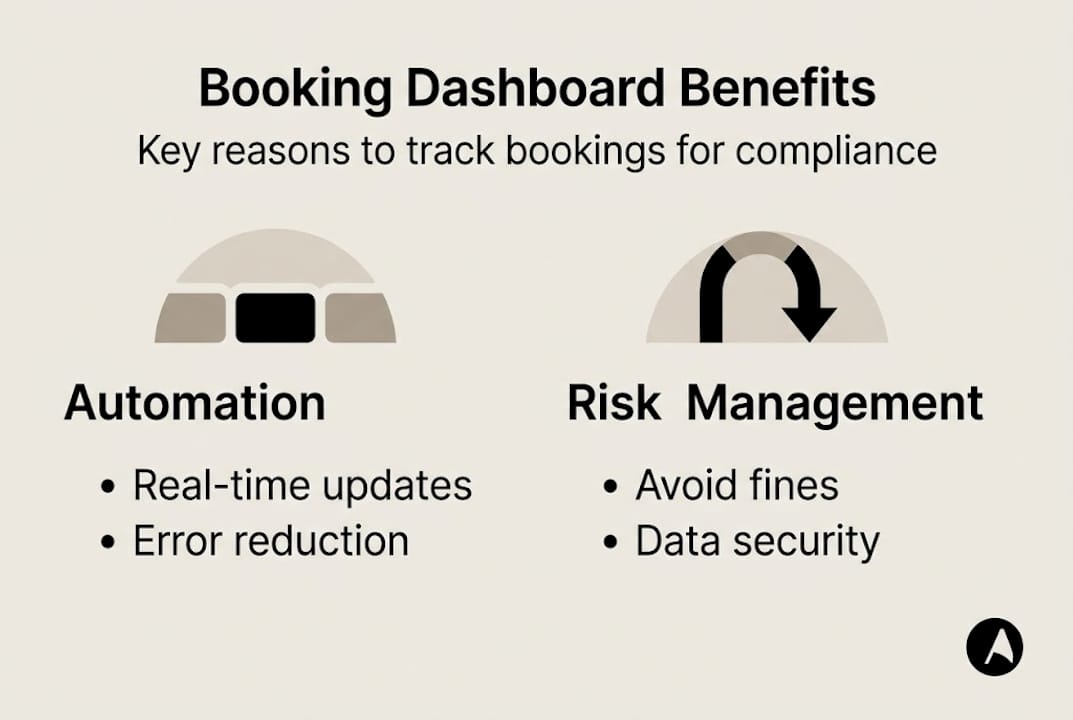
GDPR adds a second layer of obligation. Guest data collected for regulatory reporting must be encrypted, access-controlled, and retained only for the legally specified duration. A compliant dashboard handles this automatically, storing data securely and purging it when retention periods expire. You should never need to manually manage a GDPR deletion schedule.
Dashboards provide real-time alerts for deadlines, data gaps, and night cap breaches, supporting GDPR standards across your portfolio. This matters because:
- A missed SDEP submission triggers a formal non-compliance notice
- An incomplete guest record can invalidate an entire reporting batch
- Retaining guest data beyond the legal window creates GDPR liability
- A night cap breach can result in your property being flagged for investigation
The financial stakes are significant. Non-compliance can lead to fines from €1,000 to €50,000 or more, along with delisting from major OTAs. Delisting is particularly damaging because it removes your property from the platforms that generate the majority of bookings, often with immediate effect and limited right of appeal.
“Regulatory enforcement in the short-term rental sector is accelerating. Operators who treat compliance as optional are increasingly finding that the cost of inaction far exceeds the cost of proper systems.”
The STR regulatory framework in place across EU member states means that enforcement is no longer theoretical. Dashboards that flag problems before submission give you the response time needed to correct records, chase missing guest data, or escalate urgent cases. The booking data and GDPR relationship is one that every property manager needs to understand and manage actively, not reactively.
The overlooked value of tracking dashboards: Beyond mere compliance
Most conversations about booking dashboards stop at compliance. Avoid fines, meet deadlines, tick the right boxes. That framing misses the larger opportunity.
When your booking and guest data flows through a single, structured system, you gain something far more valuable than a clean audit trail. You gain operational clarity. You can see which properties are generating the most check-in friction, which markets have the most complex reporting requirements, and where your team is spending disproportionate time. That visibility drives better decisions.
Dashboards create a single source of truth and foster portfolio-level oversight that spreadsheets simply cannot replicate. As EU rules continue to evolve, managers who already operate within a structured dashboard environment adapt quickly. Those still relying on manual processes face a rebuild every time requirements change.
The automation and visibility that dashboards provide is not a luxury for large operators. It is increasingly the baseline for running a sustainable, scalable short-term rental business in Europe.
Streamline your compliance process with end-to-end dashboard solutions
The case for tracking booking dashboards is clear: less admin, fewer errors, automatic submissions, and real protection against costly fines. Taking action does not need to be complicated.
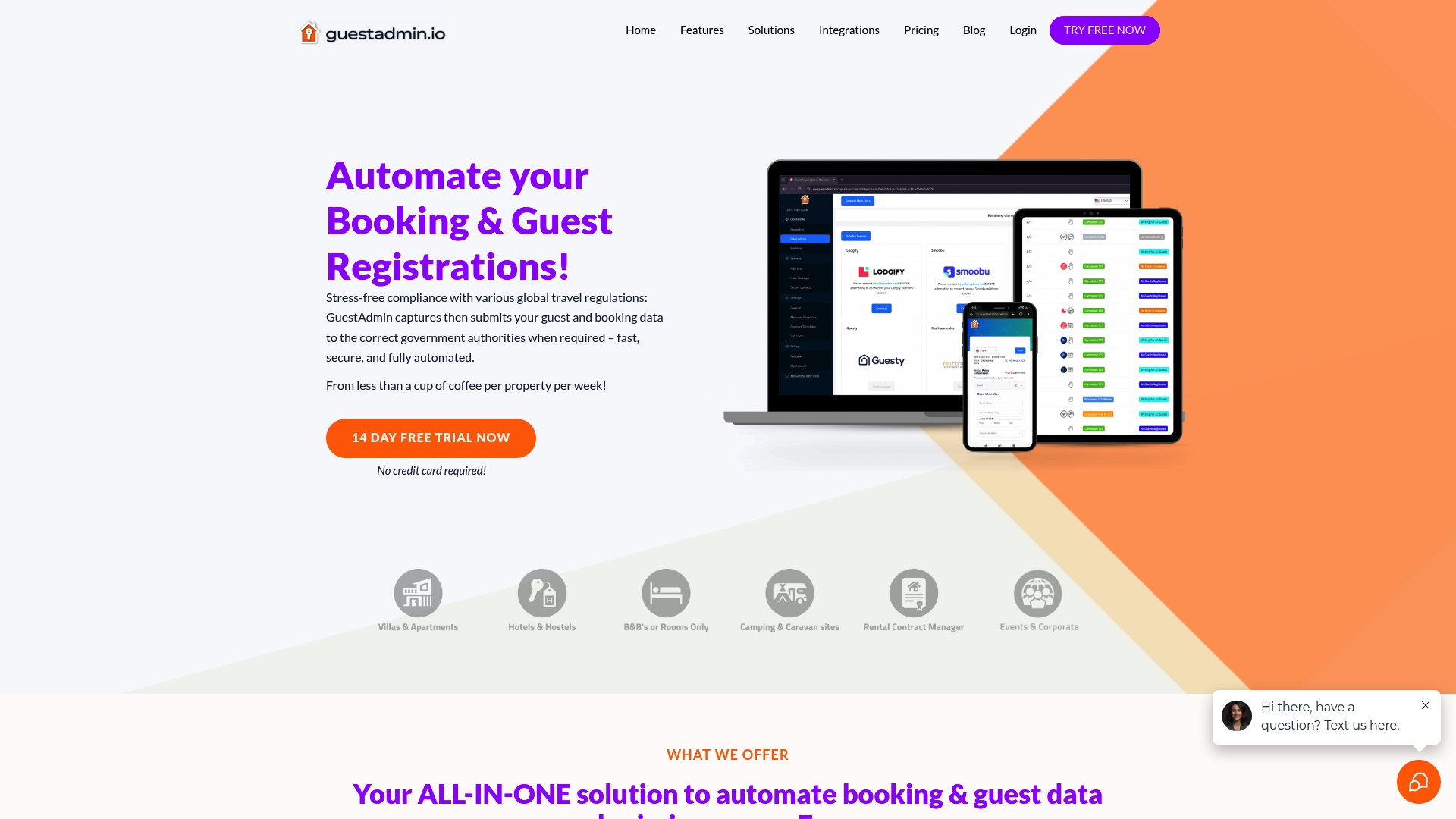
GuestAdmin.io brings all of these capabilities together in one platform built specifically for European short-term rental operators. Whether you manage two properties or two hundred, the multi-property compliance solutions ensure every booking flows through a compliant, automated pipeline. For a practical starting point, the compliance essentials guide walks you through exactly what your setup needs to cover. Explore GuestAdmin.io today and see how straightforward compliant operations can be.
Frequently asked questions
Which booking dashboard features matter most for EU compliance?
Real-time integration, automated guest registration, SDEP submission, deadline alerts, and GDPR compliance are the features that matter most. Dashboards automate guest registration759356_EN.pdf), ID verification, and SDEP submission as required under EU 2024/1028, making these non-negotiable capabilities for any compliant operation.
How much time and error reduction do booking dashboards offer?
Typically, dashboards cut admin work by 40 to 60% and reduce errors by more than 50% per property each month. Empirical benchmarks show that monthly compliance time per property drops from 8 to 12 hours down to 2 to 4 hours.
What risks do booking dashboards help avoid?
They prevent missed regulatory deadlines, incomplete data submissions, and GDPR breaches. Non-compliance can bring fines of €1,000 to €50,000 or more, along with removal from major OTA platforms.
Can dashboards support multiple platforms and compliance portals?
Yes, modern dashboards sync with PMS and OTAs and format data for relevant national portals automatically. Dashboards integrate with Guesty, Hostaway, Airbnb, Booking.com, and Vrbo for full regulatory reporting across markets.
One Comment
How to streamline booking dashboards in 2026
[…] your dashboard directly to rental compliance monitoring means that operational oversight and regulatory obligations share a single source of truth, which […]