

Managing short-term rentals across different European countries often means juggling booking data, guest details, and compliance paperwork in a maze of separate systems. Staying on top of legal duties and revenue trends becomes harder as properties multiply and rules change city by city. A real-time booking dashboard gives you a centralised control panel, instantly combining key metrics and compliance alerts so you make faster, more confident decisions—all while keeping guest data secure and up to date without manual effort.
Table of Contents
- Defining Real-Time Booking Dashboards In Hospitality
- Key Features Supporting Automated Compliance
- Types Of Dashboards And Integration Options
- Legal Responsibilities And Data Security Requirements
- Operational Risks And Common Compliance Pitfalls
Key Takeaways
| Point | Details |
|---|---|
| Real-Time Data Centralisation | Real-time booking dashboards consolidate information from multiple sources, enabling faster decision-making and improved operational efficiency. |
| Automated Compliance Features | These dashboards automate compliance processes, significantly reducing the risk of regulatory violations through real-time monitoring and alerts. |
| Customisation for Different Needs | Understanding the types of dashboards available allows property managers to tailor tools to their specific requirements, enhancing data management. |
| Integration Capabilities | Strong integration options across various systems reduce manual data entry and improve data accuracy, essential for compliance across jurisdictions. |
Defining Real-Time Booking Dashboards in Hospitality
A real-time booking dashboard is a centralised digital interface that displays live information about your rental properties, bookings, and guest data. Instead of checking multiple systems—your property management system (PMS), online travel agencies (OTAs), and email—everything appears in one place.
These dashboards consolidate data from various sources into actionable insights. You see occupancy rates, upcoming arrivals, cancellations, and guest information the moment something changes. Live data from property management systems enables faster, data-driven decisions that improve operational efficiency.
Key characteristics of booking dashboards include:
- Consolidated information: All your bookings, guest details, and property status in one view
- Live updates: Data refreshes instantly as bookings change, cancellations occur, or guests check in
- Accessibility: Access your dashboard from any device, anywhere—crucial when managing multiple properties across different cities
- Alerts and notifications: Automated warnings for last-minute cancellations, new bookings, or compliance deadlines
- Compliance integration: Direct links to regulatory requirements specific to your jurisdictions
For European property managers, real-time dashboards solve a persistent problem: scattered information across incompatible systems. You’re no longer checking your Airbnb portal, then your booking.com account, then your PMS, then your email for guest registration forms.
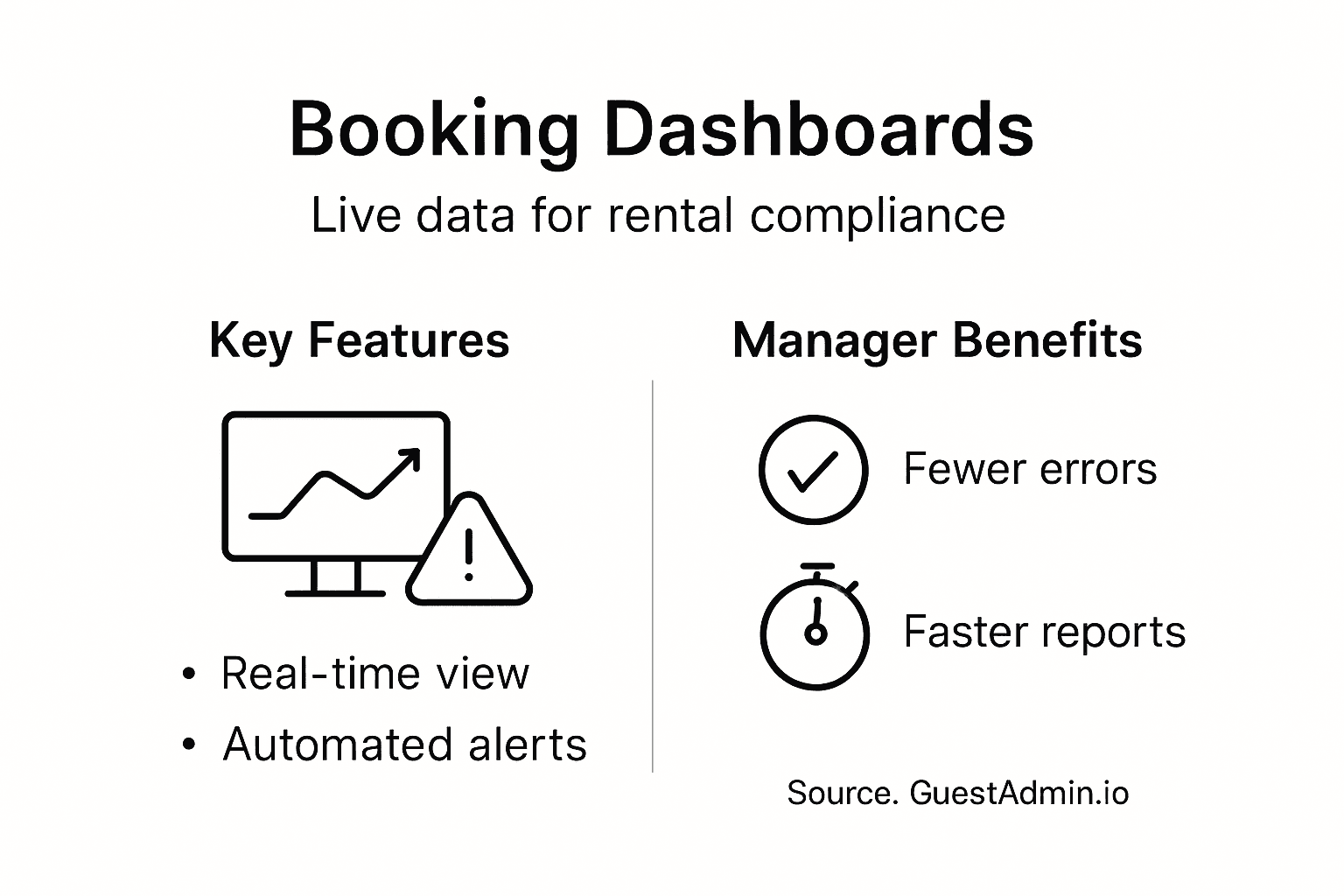
Hotel management dashboards provide insights into critical metrics such as occupancy, revenue, and booking trends. For short-term rental operators, this means understanding which properties perform well, which dates are problematic, and where compliance issues might emerge.
The technology behind these dashboards uses cloud computing to handle data from multiple sources simultaneously. Some integrate artificial intelligence to predict trends—which bookings might cancel, when to adjust pricing, or which guests need extra attention.
Think of it as giving you a command centre for your business instead of a fragmented filing cabinet. You see everything that matters at a glance, then drill down for details when needed.
Pro tip: Start by identifying which 3-5 metrics matter most to your business—occupancy, revenue, compliance submissions, or guest satisfaction—then focus your dashboard view on those rather than getting overwhelmed by all available data.
Key Features Supporting Automated Compliance
Real-time booking dashboards don’t just display information—they actively work to keep your business compliant with European regulations. The right features transform compliance from a manual burden into an automated process that runs in the background.
Automated alerts form the backbone of compliance dashboards. These notifications flag critical events before they become problems. You receive warnings when bookings arrive, when cancellations occur, or when regulatory submission deadlines approach. Instead of manually tracking 50 properties across multiple platforms, the system watches everything for you.

Real-time monitoring continuously tracks your data against regulatory requirements. Automated compliance mechanisms verify regulations like GDPR and PCI DSS by checking encryption, access controls, and data privacy continuously. Your guest information stays secure without requiring constant manual verification.
Key compliance features include:
- Automated data capture: Guest details flow directly from bookings into your system without manual entry
- Audit trails: Complete records of who accessed what data and when, essential for regulatory inspections
- Encryption and access control: Data remains protected throughout the booking lifecycle
- Predictive analytics: Predictive analytics enable compliance by anticipating risks before they materialise
- Scheduled submissions: Automatic reminders ensure you meet jurisdiction-specific deadlines
For European property managers, this means your dashboard connects directly to local authority requirements. Instead of researching what Athens requires versus Amsterdam versus Barcelona, your system knows and enforces those rules automatically.
Integration capabilities let your dashboard talk to your PMS, booking channels, and payment systems. Data flows seamlessly between platforms without manual re-entry or transcription errors that create compliance gaps.
Automated dashboards reduce compliance risk by handling routine monitoring and data verification continuously, leaving you free to focus on guest experience and business growth.
The technology behind these features uses cloud infrastructure to process data instantly across multiple properties and jurisdictions simultaneously. When a guest checks in, their registration data automatically routes to the correct authority in the correct format.
Pro tip: Configure your dashboard alerts to match your workflow—receive daily summaries rather than hundreds of individual notifications, so important compliance issues stand out rather than disappearing in notification noise.
Types of Dashboards and Integration Options
Not all dashboards work the same way. Different property managers need different views depending on their role, property size, and specific compliance challenges. Understanding dashboard types helps you choose the right tool for your business.
Operational dashboards focus on day-to-day management. These show occupancy status, upcoming check-ins, cancellations, and maintenance needs. A manager checking the system first thing Monday morning uses this view to understand their week at a glance.
Compliance dashboards track regulatory requirements and data submission deadlines. They monitor which guest registrations need submitting, which jurisdictions you operate in, and which deadlines are approaching. This is your safeguard against missed submissions and regulatory penalties.
Revenue dashboards display booking patterns, average daily rates, and income across properties. These help you understand which properties perform well and where pricing adjustments might help.
Hospitality dashboards vary from operational monitors to revenue management tools, with customisation options tailored to departmental needs. Some property managers need only compliance tracking; others need complete business oversight.
Here is a comparison of dashboard types for property managers:
| Dashboard Type | Main Focus | Suitable For | Typical Use Case |
|---|---|---|---|
| Operational | Daily property management | Managers overseeing daily tasks | Monitoring arrivals and maintenance |
| Compliance | Regulatory monitoring | Owners operating in multiple countries | Tracking jurisdiction deadlines |
| Revenue | Financial performance | Investors and owners | Analysing income trends |
| Custom (Hybrid) | Chosen metrics by user | Properties with unique challenges | Blending occupancy and compliance views |
Integration Options
Direct API connections link your dashboard to your PMS, booking platforms, and payment systems automatically. Data flows in real-time without manual intervention. When a guest books on Airbnb, the information appears in your dashboard within seconds.
Cloud-based integrations use secure web connections rather than direct database access. They’re simpler to set up and require less technical expertise from your team.
Webhook connections let external systems trigger actions in your dashboard. A new booking triggers automatic guest data capture. A cancellation triggers compliance status updates.
Integration options available:
- PMS integration: Connects directly to your property management system
- OTA connections: Links to Airbnb, Booking.com, and other booking platforms
- Payment gateways: Captures transaction data for financial compliance
- Custom APIs: Connects to any system with API capability
Dashboards supporting cloud-based APIs and database connections enable real-time updates across multiple properties and jurisdictions simultaneously. This scalability matters when you manage properties across different countries with different requirements.
To clarify the distinct integration methods, see this summary:
| Integration Method | Technical Complexity | Data Refresh Speed | Best Use Case |
|---|---|---|---|
| Direct API | High | Instantaneous | Modern PMS and tech-savvy operators |
| Cloud-based | Moderate | Real-time (near) | Most medium-sized property managers |
| Webhook | Low | Event-driven (on change) | Small teams wanting easy automation |
The best integration approach matches your existing systems—there’s no point adopting a dashboard that requires replacing everything else.
For European rental managers, integration capability determines whether your dashboard saves time or creates more work. Poor integration means manual data entry; strong integration means compliance that happens automatically.
Pro tip: Before selecting a dashboard, document which systems you currently use (PMS, booking channels, payment processors, accounting software), then verify the dashboard integrates with all of them before committing.
Legal Responsibilities and Data Security Requirements
Managing guest data in European short-term rentals isn’t optional—it’s legally mandated. Understanding your responsibilities protects your business, your guests, and your reputation.
European property managers operate under strict data protection laws. GDPR sets the foundation, but individual countries add their own requirements. France requires registration data submitted within 24 hours. Spain mandates police reporting. The Netherlands has specific income declaration thresholds. Each jurisdiction differs, which is why centralised compliance matters.
Your core legal responsibilities include:
- Obtaining informed consent: Guests must knowingly agree to data collection before you capture their information
- Data encryption: Guest details must be encrypted both during transmission and at rest
- Access controls: Only authorised staff members can view sensitive guest information
- Deletion rights: Guests can request their data be removed, and you must comply within specified timeframes
- Breach notification: You must report data breaches to authorities within prescribed timeframes, typically 72 hours
Legal obligations require transparent data collection with informed consent, strict access controls, and breach notification procedures. Non-compliance carries significant financial penalties—GDPR violations can reach €20 million or 4% of global revenue, whichever is higher.
Payment data security follows separate rules under PCI DSS. If you handle credit card payments directly, you must comply with strict payment card security standards. Most property managers avoid this by using payment processors that handle compliance.
Hospitality businesses must navigate jurisdictional differences whilst maintaining continuous compliance through robust data governance frameworks. When you manage properties across multiple European countries, your compliance system must adapt to each location’s specific rules.
Non-compliance doesn’t just mean fines—it damages guest trust and can force you to stop accepting bookings in regulated jurisdictions.
Real-time dashboards with security features reduce your compliance burden significantly. They automate consent capture, encrypt data automatically, log all access attempts, and alert you to potential breaches. Instead of managing spreadsheets and hoping you comply, your system enforces compliance continuously.
Security requirements aren’t just legal—they’re practical. Guests share their passport numbers, home addresses, and payment information with you. Protecting that data is a moral responsibility, not just a legal one.
Pro tip: Document your data handling processes in writing—what data you collect, how long you keep it, who can access it, and how you delete it. This documentation becomes your evidence of intentional compliance if regulators investigate.
Operational Risks and Common Compliance Pitfalls
Even well-intentioned property managers fall into compliance traps. Understanding common pitfalls helps you avoid costly mistakes that damage your business and expose you to regulatory action.
Fragmented systems create the biggest compliance risk. You use your PMS for bookings, Airbnb for listings, email for guest communications, and spreadsheets for tracking submissions. Data gets lost between systems. Deadlines slip through the cracks. Staff members work from different versions of procedures.
When your registration deadline is Friday but your PMS doesn’t talk to your compliance tracker, something gets missed. When a team member leaves and nobody documented the process, compliance quality drops immediately.
Manual data entry introduces human error at scale. A property manager typing guest details into five different systems makes mistakes. A digit gets transposed in a passport number. A registration gets submitted twice. Data quality suffers, and regulators notice inconsistencies.
Compliance pitfalls often stem from complex regulatory landscapes and manual processes prone to human error. When you manage 20 properties across three countries, manual tracking becomes mathematically impossible to execute perfectly.
Common pitfalls affecting European operators:
- Missed jurisdiction requirements: Operating in Spain but following Portuguese rules
- Outdated procedures: Staff using old submission methods instead of current regulations
- Inadequate staff training: New team members processing compliance incorrectly
- No audit trail: Unable to prove you submitted data if challenged by authorities
- Delayed submissions: Missing 24-hour or 72-hour deadlines by hours
- Incomplete guest information: Submitting registrations missing required fields
Operational risks include fragmented reporting, high staff turnover, and disconnected systems that challenge consistent adherence. Staff turnover in hospitality averages 30-50% annually. Each departure creates compliance gaps until new staff get trained.
Data breaches represent a silent risk. You collect sensitive information but store it unsecured. An employee’s laptop gets stolen. A password is shared publicly. Guest data ends up exposed. Then comes the 72-hour notification requirement, the regulatory investigation, the potential €20 million fine.
Operational compliance failures rarely stem from deliberate violations—they result from fragmented systems and staff gaps that accumulate over time.
Automated dashboards prevent most of these pitfalls by centralising information, enforcing procedures, and creating audit trails automatically. When your system tracks every submission, documents every deadline, and alerts staff to upcoming requirements, compliance becomes structural rather than dependent on individual memory.
Pro tip: Audit your current compliance process monthly—document which deadlines you met, which submissions succeeded, and where delays occurred. This reveals patterns that expose your real vulnerabilities before regulators do.
Streamline Your Rental Compliance with Real-Time Dashboards
Managing multiple properties across varied European jurisdictions presents constant challenges from fragmented data to complex compliance demands. The article highlights how real-time booking dashboards offer a centralised command centre that simplifies monitoring bookings, automates regulatory submissions, and reduces operational risks — transforming compliance from a burden into a seamless process.
GuestAdmin.io is designed precisely to address these pain points by offering an all-in-one SaaS platform tailored for property managers and owners navigating the complexities of European short-term rental regulations. With features like AI-powered data processing, multi-property integration, and GDPR-compliant secure access, GuestAdmin ensures your guest data submission is accurate and always on time.
Discover how our platform bridges operational efficiency with legal compliance through powerful dashboards and automated alerts. Learn more in our Stratus Archives – Guest Registration Services to understand how technology adapts to your needs.
Take control of your rental business today. Visit GuestAdmin.io now and experience seamless compliance management that saves time, lowers risk, and gives you valuable insights. For further updates and tips, explore our Uncategorized Archives – Guest Registration Services and make compliance your competitive advantage.
Frequently Asked Questions
What is a real-time booking dashboard?
A real-time booking dashboard is a centralised digital interface that displays live information about properties, bookings, and guest data, allowing managers to see crucial metrics like occupancy rates, cancellations, and guest details in one place.
How do real-time booking dashboards enhance compliance in the rental industry?
These dashboards automate compliance processes by providing alerts for deadlines, tracking regulatory requirements, and ensuring data security, thus minimising the risk of human error and missed submissions.
What are the key features of a compliance dashboard?
Key features include automated alerts for deadlines, real-time data monitoring against regulations, encrypted data capture, and audit trails that track access to sensitive information.
How can I integrate a real-time booking dashboard with my existing systems?
You can integrate a real-time booking dashboard through direct API connections, cloud-based integrations, or webhooks, allowing data to flow seamlessly between your property management system, booking platforms, and payment processors.
3 Comments
Real-time booking dashboards cut compliance work by 50% in 2026
[…] your entire property portfolio. Unlike traditional management systems that update periodically, real-time dashboards capture instant updates on bookings, occupancy, and revenue using APIs and webh… to synchronise multiple platforms […]
Why track booking dashboards for rental compliance
[…] Booking dashboards explained shows clearly why manual exports simply cannot keep pace. A CSV download from Airbnb tells you who booked. It does not validate ID formats, flag night cap breaches, or push structured data to national authorities. That gap is exactly where fines happen. […]
Real-time booking dashboard advantages for managers
[…] Real-Time Booking Dashboards: Enhancing Rental Compliance […]