

TL;DR:
- Booking dashboards automate compliance reporting and data management, reducing manual effort and errors.
- They provide real-time insights into occupancy, revenue, and guest demographics for smarter decisions.
- Advanced security features ensure GDPR compliance and protect sensitive guest information.
Spreadsheets and manual logs are no longer fit for purpose. Across Europe, short-term rental managers are facing a wave of new digital reporting obligations, and the stakes are rising fast. EU Regulation 2024/1028, effective May 2026, requires monthly guest data submissions to Single Digital Entry Points, and real-time booking dashboards cut compliance work by 50% for managers who adopt them early. This guide breaks down exactly what booking dashboards are, how they handle compliance automatically, and how you can use them to run a sharper, more profitable operation without the administrative burden.
Table of Contents
- What is a booking dashboard?
- How booking dashboards ensure compliance with EU regulations
- Key metrics and insights: using booking dashboards for smarter operations
- Data security and privacy: protecting guest and booking information
- Choosing the right booking dashboard for your properties
- Our perspective: why property managers can’t afford to ignore booking dashboards any longer
- Streamline your compliance and guest management with the right solution
- Frequently asked questions
Key Takeaways
| Point | Details |
|---|---|
| Effortless compliance | Booking dashboards automate guest registration, data submissions, and GDPR compliance for European property managers. |
| Real-time business insights | Dashboards deliver live metrics like revenue and occupancy, helping maximise bookings and guest reviews. |
| Enhanced data security | Integrated encryption and access controls keep guest and booking data safe under EU law. |
| Informed decision-making | Evaluate dashboard features, user ratings, and compliance support to choose the right solution for your portfolio. |
What is a booking dashboard?
A booking dashboard is a centralised, web-based interface that lets you view, organise, and act on all your booking and guest data in one place. Think of it as your operational control room. Instead of switching between OTA portals, spreadsheets, and email threads, everything you need sits in a single screen.
At its core, a booking dashboard pulls together live information from all your booking channels and presents it in a format that is easy to read and act on. The best platforms go well beyond a simple calendar view.
Key features you should expect from a modern booking dashboard:
- Live booking calendar: See all reservations across every property and channel in real time, with instant updates when bookings are made, modified, or cancelled.
- Guest data management: Capture, store, and retrieve guest information securely, including identification documents, contact details, and check-in records.
- Compliance tracking: Monitor submission deadlines, flag missing guest data, and track which records have been sent to national authorities.
- Data export and reporting: Generate reports for regulatory submissions, internal audits, or financial reviews with a few clicks.
- Multi-property support: Manage a single apartment or a portfolio of fifty properties from the same interface without switching accounts.
Booking dashboards automate guest registration and enhance regulatory compliance, removing the manual effort that leads to errors and missed deadlines. They also integrate with popular property management systems (PMS) and online travel agencies (OTAs), so your data flows automatically rather than requiring manual entry.
Pro Tip: When evaluating a dashboard, check whether it supports booking dashboard compliance basics out of the box, including automated guest registration and deadline alerts, rather than treating compliance as an add-on feature.
For property managers overseeing multiple listings, the time savings alone justify the switch. A dashboard that auto-populates guest records from OTA bookings can eliminate hours of weekly data entry, freeing you to focus on guest experience and revenue growth.
How booking dashboards ensure compliance with EU regulations
Understanding what booking dashboards offer, it is crucial to see how they solve compliance challenges facing property managers across Europe. The regulatory environment has shifted significantly, and manual processes simply cannot keep pace.
Here is how a modern booking dashboard moves a guest from check-in to compliant submission:
- Guest data capture: When a booking is confirmed, the dashboard automatically collects required guest information, either from the OTA or via a digital check-in form sent directly to the guest.
- Identity verification: The platform prompts guests to upload identification documents, which are then stored securely and linked to the booking record.
- Data validation: Before submission, the system checks for missing or inconsistent fields and alerts you to resolve them, preventing rejected reports.
- Encryption and storage: All guest and booking data is encrypted at rest and in transit, meeting GDPR requirements without any manual configuration.
- Automated SDEP submission: Dashboards automate data reporting under EU Regulation 2024/1028, handling monthly submissions to Single Digital Entry Points and integrating with national systems across member states.
“The shift from manual reporting to automated dashboard submissions is not just about saving time. It is about eliminating the legal risk that comes with late or incomplete filings.”
To put the difference in perspective, consider this comparison:
| Method | Time per submission | Error risk | SDEP integration | GDPR compliance |
|---|---|---|---|---|
| Manual spreadsheet | 4 to 6 hours | High | None | Manual effort required |
| Booking dashboard | Under 30 minutes | Low | Automated | Built-in encryption |
The efficiency gains for short-term rentals are substantial, but the compliance gains are what matter most in 2026. Missing a monthly SDEP deadline or submitting incomplete guest records can result in fines and, in some jurisdictions, suspension of your rental licence. A well-configured compliance workflow through a booking dashboard makes those risks effectively disappear.

Key metrics and insights: using booking dashboards for smarter operations
With compliance tackled, let us turn to how booking dashboards drive smart business decisions and operational performance. The data your dashboard collects is not just for regulators. It is a goldmine for improving how you run your properties.
Critical metrics a strong booking dashboard surfaces:
- Occupancy rate: The percentage of available nights that are booked, broken down by property, season, or channel.
- Average daily rate (ADR): Your average revenue per occupied night, which helps you benchmark pricing against the market.
- Guest demographics: Nationality, booking lead time, and length of stay patterns that reveal who your guests are and how they book.
- Revenue per available room (RevPAR): A combined measure of occupancy and rate that gives a true picture of financial performance.
- Cancellation rates: Track which channels or booking windows produce the most cancellations so you can adjust policies accordingly.
| Metric | What it tells you | How to act on it |
|---|---|---|
| Occupancy rate | Demand patterns by season | Adjust minimum stays and pricing |
| ADR | Pricing effectiveness | Compare against local competitors |
| Guest demographics | Source markets | Target marketing spend more precisely |
| Cancellation rate | Policy effectiveness | Tighten terms for high-risk windows |
The business case for data-driven management is clear. Hostfully tracks revenue, occupancy, and ADR, and users report a 7% increase in 5-star reviews when using quality dashboards to manage guest communications and operational quality.
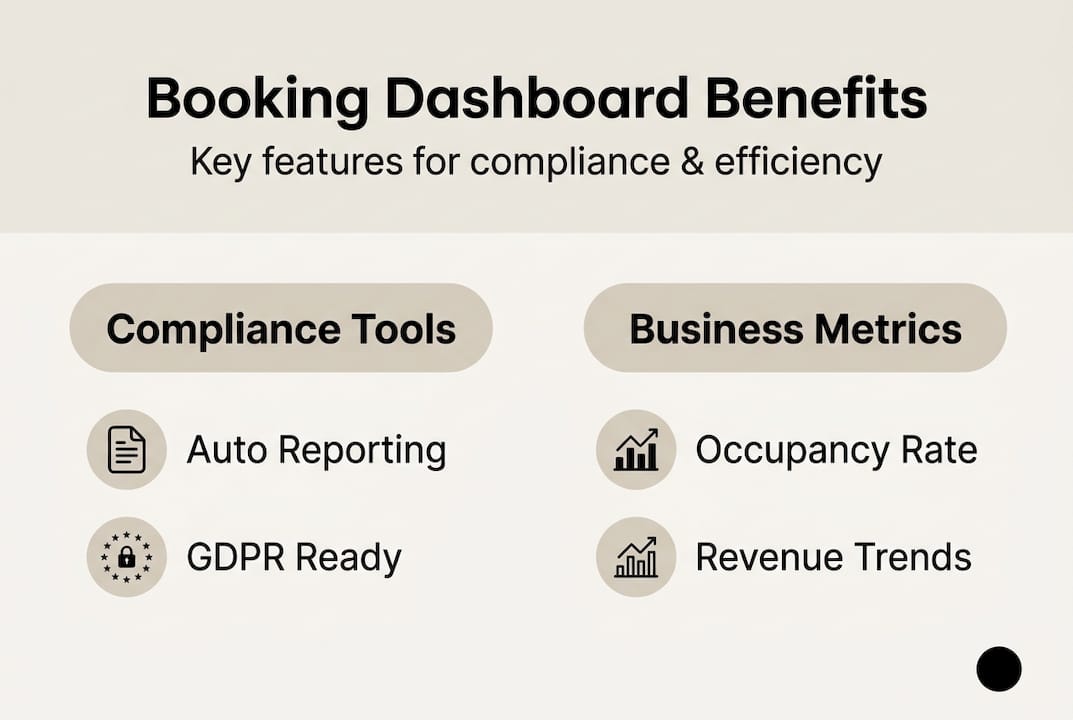
That figure matters because guest reviews directly affect your ranking on OTAs and your ability to command premium rates. A dashboard that surfaces guest satisfaction signals early, such as late check-in requests or unanswered messages, lets you intervene before a guest becomes a disappointed reviewer.
Pro Tip: Use your dashboard’s efficiency reporting tools to identify your lowest-performing properties each quarter. Even a 5% occupancy improvement on one underperforming listing can meaningfully shift your annual revenue.
Data security and privacy: protecting guest and booking information
Operational data is invaluable, but only if it stays protected. Booking dashboards keep your sensitive guest and booking information safe through a combination of technical controls and structured access management.
GDPR is not optional for European property managers. Every guest record you hold, from passport scans to email addresses, falls under its scope. A compliant booking dashboard removes the guesswork.
How booking dashboards protect your data:
- End-to-end encryption: GDPR-compliant encryption standards protect guest data both in transit and at rest, so intercepted data is unreadable without the correct decryption key.
- Role-based access control: Assign different permission levels to staff, cleaners, and co-managers. A cleaner needs check-in times, not passport numbers.
- Automatic data retention policies: Set rules for how long guest records are stored before automatic deletion, keeping you aligned with GDPR’s data minimisation principle.
- Audit logs: Every access event is recorded, so you can see who viewed or modified a guest record and when.
- Regular security updates: Reputable platforms update their security protocols in line with evolving EU legislation, so you are not left managing compliance manually.
For a deeper look at protecting your operation, explore data security in property management and the specific controls European managers should have in place.
Pro Tip: Schedule a quarterly access audit on your dashboard. Remove permissions for staff who no longer work with you and review which team members have access to full guest records. This single habit significantly reduces your data breach risk and demonstrates GDPR accountability.
Choosing the right booking dashboard for your properties
Armed with the facts, you can now make an informed decision. Here is how to compare and select the ideal booking dashboard for your needs.
Must-have features to check before committing:
- Automated regulatory compliance: Does the platform support SDEP submissions and EU Regulation 2024/1028 out of the box, or does it require manual configuration?
- OTA and PMS integrations: Check whether it connects natively with Airbnb, Booking.com, and your existing property management system.
- Analytics depth: Can you access occupancy, ADR, and revenue reports without exporting to a separate tool?
- GDPR data handling: Is encryption built in? Does the platform offer data retention controls and audit logs?
- Customer support quality: Look for platforms with dedicated onboarding support and responsive help desks, not just a knowledge base.
- Transparent pricing: Watch for platforms that charge extra for compliance features, additional properties, or API access.
Real-time dashboards cut compliance work by 50%, and G2 ratings show Hospitable scoring 4.9 out of 5 for ease of use, while Hostfully scores 4.3 out of 5. Ease of use matters because a powerful platform that your team finds confusing will not deliver its potential.
Red flags to avoid:
- Hidden costs for compliance modules or multi-property access
- No mention of GDPR or data encryption in the platform documentation
- Poor or slow customer support during the trial period
- No native integration with major OTAs
Pro Tip: Always request a live demo and a trial period before signing a contract. Use the trial to test dashboard compliance essentials specifically: create a test booking, run through the guest registration flow, and attempt a mock regulatory submission. If any step feels unclear, that is a signal worth heeding.
Our perspective: why property managers can’t afford to ignore booking dashboards any longer
Here is the honest truth that most guides skip over. Many property managers still treat booking dashboards as a convenience rather than a necessity. That mindset is becoming a liability.
The managers who will struggle most in 2026 are not those who lack technology. They are those who underestimate how much value sits in their booking data. Compliance is the obvious driver, and dashboard adoption does solve that problem effectively. But the deeper opportunity is using that same data to make genuinely better decisions about pricing, marketing, and guest experience.
Conventional workflows, manual logs, and reactive management are not just inefficient. They are actively costing you revenue and exposing you to regulatory risk. The managers who treat their dashboard as a strategic tool rather than a reporting obligation will outperform those who do not. The gap between those two groups is widening every month.
Streamline your compliance and guest management with the right solution
If you want to shift from reactive management to full control, GuestAdmin is built precisely for this moment. The platform gives European short-term rental managers a purpose-built booking dashboard that automates GDPR compliance, SDEP reporting, and guest data management without the administrative overhead.
Explore top compliance tips to see how other managers are staying ahead of EU regulation, or learn how to automate your compliance workflows from end to end. When you are ready to see it in action, GuestAdmin’s booking dashboard is available for a live demo. No more juggling portals, spreadsheets, and paperwork. Just one platform, fully in control.
Frequently asked questions
Do booking dashboards help with new EU guest registration rules in 2026?
Yes, modern booking dashboards automate compliance with EU Regulation 2024/1028, supporting guest registration and SDEP submissions so managers meet monthly reporting deadlines without manual effort.
How do booking dashboards improve guest experience?
Dashboards reduce manual errors and speed up communication, and quality dashboards have been linked to a 7% increase in 5-star reviews by helping managers respond faster and more accurately to guest needs.
What is the difference between a booking dashboard and a property management system?
A booking dashboard focuses on booking analytics and guest data reporting, while a property management system covers broader operations including finances, maintenance scheduling, and team communication.
Are booking dashboards necessary for a single property?
Absolutely. Even single-property managers benefit from automated compliance tools and secure guest data handling, as dashboards support all portfolio sizes and remove the risk of manual reporting errors.
One Comment
What is booking analytics for hospitality managers
[…] Booking dashboards for property managers: streamline compliance […]