

TL;DR:
- Automation significantly reduces compliance admin time and errors for European short-term rentals.
- It ensures digital registration, platform reporting, and data security required by 2026 regulations.
- Human oversight remains essential to address automation limitations and stay fully compliant.
European short-term rental operators face a compliance landscape that grows more demanding every year. Manual processes that once felt manageable now carry serious legal and financial risk. Automation reduces admin time by up to 87% and errors by 85% for operators across the continent, yet many property managers still rely on spreadsheets and manual portal uploads. This guide covers the regulatory changes taking effect in 2026, the specific tasks automation handles best, the real numbers behind the savings, the genuine risks to watch for, and how to choose tools that will protect your business for years ahead.
Table of Contents
- Why automation matters: The 2026 compliance landscape
- Key compliance tasks automated in short-term rentals
- Quantifying the impact: Time, error, and cost savings
- Risks and limits of automation: What managers must address
- Best practices for choosing and implementing automation tools
- Beyond the tech: What automation can’t solve in hospitality compliance
- Simplify your compliance journey with advanced automation
- Frequently asked questions
Key Takeaways
| Point | Details |
|---|---|
| New EU regulations demand automation | Digital registration and reporting are mandatory from May 2026, making automation essential for short-term rental compliance. |
| Automation massively cuts errors and admin | Switching from manual to automated compliance reduces admin work by up to 87% and errors by as much as 85%. |
| Human oversight remains vital | Even the best automation tools need manual review for legal edge cases and regulation changes. |
| Choose flexible, integrated platforms | The most effective automation tools offer local adaptation, PMS integration, and robust audit trails. |
Why automation matters: The 2026 compliance landscape
The regulatory environment for short-term rentals in Europe has shifted dramatically. EU Regulation 2024/1028759356_EN.pdf) harmonises digital registration, platform reporting, and new data requirements from May 2026, creating a single framework that applies across all member states. Every short-term rental must now be digitally registered and assigned a unique reference number, which must appear on all online listings. Platforms are required to report booking and guest data monthly to both local and central authorities through Single Digital Entry Points, known as SDEPs.
The consequences of falling short are significant. Fines for non-compliance now range from €1,000 to more than €50,000, depending on the jurisdiction and severity of the breach. For a property manager handling multiple listings across different regions, the administrative load of keeping up manually is simply unsustainable. A single missed submission or incorrect data entry can trigger a formal investigation.
Manual processes leave you exposed in several ways:
- Missed submission deadlines due to volume or oversight
- Data entry errors that trigger regulatory flags
- Inconsistent record-keeping across properties
- Difficulty tracking regulatory changes across multiple jurisdictions
- No audit trail to defend your compliance history
“The shift to digital registration and monthly platform reporting is not a future aspiration. It is a legal obligation that takes effect in 2026, and operators who are not prepared will face real consequences.”
This is precisely where automation for compliance becomes essential rather than optional. When you automate the submission, verification, and archiving of guest data, you remove the human error risk at the point where it matters most. Reviewing a compliance checklist for your portfolio is a useful starting point, but automation is what makes consistent execution possible at scale. As the 2026 property management guide makes clear, efficiency and regulatory readiness are now inseparable goals.
Now that the scale of digital change is clear, let’s see how automation delivers such dramatic results in practice.
Key compliance tasks automated in short-term rentals
Automation does not mean replacing every human decision. It means removing the repetitive, high-volume tasks that drain time and introduce errors. For short-term rental operators, the core tasks that benefit most from automation are:
- Guest data collection — capturing names, passport or ID numbers, nationality, and arrival details at check-in
- ID verification — cross-checking documents against booking records and flagging discrepancies automatically
- Regulatory submission — uploading completed guest data to portals such as SES.Hospedajes in Spain and Alloggiati Web in Italy, as well as other national systems
- Record archiving — storing guest data securely in a GDPR-compliant format with timestamped audit trails
To understand the practical difference, consider a property manager running five listings. Manually, this typically involves around 12 hours of admin work per week, with an estimated error rate of 25%. With automated guest management, the same workload drops to roughly five hours per week and the error rate falls to around 4%. That is not a marginal improvement. It is a fundamental change in how the business operates.
| Task | Manual process | Automated process |
|---|---|---|
| Admin time per week | ~12 hours | ~5 hours |
| Error rate | 18–25% | 3–4% |
| Compliance rate | 70–80% | 94%+ |
| Fine risk | High | Low |
| Audit trail | Inconsistent | Automatic |
Automation cuts admin time by 40–87% and error rates by up to 85%, while manual effort remains error-prone and time-intensive. These numbers are consistent across operators of different sizes, from individual hosts to large management companies. The rental efficiency guide reinforces that efficiency gains compound over time as your portfolio grows.

Pro Tip: Integrate property management software that syncs directly with local compliance portals and automatically generates audit trails for every submission. This single step eliminates the most common source of regulatory risk for multi-property operators.
With automation’s reach now defined, the next step is understanding not just its benefits but also the real numbers behind the transformation.
Quantifying the impact: Time, error, and cost savings
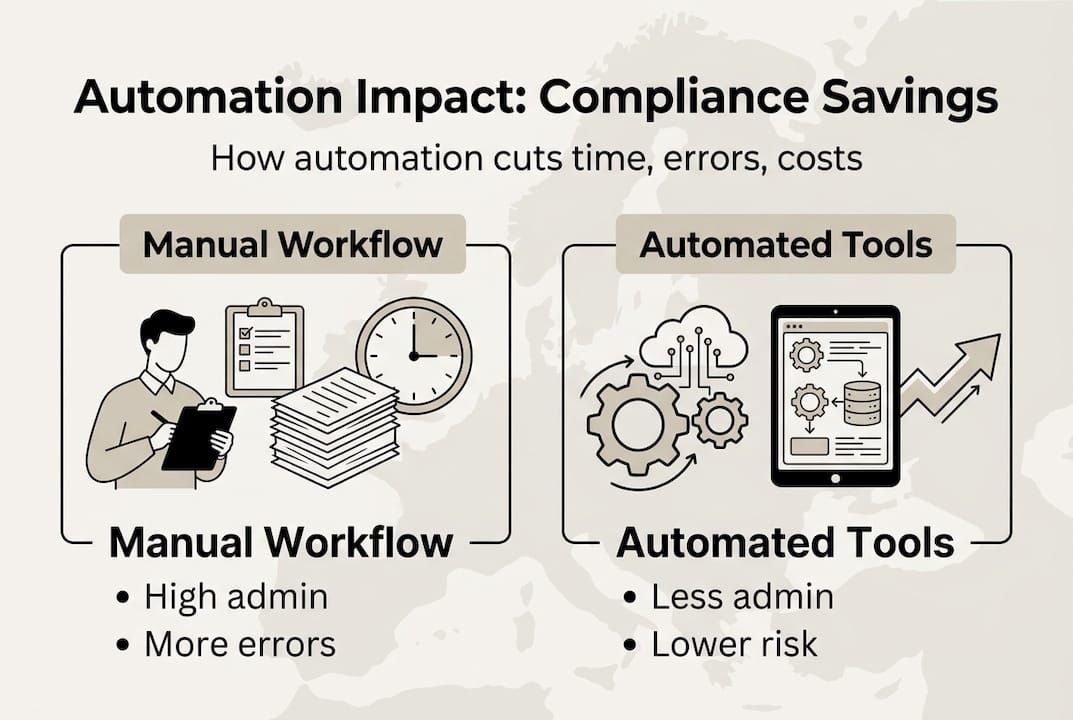
Numbers tell the clearest story. Manual error rates sit at 18–25%, with managers spending up to 12 hours per week on compliance admin. Automation achieves 94% or higher compliance rates, saves 60% of that time, and reduces errors by 85%. The AMA Registry in Greece reached a 94% compliance rate following the introduction of automated reporting tools, a benchmark that demonstrates what is achievable across the continent.
“Compliant managers gain as market supply shrinks 18–30% in regulated cities, because non-compliant operators are forced out.”
The financial picture is equally compelling. Consider the key savings across a typical portfolio:
- Time saved per week: 5–8 hours for a five-property portfolio
- Error reduction: From roughly 1 in 4 submissions to fewer than 1 in 25
- Reduced financial risk: Avoiding fines that can reach €50,000 per breach
- Compliance rate improvement: From 70–80% manually to 94%+ with automation
Non-compliance rates drop from around 30% with manual processes to single digits when technology handles submissions consistently. That gap represents real money. A single fine at the upper end of the scale could cost more than an entire year’s subscription to a compliance automation platform. The EU compliance benchmarks759356_EN.pdf) confirm that regulators are actively enforcing these standards, not simply issuing warnings.
For property managers, the return on investment from automation is not theoretical. It shows up in fewer hours spent on admin, fewer panicked corrections before deadlines, and fewer conversations with local authorities about missing submissions. Reviewing manual data pitfalls that operators commonly encounter makes it clear that most compliance failures are entirely preventable with the right tools in place.
Clear numbers build the case, but automation is not without its pitfalls.
Risks and limits of automation: What managers must address
Automation is powerful, but it is not infallible. Property managers who treat any platform as a fully hands-off solution are taking a risk that the technology itself cannot absorb. The main vulnerabilities to be aware of include:
- Privacy vulnerabilities: Automated systems that handle guest data are attractive targets for breaches. GDPR obligations remain your responsibility regardless of which tool you use.
- Integration failures: When a compliance platform loses its connection to a local government portal, submissions can fail silently. Without monitoring, you may not know until a fine arrives.
- Over-reliance on AI: AI-driven data processing is fast and largely accurate, but AI in compliance fails up to 23% of the time, and human review remains critical for edge cases.
- Lack of nuance: Automated tools struggle with unusual guest situations, name discrepancies, or document formats that fall outside their training data.
“Automation’s challenges include data breaches, integration failures, and a 23% AI fail rate; human review remains critical.”
Do not trust automated delisting or enforcement notifications without a human review step. If your platform flags a listing or triggers a compliance follow-up, a staff member needs to assess the situation before any action is taken. Automated decisions in regulatory contexts can compound errors rather than resolve them.
The automation risks and challenges that operators face are manageable with the right safeguards. Practical steps include setting up audit trails that log every submission and flag failures, scheduling quarterly tool audits to confirm integrations are functioning correctly, and developing a clear manual review process for any case the system flags as uncertain. The automation limitations discussion in wider property management circles reinforces that the strongest operations combine technology with structured human oversight.
Pro Tip: Choose compliance tools that offer both AI-powered processing for high-volume routine tasks and a built-in manual verification step for flagged or complex cases. Test the system with edge cases before full deployment, not after.
With both opportunities and risks in focus, success now means application: How do managers implement automation confidently in 2026?
Best practices for choosing and implementing automation tools
Selecting the right automation platform is not simply a matter of picking the most feature-rich option. The tool needs to match your specific regulatory context, your property management system, and your capacity for ongoing oversight. Follow this framework when evaluating your options:
- Confirm local regulation compatibility — Verify that the platform supports the specific portals and data formats required in each jurisdiction where you operate, including SES.Hospedajes, Alloggiati Web, and any regional systems.
- Insist on integration with property management systems — A compliance tool that does not connect to your existing PMS creates double-entry work and defeats the purpose of automation.
- Require unique reference and audit trails — Every submission should generate a timestamped record that you can produce in the event of an inspection or dispute.
- Test for edge cases — Before full deployment, run the system through unusual scenarios: guests with non-standard documents, last-minute bookings, and multi-night stays spanning regulatory reporting periods.
- Establish human review — Define which case types always receive a manual check, and assign clear responsibility for that review within your team.
When assessing platforms, look specifically for these features:
- Jurisdiction-adaptive rules that update automatically when local regulations change
- API connections to OTA platforms and PMS systems
- Built-in platform reporting for SDEP submissions
- Comprehensive audit logs with export capability
Jurisdiction-adaptive software, platform integrations, and layered audit controls distinguish robust solutions from basic tools. The difference matters most when regulations change mid-season and you need your platform to adapt without manual reconfiguration. Exploring automated booking compliance options that are built specifically for 2026 requirements will save significant time during the selection process.
Pro Tip: Always combine AI handling for volume tasks with manual review for complex or sensitive cases. Do trial runs with a subset of your portfolio before full rollout, and schedule a formal audit of your automation setup every quarter.
By following these best practices, property managers empower themselves not just to survive but thrive in automated compliance.
Beyond the tech: What automation can’t solve in hospitality compliance
Here is something most guides on this topic do not say plainly: technology alone will not make you compliant. Automation handles volume and consistency brilliantly, but it cannot replace regulatory agility, operational judgement, or the ability to adapt quickly when rules change mid-season.
The managers who gain the most from automation are those who treat it as infrastructure, not a substitute for expertise. They use platforms to handle routine submissions while maintaining clear internal procedures for anything outside the ordinary. They review their tools regularly, not just when something goes wrong.
There is also a competitive dimension that rarely gets discussed. As compliance pressure forces casual or unprepared operators out of regulated markets, the supply of available short-term rentals in major cities is shrinking by 18–30%. That is a genuine opportunity for professional operators who have their compliance processes in order. Following manager compliance tips from operators who have navigated this shift successfully reveals a consistent pattern: the winners combine strong automation with robust human processes, not one or the other.
Simplify your compliance journey with advanced automation
The insights in this guide point to one practical conclusion: the right automation platform, implemented thoughtfully, transforms compliance from a burden into a competitive advantage.
GuestAdmin.io is built specifically for European short-term rental operators who need reliable, jurisdiction-adaptive compliance automation. From real-time portal submissions to multi-property dashboards, the key automation features are designed to handle the full compliance workflow without adding complexity to your day. Whether you manage two properties or two hundred, the multi-property workflow tools scale with your portfolio. Start with a workflow audit or explore how to automate booking compliance across all your listings today.
Frequently asked questions
What local guest data reporting duties can be automated in Europe?
Tasks such as ID collection, daily or monthly portal uploads to SES.Hospedajes and Alloggiati Web, form filing, and error flagging are now fully automatable with specialised platforms, removing the need for manual data entry at each step.
How can automation reduce the risk of non-compliance fines?
By eliminating manual data entry and ensuring consistent, timely submissions, automation reduces human error significantly. Automated tools reduce errors by up to 85%, helping operators avoid fines that can reach €50,000 per breach.
Is automation enough to guarantee legal compliance?
No. Automation is a critical tool but still requires human oversight, regular updates, and integration checks. AI solutions have a 23% fail rate, which means human review remains an essential part of any compliant operation.
What should I look for in an automated compliance tool for short-term rentals?
Prioritise platforms with jurisdiction-adaptive rules, integration with your PMS, comprehensive audit controls, and the capacity to combine AI processing with manual review. Adaptive rules and audit trails are the features that separate genuinely robust tools from basic alternatives.
3 Comments
Why hospitality SaaS is essential for compliance success
[…] changes automatically. The cost of getting this wrong is simply too high. For more on how automation transforms compliance for European operators, the direction of travel is […]
Step-by-step guide to automating hospitality compliance
[…] automation in hospitality compliance relies on connecting the right tools. Here is what your compliance stack should […]
Automation trends in hospitality 2026: the operator's guide
[…] data to government authorities within strict timeframes. Manual processes create risk. Automated compliance reporting for rentals removes that risk by processing guest data and submitting it within required windows, with full […]