

TL;DR:
- Effective guest onboarding sets the tone for a positive stay, builds trust, and minimizes disputes. Proper preparation, transparent communication, and automated compliance ensure operational readiness and legal adherence. Focusing on structured, scalable processes enhances guest retention and reduces operational risks as property management scales.
Getting guest onboarding right is one of the most consequential decisions you will make as a short-term rental owner. Done well, it sets the tone for the entire stay, builds trust, and reduces the friction that leads to poor reviews and early departures. Done poorly, it creates confusion, disputes, and costly gaps in compliance. These property owner onboarding tips are designed to cut through the generic advice and give you a concrete, practical framework, whether you are managing one flat in Lisbon or a portfolio of apartments across multiple European cities.
Table of Contents
- Key takeaways
- 1. Define what successful property owner onboarding looks like
- 2. Prepare the property thoroughly before every arrival
- 3. Establish transparent communication and documentation from day one
- 4. Use technology and automation to handle compliance and operations
- 5. Build a responsibility matrix to avoid operational gaps
- 6. Compare onboarding strategies by property type and scale
- My honest take on what most property owners get wrong
- Simplify your onboarding with the right tools
- FAQ
Key takeaways
| Point | Details |
|---|---|
| Preparation prevents disputes | Document property condition with dated photos and signed reports before every guest arrival. |
| Transparency builds trust | Guests are far more likely to stay and rebook when all costs and terms are disclosed upfront. |
| Technology reduces human error | Automated data collection and compliance tools remove the manual mistakes that cause regulatory problems. |
| Compliance is non-negotiable | Short-term rental regulations across Europe require timely, accurate guest data submission to authorities. |
| Structured checklists signal professionalism | A structured onboarding checklist directly correlates with client retention and reduced early guest loss. |
1. Define what successful property owner onboarding looks like
Before you can apply any property owner onboarding tips, you need a clear picture of what you are aiming for. Effective onboarding is not just handing over keys. It is the entire process from the moment a booking is confirmed to the point a guest is settled, comfortable, and clear on what to expect.
The core criteria for successful property management onboarding are:
- Clear communication: Guests receive accurate information about the property, rules, and local area before arrival.
- Transparent terms: All fees, deposits, and cancellation policies are disclosed in writing before check-in.
- Regulatory compliance: Guest data is collected and submitted to the relevant authorities in accordance with local short-term rental laws.
- Operational readiness: The property is clean, safe, and fully functional at the time of handover.
- Technology integration: Digital tools handle repetitive tasks so your team focuses on the guest experience.
Every tip that follows maps back to one or more of these criteria. Keep them visible as your reference point.
Pro Tip: When setting up your landlord onboarding checklist, organise it by these five criteria rather than by task type. This makes it far easier to spot gaps and train new team members quickly.
2. Prepare the property thoroughly before every arrival
This is the tip most property owners underestimate. Not because they do not care, but because they assume the previous guest left things in reasonable order. They rarely do.

A professional inspection covers 31 critical points across six core sections, typically taking 60 to 90 minutes per property. That includes checking appliances, plumbing, lighting, furniture condition, safety equipment, and outdoor areas. Skipping any section creates liability.
Beyond the inspection, there are two tasks that experienced managers treat as non-negotiable:
- Change all exterior locks between guest stays or when onboarding a new property into your portfolio.
- Photograph every room with dated photo documentation and keep a signed move-in condition report.
These two steps alone resolve the majority of deposit disputes before they escalate. Guests cannot credibly claim damage that exists in your timestamped record.
“Early documentation with dated photos and signed move-in reports protect against future disputes and eliminate ambiguity about property condition at the point of handover.”
Schedule cleaning and maintenance at least 48 hours before arrival, not the morning of. This gives you a buffer to address anything unexpected, and it signals to guests arriving early that the property was properly prepared for them, not rushed.
Pro Tip: Keep a digital copy of your inspection report in your property management platform, linked to the specific booking. If a dispute arises six months later, you need that record accessible in seconds, not buried in an email thread.
3. Establish transparent communication and documentation from day one
95% of residents want all costs and lease terms disclosed clearly before they commit. In short-term rentals, this expectation is even higher because guests are making decisions quickly and often remotely.
Transparent communication during onboarding covers several areas that are easy to overlook:
- Provide a written summary of all fees, including cleaning charges, tourist taxes, and security deposit terms, before the booking is confirmed.
- Use a digital lease or rental agreement that guests sign before arrival, not on the doorstep.
- Set up a dedicated channel for guest inquiries, whether that is a messaging thread, a WhatsApp number, or a portal. Make the response time expectation clear.
- Offer optional services, such as airport transfers, late check-out, or local experience packages, as part of a transparent benefit package. Opt-in benefit packages improve both guest wellbeing and retention when presented clearly.
- Explain how and where guests can access property information during their stay, including Wi-Fi details, appliance instructions, and emergency contacts.
Consistent communication during onboarding is one of the most reliable ways to build owner and guest confidence. When guests know exactly what to expect and have a clear route to get help, they are far less likely to leave a negative review, even when minor issues arise.
For property managers working with multiple owners, weekly owner updates during the leasing and onboarding phase are a recognised best practice for maintaining trust and demonstrating professionalism.
4. Use technology and automation to handle compliance and operations
Manual onboarding processes do not scale. If you are managing three or more properties, the administrative load of collecting guest data, submitting it to local authorities, tracking bookings across platforms, and maintaining compliance records will consume your time completely. Technology removes that burden.
Here is how automation changes the onboarding equation:
| Task | Manual approach | Automated approach |
|---|---|---|
| Guest data collection | Paper forms at check-in | Digital pre-arrival forms via PMS |
| Regulatory submission | Manual portal uploads per booking | Automatic submission within 24 hours |
| Inspection records | Paper checklists, emailed photos | Digital reports linked to bookings |
| Compliance monitoring | Calendar reminders, spreadsheets | Real-time dashboard alerts |
| Multi-property management | Separate logins per platform | Single interface, all properties |
Technology automation such as default charge schedules, interface auto-balancing, and integrated compliance tools significantly reduces human error during onboarding. The compliance piece is particularly critical for short-term rental operators in Europe, where guest registration requirements vary by country and local authority.
Guestadmin is built specifically for this. It captures, processes, and submits guest data to the relevant government authorities automatically, with AI-powered processing that meets digital onboarding standards across European jurisdictions. Your team does not need to log in to multiple portals or maintain separate spreadsheets. One platform handles it all.
When selecting and implementing your technology stack, prioritise software go-live and team training before attempting system-wide changes. Getting your core platform functional and your team confident is more valuable than implementing every feature at once.
5. Build a responsibility matrix to avoid operational gaps
One of the least discussed but most damaging onboarding failures is unclear task ownership. When everyone assumes someone else is handling compliance submissions, inspection sign-offs, or guest communication, things fall through the gaps. And in a regulated industry, gaps are expensive.
Effective onboarding needs a clear responsibility matrix that assigns specific tasks to specific roles. This is not about bureaucracy. It is about making sure that when a guest checks in at 11pm on a Friday, someone owns that process from start to finish.
A practical responsibility matrix for short-term rental onboarding should define who handles:
- Pre-arrival inspection and sign-off
- Guest communication before and during the stay
- Regulatory data submission and compliance reporting
- Deposit management and damage documentation
- Post-stay review and property reset
For solo operators, this matrix is still useful. It becomes your personal checklist, organised by role rather than by day. For managers with a team, it is the document that prevents your best-performing member from becoming a single point of failure.
6. Compare onboarding strategies by property type and scale
Not every tip applies equally to every situation. A sole owner managing a holiday cottage in Cornwall has different priorities than a management company handling 40 apartments in Barcelona. This comparison helps you prioritise.
| Strategy | Best for | Ease of implementation | Impact on guest satisfaction |
|---|---|---|---|
| Dated photo documentation | All property types | High | High (dispute prevention) |
| Digital lease agreements | Urban short-term rentals | Medium | High (transparency) |
| Automated compliance tools | Multi-property operators | Medium | Medium (operational) |
| Responsibility matrix | Teams of 2 or more | Medium | High (consistency) |
| Opt-in guest benefit packages | Premium and luxury rentals | Low | High (retention) |
| Weekly owner communication | Managed properties | High | High (trust building) |
For multi-property management, the compliance and automation strategies carry the most weight. The manual approaches that work fine for one property create serious bottlenecks at scale.
Budget-conscious owners should start with the high-impact, low-cost strategies: dated documentation, a written responsibility matrix, and clear pre-arrival communication templates. These require time, not money, and they deliver measurable results in dispute reduction and guest satisfaction.
Satisfied guests are significantly less likely to leave a negative review or cancel early. The data shows 45% of satisfied residents plan to move within 12 months, compared to 68% of unsatisfied ones. That gap is largely determined by what happens in the first 24 hours of a stay.
My honest take on what most property owners get wrong
I have worked with a wide range of property owners, from first-time hosts to operators running dozens of short-term lets across multiple cities. The pattern I see consistently is not that people do not know what good onboarding looks like. They do. The problem is execution under time pressure.
Most owners try to fix everything at once when they onboard a new property or implement a new process. They want the perfect inspection checklist, the perfect welcome pack, the perfect compliance setup, all before the first guest arrives. The result is a rushed, incomplete version of all three.
What I have found actually works is sequencing. Get your compliance and documentation processes right first. They carry the most legal and financial risk. Then refine your guest communication. Then layer in the guest experience enhancements. Each stage builds on a stable foundation.
The other thing I see underestimated is the trust signal that a structured, professional onboarding process sends to guests. When a guest receives clear pre-arrival information, a property that matches its listing, and a frictionless check-in, they start from a position of confidence. They are far less likely to scrutinise every minor issue. That shift in guest psychology is worth more than any number of premium amenities added without a solid onboarding process underneath them.
Do not try to be excellent at everything immediately. Be reliable first. Excellence follows.
— Alex
Simplify your onboarding with the right tools
If you are reviewing your onboarding process and realising how much is still manual, you are not alone. Most short-term rental operators in Europe are managing compliance, guest data, and multi-platform bookings with a patchwork of tools that were never designed to work together.
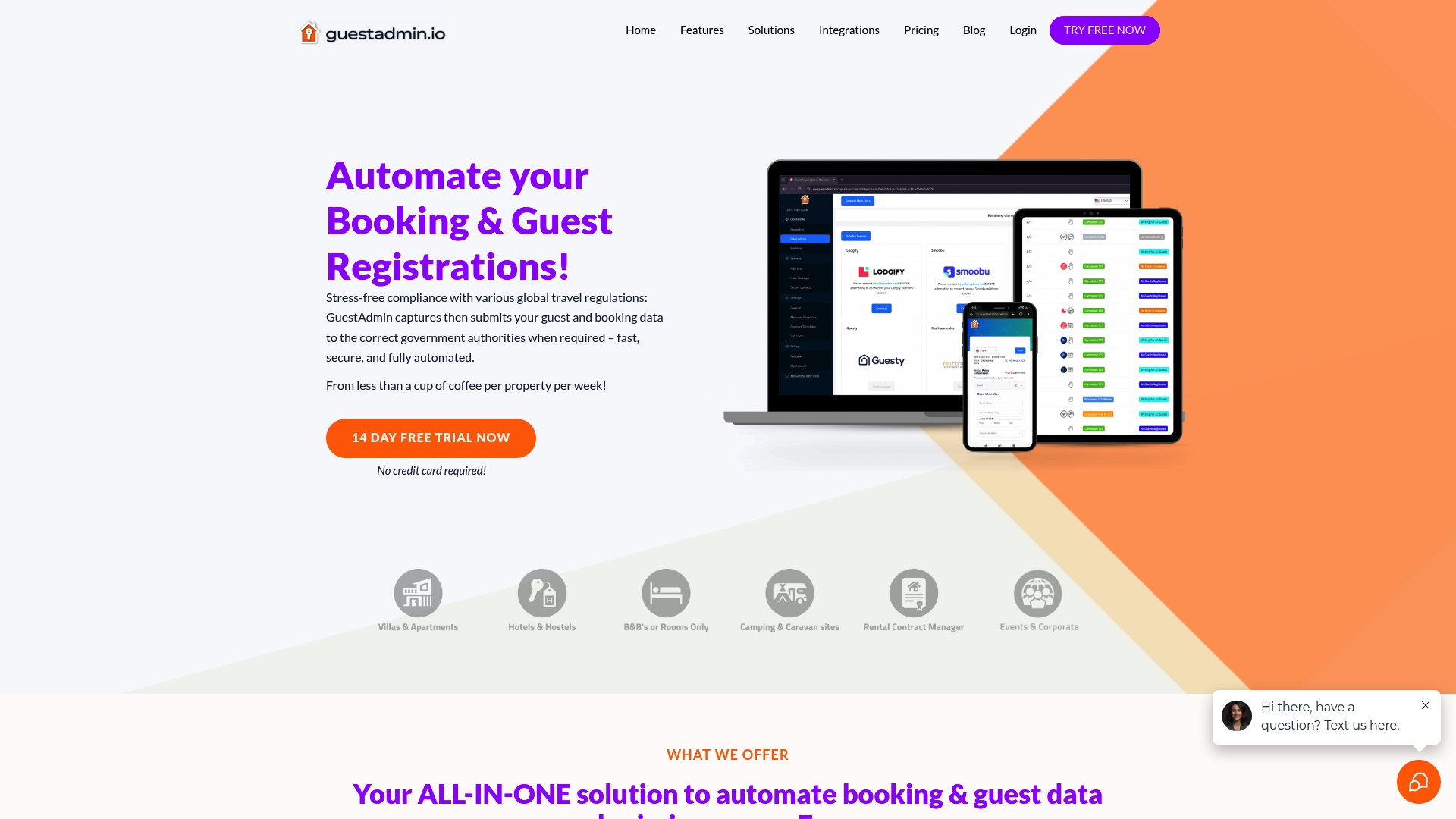
Guestadmin brings all of that together in one place. The platform automates guest data collection, handles regulatory submissions across European jurisdictions, and gives you a real-time dashboard across all your properties. Whether you are managing two apartments or two hundred, it removes the administrative load that slows your onboarding down and creates compliance risk.
Start with the top property management software comparison to see how the leading platforms stack up for short-term rental onboarding. Or if you want to see how Guestadmin handles short-term rental compliance for your specific property setup, book a demo and speak to the team directly.
FAQ
What is the most important step in guest onboarding?
Thorough property preparation with dated documentation is the single most protective step. It prevents disputes, signals professionalism, and creates a legal record before guests arrive.
How does a landlord onboarding checklist improve guest retention?
A structured checklist correlates directly with client retention by reducing the inconsistencies and gaps that lead to poor first impressions and early departures.
What technology do short-term rental owners need for compliance?
You need a platform that automates guest data collection and submits it to local government authorities within the required timeframe. In Europe, requirements vary by country, making automated tools far more reliable than manual processes.
When should I implement automation in my onboarding process?
Prioritise your core platform and team training first, then expand automation incrementally. Attempting to automate everything before your team understands the workflow creates more problems than it solves.
How does guest satisfaction connect to onboarding quality?
Research shows that satisfied guests plan to move at a rate of 45% versus 68% for unsatisfied guests. The difference is largely determined by the quality of the onboarding experience in the first 24 hours of arrival.
One Comment
Short-term rental onboarding checklist for Europe
[…] you open a checklist, you need a clear framework. Effective rental property onboarding balances three things: legal compliance, property readiness, and guest experience. Miss any one of […]