

TL;DR:
- Securing guest data involves protecting sensitive information using technical, legal, and staff discipline measures.
- Strong data protection builds guest trust, reduces operational risks, and ensures compliance with GDPR and ICO standards.
Securing guest data is defined as the practice of protecting sensitive personal information collected during the booking and stay process through technical controls, legal compliance, and staff discipline. For property managers operating across Europe, this means safeguarding names, passport numbers, payment details, and travel records under frameworks including the General Data Protection Regulation (GDPR) and guidance from the Information Commissioner’s Office (ICO). Why secure guest data matters is not simply a legal question. It is a business question, and the answer affects your reputation, your revenue, and your guests’ trust in you.
What are the main risks of unsecured guest data?
Unprotected guest data exposes property managers to three distinct categories of harm: regulatory penalties, reputational damage, and operational disruption. Each one compounds the others. A single breach can trigger an ICO investigation, generate negative press, and cause a wave of cancellations simultaneously.
Ransomware attacks on hospitality businesses halt booking systems and freeze access to guest records. The operational impact is immediate. Staff cannot check guests in, refunds cannot be processed, and the property’s reputation suffers damage that takes months to repair.
The risks of unprotected guest data are not theoretical. Cybercriminals target hospitality businesses precisely because they hold high volumes of personal and payment data, often with weaker controls than financial institutions.
The most common failure points property managers face include:
- Absent multi-factor authentication (MFA): Without MFA, a single stolen password unlocks every guest record in your system.
- Excessive data retention: Holding guest data far beyond its useful period increases the volume of information exposed in any breach.
- Broad staff access: Giving all staff access to all guest records, rather than only what their role requires, multiplies the risk of both accidental and deliberate leaks.
- Unencrypted data in transit: Guest information sent between systems without encryption can be intercepted.
Human error remains a leading cause of data breaches in hospitality. That means the risk is not only external. An untrained member of staff forwarding a guest list to the wrong email address, or leaving a spreadsheet on a shared drive, creates the same exposure as a sophisticated cyberattack.
How do current regulations shape guest data protection?
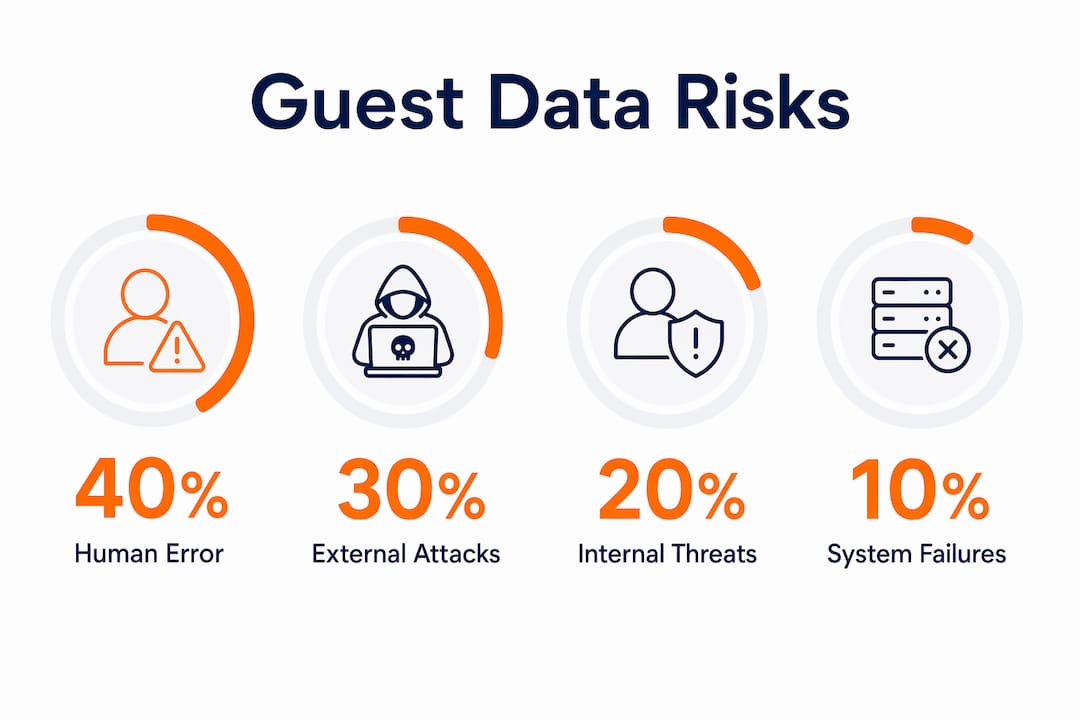
GDPR sets the legal baseline for guest data protection across Europe, and ICO enforcement in 2022 and 2023 made the hospitality sector’s weak points very clear. ICO enforcement themes include the absence of MFA, over-retention of guest data, and broad staff access without a legitimate reason. These are not edge cases. They are the most common failures found during investigations.
For property managers operating short-term rentals in the EU, the practical compliance requirements break down into four areas:
- Lawful basis for collection: You must have a clear legal reason to collect each piece of guest data, whether that is a contractual obligation, a legal requirement, or explicit consent.
- Data minimisation: Collect only what you genuinely need. If a local authority requires a guest’s nationality and date of birth, you do not need their dietary preferences stored in the same record.
- Retention limits: Guest personal data should not be held indefinitely. Automated retention policies that delete personal information 180 days after checkout reduce compliance risk significantly.
- Access controls and audit trails: Only staff with a legitimate need should access guest records. Detailed audit trails recording timestamps and user IDs are the only reliable evidence you can present during a compliance audit.
| Compliance requirement | What it means in practice |
|---|---|
| Lawful basis | Document why you collect each data field before you collect it |
| Data minimisation | Remove fields from forms that serve no compliance or operational purpose |
| Retention limits | Set automated deletion at 180 days post-checkout as a default |
| Role-based access | Restrict system permissions to the minimum needed for each staff role |
| Audit trails | Log every access event with a timestamp and user identifier |
Transparent data handling policies also matter. Guests have the right to know what you collect, why you collect it, and how long you keep it. A clear privacy notice is not just a legal formality. It signals to guests that you take their information seriously, which directly affects their willingness to book again.
Pro Tip: Review your privacy notice annually and update it whenever you add a new booking channel or property management system. Outdated notices are a common trigger for ICO enquiries.
What practical steps protect guest information effectively?
The most effective guest data protection strategies combine technical controls with staff behaviour and process discipline. No single measure is sufficient on its own.

Start with a data flow audit. Mapping every system that touches guest data reveals shadow IT, unencrypted transfers, and over-permissive API keys that most property managers do not know exist. A data flow audit is the foundation of every other security decision you make.
Once you know where your data lives, apply the following controls:
- Encryption at rest and in transit: All guest data stored in your systems and all data moving between systems must be encrypted. This applies to your property management system (PMS), your booking channel integrations, and any cloud storage you use.
- Granular role-based access: Off-the-shelf PMS platforms often grant all-or-nothing access rather than role-specific permissions. Audit your current setup and restrict access so that a housekeeper cannot view payment records and a finance manager cannot edit guest passport details.
- Zero Trust principles: Apply a “never trust, always verify” approach to every access request. Require authentication even for internal systems, and treat every login as a potential threat until verified.
- Automated data purging: Set your systems to delete guest personal data automatically after the retention period expires. Manual deletion processes fail because they depend on someone remembering to act.
- Staff training: Cybersecurity awareness among staff is as important as any technical control. Train your team to recognise phishing attempts, handle guest data with discretion, and report suspicious activity immediately.
Internal notes and ad hoc attachments in your PMS are a frequently overlooked risk. Audit trails covering guest data access including who viewed what and when, give you the evidence needed to demonstrate compliance and identify any internal misuse quickly.
For property managers running multiple units, the complexity multiplies. Each property may use different systems, different staff, and different booking channels. A centralised approach to access control and data retention, supported by a platform that integrates across all your properties, is the only way to maintain consistent standards at scale. Guestadmin’s multi-property compliance tools are built specifically for this challenge.
How does securing guest data build trust and grow your business?
Guest data protection is not only a compliance obligation. Industry experts identify data transparency as a genuine competitive advantage that drives guest loyalty beyond what legal requirements alone can achieve.
Guests who trust that their data is handled with care are more likely to return and more likely to recommend your property. Transparency about what you collect and why is now a market differentiator, not just a legal formality.
The benefits of securing guest data extend well beyond avoiding fines. Property managers who invest in strong data protection practices see measurable business gains:
- Repeat bookings: Guests who feel their information is safe are more likely to book directly rather than through a third-party channel, reducing your commission costs.
- Reduced operational disruption: A ransomware attack or data breach can shut down your operations for days. Strong security prevents that disruption before it happens.
- Positive reviews: Guests notice when check-in is smooth, data collection is clear, and their information is handled professionally. That experience feeds into reviews and referrals.
- Regulatory confidence: Property managers with documented security practices face ICO investigations with evidence rather than excuses. That confidence has real financial value.
Being explicit about data collection and protection builds competitive advantage. A simple, clear statement at check-in explaining what data you collect and why costs nothing to implement. Its effect on guest confidence is significant.
Key takeaways
Securing guest data protects your business from regulatory penalties, operational disruption, and reputational damage while building the guest trust that drives repeat bookings.
| Point | Details |
|---|---|
| Regulatory compliance is non-negotiable | GDPR and ICO enforcement target MFA absence, over-retention, and broad access as the most common failures. |
| Data flow audits reveal hidden risks | Mapping every system that handles guest data uncovers unencrypted transfers and over-permissive access before a breach does. |
| Automated retention reduces exposure | Deleting guest personal data 180 days after checkout cuts compliance risk without manual effort. |
| Staff training is a technical control | Human error causes a significant share of breaches; training is as important as encryption or access restrictions. |
| Transparency drives loyalty | Guests who understand how their data is used are more likely to return and book directly. |
Data security is a management decision, not just an IT problem
After working with property managers across Europe, the pattern I see most often is this: security is treated as something the IT provider handles, not something the business owns. That assumption is the single most dangerous gap in hospitality data protection.
The ICO does not fine your software vendor when guest data is breached. It fines you. That means the decision to implement MFA, restrict staff access, and set automated deletion policies belongs to you as the property manager, not to the platform you use. Technology makes these controls easier to apply, but the decision to apply them is yours.
The property managers who handle this well share one habit: they treat data security as a recurring management agenda item, not a one-time setup task. They review access permissions when staff change roles. They check retention settings when they add a new booking channel. They train new staff before giving them system access, not after. That discipline is not complicated. It is consistent.
If you manage multiple properties, the stakes are higher and the complexity is greater. A breach at one property can expose data from all of them if your systems share access credentials or centralised storage. Building security into your management workflow from the start is far less costly than recovering from a breach later.
— Alex
How Guestadmin supports secure guest data management
Property managers who want to meet 2026 compliance standards without building a security team from scratch have a practical option.
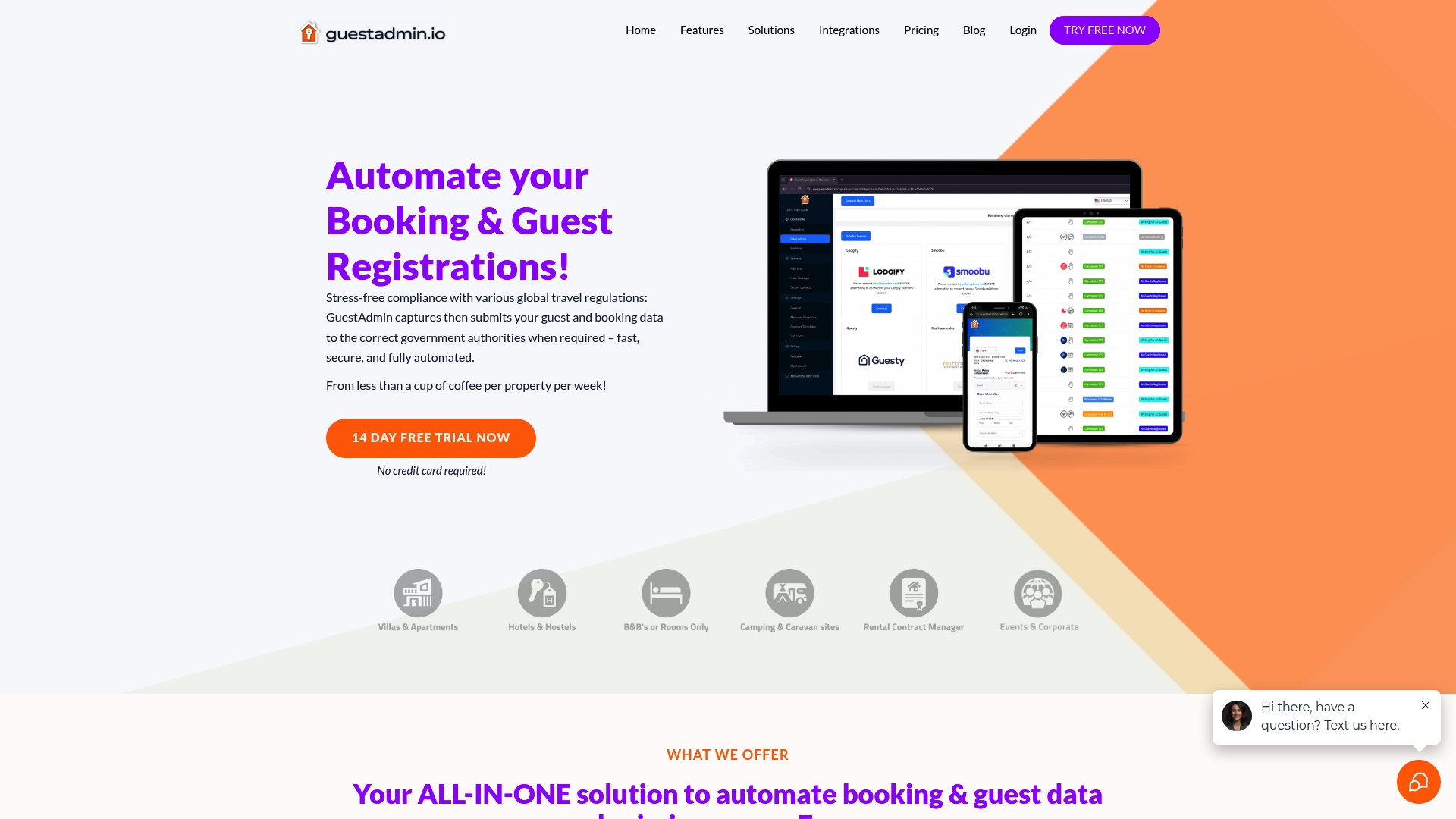
Guestadmin automates the compliance workflows that create the most risk when handled manually: guest data capture, submission to government authorities, and data archiving. The platform applies GDPR-compliant access controls by default, integrates with your existing PMS and booking channels, and gives you a real-time dashboard across all your properties. For managers running multiple units, Guestadmin’s short-term rental compliance tools remove the administrative burden of tracking different regulatory requirements across different jurisdictions. You can also review the top property management software options to see how Guestadmin compares on security and compliance features.
FAQ
What is guest data security in hospitality?
Guest data security is the practice of protecting personal information collected from guests, including names, passport details, and payment records, through encryption, access controls, and GDPR-compliant retention policies.
Why does the ICO focus on hospitality businesses?
The ICO targets hospitality because the sector frequently fails on MFA, excessive data retention, and broad staff access, which are the three most common causes of preventable breaches in the industry.
How long should property managers retain guest data?
Automated retention policies that delete guest personal information 180 days after checkout represent current best practice and significantly reduce compliance risk under GDPR.
What is a data flow audit and why does it matter?
A data flow audit maps every system that handles guest data, identifying unencrypted transfers, shadow IT, and over-permissive API keys that create hidden exposure risks.
How does guest data security affect repeat bookings?
Guests who trust that their personal information is handled transparently and securely are more likely to book directly and return, reducing reliance on third-party booking channels and their associated commission costs.