

Many property owners treat data security as purely an IT concern, delegating responsibility to technical staff whilst focusing on bookings and guest experience. This mindset exposes your rental business to severe financial penalties and operational risks under GDPR regulations. European authorities have issued fines reaching millions for data breaches, and non-compliance can result in licence revocation. Understanding data security isn’t optional anymore; it’s a fundamental business requirement. This guide reveals why securing guest information protects your revenue, reputation, and legal standing whilst providing actionable strategies to achieve compliance efficiently.
Table of Contents
- Key takeaways
- Understanding the legal importance of data security in rentals
- Core data security practices for short-term rental managers
- Challenges and nuances in GDPR compliance across Europe’s rental markets
- Leveraging automation and technology to enhance data security and compliance
- Protect your rental business with GuestAdmin
- Frequently asked questions
Key Takeaways
| Point | Details |
|---|---|
| GDPR penalties | Fines can reach up to four per cent of turnover and licences may be revoked for non compliance. |
| Automation advantage | Automation tools streamline compliance tasks and reporting, reducing workload and errors. |
| Data minimisation | Collect only information necessary for legal compliance and service delivery. |
| Security foundations | Encryption, access controls and audit trails protect guest data at rest and in transit. |
Understanding the legal importance of data security in rentals
GDPR establishes comprehensive rules for processing personal information across the European Union, directly impacting how you handle guest data in short-term rentals. Every booking generates protected information: full names, dates of birth, nationality details, identification documents, payment credentials, and increasingly data from smart locks or thermostats. GDPR mandates secure processing with fines reaching 4% of turnover alongside local penalties ranging from €1,000 to €50,000 per violation.
Real consequences demonstrate these aren’t theoretical risks. Booking.com faced a €560,000 fine for delayed breach notification affecting 4,100 customers, whilst Marriott received an £18.4 million penalty following a breach exposing 383 million records. These cases involved established hospitality operators with dedicated compliance teams, highlighting how easily smaller property managers can fall foul of regulations.
The urgency intensifies with strict reporting deadlines. Many jurisdictions require guest data submission within 24 hours of check-in, leaving minimal margin for errors or delays. Missing these windows triggers immediate regulatory scrutiny and potential sanctions. Beyond legal obligations, data breaches destroy the trust guests place in you when sharing sensitive documents.
“Securing guest data isn’t just regulatory compliance; it’s protecting the foundation of your rental business and customer relationships.”
Your dual responsibility encompasses both legal adherence and business continuity. A single breach can result in:
- Immediate fines from data protection authorities
- Loss of operating licences in regulated markets
- Reputational damage reducing future bookings
- Legal claims from affected guests
- Increased insurance premiums
Understanding legal compliance for rentals in Europe transforms data security from an abstract IT concept into a concrete business priority requiring systematic attention and resources.
Core data security practices for short-term rental managers
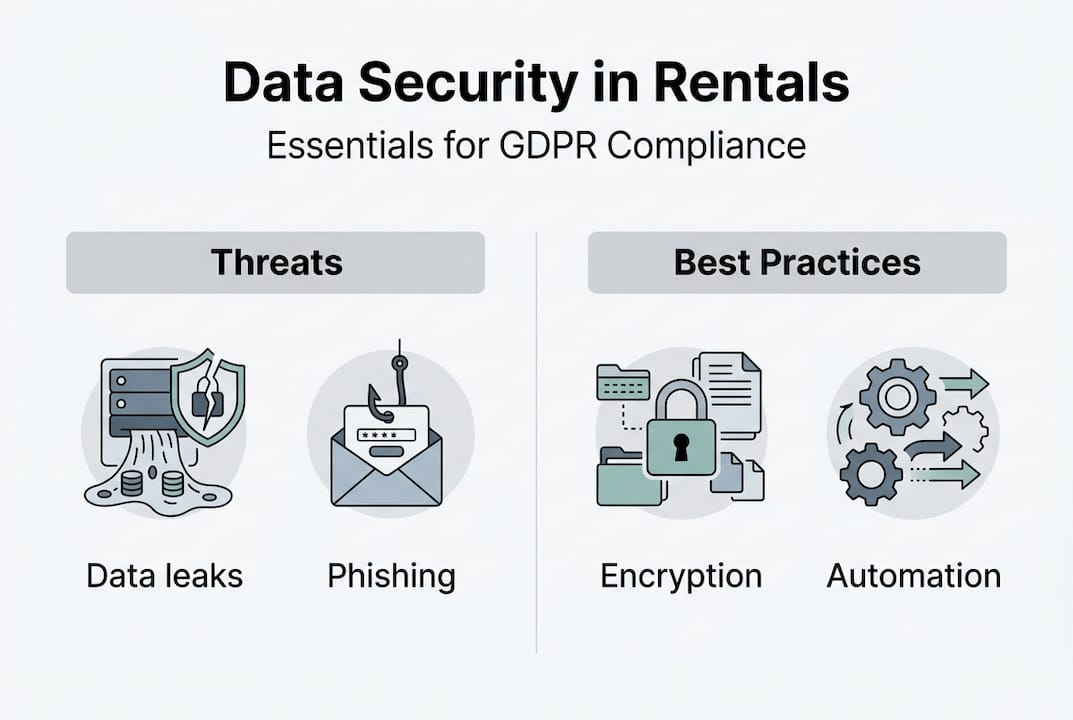
Implementing robust security measures protects guest information whilst demonstrating regulatory compliance. Key methodologies include encrypting data at rest and in transit, implementing access controls, maintaining audit trails, performing regular backups, practising data minimisation, establishing retention and deletion policies, and using GDPR-compliant cloud storage.

Physical and logical controls form your first defence layer. Encryption renders data unreadable to unauthorised parties even if systems are compromised. Access restrictions ensure only necessary staff view sensitive information, with unique credentials enabling accountability. Audit logs track every interaction with guest data, creating transparent records for regulatory inspection. These technical safeguards must operate continuously, not just during audits.
Policies governing data lifecycle prove equally critical. Data minimisation means collecting only information required for legal compliance and service delivery. Retention periods typically span 2-6 years depending on jurisdiction, after which systematic deletion must occur. Clear procedures for secure disposal prevent abandoned data becoming liability.
| Security practice | Purpose | Compliance benefit |
|---|---|---|
| End-to-end encryption | Protects data during transmission and storage | Demonstrates technical safeguards to regulators |
| Role-based access controls | Limits data exposure to authorised personnel only | Reduces breach risk and enables accountability |
| Automated audit trails | Records all data access and modifications | Provides evidence of due diligence during investigations |
| Scheduled data deletion | Removes information after retention period expires | Minimises exposure and satisfies GDPR principles |
| Regular security assessments | Identifies vulnerabilities before exploitation | Shows proactive compliance management |
Automating data collection and reporting reduces errors and workload by roughly 60%, according to industry analysis. Integration between property management systems and online travel agencies creates single data entry points, eliminating duplicate handling that multiplies breach opportunities. Real-time monitoring alerts you to compliance gaps before they escalate into violations.
Pro Tip: Regular cybersecurity training for staff prevents common threats like phishing attacks that bypass technical controls. Human error causes most breaches, making education as important as technology.
Successful property management compliance combines these elements into cohesive systems rather than treating them as isolated tasks. Automation in rentals compliance enables consistent application across all properties and bookings whilst freeing your time for guest experience improvements.
Challenges and nuances in GDPR compliance across Europe’s rental markets
Navigating compliance complexity requires understanding five persistent challenges property managers face:
- Jurisdictional variations in reporting timelines and data requirements across countries
- Breach notification deadlines demanding rapid response capabilities
- Over-retention of guest information beyond legal requirements
- Phishing and social engineering attacks targeting staff with data access
- Multi-jurisdiction operations requiring simultaneous compliance with conflicting rules
Jurisdictional variations create confusion, with Spain requiring 24-hour reporting whilst France maintains different retention rules. Late breach reports have triggered penalties like Booking.com’s €560,000 fine, demonstrating how procedural failures compound initial security lapses. Regional nuances mean blanket policies often fail, requiring tailored approaches for each operating location.
Ignoring these subtleties carries tangible consequences. Airbnb received regulatory reprimands for excessive identification document storage beyond necessary verification periods. What seems like thorough record-keeping becomes liability when retention exceeds legal justification. The principle of data minimisation demands continuous evaluation of what you actually need versus what you habitually collect.
Breach reporting under GDPR’s 72-hour rule requires prepared response protocols:
- Immediately contain the breach to prevent further data exposure
- Assess the scope and severity of compromised information
- Document all breach details including timeline and affected records
- Notify your data protection authority within 72 hours of discovery
- Inform affected guests if the breach poses high risk to their rights
- Implement corrective measures to prevent recurrence
Mergers and acquisitions introduce inherited security debts. Marriott’s £18.4 million fine stemmed from a breach in systems acquired during a merger, demonstrating how due diligence failures create lasting liability. When acquiring properties or management contracts, thorough security audits must precede integration.
“The financial and reputational damage from mishandling data security complexities far exceeds the investment required for proper compliance systems and expertise.”
Understanding property owner responsibilities in EU rentals clarifies your accountability regardless of operational structure. Whether managing properties directly or through agencies, ultimate responsibility for guest data security remains with the controller who determines processing purposes. This legal reality makes delegation risky without robust oversight and contractual protections.
The property management compliance checklist for Europe 2026 addresses these regional variations systematically, providing jurisdiction-specific guidance that generic advice cannot match.
Leveraging automation and technology to enhance data security and compliance
Technology transforms data security from overwhelming burden into manageable process. Automation delivers measurable advantages:
- Error reduction through systematic data validation and processing
- Time savings averaging 60% compared to manual compliance workflows
- Consistency ensuring every booking receives identical security treatment
- Audit readiness with complete documentation generated automatically
- Scalability enabling growth without proportional compliance cost increases
Automation reduces compliance workload by around 60% and significantly lowers errors in GDPR data management. Manual processes introduce transcription mistakes, missed deadlines, and inconsistent application of security protocols. Automated systems eliminate these human factors whilst providing verifiable audit trails.
| Aspect | Manual compliance | Automated compliance |
|---|---|---|
| Initial cost | Lower upfront investment | Higher initial setup expense |
| Ongoing time requirement | 15-20 hours monthly per property | 3-5 hours monthly per property |
| Error rate | 8-12% data entry mistakes | Under 1% system errors |
| Scalability | Linear cost increase with properties | Marginal cost for additional properties |
| Audit preparedness | Requires manual compilation | Instant report generation |
Best practices include real-time monitoring, integrated PMS and OTA systems, checklist-driven workflows, and blockchain for tamper-proof logs. Blockchain technology creates immutable audit trails where every data access or modification is permanently recorded and verifiable, eliminating disputes about compliance history.
Single data entry points through automated booking compliance prevent the multiplication of guest information across disconnected systems. When data exists in multiple locations, each becomes a potential breach point requiring separate security measures. Centralised platforms with controlled access dramatically reduce this exposure.
Pro Tip: Combine automation with regular phishing simulation training to build security culture. Technology handles systematic processes brilliantly but cannot prevent staff from clicking malicious links or sharing credentials. Layered defence combining automated controls and human awareness provides strongest protection.
Automated guest management enables effortless rental compliance by handling data collection, validation, submission, and archiving without manual intervention. Real-time monitoring alerts you to anomalies or compliance gaps immediately rather than discovering issues during audits. This proactive approach prevents violations before they occur.
Property automation examples demonstrate how technology cuts compliance work whilst improving security outcomes. The investment in proper systems pays for itself through avoided fines, reduced labour costs, and peace of mind that regulatory obligations are consistently met.
Protect your rental business with GuestAdmin
Navigating GDPR compliance and data security doesn’t require becoming a regulatory expert or hiring dedicated compliance staff. GuestAdmin provides purpose-built solutions for property owners and managers operating in Europe’s complex regulatory environment. Our platform automates guest data collection, validates information against jurisdiction requirements, and submits reports within mandated deadlines.
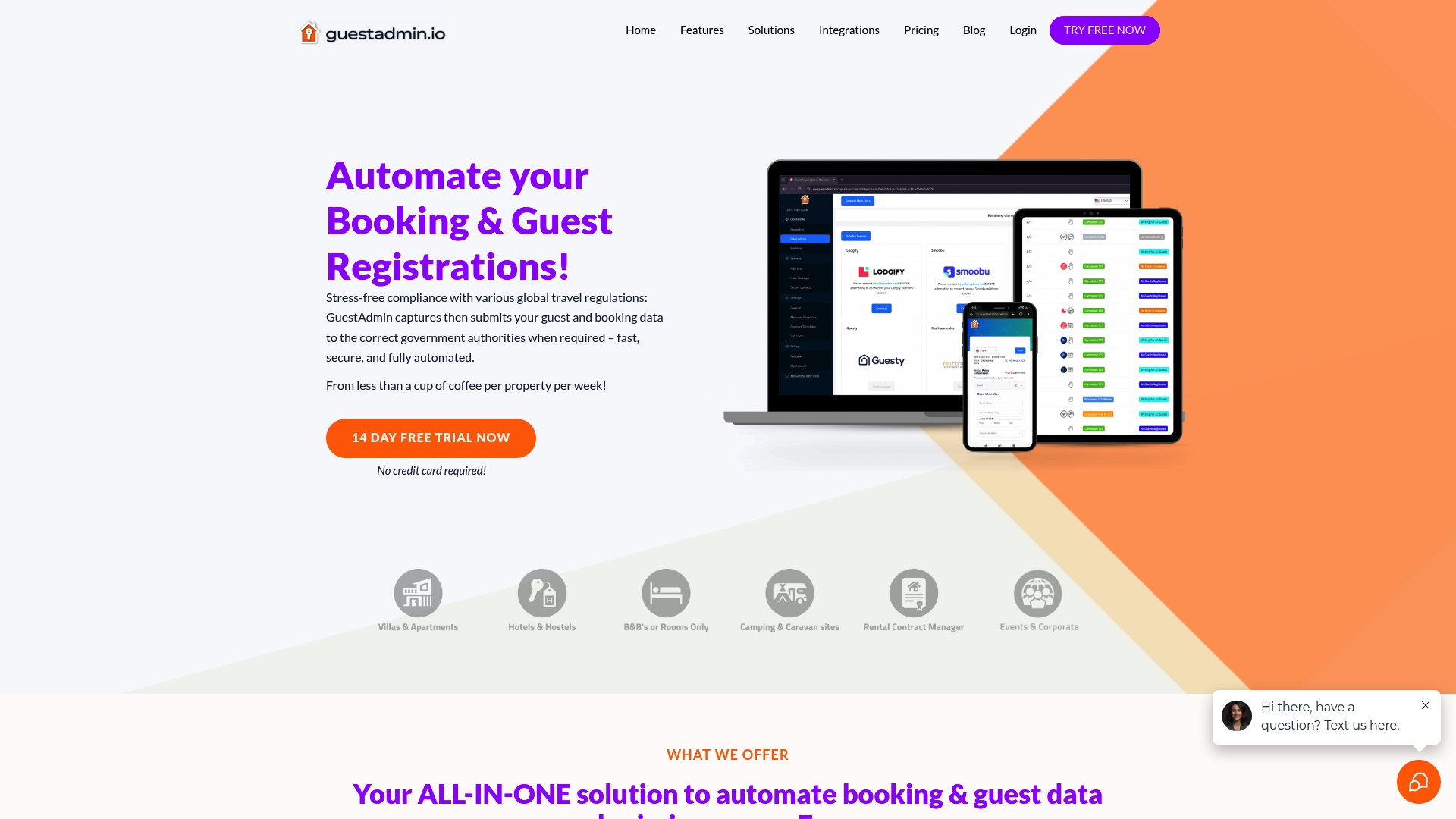
Integration with major booking platforms and property management systems creates seamless workflows where compliance happens automatically in the background. Real-time dashboards show your compliance status across all properties, whilst AI-powered processing ensures accuracy and completeness. Explore our legal compliance guide for 2026 to understand your obligations, discover how to automate booking compliance for short-term rentals, and access our comprehensive property management compliance checklist for Europe 2026 tailored to your operating jurisdictions.
Frequently asked questions
What data must rental managers collect under GDPR?
Rental managers must collect guest names, dates of birth, nationality, and identification documents for regulatory reporting within 24 hours of check-in. Consent principles require informing guests how their information will be used, whilst minimisation mandates collecting only data necessary for legal compliance and service delivery. Payment information and booking details also require protection under GDPR standards.
How quickly must data breaches be reported in Europe?
Data breaches must be reported within 72 hours of discovery to comply with GDPR obligations across European jurisdictions. This tight deadline requires prepared incident response procedures and clear communication channels with data protection authorities. Failure to report promptly can result in substantial fines that compound penalties for the initial breach itself.
Can automation fully ensure GDPR compliance for rental properties?
Automation in rental compliance greatly reduces errors and workload but must be combined with regular staff training and periodic manual checks. Technology handles systematic data processing brilliantly, yet human oversight remains necessary for unusual situations and strategic compliance decisions. Automation supports but does not replace your ultimate responsibility for guest data protection.
5 Comments
Property compliance in Europe: checklist and automation guide
[…] compliant guest data storage, encryption at rest and in transit is the baseline. Any tool you choose should be able to […]
Property owner compliance essentials: streamline Europe 2026
[…] data security considerations, the secure guest data guide covers GDPR-compliant storage, retention schedules, and deletion workflows in practical […]
How to sync booking data for short-term rental compliance
[…] fields, it is typically rejected outright, and you may face penalties for late or failed reporting. Data security in rentals is equally important — storing guest passport numbers or personal details in unencrypted files is […]
Master data privacy in hospitality for smooth EU compliance
[…] data security in short-term rentals is now essential for every operator, not just large hotel chains. Here is how the old local regime […]
Why secure guest data matters for property managers
[…] Why data security matters in short-term rentals […]