

TL;DR:
- Manual guest data entry is increasingly risky due to tightening EU regulations and the need for structured, digital submissions. Automation builds reliable data pipelines that capture, validate, and securely submit guest information, minimizing compliance errors and legal penalties. Small operators stand to gain significantly from automating processes, ensuring efficiency and reducing exposure to fines, data breaches, and enforcement actions.
Manual guest data entry is now the biggest compliance risk759356_EN.pdf) for short-term rental operators across Europe, yet many property owners still rely on spreadsheets, paper forms, and fragmented portals to manage their obligations. The problem is no longer a minor inconvenience. European regulators are tightening requirements, new EU legislation is reshaping what structured guest data submission actually means, and the penalties for getting it wrong are growing sharper. If you manage one property or fifty, understanding why automation has moved from a convenient option to a practical necessity is now one of the most important steps you can take to protect your business.
Table of Contents
- What is guest data automation and why is it now vital?
- How does guest data automation reduce compliance risk?
- The European regulatory shift: Why automation is no longer optional
- How property owners and managers apply automation to their rentals
- The uncomfortable truth: Why manual methods are unsustainable in Europe
- Get started with automated guest data compliance solutions
- Frequently asked questions
Key Takeaways
| Point | Details |
|---|---|
| Manual entry increases risk | Manual guest data handling is now the primary source of compliance errors within European short-term rentals. |
| Automation enables real-time compliance | Automated systems allow property owners to meet EU regulations accurately and promptly. |
| Regulations demand structured pipelines | EU rules now require secure, harmonised data sharing between host platforms and authorities. |
| All sizes benefit from automation | Automation streamlines compliance for both small property owners and large management companies. |
| Transition is essential | Moving from manual to automated guest data management is critical for operational security and regulatory peace of mind. |
What is guest data automation and why is it now vital?
Guest data automation is not simply the act of moving paper forms onto a computer screen. It means building structured, reliable data pipelines that capture guest information at booking or check-in, validate it automatically, and submit it securely to the appropriate government authorities, all without manual intervention at each step.
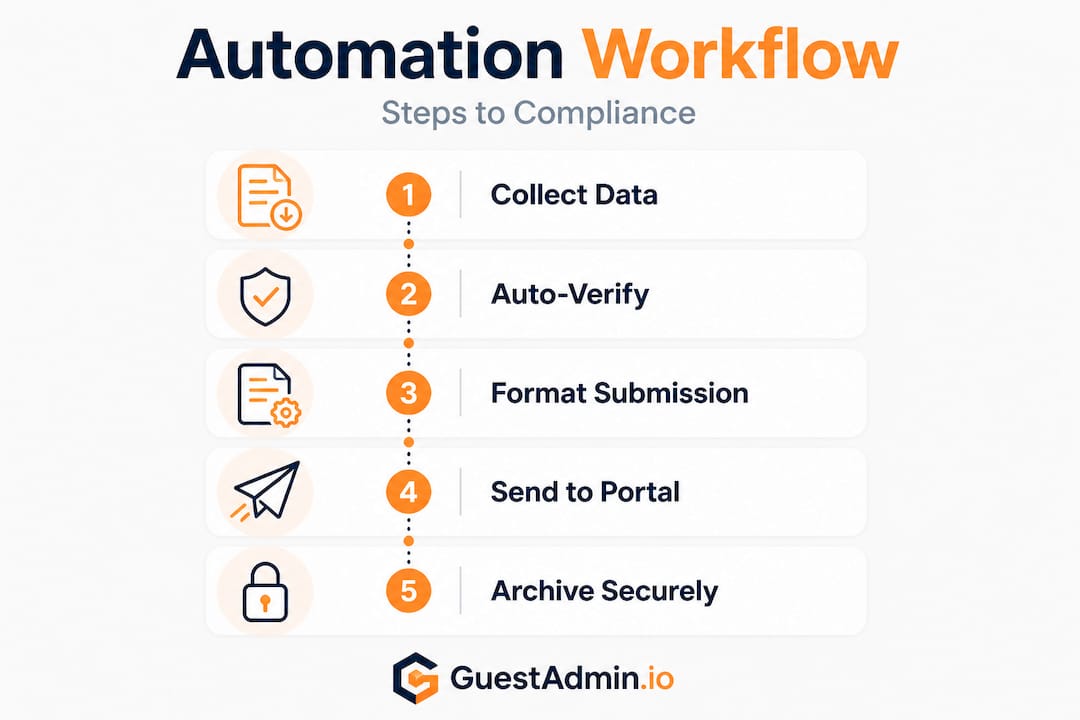
To understand why this matters so much right now, consider what guest registration automation actually involves in practice. A guest books through an OTA platform. Their passport details, nationality, arrival date, and contact information must be collected, cross-referenced against your local reporting requirements, and submitted to authorities within a defined window. In Italy, Spain, France, or Portugal, that window can be as short as 24 hours. Doing this by hand, for every booking, across every channel, leaves enormous room for error.
Regulation (EU) 2024/1028759356_EN.pdf) represents a significant turning point. It harmonises guest data collection across member states and establishes requirements for privacy-compliant, structured sharing between accommodation providers and national authorities. This is not a minor technical adjustment. It is a fundamental shift in how compliance data must flow.
Here is what that means in real terms for property operators:
- Guest data must meet specific structural formats before submission, not just general accuracy
- Submissions to authorities increasingly require secure digital channels, not email or paper
- Records must be archived in ways that permit auditing and retrieval on demand
- Cross-border properties face different but interconnected requirements that must be managed in parallel
“Regulation (EU) 2024/1028 harmonises guest data collection and enhances privacy-compliant sharing across member states, setting a new baseline for all short-term rental operators.”
Understanding the full scope of registration requirements in Europe clarifies why automation is vital. No two countries have identical rules, yet operators must comply with all of them simultaneously if they manage properties across borders. Manual handling of this complexity is not just slow. It is structurally unreliable.
How does guest data automation reduce compliance risk?
Understanding what automation is, it becomes clear how it acts as a practical shield against the most common and costly compliance failures. Let’s look at how it reduces risk at each stage of the process.
Manual processes are the leading cause759356_EN.pdf) of compliance errors, and automation directly addresses each of the vulnerabilities that make manual methods so risky. Consider the following comparison:
| Process element | Manual approach | Automated approach |
|---|---|---|
| Data capture | Staff-entered, error-prone | Structured, validated at source |
| Submission timing | Reliant on staff availability | Triggered automatically within set windows |
| Audit trail | Fragmented or absent | Complete, timestamped, exportable |
| Multi-property management | Separate portals, high duplication | Centralised dashboard, single workflow |
| Regulatory updates | Requires manual monitoring | System updates reflect legal changes |
| GDPR compliance | Depends on individual vigilance | Built into platform architecture |
The contrast is stark. An automated system does not forget to submit. It does not mistype a passport number under pressure at peak season. It does not miss a regulatory change that took effect last month.
Here is a numbered breakdown of the five core ways automated guest management reduces your compliance risk:
- Validation at point of entry. Data is checked for completeness and format before it ever enters your submission pipeline, catching errors before they become violations.
- Time-triggered submissions. Systems submit data within your jurisdiction’s required window automatically, removing the risk of deadline breaches.
- Centralised audit logs. Every submission is logged with a timestamp, giving you an auditable record that satisfies authority requests quickly and confidently.
- Regulatory alignment. Good automation platforms update their data structures and submission protocols to reflect legislative changes, so your compliance workflow stays current without constant manual monitoring.
- Secure data handling. Encrypted transmission and GDPR-compliant storage replace ad hoc email chains or shared spreadsheets that expose guest data unnecessarily.
Pro Tip: When evaluating any automation platform, ask specifically whether it updates its submission formats automatically when local regulations change. A platform that requires you to manually update templates offers only partial protection.
The operational and financial case is equally strong. A missed submission in Spain can trigger an immediate fine. A data breach caused by unsecured manual records can result in GDPR enforcement action. Automation removes the human variables that create these risks.
The European regulatory shift: Why automation is no longer optional
The broader European landscape is shifting rapidly, and property owners need to understand the direction of travel clearly. The introduction of Regulation (EU) 2024/1028 represents a move759356_EN.pdf) toward data-driven enforcement and structured digital pipelines across all member states.
What does this mean practically? Several countries are now establishing or upgrading single digital entry points: centralised portals through which accommodation providers must submit guest data in standardised formats. Portugal’s SEF system, Italy’s Alloggiati Web, and Spain’s various regional platforms all point in the same direction. The property management automation trends of 2026 make clear that this is accelerating, not slowing.
Here is a summary of key regulatory drivers currently reshaping the landscape:
| Regulatory element | Current requirement | Direction of change |
|---|---|---|
| Submission format | Varies by country | Harmonising towards structured digital standards |
| Submission timing | 24 to 48 hours in most EU countries | Window shrinking in some jurisdictions |
| Data fields required | Passport, nationality, arrival/departure | Expanding to include booking source and platform data |
| Enforcement mechanism | Inspections and audits | Moving towards automated cross-checking |
| Operator scope | Hotels and registered operators | Expanding to include all short-term rental hosts |
For property owners managing rentals in multiple countries, the implications are significant. Harmonised, structured data pipelines759356_EN.pdf) will rapidly become the European norm, meaning operators who have not automated will face mounting difficulties satisfying requirements across jurisdictions simultaneously.
Key points all property owners and managers should take away from this regulatory shift:
- Non-compliance is increasingly detected automatically, not just during inspections
- Regulatory requirements now encompass more data fields and tighter timelines than five years ago
- The expansion of short-term rental oversight means hosts who previously operated informally are now firmly within scope
- A guest registration guide designed for the current regulatory environment needs to account for cross-border variations and evolving standards
The simplest way to think about this: the rules have always existed, but the enforcement infrastructure is catching up. Regulators are no longer relying solely on inspections. They are building systems that cross-reference submissions against booking platform data and flag discrepancies automatically. If your records are incomplete or inaccurate, the gap will be found.
How property owners and managers apply automation to their rentals
With policies shifting and enforcement tightening, the practical question becomes: how do you actually implement guest data automation safely and efficiently? The answer involves three clear phases.
Phase one: Choose software that is aligned with EU regulations
Not all compliance software is equal. You need a platform that specifically addresses the submission requirements of the countries in which you operate, integrates with the OTA and PMS platforms you already use, and updates its regulatory data automatically. Automated guest compliance should come as a built-in feature, not an afterthought.
Look for these capabilities when evaluating platforms:
- Direct API integrations with national submission portals (Alloggiati Web, SEF, SES.Hospedajes, and others)
- GDPR-compliant data storage with configurable retention periods
- Multi-property dashboard that shows submission status across all locations at a glance
- AI-powered data validation that flags incomplete or inconsistent guest records before submission
- Webhook support for real-time synchronisation with your existing booking tools
Phase two: Map your internal processes to the automated workflow
Automating guest data759356_EN.pdf) makes compliance and reporting happen in real time, with far fewer errors, but the transition requires deliberate process mapping. Identify every point in your current workflow where guest data is captured, transferred, checked, or submitted. Then match each of those steps to the equivalent automated function in your chosen platform.
Here is a practical numbered process for property managers making this transition:
- Audit your current data flow. Document every step from booking confirmation to data submission. Note where human intervention currently occurs and where errors most commonly arise.
- Integrate your booking channels. Connect your OTA accounts and PMS to the automation platform so guest data flows directly into your compliance pipeline without re-entry.
- Configure submission settings. Set up jurisdiction-specific rules for each property, including submission timing, required data fields, and the relevant authority portals.
- Test with live bookings. Run a parallel period where you process compliance both manually and through the automated system, comparing outputs for accuracy before going fully automated.
- Archive and review regularly. Ensure your archived records are accessible and that your team understands how to retrieve them in the event of an authority request.
Phase three: Train your team effectively
Automated guest registration removes most manual tasks, but your team still needs to understand the system well enough to spot exceptions and respond to submission failures promptly. Brief training sessions focused on the dashboard, alert handling, and escalation procedures ensure the system functions as intended.
Pro Tip: Schedule a quarterly compliance review to check that your automation platform’s submission templates still match current local requirements. Even the best platforms benefit from an occasional manual sense-check.
The uncomfortable truth: Why manual methods are unsustainable in Europe
Here is an opinion we hold firmly, and it is grounded in observable reality rather than vendor enthusiasm. Manual guest data management is not just inefficient. It is structurally incompatible with the direction of European regulation.

The conventional wisdom among smaller operators is that automation is for large management companies with dozens of properties. The thinking goes: “I only have two apartments in Lisbon. I can handle this myself.” That logic was reasonable five years ago. It no longer holds.
Harmonised, structured data pipelines759356_EN.pdf) are the only way to synchronise internal records with official submissions at the speed and accuracy that modern enforcement systems expect. The moment a national authority’s system begins cross-referencing your submissions against OTA booking data automatically, the margin for manual error becomes effectively zero.
Small operators actually have the most to gain from automation, for two reasons. First, they rarely have dedicated compliance staff, meaning errors accumulate undetected. Second, a single fine or enforcement action represents a proportionally greater financial impact for a sole operator than for a large management company. The risk-to-resource ratio argues strongly for automation at every scale.
The automation savings for property managers are well documented. Time spent on manual data entry, portal navigation, and record chasing is time not spent on guest experience, property maintenance, or growing your portfolio. Automation does not replace the human elements of hospitality. It frees you to focus on them.
The uncomfortable truth is this: operators who delay automation are not saving money. They are accumulating risk that will eventually materialise as a fine, a data breach, or an enforcement notice at the worst possible moment. The question is not whether to automate but when, and the honest answer is: the sooner, the better.
Get started with automated guest data compliance solutions
The regulatory landscape is clear, and the operational case for automation is stronger than it has ever been. Whether you manage a single holiday let or a portfolio spanning multiple European countries, the right tools can make compliance straightforward and secure.
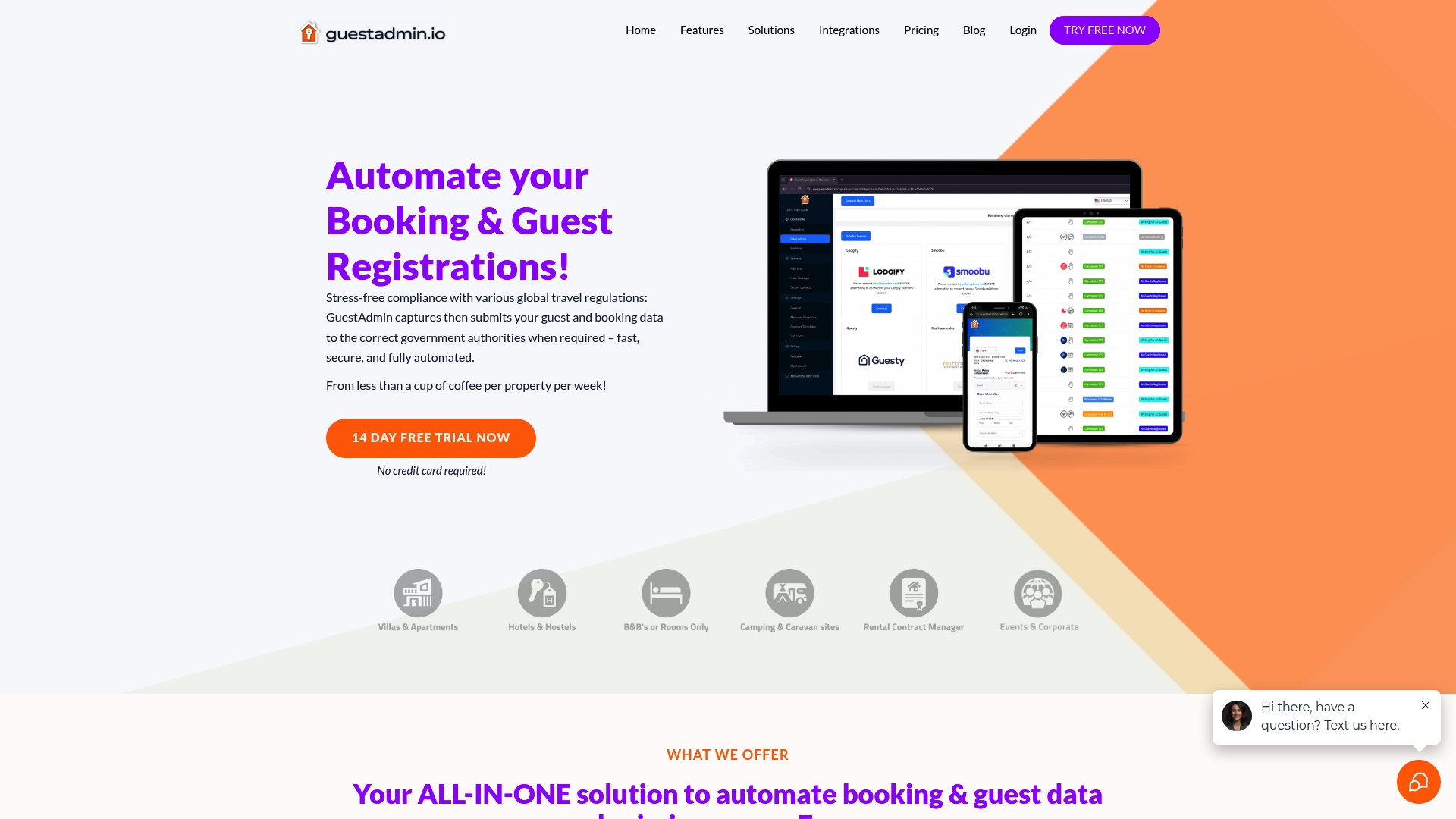
GuestAdmin.io is built specifically for property owners and managers operating in the European short-term rental market. It automates the entire guest data pipeline, from capture through validation to secure submission, across all major jurisdictions. No more juggling portals, spreadsheets, and paperwork.
Explore our rental compliance guidance to understand exactly what is required in your country, or go straight to our automated guest management solutions to see how the platform handles your compliance end to end. If you are ready to eliminate manual guest registration entirely, our automated guest registration feature gets you set up quickly, with integrations for all major OTA and PMS platforms. Compliance does not have to be complicated.
Frequently asked questions
Why do European short-term rental regulations make automation necessary?
EU 2024/1028 requires759356_EN.pdf) structured digital guest data submission in standardised formats, making manual entry increasingly impractical and legally risky for operators of any size.
Is automation suitable for small property owners or only larger management firms?
Automation reduces compliance errors759356_EN.pdf) for operators of all sizes, and small property owners often benefit most because they lack dedicated compliance staff to catch manual mistakes before they become violations.
Does automation compromise guest privacy?
Proper automation platforms are designed to be privacy-compliant under EU regulation759356_EN.pdf), incorporating GDPR-aligned data storage, encrypted transmission, and access controls that protect guest information throughout the compliance process.
What is the key operational benefit of automating guest data?
Automation enables real-time compliance759356_EN.pdf) and removes manual tasks, reducing the risk of deadline breaches, data errors, and fines while freeing up your team’s time for higher-value work.