

TL;DR:
- EU Regulation 2024/1028 mandates digital registration and instant guest data submission for short-term rentals across Europe, with strict deadlines that can be as short as six hours in Italy. Manual onboarding risks severe fines, delisting, and compliance failures, which automation solutions can mitigate by providing reliable, timestamped audit trails. Implementing automated platforms ensures seamless, scalable compliance, reduces administrative workload, and facilitates confident business growth in the evolving regulatory landscape.
Picture this: a new booking arrives at 11 pm, you have six hours to submit guest data to Italian authorities, and you are still manually copying passport details into a government portal. One mistake, one missed field, and you are looking at a fine that could reach tens of thousands of euros or, worse, removal from your booking platform entirely. This is the reality facing property managers and owners across Europe right now, as EU Regulation 2024/1028 reshapes short-term rental compliance from May 2026 onwards. This guide walks you through exactly what the regulation demands, how to prepare, and how automation can make the entire process reliable and stress-free.
Table of Contents
- Understanding EU onboarding regulations for rentals
- What you need to prepare for streamlined onboarding
- Step-by-step guide to digital property onboarding
- Troubleshooting, verification, and avoiding common pitfalls
- Why manual onboarding is no longer sustainable
- How automation solutions make onboarding effortless
- Frequently asked questions
Key Takeaways
| Point | Details |
|---|---|
| Automation avoids fines | Proper digital onboarding and guest registration automation helps prevent steep penalties and platform delisting. |
| Regulatory deadlines matter | Submitting property and guest data within strict national time frames is essential for legal compliance. |
| Audit trail is your safeguard | Maintaining digital records with an audit trail protects your business in the event of regulatory checks. |
| Preparation is key | Gathering all required documents and choosing the right tools streamlines onboarding from start to finish. |
| Manual methods are risky | Reliance on manual processes exposes your business to errors, missed deadlines, and costly consequences. |
Understanding EU onboarding regulations for rentals
The regulatory landscape for short-term rentals in Europe changed significantly with the introduction of EU Regulation 2024/1028. Understanding what it requires is the first step to protecting your business.
The regulation mandates that all short-term rental property operators digitally register their properties and submit guest data through approved Single Digital Entry Points (SDEPs). These are centralised national portals where authorities collect and verify rental activity and guest information. The scope covers hosts operating on any platform, whether they list on Airbnb, Booking.com, or their own website.
Deadlines are strict and vary by country:
| Country | Submission deadline | Entry point type |
|---|---|---|
| Italy | 6 hours after check-in | National SDEP (Alloggiati Web) |
| France | 24 hours after check-in | Préfecture system |
| Spain | 24 hours after check-in | SES.hospedajes |
| Portugal | 48 hours after check-in | SEF portal |
| Germany | 24 hours after check-in | Local authority systems |
As the EU Regulation 2024/1028 compliance guide confirms, digital registration and guest data submission via Single Digital Entry Points is mandatory from May 2026, with country-specific deadlines as tight as six hours in Italy and 24 to 48 hours elsewhere in the EU.
The risks of staying with manual processes are significant:
- Fines that can exceed €50,000 per violation in certain jurisdictions
- Delisting from major booking platforms that require compliance proof
- Reputational damage if authorities flag your property
- Audit failures due to missing or incomplete records
You can review the full Europe compliance checklist to understand every obligation by country. Manual onboarding simply cannot keep pace with these demands reliably.
What you need to prepare for streamlined onboarding
Having understood the regulation, it is vital to be prepared with the right documentation and tools for a hassle-free onboarding process.
Before you even log into a government portal or compliance platform, gather these essentials:
Documents and data you will need:
- Property registration certificates and licence numbers for each country of operation
- Owner or company identification (passport, national ID, or company registration documents)
- Property address details including cadastral reference numbers where required
- Tax identification numbers for each jurisdiction
- Guest ID capture capability (passport scanner, mobile ID verification, or digital upload tools)
- Booking confirmation templates that capture required data fields
Software capabilities to look for:
| Feature | Why it matters | Manual alternative |
|---|---|---|
| SDEP integration | Submits data directly to authorities | Copy-paste into portals |
| Audit trail logging | Proves compliance in inspections | Spreadsheet records |
| Multi-property dashboard | Manages all properties in one view | Separate logins per property |
| PMS/OTA integration | Pulls booking data automatically | Manual data entry |
| GDPR-compliant storage | Protects guest data legally | Local files, risky |
The digital onboarding benefits for property managers go well beyond convenience. An automated platform gives you a complete, timestamped record of every submission, which is essential if an authority questions your compliance at any point.
Pro Tip: Always choose a platform that has verified SDEP connections for every country where you operate. A platform that works for France but not Italy will leave you exposed in your highest-risk market.
Manual processes risk fines exceeding €50,000 and delistings, while automation provides the audit trails and scalability needed for multi-property portfolios. You can explore property automation examples to see how managers across Europe are already cutting compliance workloads significantly.

Step-by-step guide to digital property onboarding
With all your materials ready, let us break down exactly how to execute smooth and compliant onboarding, step by step.
Step 1: Register your property on the relevant national SDEP
Visit the national Single Digital Entry Point for each country where your property is located. Create an operator account, submit your property details, and obtain your unique property registration number. Keep this number accessible because you will need it for every future guest submission.
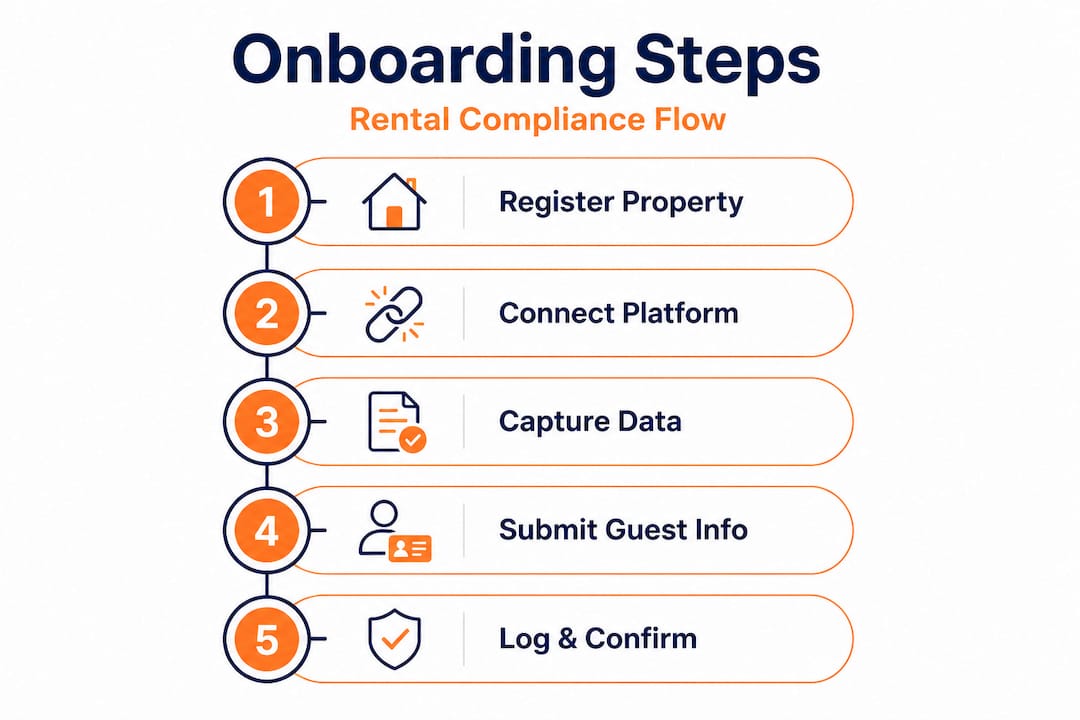
Step 2: Connect your booking platform or PMS to your compliance software
Most modern compliance platforms support API connections to booking systems such as Airbnb, Booking.com, Guesty, and Lodgify. Setting up this integration means booking data flows automatically into your compliance workflow without manual input. This alone eliminates a major source of errors.
Step 3: Configure your guest data capture workflow
Set up automated guest communication that requests ID documents and personal details at the point of booking confirmation or before check-in. Digital ID verification tools can extract data from passports and national identity cards, removing the need for manual transcription. This is where you eliminate the most common manual guest data mistakes.
Step 4: Set automated submission triggers
Configure your platform to automatically submit guest data to the relevant authority the moment a guest checks in, or at a set interval before the deadline. For Italian properties, your trigger should fire within the first hour of check-in to provide a comfortable buffer before the six-hour cutoff. For other countries, set triggers for two to four hours after check-in.
Step 5: Enable confirmation and audit logging
Every submission should generate a confirmation receipt from the authority portal. Ensure your platform logs these receipts against each booking record. This creates the audit trail you will rely on during inspections. You can find specific automate compliance tips to help you configure these workflows efficiently.
Step 6: Test your entire workflow with a dummy booking
Before you go live, run a test booking through your system. Verify that data flows from your PMS to your compliance platform, that the submission reaches the authority portal, and that a confirmation receipt is logged. Fix any gaps at this stage rather than discovering them during a real guest stay.
Important: Missing a submission deadline is not treated as a minor administrative error under EU Regulation 2024/1028. Deadlines as tight as six hours in some countries mean that a system fault or manual delay can put you in breach before you even realise it. Always configure deadline alerts in addition to automated triggers.
Pro Tip: Build a 30-minute buffer into every automated trigger. If your deadline is six hours, set your automation to submit at the five-hour mark. This gives you time to catch and correct any technical errors before the actual cutoff.
Troubleshooting, verification, and avoiding common pitfalls
Even the best systems can encounter snags, so here is how to check your compliance and fix issues before they become costly.
How to verify your compliance status:
Most SDEP portals provide a submission status dashboard where you can see confirmed, pending, and rejected records. Log into this dashboard weekly, or set up automated status alerts. Check that every booking in your system has a corresponding confirmed submission.
Common onboarding and registration errors to watch for:
- Mismatched guest name formatting between the booking platform and the authority portal
- Expired or invalid property registration numbers not updated after annual renewal
- Missing data fields for certain nationalities, particularly non-EU guests who require additional details
- Submission failures caused by portal downtime that are not automatically retried
- Incorrect check-in date or time recorded due to time zone mismatches in your booking system
- Guest data submitted to the wrong national portal when managing cross-border portfolios
- GDPR consent not captured correctly, making your stored guest data non-compliant
These issues are far more manageable when you have a property compliance workflow that flags exceptions automatically rather than leaving you to spot them manually.
Pro Tip: Enable audit logging for every submission, including failed attempts. A failed submission that is not logged leaves you with no evidence of an attempted submission, which weakens your position significantly if you face an inspection.
Automation provides audit trails and scales for multi-property portfolios, reducing the risk of fines that can exceed €50,000 per violation. The best platforms, such as those covered in our guide to automated guest management, handle retries, confirmations, and exception alerts without requiring you to monitor each submission manually.
Resolving errors before the deadline:
If a submission is rejected by the authority portal, act immediately. Most rejections are caused by formatting errors or missing fields that can be corrected in minutes. Some platforms allow you to resubmit directly from the error notification, cutting resolution time significantly. If a deadline has already passed, contact the relevant authority proactively and document your corrective actions. Demonstrating good faith and a clear compliance process can reduce penalties in some jurisdictions.
Why manual onboarding is no longer sustainable
Having worked through the practical details, it is time to consider the broader implications for your strategy and business model.
There is a pattern worth acknowledging honestly: many property managers who still rely on manual onboarding do so not because they prefer it, but because switching feels daunting. Setting up new software, connecting portals, and changing workflows takes time upfront. The problem is that this delay is not neutral. Every month you manage compliance manually, you accumulate risk.
Consider the economics. A property manager with 20 listings in Italy, France, and Spain processes, on average, roughly 60 to 80 check-ins per month. At 15 minutes per manual submission, that is 15 to 20 hours of administrative work every month, work that generates no revenue and that could be eliminated almost entirely with automation. That time has a real cost, whether you account for it as your own hours or as staff wages.
Beyond the time cost, manual processes carry a compounding reliability problem. The more check-ins you handle, the more opportunities there are for a missed submission, a typo, or a portal login that has expired. One enforcement action can cost more than a year of compliance software fees. That is not a theoretical risk. As EU Regulation 2024/1028 tightens across EU member states, enforcement activity is increasing alongside the new digital infrastructure that makes violations easier for authorities to detect.
Automation does not just save time. It delivers certainty. When a platform submits guest data automatically, logs the confirmation, and alerts you to any exceptions, you are not hoping that compliance happened. You know it happened. That certainty is the foundation that allows you to scale your portfolio confidently, whether from 5 properties to 15 or from 15 to 50. You can explore why automating hotel compliance boosts efficiency and reduces risk at every scale.
The managers who will thrive under the new regulatory environment are not those who have the most time to dedicate to compliance. They are the ones who have built systems that handle compliance reliably, regardless of how busy operations get.
How automation solutions make onboarding effortless
To put these lessons into practice, here is how you can immediately simplify and secure your onboarding using proven solutions.
Managing compliance across multiple European jurisdictions no longer requires a team of administrators or hours of daily portal work. GuestAdmin.io is built specifically for property managers and owners who need reliable, automated compliance across the EU’s diverse regulatory requirements.
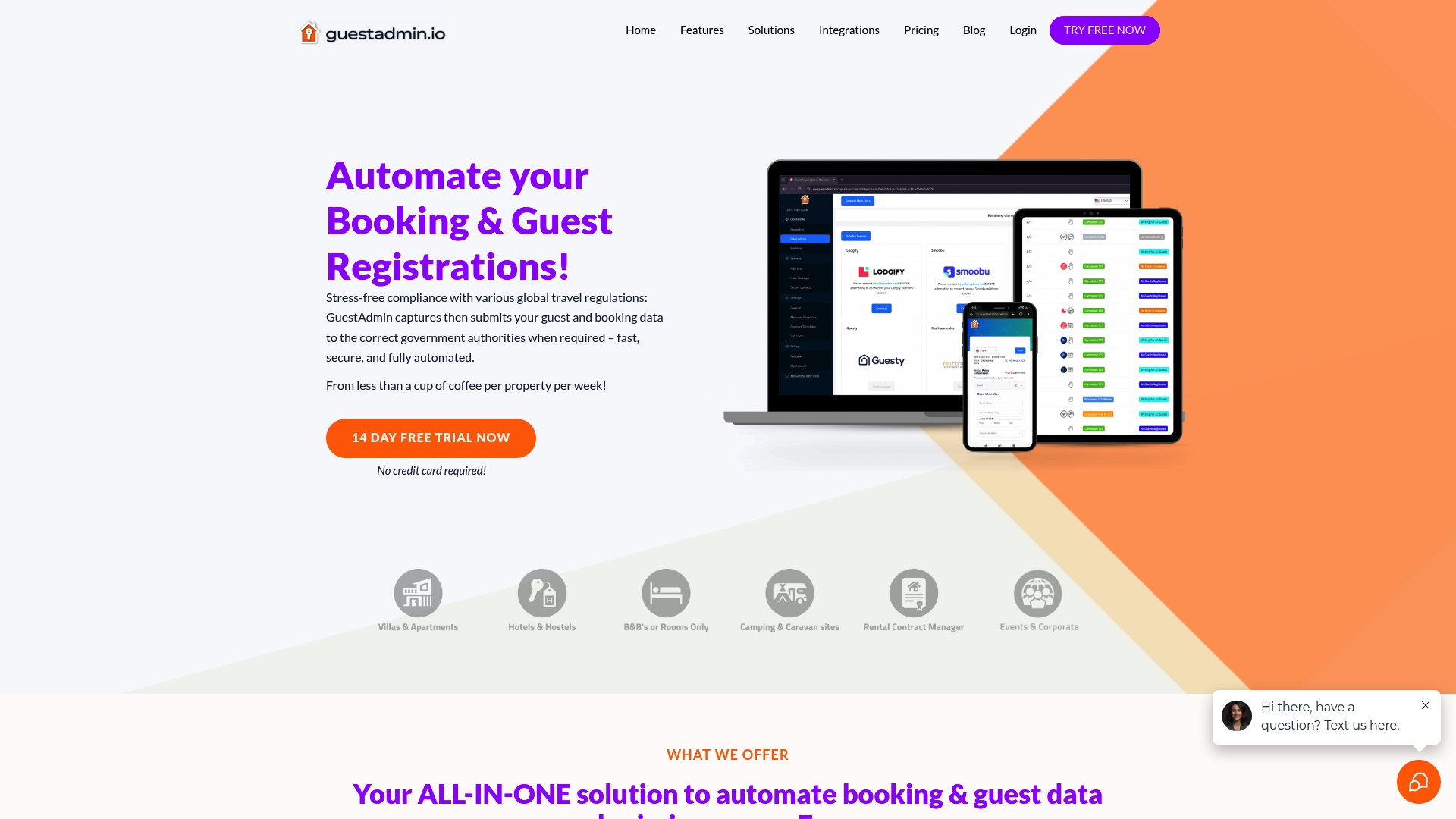
With GuestAdmin.io, you connect your existing booking platforms and PMS in minutes, and the platform handles the rest. Guest data is captured digitally, verified, and submitted to the relevant SDEP within 24 hours, well inside every national deadline. Every submission is logged with a timestamped confirmation, giving you a complete audit trail accessible from any device. To understand the full scope of what automated guest compliance can protect for your business, or to see how automated guest registration removes the manual burden entirely, visit GuestAdmin.io. You can also compare property management software options to find the right fit for your portfolio size and countries of operation.
Frequently asked questions
What is required for property onboarding under EU Regulation 2024/1028?
You must digitally register your property and submit guest data on approved Single Digital Entry Points within strict national deadlines, with digital registration mandatory from May 2026 across all EU member states.
What happens if I miss the deadline for guest data submission?
Missing the deadline can lead to fines exceeding €50,000 and delisting from rental platforms, with enforcement becoming more active as digital infrastructure improves.
Can automation help with multi-property rentals and compliance?
Yes. Automation scales submissions across any number of properties, maintains full audit trails for inspections, and handles multiple national portals simultaneously without additional administrative overhead.
How do I verify my onboarding and submission are compliant?
Check submission confirmations within your SDEP dashboard regularly, and ensure your compliance platform logs every submission with a timestamped receipt that you can retrieve during an inspection.
Is digital onboarding mandatory for short-term rentals across Europe now?
Yes. From May 2026, all short-term rental onboarding and guest registration must be conducted digitally through approved national portals across the entire EU.