

TL;DR:
- European short-term rental owners must submit guest data to authorities to ensure transparency and avoid penalties. Automation simplifies compliance by handling complex, country-specific requirements, saving time and reducing errors. Proper data submission enhances trust, operational efficiency, and long-term competitiveness in a regulated market.
Every short-term rental property owner in Europe faces a legal obligation that many discover too late: submitting guest data to the relevant authorities is not optional. Reporting regimes across the EU are designed to improve transparency and enforcement, and non-compliance can trigger fines, platform suspensions, or even loss of operating licences. Whether you manage one apartment in Lisbon or fifty properties across multiple countries, understanding what data you must submit, when, and how is essential to keeping your business running smoothly. This article explains your obligations clearly and shows you how automation turns a complex legal task into a seamless process.
Table of Contents
- The regulatory landscape for guest data submission
- What guest data must be submitted and why it matters
- Common challenges in guest data submission
- How automation optimises compliance and efficiency
- The overlooked advantage: Data submission as a strategic asset
- Simplify guest data compliance with automated solutions
- Frequently asked questions
Key Takeaways
| Point | Details |
|---|---|
| Compliance is mandatory | Submitting guest data is a legal requirement for short-term rental owners in Europe. |
| Automation saves time | Technology streamlines submissions and avoids manual errors. |
| Non-compliance risks fines | Failure to submit data can result in heavy penalties or business disruption. |
| Different countries, different rules | Understand the specific obligations and platforms required for each country. |
| Data submission enables business growth | Using guest data workflows strategically builds trust and operational agility. |
The regulatory landscape for guest data submission
The rules governing short-term rentals in Europe are no longer fragmented or easy to ignore. Since the passage of Regulation (EU) 2024/1028, which harmonises data collection and sharing for short-term accommodation rental services via standardised channels and Single Digital Entry Points, property managers now operate within a much more coherent but demanding legal framework. The regulation aims to give public authorities the standardised data they need to develop and apply appropriate policy responses, from housing market analysis to tax enforcement.
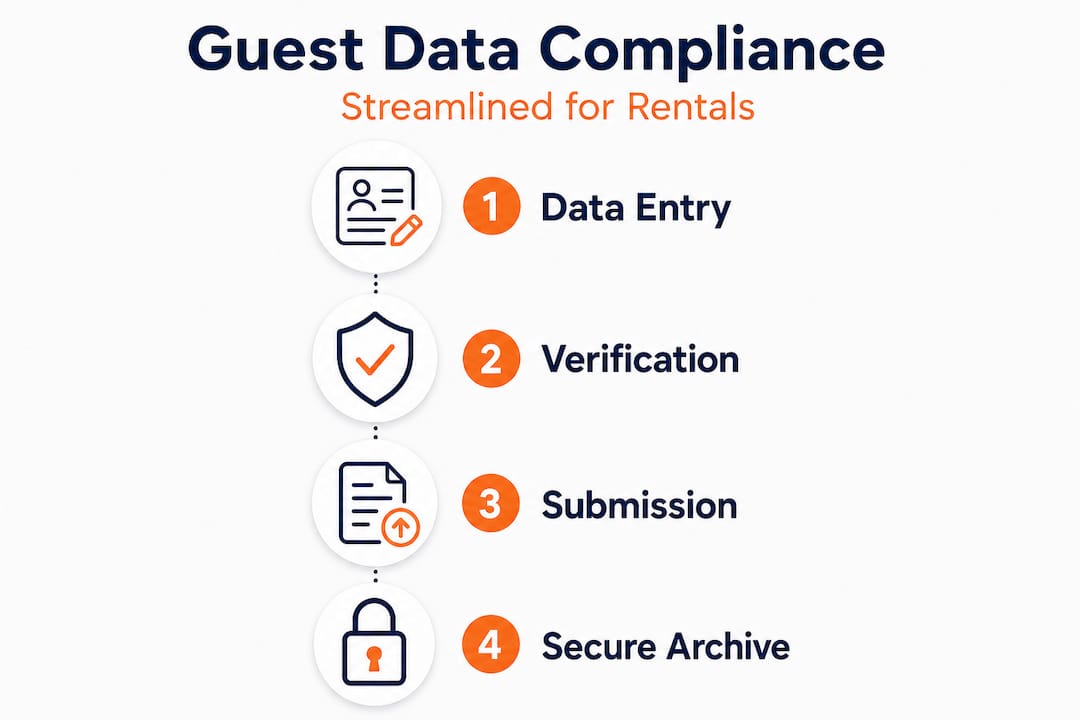
Understanding this framework is the first step in our rental registration guide. In practical terms, the regulation means that platforms and property owners must ensure guest and booking data flows reliably to the right authorities, in the right format, at the right time. Failure is not an administrative inconvenience. It carries genuine consequences.
Key points to understand about the regulatory context:
- EU-wide baseline standards: Regulation (EU) 2024/1028 sets minimum data requirements across all member states, creating a foundation for national systems to build upon.
- National variations remain: Individual countries layer additional requirements on top of the EU framework, including different deadlines, portals, and data fields.
- Platform accountability: Online platforms operating in the EU are required to collect and transmit registration numbers and associated guest data, which means your listing can be removed if your data does not match official records.
- Enforcement is increasing: Tax authorities and local councils are using data submissions to audit occupancy figures and revenue, making accurate reporting more important than ever.
“The regulation is designed to ensure that short-term rental markets operate with the same transparency and accountability as other sectors of the accommodation industry.”
For a broader overview of your obligations, the legal compliance for rentals framework and the government reporting guide offer country-specific detail that every property owner should review.
Here is a simplified comparison of how guest data submission requirements differ across several key European markets:
| Country | Submission frequency | Primary authority | Deadline after check-in |
|---|---|---|---|
| Spain | Per stay | Local police / Mossos | Within 24 hours |
| Italy | Per stay | Alloggiati Web (Police) | Within 24 hours |
| Portugal | Per stay | SEF / AIMA | Within 3 days |
| Greece | Per stay | AADE (tax authority) | Within 24 hours |
| France | Varies by commune | Local mairie or prefecture | Varies |
| Austria | Per stay | Municipal authority | Within 24 hours |
The variation across markets underlines why a single manual process cannot serve property owners operating in multiple countries. Each jurisdiction has its own portal, its own deadline, and its own tolerance for error.
What guest data must be submitted and why it matters
The specific data fields required across EU countries follow a broadly consistent pattern, even where deadlines and portals differ. Most authorities require a combination of personal identification, booking details, and stay information. Getting each field correct is not merely administrative. Errors in a guest’s passport number or nationality can cause a submission to be rejected entirely, which counts as a failed submission in the eyes of the authority.
Here is a breakdown of the data types most commonly required:
| Data field | Purpose | Consequences of omission |
|---|---|---|
| Full name | Identity verification | Submission rejected |
| Date of birth | Security and age verification | Submission rejected |
| Nationality | Statistical and security use | Incomplete submission |
| Passport or ID number | Identity confirmation | Submission rejected |
| Country of issue | Cross-border enforcement | Submission incomplete |
| Check-in and check-out dates | Occupancy tracking | Tax miscalculation |
| Number of guests | Housing market data | Regulatory non-compliance |
| Address of accommodation | Location tagging | Submission invalid |
These requirements exist for clear reasons. Security agencies use guest identity data to monitor movement and flag persons of interest. Tax authorities cross-reference guest nights against declared income. Local councils use occupancy data to manage housing pressure in high-demand areas. Statistical agencies rely on accurate data to produce reports that influence tourism investment decisions.
The benefits of getting it right extend beyond simply avoiding a fine:
- Regulatory trust: Authorities treat compliant property managers more favourably during inspections or licence renewals.
- Smoother operations: Accurate data submission reduces the likelihood of follow-up requests or audits.
- Guest confidence: When your data processes are organised, guests experience a more professional check-in process.
- Platform protection: Many online platforms cross-check registration numbers. Accurate submissions protect your listing from suspension.
- Reduced amendment burden: Submitting correct data the first time avoids the time-consuming process of filing corrections later.
Automated guest registration systems capture these fields directly from guests during the booking or pre-arrival process, reducing the room for human error significantly.
Property owners in Europe must submit or make available guest and booking data to comply with short-term rental registration and reporting regimes, and those regimes are designed to improve transparency and enforcement across all markets.

Pro Tip: Collect guest data before arrival using a digital pre-check-in form. This gives you time to identify and correct any errors before the submission deadline, rather than scrambling at check-in.
Discovering how to automate guest data for hassle-free compliance means you never have to rely on last-minute data entry again.
Common challenges in guest data submission
Even property owners who understand their obligations often struggle to meet them consistently. The challenges are practical, not conceptual. Managing guest data submission across multiple stays, multiple properties, or multiple countries creates a workload that grows rapidly as your portfolio expands.
Edge cases that make submission difficult include multi-property and multi-country differences in deadlines and portals, field-level completeness and formatting issues that cause rejection, and the need to correct previously submitted data when guest details change. These are not rare exceptions. They are everyday realities for property managers handling more than a handful of bookings per month.
The most frequent pain points include:
- Varying portal systems: Italy uses Alloggiati Web. Spain uses SES.Hospedería or local police portals. Portugal has recently transitioned its system. Each portal has its own login, its own data format, and its own quirks.
- Strict field formatting: Some systems require dates in a specific format, passport numbers without spaces, or nationality codes in ISO format. A simple formatting error can cause the entire submission to fail.
- Late guest information: Guests who provide their passport details after arriving, or who send blurry photos of their documents, create delays that push submissions past official deadlines.
- Amendments after submission: If a guest extends their stay, changes rooms, or adds a companion, the original submission may need to be amended. Not all portals make this straightforward.
- Language barriers: Several national portals are only available in the local language, which creates additional friction for property managers overseeing properties across multiple countries.
“No more juggling portals, spreadsheets, and paperwork. The administrative burden of manual guest data submission is one of the most common reasons property managers in Europe seek automated solutions.”
Understanding common mistakes in manual guest data submission is essential before you can fix them. And understanding your property owner responsibilities as set out by each jurisdiction ensures you are not caught off-guard by a requirement you did not know existed.
For property owners new to the market, this essential rental guide for Swedish owners is a practical example of how country-specific guidance can reduce early compliance mistakes. Similar guides exist for most EU markets, and consulting them before your first booking is always time well spent.
Managing the submission process manually across even three or four properties quickly becomes a part-time job. The margin for error is high, the time investment is significant, and the consequences of mistakes are serious.
How automation optimises compliance and efficiency
Automation addresses every major pain point in guest data submission, and it does so at scale. Whether you manage a single flat or a portfolio spanning several countries, an automated compliance system handles the heavy lifting so you can focus on guest experience and property performance.
The core advantages of automation include:
- Pre-arrival data capture: Guests receive a digital registration form before check-in. Data is collected, validated, and stored automatically, without any manual re-entry.
- Automatic formatting: The system converts data into the format required by each national portal, eliminating the field-level errors that cause rejections.
- Deadline management: Automated systems track submission deadlines by country and property, sending reminders or completing submissions without prompting.
- Amendment handling: When guest details change, the system flags the affected submission and processes the amendment, maintaining an accurate audit trail.
- Multi-property scalability: Adding a new property to your portfolio does not require building a new compliance process from scratch. The system applies the same rules to every property, adjusted for local requirements.
The same edge cases that make submission difficult, including multi-country deadline differences and field-level formatting requirements, are precisely where automation delivers the most value. A manual process degrades under pressure. An automated one does not.
Pro Tip: When evaluating an automation platform, check whether it supports amendments and correction submissions, not just initial reporting. Many platforms handle first-time submissions well but fall short when guest data changes after the initial filing.
Additional benefits that property owners often underestimate:
- Audit-ready records: Automated systems archive every submission with timestamps, creating a documented compliance history that is invaluable during an inspection.
- GDPR-compliant storage: Guest data must be stored securely and only for as long as legally required. Good automation platforms handle data retention policies automatically.
- Integration with booking channels: Automation platforms that connect with your property management system or online travel agency feed pull booking data directly, eliminating the need for duplicate data entry.
- Real-time dashboards: At a glance, you can see which submissions are complete, which are pending, and which need attention, across your entire portfolio.
For property managers ready to take the next step, effortless guest management through automation is achievable regardless of portfolio size. Platforms with API integration for managers allow seamless connections with your existing tools, meaning the transition to automation does not require rebuilding your workflows from the ground up.
The overlooked advantage: Data submission as a strategic asset
Most property managers view guest data submission as a legal chore. It is something to be done, filed away, and forgotten. This perspective misses a significant opportunity.
Consider what consistent, accurate compliance actually signals. To local authorities, it marks you as a credible and professional operator. To online platforms, it confirms your registration status and protects your listings. To prospective guests, the professionalism of your check-in process reflects directly on the quality of the stay they can expect. Compliance, when done well, is a form of brand building.
There is also an operational argument. Property managers who automate their compliance workflows report that removing the data submission burden from their weekly routine creates meaningful time for revenue-generating activities: improving listings, responding to guest enquiries, developing relationships with local service providers, and planning portfolio expansion. The administrative hours saved by automation do not simply disappear. They get redirected.
Early adopters of automated compliance platforms have also found an unexpected commercial benefit. When approaching local authorities, tourism boards, or institutional partners, having a documented and structured compliance record is a differentiator. It signals that your operation meets the standards expected of a professional hospitality business, not just a private landlord supplementing their income.
The short-term rental market across Europe is maturing. Regulatory scrutiny will intensify, not ease. Those who treat compliance as an afterthought will face increasing friction. Those who build compliance into their operational infrastructure will find it a source of stability and competitive advantage. Following tips to stay compliant is not just about avoiding penalties. It is about positioning your business for long-term viability in a tightening regulatory environment.
Simplify guest data compliance with automated solutions
Staying compliant with guest data submission requirements across Europe is entirely manageable when you have the right tools in place. The obligation is real, the deadlines are strict, and the variation between countries is significant. But none of that needs to translate into hours of manual work or a persistent anxiety about missing a filing.
GuestAdmin.io automates the entire guest data submission process, from pre-arrival data capture to secure submission to national authorities, across multiple countries and properties. With AI-powered processing, real-time booking dashboards, and Guest Registration Services built specifically for the European market, GuestAdmin removes the administrative burden so you can focus on what matters. Find out why property managers across Europe choose to automate hotel compliance and automate guest compliance to protect their businesses and improve efficiency.
Frequently asked questions
What guest data do I need to submit for short-term rentals in the EU?
You must submit guest identification details, booking dates, and stay information as required by national regulations and Regulation (EU) 2024/1028. Property managers must submit guest and booking data to comply with short-term rental registration and reporting regimes that apply across European markets in 2026.
What happens if I don’t submit guest data as required?
Non-compliance can lead to fines, loss of operating licences, or platform suspension, depending on the country and local enforcement priorities. Reporting regimes across Europe are designed for transparency and enforcement, which means authorities actively pursue non-compliant operators.
How can automation help with guest data compliance?
Automation reduces manual errors, ensures timely submissions, and simplifies handling different national requirements for property managers. Multi-country differences in deadlines and portals, along with field-level formatting issues that cause rejection, are precisely the challenges that automated systems are designed to resolve.
Are the guest data submission rules the same in every EU country?
No. While the EU sets baseline standards through Regulation (EU) 2024/1028, each member state applies its own additional requirements, including differences in deadlines and portals, data fields, and submission frequencies that vary significantly from country to country.
5 Comments
How to archive guest records: a compliance guide
[…] Guest data compliance varies significantly across European borders, so a one-size-fits-all approach will leave gaps. […]
Why guest data security matters for property managers
[…] Guest data compliance: Protect and streamline your rental […]
What is automated data submission: a clear guide
[…] Guest data compliance: Protect and streamline your rental […]
Rental Reporting Software for Stress-Free Compliance - Guest Registration Services
[…] add another concern: security. Guest information can include names, dates of birth, nationality and identity document details. Sending files by […]
When Must Hosts Report Guests? A Practical Guide - Guest Registration Services
[…] collect every possible field simply because it may be useful later. Guest data is sensitive, and GDPR principles still apply. Collect the information required for the legal purpose, explain why you need it, […]