

TL;DR:
- Getting onboarding right is crucial for European short-term rentals, as it influences guest experience and regulatory compliance. A comprehensive checklist ensures legal registration, property readiness, and optimized listings are aligned before publishing to prevent suspensions and negative reviews. Automated tools like Guestadmin streamline compliance and operational workflows, safeguarding long-term success.
Getting onboarding right is one of the most consequential decisions you will make as a short-term rental host or property manager in Europe. A solid short-term rental onboarding checklist does more than tick boxes. It shapes your first live guest experience, protects you from regulatory penalties, and sets the operational standard your property will be held to from day one. With EU Regulation 2024/1028 entering application on 20 May 2026, the stakes for getting your compliance steps right before publishing a listing have never been higher.
Table of Contents
- Key takeaways
- 1. Define your onboarding criteria before you start
- 2. Secure your official registration number and documents
- 3. Conduct a thorough property inspection and condition report
- 4. Set up professional photography and optimise your listing
- 5. Configure pricing, calendars, and channel management
- 6. Build your cleaning and turnover workflow
- 7. Establish your inventory management and guest readiness systems
- 8. Complete the pre-publish verification walkthrough
- My take on what most European hosts get wrong
- How Guestadmin makes your onboarding compliant from day one
- FAQ
Key takeaways
| Point | Details |
|---|---|
| Compliance comes first | Obtain and verify your official registration number before publishing any listing on any platform. |
| Operational setup drives revenue | A typical onboarding takes 2 to 4 weeks; standardised workflows accelerate time to first booking. |
| Platform enforcement is automatic | Platforms remove listings with invalid registration numbers within 24 hours, so data accuracy is non-negotiable. |
| Guest readiness requires systems | Quarterly inventory reviews and photo-verified turnover processes protect your reviews and your reputation. |
| Final verification prevents costly errors | A pre-publish walkthrough as if you are the first guest catches compliance gaps before they become suspensions. |
1. Define your onboarding criteria before you start
Before you open a checklist, you need a clear framework. Effective rental property onboarding balances three things: legal compliance, property readiness, and guest experience. Miss any one of these and the others will not compensate.
Legal compliance in 2026 is no longer optional paperwork. The EU framework mandates that hosts register with their national authority, obtain a unique registration number, and display it on all listings. Property readiness covers inspections, furnishings, photography, pricing, and cleaning schedules. Guest experience is built from everything the guest touches: the accuracy of your listing, the quality of your welcome information, and the consistency of your turnover.
The most common mistake new hosts make is treating these three as sequential steps. They complete compliance first, then set up the property, then think about the guest. In practice, all three need to be planned together from the outset, because decisions in one area directly affect the others.
Pro Tip: Create a master onboarding document that maps each task to one of the three pillars: compliance, property, or guest experience. This makes it easier to delegate tasks to different team members without anything falling through the gaps.
2. Secure your official registration number and documents
This is the non-negotiable first step of your compliance checklist. EU Regulation 2024/1028 mandates the use of Single Digital Entry Points, the display of registration numbers on every listing, and a platform-level verification process.
- Register your property with the relevant national or regional authority in your country of operation.
- Receive and record your unique registration number.
- Verify that the registration number format is accepted by each platform you intend to list on.
- Upload registration documentation to your property management system (PMS) so it is available for automated data transmission.
- Confirm your property details match exactly across your PMS, your OTA profiles, and your national registry entry.
Data mismatches between your PMS and the Single Digital Entry Point are one of the most common causes of compliance failure. A property listed in Portugal, for example, must have its registration details transmitted accurately to the Portuguese digital entry point, not just displayed on the listing page. Platforms are required to verify this data, and missing or invalid numbers trigger automatic listing suspension within 24 hours.
This is not a new licensing regime. As one analysis of the regulation notes, EU Regulation 2024/1028 is best understood as an infrastructure upgrade mandating data consistency and verification rather than entirely new licensing requirements. The underlying message is the same: your data must be correct, current, and consistent across every touchpoint.
3. Conduct a thorough property inspection and condition report
A professional inspection before onboarding serves two purposes: it protects you legally, and it gives you a clear baseline for maintenance and turnover standards.
Your inspection should cover:
- Structural and safety checks: smoke alarms, carbon monoxide detectors, fire extinguishers, emergency exit clarity, and electrical safety certificates where required by local law.
- Fixture and fitting condition: note any existing damage with photographs and timestamps so you have a pre-tenancy record.
- Appliance functionality: test every appliance a guest might use, from the hob and oven to the washing machine and Wi-Fi router.
- Outdoor spaces: check garden furniture, locks, pathways, and any pool or hot tub safety requirements.
- Accessibility features: if you intend to market your property to guests with mobility requirements, confirm what access genuinely exists.
The condition report you produce at this stage becomes your operational baseline. Every turnover check and every damage claim in the future will reference it. Do not skip it or treat it as an informal walkthrough.
4. Set up professional photography and optimise your listing

Photography is the single most commercially impactful element of your short-term rental setup. Listings with professional images consistently outperform those with phone photos, and the gap widens on competitive platforms where guests are comparing multiple properties at once.
For rental listing optimisation, focus on:
- Natural light: shoot during daylight hours with curtains fully open. Avoid flash photography, which flattens depth and makes rooms appear smaller.
- Decluttered staging: remove personal items, excess furniture, and anything that makes the space feel lived-in rather than welcoming.
- Logical sequence: present images in the order a guest would move through the property: entrance, living area, kitchen, bedrooms, bathrooms, outdoor space.
- Detail shots: include close-ups of amenities guests care about, such as the coffee machine, the shower head, the bed linen quality, and the view.
Your listing copy should complement the images, not repeat them. Write the title and description to answer the questions guests actually have: how many people does it sleep, what is the nearest transport link, and what makes this property worth the price?
5. Configure pricing, calendars, and channel management
Pricing is not a one-time decision. Your onboarding checklist should include setting up a dynamic pricing strategy from the outset, because flat-rate pricing leaves money on the table during peak seasons and reduces competitiveness during quieter periods.
Connect your property to a channel manager during onboarding so that availability and pricing sync automatically across all platforms. Manual calendar management across two or more platforms is a reliable source of double bookings and guest complaints. Configure minimum and maximum stay rules, gap-fill pricing, and last-minute discount thresholds before your listing goes live.
Set your base rate, seasonal rates, and special event rates in your PMS first, then push them outward to each channel. Working the other way creates inconsistencies that are difficult to untangle once bookings begin arriving.
6. Build your cleaning and turnover workflow
Cleaning is where operational maturity is most visible to guests. A property that looks beautiful in photographs but delivers an inconsistent cleaning standard will accumulate negative reviews faster than almost anything else.
Your cleaning and turnover checklist should be broken down by room, by task type, and by frequency:
- Per-turnover tasks: full linen change, bathroom sanitisation, kitchen deep clean, rubbish removal, restocking of consumables, and a final visual sweep of all surfaces.
- Weekly tasks (for long-stay guests): mid-stay towel exchange, replenishment of toiletries, and a brief inspection of appliances.
- Monthly tasks: oven and extractor fan cleaning, mattress inspection, check of smoke alarm batteries, and review of kitchen inventory.
Photo-verified turnover processes reduce errors significantly and improve review quality by documenting cleaning completions with date-stamped images. This is particularly valuable when you are managing multiple properties or working with a team of cleaners who operate under time pressure.
Pro Tip: Assign a specific cleaner to be responsible for the final photo verification at each property. When one person owns the sign-off, accountability is clear and errors drop noticeably.
7. Establish your inventory management and guest readiness systems
Inventory management with quarterly reviews is one of the most underrated elements of the host onboarding process. Guests notice missing or broken items immediately, and the reviews reflect it.
| Category | Quarterly check | Immediate replacement trigger |
|---|---|---|
| Kitchen equipment | Count all items against master list | Any broken, chipped, or missing item |
| Bed linen and towels | Check for staining, pilling, or wear | Anything a guest would notice |
| Toiletries and consumables | Count against expected usage rate | Running below one full guest set |
| Technology (TV, Wi-Fi, remotes) | Test all devices and connections | Any device not functioning correctly |
Set up a communication workflow for check-in and check-out at the same time as your inventory system. Guests should receive a pre-arrival message 48 hours before check-in, a check-in instruction message on arrival day, and a mid-stay check with any useful local information. At check-out, a prompt reminder of the departure procedure reduces late check-outs and gives guests an opportunity to flag any issues before they write a review.
8. Complete the pre-publish verification walkthrough
The final step of any host onboarding process is a pre-publish walkthrough conducted as if you are the first guest. Onboarding often fails at handoff points, particularly around listing asset finalisation and compliance data propagation. A structured final check prevents those errors from becoming live problems.
Work through this before you publish:
- Confirm your registration number is displayed correctly on every platform listing.
- Test your PMS integration to verify that guest data transmits accurately to the relevant Single Digital Entry Point.
- Complete a physical walkthrough of the property with your cleaning checklist in hand.
- Check that your welcome pack, key collection instructions, and emergency contact information are all in place.
- Verify that your pricing and availability calendar is correct for the next 90 days.
- Confirm that your channel manager is syncing across all active platforms.
Publishing before this step is complete is the single most avoidable source of early listing suspensions and negative first reviews. Take the time. It is a two-hour investment that protects months of effort.
My take on what most European hosts get wrong
I have worked through enough onboarding processes to say with confidence that the majority of issues I see do not come from hosts who did not try. They come from hosts who treated their compliance steps as a separate track from their operational setup.
The 2026 EU regulation is not as complex as many hosts fear. What it requires, fundamentally, is data accuracy and consistency. The challenge is that most hosts build their compliance data in one place and their operational setup in another, and the two never fully connect. Registration numbers get entered differently across platforms. Guest data fields do not match what the national authority expects. PMS integrations are set up but never tested end-to-end.
What I have found actually works is treating the onboarding checklist as a single document with compliance and operations running in parallel columns, not as two separate processes. When the person setting up your Airbnb listing is the same person confirming your registration number is displaying correctly, errors get caught before they matter.
Photo-verified turnovers changed the quality of operations I have seen more than any other single tool. Not because the photos themselves are magical, but because requiring them forces the cleaner or property manager to genuinely complete the checklist rather than assume everything is fine. That accountability shift is where quality comes from.
Future-proofing your onboarding means building workflows that do not depend on you personally to function. If your system requires you to check every platform manually, every turnover, you do not have a system. You have a job.
— Alex
How Guestadmin makes your onboarding compliant from day one
Running an onboarding checklist manually across multiple properties, platforms, and national registries is exactly the kind of administrative load that causes errors and delays. Guestadmin is built to remove that burden.
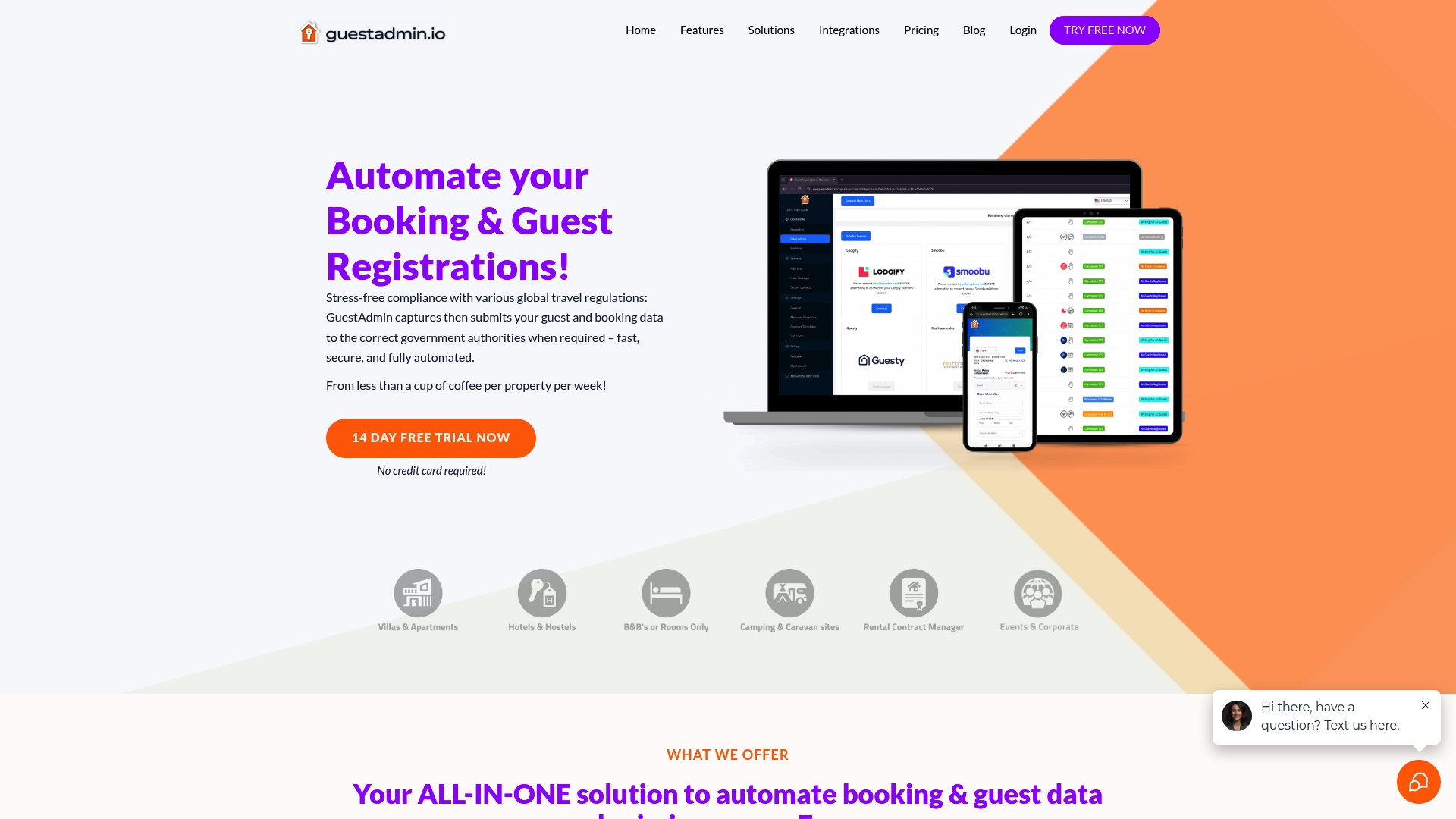
Guestadmin automates guest registration and compliance by capturing, processing, and securely submitting guest and booking data to the relevant government authorities, all within 24 hours of each booking. The platform integrates directly with your PMS and OTA platforms, so your registration data flows accurately to Single Digital Entry Points without manual intervention.
For property managers running multiple properties across different European jurisdictions, Guestadmin’s multi-property dashboard gives you real-time visibility of compliance status across your entire portfolio. If you want to understand how short-term rental compliance works in practice and what the penalties for non-compliance look like, Guestadmin’s resources walk you through it clearly. You can also explore practical compliance tips tailored specifically for property managers operating across Europe in 2026.
FAQ
What is included in a short-term rental onboarding checklist?
A short-term rental onboarding checklist covers legal registration, property inspection, professional photography, listing setup, pricing configuration, cleaning workflows, inventory management, and a pre-publish compliance verification. All steps should be completed before the listing goes live.
When does EU Regulation 2024/1028 take effect?
EU Regulation 2024/1028 enters application on 20 May 2026 and requires hosts to register, display registration numbers on all listings, and transmit guest data to Single Digital Entry Points.
What happens if my registration number is missing from my listing?
Platforms are required to verify registration numbers under the 2026 EU regulation, and listings with invalid numbers can be suspended within 24 hours of the issue being identified.
How often should I review my rental property inventory?
Quarterly reviews are the recommended standard for short-term rental inventory management. They maintain guest-ready amenities and help you catch wear, breakage, or missing items before a guest does.
How long does the onboarding process typically take?
A typical onboarding process takes 2 to 4 weeks when all steps, from compliance registration to property inspection and listing setup, are completed using a structured workflow.