

TL;DR:
- Europe’s short-term rental market faces increasing regulation, requiring property-level compliance across licensing, safety, GDPR, and transparency. Effective management involves centralized records, automation, regular audits, and strategic integration of legal obligations into daily operations. Platforms like Guestadmin streamline these processes, helping operators stay compliant and reduce risks at scale.
Europe’s short-term rental market has never been more tightly regulated. Hospitality industry regulations are shifting faster than most operators can track, with local authorities in cities like Barcelona, Amsterdam, and Lisbon introducing rules that override national frameworks entirely. The cost of falling behind is real: fines, licence revocations, and guest complaints that damage your reputation overnight. This guide breaks down what matters most in 2026, where operators most often get caught out, and what you can do to stay ahead without drowning in paperwork.
Table of Contents
- Key takeaways
- Hospitality industry regulations: the core framework
- Why compliance is genuinely difficult
- Strategies for effective compliance management
- Recent regulatory updates affecting European rentals
- Best practices for sustained compliance
- My perspective on regulatory compliance in short-term rentals
- How Guestadmin supports your compliance workflow
- FAQ
Key takeaways
| Point | Details |
|---|---|
| Regulations vary sharply by jurisdiction | Local rules frequently override national law, so property-level compliance checks are non-negotiable. |
| GDPR shapes daily operations | Guest data handling, storage, and deletion must follow GDPR requirements at every touchpoint. |
| Reactive compliance is costly | Waiting for an inspection or complaint before acting exposes you to fines and closure orders. |
| Automation reduces human error | Digital platforms that track deadlines and log data remove the gaps that manual processes leave open. |
| Food safety logs require equipment upkeep | HACCP documentation is only valid when monitoring equipment is calibrated on schedule. |
Hospitality industry regulations: the core framework
Short-term rental operators in Europe sit at the intersection of several overlapping legal frameworks. Understanding each category is the foundation of sound hospitality compliance standards.
Registration and licensing
Most European jurisdictions now require short-term rental properties to be registered with a local or national authority before accepting guests. Portugal requires a Alojamento Local licence. France mandates a declaration at the mairie. Spain’s regions each maintain separate hotel licensing requirements, with Catalonia operating under rules distinct from those in Andalucía. Failure to hold the correct licence does not just invite a fine; in some cities, unregistered properties face immediate guest removal orders.
| Country | Registration body | Key requirement |
|---|---|---|
| Portugal | Municipal council | Alojamento Local number displayed publicly |
| France | Mairie | Declaration and rental duration limits in some cities |
| Spain | Regional tourism authority | Regional tourism licence, rules vary by autonomous community |
| Italy | Regional authority | CIN national code required since 2024 |
| Netherlands | Municipality | Permit required, strict night limits in Amsterdam |
Health, safety, and food standards
Health and safety obligations cover fire safety certificates, emergency signage, gas and electrical inspections, and, where food is served, full food safety regulations including HACCP (Hazard Analysis and Critical Control Points) compliance. A common and expensive mistake: HACCP documentation is invalid when thermometers and other monitoring equipment have lapsed calibration dates. Auditors reject such records outright, leaving operators exposed even when they believed they were compliant.

For operators offering breakfast or catering, restaurant health codes apply alongside tourism rules, meaning two separate inspections are possible from two separate authorities.
GDPR and data privacy
Any operator collecting guest names, passport numbers, or contact details is processing personal data under the General Data Protection Regulation. GDPR obligations include lawful basis for data collection, defined retention periods, secure storage, and the right of guests to request deletion. EU data privacy obligations in hospitality extend to how booking confirmations are sent, how long records are held, and which third-party systems those records pass through.
Price transparency and consumer protection
Across Europe, consumer protection frameworks require that all mandatory fees be disclosed upfront. This mirrors the direction regulators have taken elsewhere: hidden mandatory fees are increasingly treated as deceptive trade practices, and enforcement activity is rising. Cleaning fees, tourist taxes, and service charges must all appear in the initial price display, not as additions at checkout.
Why compliance is genuinely difficult
Knowing the rules exists on paper. Executing them consistently across multiple properties, staff shifts, and booking channels is where most operators struggle.
- High staff turnover creates knowledge gaps. The hospitality sector has one of the highest turnover rates of any industry. Each time a trained employee leaves, their compliance knowledge leaves with them unless it has been captured in a system.
- Fragmented reporting tools. Many operators manage registrations, fire safety logs, and GDPR records across separate spreadsheets and portals. There is no single view of where the gaps are.
- Regulatory overload. Overlapping compliance requirements across local, regional, and national levels reduce operational efficiency and push smaller operators toward non-compliance simply through exhaustion.
- Rapid rule changes. Relying on precedent is risky when amendments to licencing requirements and retaliation penalties can arrive with little notice.
- Incomplete execution. Understanding a rule and executing it fully are different things. Operators who know HACCP requirements still fail audits because calibration schedules slip. Operators who understand GDPR still receive enforcement notices because a third-party booking tool was not assessed as a data processor.
Pro Tip: When a compliance failure occurs, treat it as a process failure rather than a staff failure. Map the gap back to the system, not the individual, and fix the workflow.
The reputational dimension is often underestimated. A single guest complaint about safety or a news story about an unregistered rental can cost more in lost bookings than any fine.
Strategies for effective compliance management
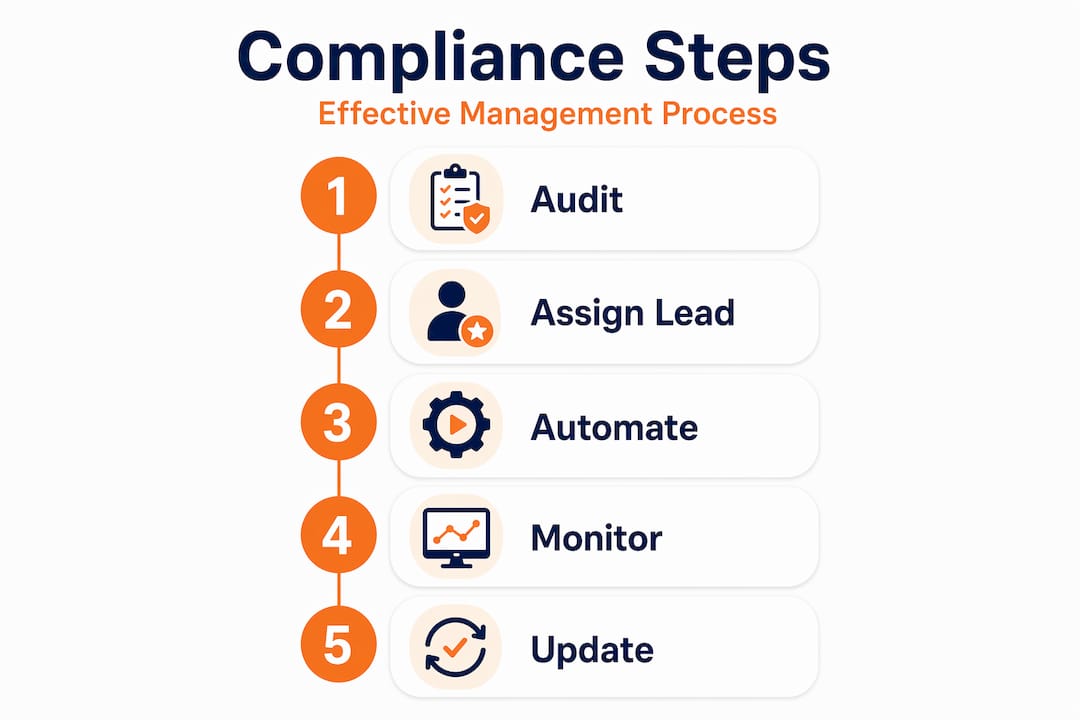
The shift operators need to make is from ad-hoc compliance to structured, system-driven compliance. Compliance as a strategic asset rather than an administrative task changes how resources are allocated and how risk is managed across a portfolio.
Practical steps that make a measurable difference:
- Centralise your obligations. Use a single platform or register to hold all licence expiry dates, inspection schedules, staff certification records, and data retention timelines. When everything lives in one place, nothing falls silently out of date.
- Automate deadline tracking. Automated reminders for fire safety inspections, HACCP calibration checks, and staff training renewals remove the reliance on memory or manual diary entries. Automating hotel compliance directly reduces the volume of missed deadlines that trigger enforcement action.
- Map regulations to individual properties. A property in Lisbon faces different rules from one in Valencia. Dynamic rule mapping, where regulations are linked to specific property locations, means you act on the right requirements for the right property rather than applying a generic checklist everywhere.
- Keep audit-ready records at all times. Do not prepare for an inspection; be ready for one on any given day. Digital logs for fire safety checks, food hygiene monitoring, and guest data processing should be maintained continuously, not reconstructed under pressure.
- Integrate your booking channels with your compliance system. Guest registration data flowing from your OTA or PMS into your compliance record automatically reduces double-entry errors and submission delays.
Pro Tip: Assign a compliance lead for each property in your portfolio, not as a separate role but as a defined responsibility within an existing role. Someone should be named, not just a process described.
The future of hospitality compliance involves platforms that ingest regulatory updates automatically and surface only the changes relevant to each property’s location and category. That is not a distant prospect; it is available now.
Recent regulatory updates affecting European rentals
The regulatory environment in 2026 has several specific developments that property managers need to act on.
| Area | Recent development | Operator action required |
|---|---|---|
| Short-term rental registration | EU Short-Term Rental Regulation (effective May 2025) requires standardised data reporting across member states | Register with national single window; submit booking data to authorities |
| GDPR enforcement | Increased enforcement activity targeting hospitality operators using non-compliant data processors | Audit all third-party tools; update data processing agreements |
| Fire safety | Digital inspection logs now required in multiple jurisdictions, with immediate enforcement for life-safety breaches | Switch from paper to digital fire safety records |
| Price transparency | Mandatory upfront disclosure of all fees gaining traction across European consumer protection frameworks | Audit your booking flow for hidden or late-stage fee disclosures |
| Environmental compliance | Increased requirements around waste management, energy reporting, and single-use plastics in rental properties | Review local environmental bylaws and update guest information |
The EU Short-Term Rental Regulation is the most significant structural change in recent years. It establishes a single registration window per member state and requires operators to submit guest data to national platforms on a standardised basis. For operators who were already submitting data to local police or municipal authorities, the process looks similar but the scope is wider and enforcement is more coordinated.
On the food safety side, food safety traceability timelines have shifted in some jurisdictions, creating a window for operators to update their documentation systems before stricter enforcement resumes. Do not treat a delayed deadline as permission to delay your own preparation.
Short-term rental compliance risks in Central and Eastern European markets are growing, with cities like Warsaw introducing registration requirements that mirror those already established in Western Europe.
Best practices for sustained compliance
Embedding compliance into routine operations, rather than treating it as a periodic project, is what separates operators who pass inspections easily from those who scramble before every visit.
- Conduct quarterly internal audits. Review licences, certifications, and data handling processes every three months. Do not wait for renewal dates to discover gaps.
- Train staff at onboarding and regularly thereafter. Staff training regulations in hospitality often specify minimum frequencies. Even where they do not, regular refreshers protect you from the knowledge decay that comes with time and turnover.
- Maintain transparent guest communication. Clearly document and communicate all fees, house rules, and emergency procedures. This satisfies both consumer protection requirements and practical hospitality safety guidelines.
- Create a compliance calendar. A shared calendar showing every inspection, renewal, certification, and submission deadline for every property gives your team clarity and removes ambiguity about who is responsible for what.
- Use technology to close the gaps that humans leave open. Service industry legal obligations are too numerous and too interconnected for any individual to track manually across multiple properties. Digital platforms that consolidate records and automate submissions are not a luxury; they are the only practical approach at scale.
Transparent guest communication deserves particular attention. Operators who clearly explain tourist taxes, cleaning fees, and data processing at the point of booking face far fewer disputes and chargebacks than those who rely on buried terms.
My perspective on regulatory compliance in short-term rentals
In my experience working with property managers across Europe, the most damaging compliance mistakes are never the result of operators not caring. They happen because operators trusted a system that was never actually robust enough to catch every deadline and every rule change.
I’ve seen operators who had GDPR policies in place get enforcement notices because one booking tool they integrated two years ago was never added to their data processor register. I’ve seen fire safety logs that were complete on paper but stored in a format that auditors could not verify. The compliance was there in intent. It failed in execution.
What I’ve learned is that reactive compliance, waiting to be told what to fix, is a far more expensive strategy than it appears. The fines are visible. The management time spent responding to notices, the reputation damage, and the stress on your team are not counted in the headline number but they are very real costs.
The operators I have seen handle this well treat their compliance obligations the way they treat their booking calendar. They update it constantly, they have one source of truth, and they never rely on memory alone. That mindset, paired with the right tools, makes compliance genuinely manageable rather than perpetually stressful.
— Alex
How Guestadmin supports your compliance workflow
Running compliance across multiple short-term rental properties in Europe requires more than a checklist. Guestadmin was built specifically for this challenge.
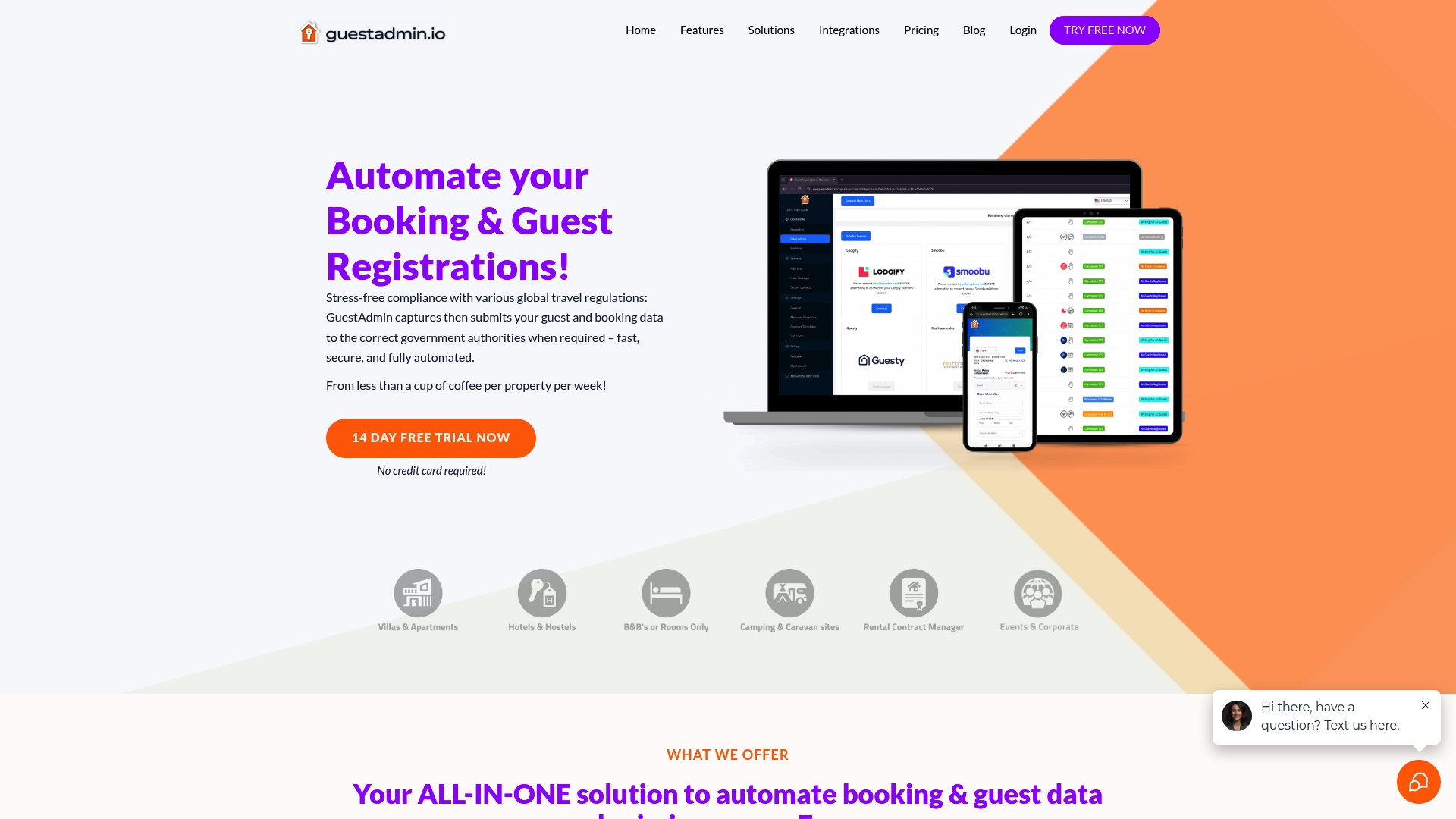
The platform automates guest data compliance by capturing, processing, and securely submitting guest registration data to the relevant national authorities, within 24 hours of check-in. It integrates with the PMS and OTA platforms you already use, so there is no manual re-entry and no missed submissions. Every data submission is GDPR-compliant, with built-in retention policies and audit trails that hold up to scrutiny.
For property managers operating across multiple jurisdictions, Guestadmin’s real-time dashboard gives you a single view of compliance status across your entire portfolio. If you are ready to move away from spreadsheets and manual portal submissions, the step-by-step implementation guide is a practical starting point for setting up automated compliance workflows that scale with your business.
FAQ
What are the main hospitality industry regulations for European short-term rentals?
The main categories are registration and licensing, health and safety (including fire safety and food hygiene), GDPR data privacy, and price transparency under consumer protection law. Requirements vary significantly by country and city.
How does GDPR apply to short-term rental operators?
GDPR applies to any operator collecting guest personal data, including names, passport numbers, and contact details. Operators must have a lawful basis for collection, defined retention periods, and data processing agreements with any third-party tools that handle that data.
What happens if HACCP food safety records are invalid?
Uncalibrated monitoring equipment renders HACCP logs legally insufficient, even if the records themselves are complete. Auditors reject documentation with lapsed calibration dates, which constitutes a compliance failure regardless of intent.
How often should short-term rental operators review their compliance status?
Quarterly internal audits are considered best practice, covering licences, certifications, data handling processes, and any regulatory changes that have come into force since the last review.
What is the EU Short-Term Rental Regulation?
The EU Short-Term Rental Regulation, effective May 2025, requires operators across member states to register through a national single window and submit booking data to authorities on a standardised basis, making cross-border compliance reporting more coordinated and consistent.