

TL;DR:
- API integrations in hospitality often prevent real-time data sharing between systems, leading to errors and inefficiencies. Implementing streaming APIs, careful configuration, and strict security practices enhance data accuracy, operational efficiency, and regulatory compliance. Proper planning and monitoring are essential to overcome common challenges like legacy incompatibility and event sequencing errors.
API integrations in hospitality are often treated as a back-office concern, something to hand off to a developer and forget about. That framing costs property managers real money. When your property management system, booking channels, CRM, and compliance tools cannot talk to each other in real time, you end up with duplicate data entry, rate discrepancies, missed regulatory submissions, and guest experience failures that could have been avoided entirely. This guide cuts through the technical noise and gives you what you actually need: a clear-eyed view of how hospitality software integrations work, what they deliver, and how to implement them without the common pitfalls.
Table of Contents
- Key takeaways
- What API integrations in hospitality actually do
- The real benefits of API in hotels and property management
- Challenges when implementing hospitality API integrations
- Best practices for integrating APIs in hospitality systems
- Future trends in hospitality API integrations
- My take on what actually goes wrong with API integrations
- How Guestadmin supports connected, compliant property management
- FAQ
Key takeaways
| Point | Details |
|---|---|
| APIs are operational tools | API integrations connect your PMS, CRM, and booking channels to share data automatically and in real time. |
| Streaming beats polling | Push-based streaming APIs deliver faster, more reliable data than pull-based polling, which has strict throughput limits. |
| Integration enforces business rules | Well-configured APIs prevent channels from overriding your rates, policies, or inventory without authorisation. |
| Configuration errors cause real damage | Incorrect subscription setup and event sequencing errors lead to data inconsistencies that affect guests and compliance. |
| Compliance is a direct beneficiary | Automated data sync through APIs reduces manual errors and supports regulatory reporting across multiple properties. |
What API integrations in hospitality actually do
An API (Application Programming Interface) is simply a defined way for two software systems to exchange data. In a hotel or short-term rental context, that means your property management system (PMS) can send a new reservation directly to your channel manager, which updates availability on every connected booking platform, which triggers a guest communication, which logs the booking for compliance reporting. All without anyone touching a keyboard.
Oracle’s Hospitality Integration Platform uses REST APIs to connect multiple hotel applications to OPERA Cloud, organising functionality into groups such as the Reservation API and the Front Desk Operations Service API. That structure matters because it shows how a modern hospitality system integration is not one connection but a collection of purpose-built data flows, each handling a specific operational domain.
There are two fundamental ways APIs exchange data in hospitality:
- Streaming (push) APIs: The source system sends data to your system the moment an event occurs. A new booking in your channel manager arrives in your PMS within seconds.
- Polling (pull) APIs: Your system checks the source system at regular intervals and asks “anything new?” Oracle documents that polling APIs cap at 20 events per call and 300 requests per minute per gateway, which creates real latency risk during busy periods.
For most operational use cases, streaming is the better choice. Polling works acceptably for low-volume or non-time-sensitive data, but if your occupancy is high and events are firing fast, polling will lag behind.
Security is the other non-negotiable. OAuth tokens and application key headers are the standard approach to authenticating API requests in hotel integrations. Every request must carry the right credentials, and access should be scoped precisely. Giving an integration broader permissions than it needs creates unnecessary risk.
Pro Tip: When setting up any new API connection, request access with the minimum necessary scope. Overly broad tokens are one of the most common security vulnerabilities in hospitality software integrations and one of the easiest to prevent.

The real benefits of API in hotels and property management
The case for third-party integrations in hospitality goes well beyond convenience. The operational and commercial benefits compound over time, and they are measurable.
-
Real-time data accuracy across all systems. Two-way API integrations synchronise reservations, guest profile changes, and activity updates bidirectionally across platforms. When a guest calls to change their check-in date, that update propagates instantly across your PMS, your housekeeping system, and your guest communication tools. No manual re-entry, no missed update.
-
Channel distribution and rate integrity. Oracle’s Distribution APIs allow booking engines and GDS channels to retrieve live availability and create bookings, but OPERA Cloud enforces hotel-defined rules on rates and inventory throughout that process. Your pricing policies travel with the data. Channels cannot simply override what you have set.
-
Custom data handling for unique properties. Off-the-shelf connectors often miss property-specific data fields such as package codes, room preferences, or loyalty programme identifiers. Custom AI-powered integrations that sync PMS and CRM in real time can resolve data conflicts within 500 milliseconds, handling these nuances automatically. That kind of precision directly improves guest experience.
-
Compliance automation at scale. For property managers operating across multiple jurisdictions, the ability to pull consistent, accurate guest data from a single integrated source is not just operationally useful. It is legally significant. Automated data flows reduce the manual handling that introduces errors into regulatory submissions. You can read more about how APIs support rental compliance across European markets specifically.
-
Reduced administrative overhead. Every manual data transfer your team performs is a potential error and a definite cost. Integrated systems eliminate the majority of that work, freeing staff to focus on guests rather than data entry.
Properties that invest in well-structured API for hotel management see measurable reductions in overbooking incidents, guest data errors, and staff time spent on administrative reconciliation. The returns are operational first, financial second, but both are real.
Challenges when implementing hospitality API integrations
Knowing the benefits is one thing. Surviving the implementation is another. These are the obstacles that catch property managers off guard.
- Legacy system incompatibility. Older PMS platforms were not built with open APIs in mind. Connecting them to modern cloud-based hospitality APIs often requires middleware layers or custom adapters, adding cost and complexity.
- Data field mismatches. Two systems may both store “guest nationality” but label it differently, format it differently, or allow different value options. Without careful field mapping, data arrives in the wrong format and causes errors downstream.
- Polling-related data lag. If your integration relies on a pull-based approach and your event volume spikes during a busy weekend, you will experience data latency issues that polling limits create. Guests may see stale availability. Your front desk may receive incomplete check-in data.
- Payment tokenisation complexity. Hotels never store raw card data; instead they use tokens provided by certified payment service providers. Token scope must align with the specific PSP context in your integration. Reusing a token across different PSPs causes failures, and your entire network must still comply with PCI Security Council standards even when tokenisation is in place.
- Event sequencing errors. Subscription configuration is a detail most teams underestimate. Using incorrect external system codes or skipping onboarding steps leads to events arriving out of order. A cancellation can arrive before the original booking, corrupting your records.
Pro Tip: Before going live with any integration, build a staging environment that mirrors your production setup exactly. Run through your most common event sequences, including cancellations, date changes, and overbooking scenarios, before a single real guest booking passes through the connection.
Best practices for integrating APIs in hospitality systems
Getting this right requires a methodical approach. Here is a framework that works in practice.
-
Audit your existing systems first. Map every platform you use: PMS, CRM, channel manager, payment processor, compliance tools. Identify which ones have published APIs, which have webhooks, and which have neither. This audit shapes every decision that follows.
-
Map your data fields in detail. Before writing a single line of configuration, document how each system names and formats every shared data field. Guest nationality, booking source, room type, arrival date. Mismatches at this stage cause failures at runtime.
-
Choose your integration architecture deliberately. A centralised hub architecture (where all systems connect to one integration layer) is easier to monitor and troubleshoot than a web of point-to-point connectors. As your property portfolio grows, the hub model scales without exponential complexity.
-
Manage subscriptions and event sequencing with care. Successful API integration depends on precise subscription configuration to prevent out-of-order events. Document the exact sequence in which events should be processed for each workflow, and configure your subscriptions accordingly.
-
Invest in monitoring, not just setup. An integration that works today may fail silently tomorrow. Set up alerts for failed API calls, response time thresholds, and data validation errors. A real-time booking dashboard gives your team visibility into whether data is flowing correctly across systems.
| Architecture type | Best for | Trade-off |
|---|---|---|
| Centralised hub | Multi-property portfolios, complex ecosystems | Higher setup cost, single point of failure if not redundant |
| Point-to-point connectors | Small operations, two or three systems | Simple to set up, difficult to scale |
| API marketplace platforms | Modular, best-of-breed system selection | Requires vendor ecosystem maturity |
- Maintain OAuth security discipline throughout. Rotate tokens on a defined schedule, audit access logs regularly, and revoke credentials immediately when a vendor relationship ends.
Future trends in hospitality API integrations
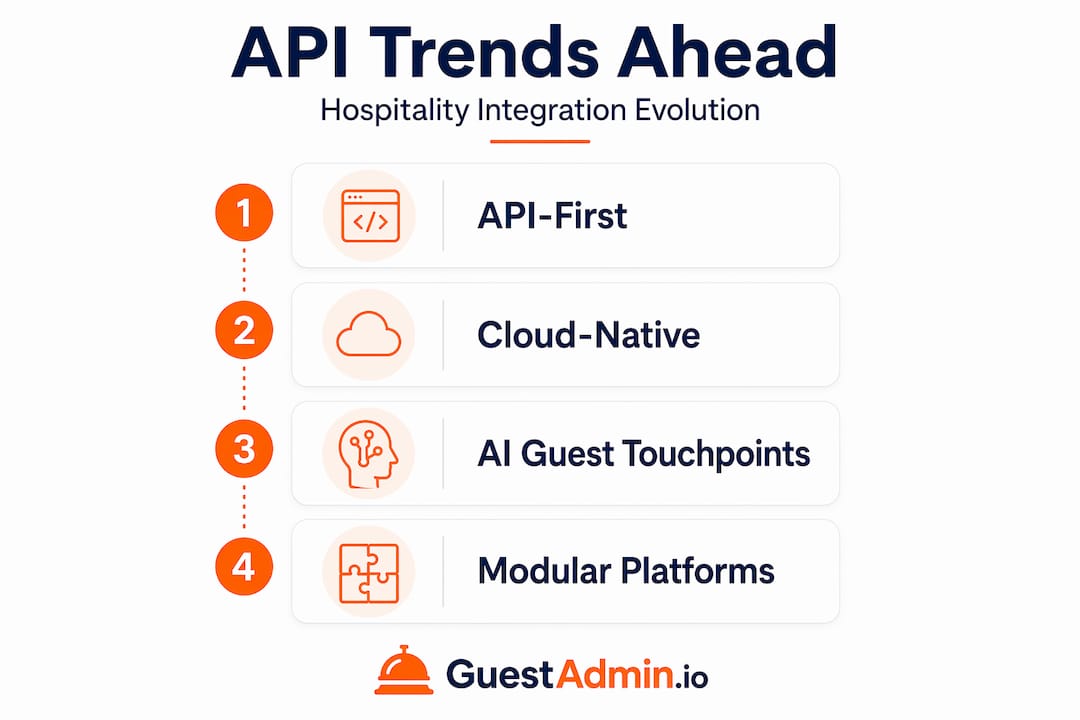
The direction of travel is clear: API-first, cloud-native, and modular. Legacy monolithic PMS platforms that locked you into their ecosystem are losing ground to open platforms that connect freely with specialised tools.
The most significant near-term shift is the integration of AI-driven guest interactions directly through APIs. Booking engines are already being connected to AI agents, meaning a guest could modify their reservation through a conversational interface, with the change flowing instantly into your PMS via API. This is not speculative. It is happening now in early adopter properties.
Payment protocol improvements are reducing the compliance burden around PCI. New tokenisation standards mean that hotels using token-based payment processing through certified PSPs can significantly shrink their audit scope, spending less time on compliance overhead and more on operations.
The marketplace model for hospitality integrations is also maturing. Rather than choosing a vendor that bundles everything into one product, property managers can now select best-in-class tools for each function and connect them through an integration platform.
“Choosing an integration hub over a monolithic vendor is increasingly the decision that separates operationally agile properties from those struggling to adapt to market changes.”
For property managers already handling multi-property compliance, the implications are significant. You can explore multi-property management workflows to see how integrated systems are reshaping compliance operations at scale.
My take on what actually goes wrong with API integrations
I have seen property managers invest time and budget into API integrations, then wonder why data is still inconsistent six months later. In most cases, the problem is not the API itself. It is the assumption that connecting two systems is enough.
An integration is not just a data pipe. As Oracle’s own documentation makes clear, integrations actively enforce hotel business rules, preventing channels from overriding your pricing or availability. If you have not configured those rules properly during onboarding, you are not protected. You are just moving bad data faster.
The most underestimated risk I encounter consistently is the pull-based API approach. Teams choose polling because it feels simpler and more controllable. But when event volume increases, polling creates exactly the stale data problems you were trying to solve. The 20-event-per-call ceiling is a hard limit, not a guideline.
What I have found genuinely makes a difference is the time invested in data field mapping before a single test call is made. Properties with unique package codes, non-standard room categories, or regional compliance fields will never get satisfactory results from an out-of-the-box connector. Custom mapping is not optional for those operations. It is the difference between an integration that works and one that creates more work than it saves.
The choice of integration architecture matters more than most teams realise at the start. A centralised hub approach gives you data freshness, easier troubleshooting, and a single place to enforce business logic. Point-to-point connections feel faster to set up but become difficult to manage the moment you add a third or fourth system.
— Alex
How Guestadmin supports connected, compliant property management
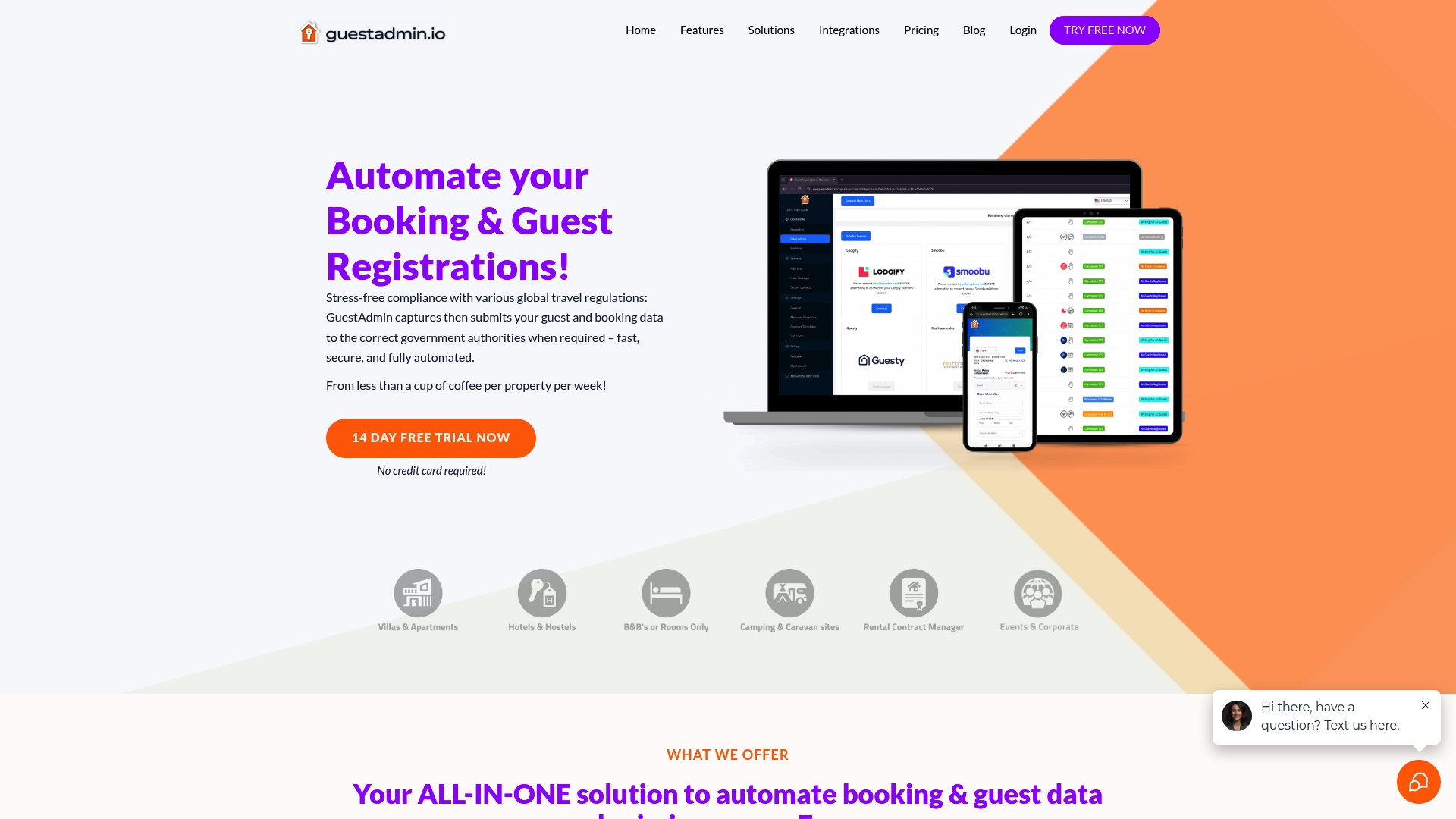
Managing multiple properties across European jurisdictions means compliance is never far from the top of your priority list. Guestadmin is built for exactly that context: a SaaS platform that automates guest data capture, processing, and submission to government authorities, with API and webhook support so your existing booking workflows feed directly into compliance reporting without manual intervention.
If you are evaluating how to tighten your operational workflows, the multi-property management tips resource from Guestadmin covers the practical steps that property managers across Europe are using to reduce administrative load while staying fully compliant. For those considering how hospitality compliance automation fits into an integrated system, Guestadmin’s platform connects with PMS and OTA platforms you already use, making onboarding straightforward and reporting reliable from day one.
FAQ
What are API integrations in hospitality?
API integrations in hospitality are connections between software systems, such as a PMS, CRM, and channel manager, that allow them to exchange data automatically in real time without manual input.
What is the difference between streaming and polling APIs in hotels?
Streaming APIs push data the moment an event occurs, while polling APIs check for updates at intervals. Polling is limited to 20 events per call and 300 requests per minute, making streaming the preferred choice for high-volume hotel operations.
How do APIs help with hospitality compliance?
APIs automate the flow of accurate guest and booking data across systems, reducing manual data entry errors and making it easier to meet regulatory reporting requirements, particularly important for multi-property managers operating across different jurisdictions.
What security measures apply to hotel API integrations?
Hotel API integrations typically use OAuth tokens combined with application key headers to authenticate requests. Payment data is handled through tokenisation via certified PSPs, which reduces PCI audit scope for the property.
Why do some API integrations in hospitality fail?
Most failures trace back to incorrect subscription configuration, poor data field mapping, or using polling APIs in high-volume environments. Event sequencing errors, where a cancellation arrives before the original booking, are a particularly common and disruptive issue.
5 Comments
The role of APIs in hospitality automation
[…] and AI readiness (can the platform feed a unified data layer cleanly?). You can explore practical API integration guidance to assess these criteria against your current tech […]
Role of AI in hospitality compliance: a 2026 guide
[…] managers with API integrations across their key platforms are significantly better positioned to deploy reliable AI compliance […]
Digital Certificate Guest Reporting Explained - Guest Registration Services
[…] source: direct bookings, online travel agencies, property-management systems, iCal calendars, APIs and webhooks. This prevents staff from copying details between disconnected tools and reduces the chance that a […]
How to Automate Check-In Workflows for Lets - Automated guest check-in for short term rental, hotels & campsites
[…] that can receive data through the connections your operation already uses. For sophisticated teams, APIs and webhooks matter because they allow reservation events to pass automatically between systems. For independent […]
Centralised Versus Local Reporting Workflows - Automated guest check-in for short term rental, hotels & campsites
[…] include direct reservations, online travel agencies, property-management systems, iCal calendars, APIs and webhooks. Instead of asking every property to interpret the same process independently, a central platform […]