

Property managers using API-driven compliance automation report a 40-60% reduction in time spent on regulatory administrative tasks. Across Europe, short-term rental operators face an increasingly complex web of travel regulations that demand precise, timely guest data submissions. This article explains how application programming interfaces transform compliance from a time-consuming burden into an automated, secure workflow that integrates seamlessly with your existing property management systems.
Table of Contents
- Understanding APIs In Property Management
- How APIs Automate Compliance In Short-Term Rentals
- Integration Between PMS, OTA Platforms And Government Compliance APIs
- Handling Multi-Jurisdiction Challenges With APIs
- Common Misconceptions About API Complexity And Adoption
- Benefits Of API-Driven Compliance Automation
- Implementing API Solutions For Property Managers
- Explore GuestAdmin’s API Compliance Solutions
- Frequently Asked Questions
Key takeaways
| Point | Details |
|---|---|
| APIs automate multi-jurisdictional compliance | Software interfaces handle complex regulatory tasks across different European regions automatically |
| Integration synchronises booking data | Connections between PMS, OTAs, and government portals eliminate manual data entry |
| Automated submission prevents fines | Real-time data transmission within 24-hour windows reduces compliance errors and penalties |
| GDPR-compliant security protects guests | AI-powered validation and anonymisation ensure data privacy throughout the process |
| Scalable solutions grow with portfolios | Right API tools simplify onboarding and adapt as property counts increase |
Understanding APIs in property management
An application programming interface acts as a digital translator between different software systems, enabling them to exchange information automatically without human intervention. For European short-term rental managers, APIs connect different platforms to automate guest data exchange, reducing manual errors. This technology addresses the specific compliance challenges you face when operating across multiple jurisdictions with varying reporting requirements.
Europe’s short-term rental market operates under a fragmented regulatory landscape. Each country, and often individual cities, maintains distinct requirements for guest registration, tourist tax collection, and booking data submission. APIs solve this complexity by:
- Capturing guest information automatically from booking platforms
- Validating data against regulatory requirements in real time
- Submitting formatted reports to the correct government portals
- Maintaining audit trails for compliance verification
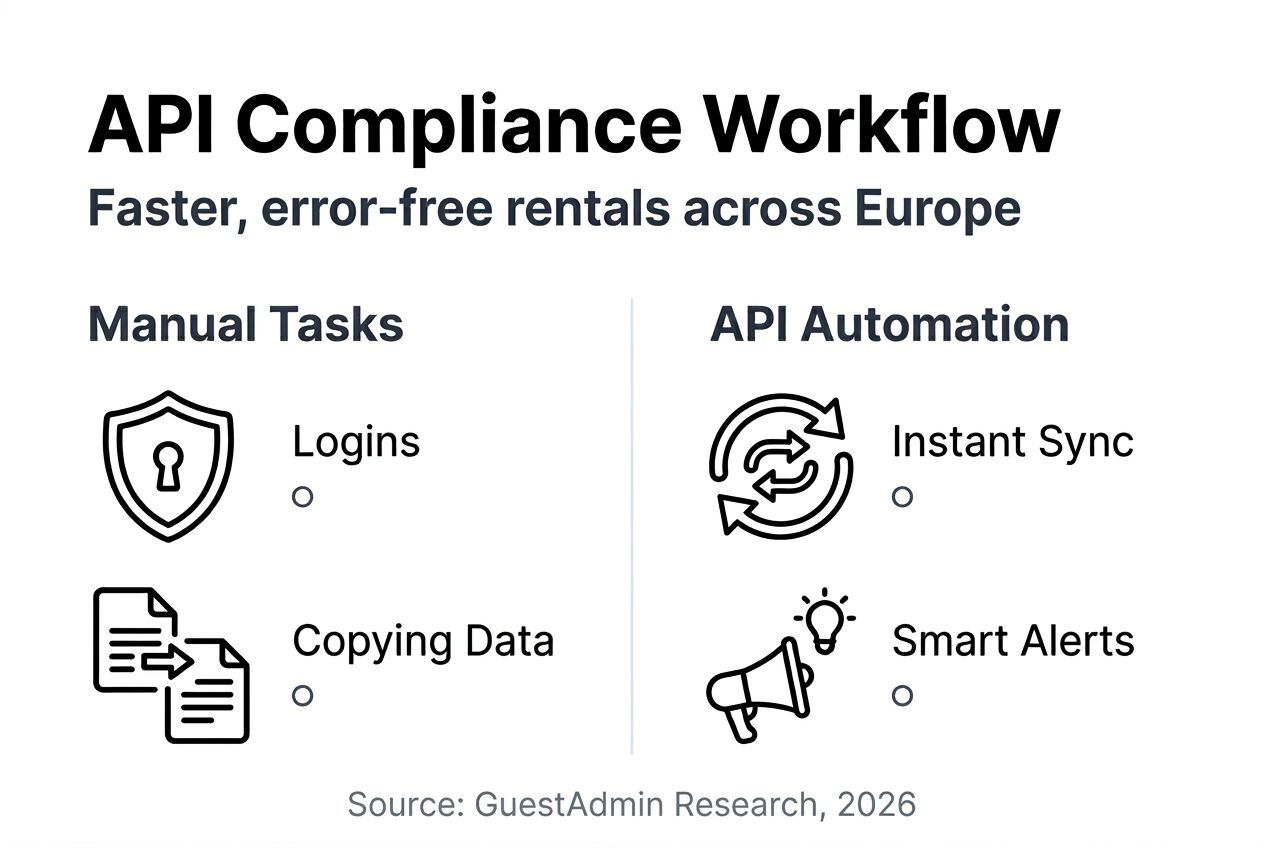
The traditional manual approach requires you to log into multiple systems, copy data between platforms, and track submission deadlines across different time zones. Property automation examples demonstrate how API-driven workflows eliminate these repetitive tasks. GuestAdmin.io leverages these APIs to create a unified compliance hub that works whilst you focus on guest experiences.
Modern APIs handle not just data transfer but also intelligent processing. They apply business logic to determine which regulations apply to each booking, calculate tourist taxes based on local rates, and flag incomplete guest information before submission deadlines pass. This automation in rentals compliance across Europe transforms a reactive scramble into a proactive system.
Pro Tip: Start by mapping all your current compliance touchpoints before implementing API solutions. Document which platforms hold guest data, which government portals require submissions, and what manual steps you perform daily. This inventory reveals exactly where APIs will deliver the greatest time savings and error reduction.
How APIs automate compliance in short-term rentals
The technical process behind API-driven compliance automation follows a systematic workflow that ensures accuracy and timeliness. APIs enable real-time data submission within regulated 24-hour windows, powered by AI validation and anonymisation. Understanding this workflow helps you appreciate why API solutions outperform manual processes.
- Guest data capture occurs the moment a booking is confirmed on any connected platform
- AI validation checks information completeness and format against regulatory requirements
- Anonymisation protocols strip unnecessary personal details whilst retaining required fields
- Automatic routing sends validated data to the appropriate government agency portals
- Confirmation tracking logs successful submissions and flags any rejected entries
This automated sequence eliminates the most common compliance failures. Manual data entry introduces typos, missed deadlines, and incomplete submissions that trigger penalties. API workflows execute consistently, processing hundreds of bookings with the same precision applied to a single reservation.
Consider the practical differences between manual and automated approaches:
| Process Element | Manual Approach | API-Driven Automation |
|---|---|---|
| Data collection | Copy-paste from multiple platforms | Automatic capture from all sources |
| Validation | Visual review prone to oversight | AI-powered checks against regulations |
| Submission timing | Calendar reminders and manual uploads | Instant transmission within compliance windows |
| Error handling | Discover problems after rejection | Pre-submission validation prevents failures |
| Audit trail | Scattered spreadsheets and receipts | Centralised logs with timestamps |
Webhooks for property managers enhance this automation further by triggering immediate actions when specific events occur. When a guest completes check-in, webhooks notify the compliance system to finalise and submit registration data without any manual trigger. This event-driven architecture ensures nothing falls through the cracks.
The security layer built into modern compliance APIs protects both your business and your guests. Encryption standards secure data during transmission. Access controls limit who can view sensitive information. Automatic anonymisation removes unnecessary personal details before storage, maintaining compliance workflows that respect privacy whilst meeting legal obligations.
Pro Tip: Test your API integrations with dummy bookings before going live. Create test reservations that represent edge cases like same-day bookings, extended stays, and group reservations. Verify that data flows correctly and government portals accept submissions in all scenarios.
Integration between PMS, OTA platforms and government compliance APIs
Seamless data synchronisation across your technology stack transforms isolated systems into a unified compliance engine. Bi-directional API data flow streamlines booking and guest information synchronisation among systems. Your property management system, online travel agency listings, and government reporting portals communicate continuously without manual intervention.
This tri-directional integration creates a single source of truth. When a guest updates their passport number through an OTA messaging system, that change propagates automatically to your PMS and updates pending government submissions. Benefits include:
- Eliminated duplicate data entry across platforms
- Real-time accuracy ensuring all systems reflect current information
- Reduced risk of conflicting records that trigger compliance audits
- Centralised oversight of all booking and guest data from one dashboard
Compare the operational differences:
| Aspect | Siloed Manual Handling | Unified API Integration |
|---|---|---|
| Data updates | Require individual edits in each system | Propagate automatically across all platforms |
| Platform visibility | Isolated views requiring separate logins | Single dashboard showing all connected systems |
| Compliance verification | Manual cross-checking between systems | Automated validation against complete dataset |
| Reporting efficiency | Compile data from multiple sources | Generate comprehensive reports instantly |
Real-world applications demonstrate these efficiencies. A property manager operating 15 apartments across three OTA platforms previously spent 12 hours weekly consolidating guest data for compliance submissions. After implementing property management SaaS with full API integration, that workload dropped to under two hours for quality checks and exception handling.

The technical foundation enabling this integration relies on standardised data formats and authentication protocols. Modern APIs use JSON for data exchange and OAuth for secure access control. These industry standards ensure different platforms can communicate reliably regardless of their underlying architecture. When you automate booking compliance, you benefit from years of API development that solved interoperability challenges.
Handling multi-jurisdiction challenges with APIs
Operating short-term rentals across multiple European locations multiplies compliance complexity exponentially. Sophisticated APIs map data schemas to region-specific regulations for automated multi-jurisdiction reporting. This centralised intelligence transforms an overwhelming administrative burden into manageable workflows.
Each jurisdiction maintains unique requirements. Barcelona demands specific tourist tax calculations. Berlin requires registration numbers on all listings. Paris enforces strict annual rental day limits. Rome mandates real-time guest check-in reporting. APIs handle these variations through:
- Centralised schema mapping that translates your standardised data into jurisdiction-specific formats
- Automated routing that sends information to the correct regional portals
- Dynamic validation rules that adjust based on property location
- Compliance calendars tracking different deadlines across regions
Property managers with multi-property portfolios report that jurisdiction-specific compliance consumed 40% of their administrative time before API automation. After implementation, the same managers redirect that time towards guest services and portfolio expansion. The API handles the regulatory variations invisibly.
Consider a practical scenario. You manage properties in Amsterdam, Lisbon, and Vienna. Amsterdam requires quarterly statistical reports. Lisbon mandates daily guest registrations. Vienna enforces immediate check-in notifications. Without APIs, you maintain three separate compliance calendars, three sets of login credentials, and three distinct submission workflows. With specialised APIs, one system manages all three jurisdictions simultaneously.
Property owner responsibilities across EU rentals vary significantly by location. APIs absorb this complexity through regularly updated compliance libraries that track regulatory changes. When Barcelona modifies its tourist tax structure, your API provider updates the calculation logic automatically. You continue operating without disruption whilst the system adapts to new requirements.
External validation from real-world software case studies confirms these benefits extend beyond property management. Industries from healthcare to finance use similar API architectures to manage multi-jurisdictional regulatory compliance. The same principles that help hospitals maintain patient privacy across state lines enable property managers to navigate European travel regulations efficiently.
Common misconceptions about API complexity and adoption
Many property managers hesitate to adopt API solutions based on outdated assumptions about cost, technical barriers, and security risks. SaaS API platforms offer rapid, cost-effective onboarding and greater data security than manual processes. Addressing these misconceptions reveals why API adoption is more accessible than commonly believed.
The affordability myth stems from early enterprise software pricing models. Modern SaaS platforms deliver API functionality through subscription pricing that scales with your property count. You avoid large upfront investments in custom development. Monthly costs typically represent a fraction of the time savings achieved through automation. Small operators with five properties access the same API capabilities as management companies overseeing hundreds of units.
Technical complexity concerns assume API integration requires programming expertise. Contemporary platforms provide guided setup wizards, pre-built connectors for major PMS and OTA systems, and comprehensive onboarding support. Most managers complete initial configuration within days, not months. The platforms handle the technical complexity whilst presenting intuitive interfaces for managing compliance workflows.
Security scepticism often reverses reality. Manual data handling creates greater risk than automated API workflows:
- Spreadsheets with guest data stored on local computers lack encryption
- Email attachments containing personal information travel unprotected
- Multiple logins across platforms multiply credential exposure
- Physical documents risk loss or unauthorised access
API platforms implement enterprise-grade security measures including encrypted data transmission, secure credential storage, automated access logging, and regular security audits. GDPR compliance is built into the architecture rather than added as an afterthought. Guest Admin use cases across hospitality demonstrate how automation enhances data protection whilst simplifying operations.
As industry experts note in code ownership white papers, understanding data governance in automated systems builds confidence. You retain ownership of your guest data whilst the API platform processes it according to your instructions. Clear contractual terms define data handling, storage duration, and deletion protocols.
API-driven compliance transforms security from a manual checklist into an automated safeguard. Every data transmission, every access event, and every submission creates an auditable record that manual processes simply cannot match.
Benefits of API-driven compliance automation
Quantifiable operational improvements make API adoption a strategic investment rather than a technical expense. API-driven compliance cuts administrative time by 40-60% and reduces regulatory fines through timely data submission. These benefits compound as your property portfolio grows and regulatory requirements evolve.
Time savings manifest across multiple workflow areas. Guest data collection becomes instantaneous rather than requiring manual entry sessions. Validation happens in real time instead of through error-prone review processes. Submissions occur automatically within compliance windows rather than through last-minute rushes. This recovered time redirects towards revenue-generating activities like guest communications, marketing initiatives, and portfolio expansion.
Financial protection extends beyond time savings. Late submission penalties in major European cities range from €500 to €5,000 per violation. Inaccurate data can trigger audits that consume weeks of staff time and professional fees. Real-time booking dashboards provide continuous visibility into compliance status, flagging potential issues before they become violations.
Data accuracy improvements deliver both immediate and long-term value:
- Reduced error rates minimise rejected submissions and resubmission cycles
- Complete audit trails simplify responses to government enquiries
- Consistent formatting prevents data quality issues that trigger manual reviews
- Historical records support trend analysis and regulatory reporting
Compliance dashboards transform passive record-keeping into active business intelligence. You gain insights into booking patterns, guest demographics, and seasonal trends alongside compliance metrics. This dual-purpose data infrastructure supports both regulatory obligations and strategic decision-making. Property automation examples show how managers leverage compliance data for operational optimisation.
External validation from software case studies across industries confirms these patterns. Organisations adopting API-driven compliance report similar benefit profiles: dramatic time savings, reduced error rates, lower regulatory risk, and enhanced data governance. The property management sector joins a broader automation trend that proves both practical and profitable.
Key statistic: Property managers report recovering an average of 8-12 hours per week after implementing comprehensive API compliance automation, equivalent to adding a part-time staff member without payroll costs.
Implementing API solutions for property managers
Successful API deployment requires methodical planning and execution across technical and operational dimensions. Selecting platforms with strong security and multi-jurisdiction support ensures regulatory alignment and GDPR compliance. Follow these implementation steps for smooth onboarding and sustainable operations.
- Assess your current technology ecosystem by documenting all PMS, OTA, and accounting platforms in use
- Evaluate API platform compatibility with your existing systems through vendor demonstrations and technical documentation
- Verify multi-jurisdiction coverage matches your current and planned property locations
- Review security certifications including GDPR compliance attestations and data processing agreements
- Configure initial property settings and compliance requirements in the API platform
- Connect PMS and OTA integrations using provided authentication protocols
- Test data flows with sample bookings across different scenarios and property types
- Launch with a subset of properties to validate workflows before full deployment
- Monitor compliance dashboards and alerts continuously during the initial transition period
- Schedule regular audits to verify data accuracy and submission success rates
Choosing vendors requires evaluating several critical capabilities. Multi-jurisdiction support should cover not just current locations but regions you might expand into. Integration libraries should include your specific PMS and major OTAs without requiring custom development. AI validation features ensure data quality before submission rather than after rejection.
Security considerations extend beyond initial compliance certifications. Understand how the platform handles data retention, deletion requests, and cross-border transfers. Verify that AI-powered anonymisation removes unnecessary personal details whilst preserving required regulatory fields. GDPR mandates specific data handling practices that your multi-property management workflow must incorporate.
Ongoing operations benefit from structured oversight processes. Weekly dashboard reviews catch emerging issues before they escalate. Monthly accuracy audits verify that automated submissions meet quality standards. Quarterly vendor reviews ensure the platform evolves with changing regulations. This disciplined approach to property management SaaS maximises long-term value.
Pro Tip: Maintain human oversight alongside automation by designating a compliance champion within your team. This person reviews weekly summary reports, investigates flagged exceptions, and stays current on regulatory changes. Automation handles routine execution whilst human judgement addresses edge cases and strategic decisions. Reference code ownership frameworks to understand how responsibility sharing between systems and people creates robust operations.
Explore GuestAdmin’s API compliance solutions
GuestAdmin.io delivers purpose-built API compliance automation for European short-term rental operators facing increasingly complex regulatory demands. Our platform integrates seamlessly with major PMS and OTA systems, capturing guest data automatically and submitting it to government portals across multiple jurisdictions within required timeframes. You gain real-time visibility through intuitive dashboards that flag potential issues before they become violations.
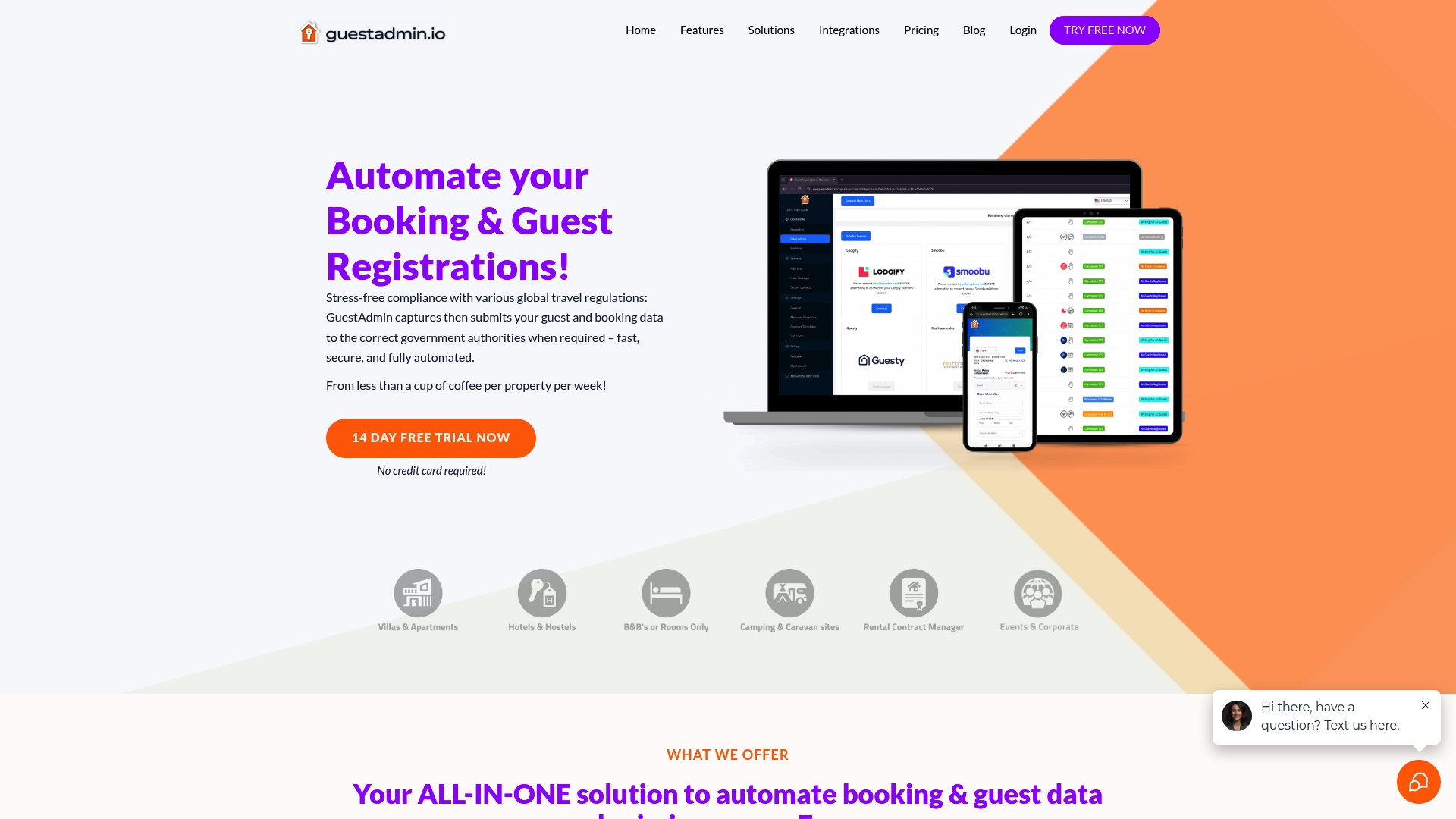
Our multi-property management tools scale from single units to extensive portfolios whilst maintaining the same reliable automation. AI-powered validation ensures data accuracy and GDPR compliance through intelligent anonymisation and error detection. Whether you operate in one city or across dozens of European locations, GuestAdmin handles jurisdiction-specific requirements automatically. Discover how to automate your booking compliance and redirect administrative time towards growing your business. Explore our comprehensive legal compliance guidance for European rentals to understand how API automation transforms regulatory obligations into competitive advantages.
Frequently asked questions
What is an API in property management?
An API is a software interface that enables different systems to communicate automatically without manual intervention. In property management, APIs connect booking platforms, property management systems, and government compliance portals to exchange guest data seamlessly. This automation eliminates repetitive data entry and reduces errors that trigger compliance violations.
How do APIs help with European travel regulation compliance?
APIs automate the entire compliance workflow by capturing guest information from bookings, validating data against jurisdiction-specific requirements, and submitting reports to appropriate government portals within regulated deadlines. They handle multi-jurisdictional complexity by applying region-specific rules automatically, ensuring each property meets its local regulatory obligations. This systematic approach prevents the missed deadlines and incomplete submissions that result in penalties.
Are API integrations difficult or costly to implement?
Modern SaaS platforms enable API setup within days through guided wizards and pre-built connectors for major PMS and OTA systems. Technical expertise is not required as platforms handle the complexity behind intuitive interfaces. Subscription pricing scales with property count, making advanced automation accessible to operators of all sizes. The time savings from automation typically offset subscription costs within the first month of operation.
How secure is guest data handled through APIs?
API platforms implement enterprise-grade security including encrypted transmission, secure credential storage, and automated access logging that exceeds manual process security. GDPR compliance is built into the architecture through features like AI-powered anonymisation that removes unnecessary personal details whilst retaining required regulatory fields. Every data movement creates an auditable record, providing transparency that manual workflows cannot match. Regular security audits and compliance certifications verify that platforms maintain the highest data protection standards.
One Comment
API integrations in hospitality: a practical guide
[…] the manual handling that introduces errors into regulatory submissions. You can read more about how APIs support rental compliance across European markets […]