

TL;DR:
- Managing short-term rental compliance in Europe requires automation to handle complex data tracking, submission, and regulation compliance effectively. Automating processes like data validation, SDEP submissions, and exception handling significantly reduces administrative workload and minimizes errors. However, continuous manual oversight and engagement with regulatory updates are essential for maintaining robust, compliant operations.
Managing short-term rental compliance across Europe has become one of the most demanding tasks facing property owners and managers today. Between tracking guest data, meeting submission deadlines, and staying current with evolving local regulations, the manual approach is fragile at best. A missed deadline or incomplete data record can result in fines, listing suspensions, or worse. This guide walks you through everything you need to know about automating your compliance workflow, from the tools and data requirements to the exact steps for building a reliable, error-resistant system that keeps your properties fully compliant.
Table of Contents
- What you need to automate hospitality compliance
- Step-by-step automation process for hospitality compliance
- How platforms and enforcement automation impact compliance
- Common mistakes and troubleshooting in automation
- A fresh perspective: automation is only part of smart compliance
- Take the next step: seamless hospitality compliance solutions
- Frequently asked questions
Key Takeaways
| Point | Details |
|---|---|
| Know compliance requirements | Understanding EU hospitality data rules is crucial before automating workflows. |
| Use SDEP for submissions | Structured data and Single Digital Entry Point processes are key for regulatory compliance. |
| Automate error handling | Exception alerts and automated workflows help resolve compliance issues quickly. |
| Integrate platform enforcement | Consider platform-side controls alongside your automation to avoid account restrictions. |
| Combine automation with vigilance | Automation is effective only when supported by regular audit and process improvement. |
What you need to automate hospitality compliance
With the compliance challenge introduced, let us look at what property managers need to automate these workflows effectively. Before you can automate anything, you need a clear picture of what compliance actually demands in the European short-term rental context.
Core compliance requirements for EU short-term rental operators
The regulatory landscape for short-term rentals in Europe is shaped by the EU Short-Term Rental Regulation, which establishes a framework for data transparency and reporting. Central to this framework is the Single Digital Entry Point759356_EN.pdf) (SDEP), a secure mechanism through which listing activity data is shared with public authorities. The European Parliament briefing confirms that SDEPs facilitate the transfer of key listing data including property address, registration number, listing URL, number of nights rented, and number of guests.
Understanding what data you must track is the foundation of any automated compliance setup. Property managers operating across multiple jurisdictions need to capture and store this information consistently for every booking, every property, and every reporting period.
Essential software tools and integrations
Effective automation in hospitality compliance relies on connecting the right tools. Here is what your compliance stack should include:
- Property Management System (PMS): The central hub where booking and guest data is stored. Your PMS should integrate with OTA platforms like Airbnb and Booking.com to pull in reservation data automatically.
- Data validation layer: Software that checks incoming data for completeness and accuracy before it reaches any submission pipeline.
- SDEP-connected submission tool: A platform capable of formatting and transmitting listing-level data to national SDEPs in the required structure.
- Alerting and notification system: Automated alerts that flag exceptions, missing data fields, or failed submissions immediately.
- Audit trail and archiving tool: A compliant data store that retains records according to GDPR and national data retention rules.
Manual versus automated compliance: a direct comparison
| Task | Manual approach | Automated approach |
|---|---|---|
| Guest data collection | Entered by hand per booking | Auto-captured via PMS/OTA integration |
| Data validation | Checked manually, error-prone | Validated in real time against required fields |
| SDEP submission | Filed manually, often delayed | Submitted automatically within defined windows |
| Exception handling | Discovered late, resolved slowly | Flagged instantly via alerts, resolved faster |
| Audit trail | Spreadsheets or paper records | Secure, searchable digital archive |
| Staff time per property | High (hours per week) | Minimal (minutes per week) |
The contrast is stark. Manual processes create bottlenecks, particularly for managers overseeing multiple properties. Automated setups scale efficiently, and you can find practical property automation examples that show precisely how much administrative time operators save once automation is in place.
Step-by-step automation process for hospitality compliance
Now that you know what you need, here is how to put automation into practice. The following steps give you a clear, sequential path from raw booking data to a fully compliant SDEP submission.
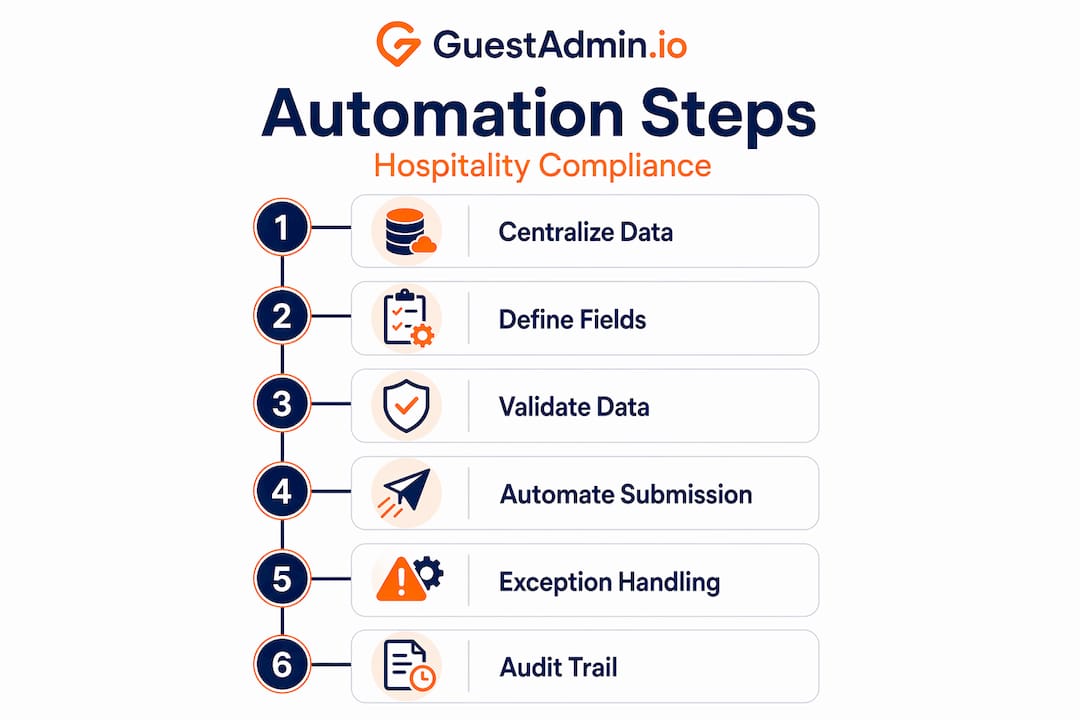
Step 1: Centralise your data sources
Connect all your booking channels, whether Airbnb, Booking.com, Vrbo, or direct bookings through your website, into a single PMS. This eliminates the risk of missed reservations and ensures every guest’s data flows into one place. Set up API connections or webhooks where available, as these transfer data in real time rather than in batches, which reduces lag.

Step 2: Define your required data fields
Map out exactly which data points your national SDEP requires. As confirmed by the European Parliament759356_EN.pdf), the standard fields include property address, registration number, listing URL, nights rented, and number of guests. Build these fields as mandatory in your PMS so that no booking can be finalised without them being populated.
Step 3: Implement real-time data validation
Once data enters your system, automated validation should run immediately. Configure rules that check for blank fields, invalid registration number formats, and date conflicts. If a booking record fails validation, the system should trigger an alert before it moves further along the pipeline. This is far more efficient than catching errors at submission time.
Step 4: Schedule and automate SDEP submissions
Your booking compliance automation tool should be configured to submit data to the relevant national SDEP on a scheduled basis, typically monthly or as required by your local authority. Ensure your stack can feed structured, listing-level activity data759356_EN.pdf) into the SDEP and handle related validation and exception workflows automatically. This removes human dependency from the submission process entirely.
Step 5: Build automated exception workflows
Not every submission will go through cleanly. Set up automated exception workflows that route failed submissions to a dedicated queue, notify the responsible manager, and suggest corrective actions. These workflows should include escalation paths, so if an exception is not resolved within a defined period, it automatically escalates to a senior contact.
Step 6: Maintain an automated audit trail
Every submission, validation result, exception, and resolution should be logged automatically. This creates a tamper-resistant record that you can produce if a local authority queries your compliance history. A solid multi-property management workflow includes audit trail generation as a default feature, not an afterthought.
Automation workflow: manual vs. automated side by side
| Stage | Manual timeline | Automated timeline |
|---|---|---|
| Data entry | 15-30 minutes per booking | Immediate (API/webhook) |
| Validation | End of month review | Real-time per booking |
| Submission preparation | 2-4 hours monthly | Automated, scheduled |
| Exception resolution | Days (when noticed) | Hours (instant alert) |
| Audit record creation | Ad hoc, inconsistent | Continuous, automatic |
Pro Tip: Always test your automation in rentals setup with a small batch of historic booking data before going live. This reveals validation gaps and integration issues before they affect actual submissions.
How platforms and enforcement automation impact compliance
With your internal workflows automated, it is also essential to understand how platforms use their own automation to enforce compliance and what that means for you as a property manager.
Booking platforms do not sit passively while hosts manage compliance independently. They run their own automated enforcement systems that interact directly with your listing status.
How platform automation works
Airbnb uses automated processes that analyse account activity and associated information to restrict or suspend access when the system detects activity that may pose a safety or compliance risk. Importantly, hosts can challenge these automated decisions if they believe the system has acted incorrectly.
This matters for property managers because platform enforcement and your own compliance automation need to work in alignment. If your listing data is inconsistent, outdated, or missing required registration information, a platform’s automated system may flag your account before any authority does.
Platform enforcement automation is not a replacement for your own compliance processes. Think of it as a secondary check that will catch gaps you have missed. The goal is to have your own systems so robust that platform automation never has a reason to act.
Key considerations for platform enforcement
- Keep your registration number current across all listings. Outdated or missing numbers are a common trigger for automated platform flags.
- Ensure listing URLs match the data you submit to national SDEPs. Discrepancies between what a platform shows and what authorities receive create compliance risk.
- Document every enforcement action a platform takes against your account, even resolved ones. This record is valuable if you need to challenge a decision or demonstrate good-faith compliance efforts.
- Act on enforcement notifications quickly. Automated platform decisions can escalate rapidly, leading to listing deactivation within days if not addressed.
For a thorough understanding of your obligations, reviewing short-term rental compliance explained is a strong starting point. You can also apply practical short-term rental compliance tips to ensure platform and authority-facing compliance stay aligned.
It is worth noting that compliance automation extends beyond hospitality. Even in adjacent sectors like food service, menu compliance automation demonstrates how structured data submission reduces regulatory risk across industries.
Common mistakes and troubleshooting in automation
Having understood the platforms’ role, it is time to prepare for pitfalls and build reliable troubleshooting into your automated compliance system. Even the best-configured automation can encounter problems. Knowing where failures typically occur makes them far easier to resolve quickly.
The most frequent errors property managers encounter
- Incomplete listing information: Properties missing a valid registration number or an accurate address will fail SDEP validation. This is the single most common cause of rejected submissions.
- Outdated guest data fields: When local regulations change and require new data points, outdated system configurations will continue submitting the old format, creating gaps.
- Missed submission windows: If your scheduling configuration is not tested and monitored, automated submissions can silently fail, leaving you non-compliant without knowing it.
- Ignored exception alerts: Exception alerts are only useful if someone reviews them. Many operators configure alerts but never assign clear ownership, so reports pile up unresolved.
- Integration failures: API connections between your PMS and submission tools can break silently when a platform updates its interface. Without monitoring, these breaks go undetected for weeks.
How to set up automated reminders and validation checks
Configure your system to send automated reminders five days before each submission deadline. This gives your team time to address any outstanding exceptions before the window closes. Additionally, schedule weekly automated validation runs that check all active listings against the required SDEP data fields759356_EN.pdf), flagging any records that have become incomplete since the last check.
For legal compliance automation to be genuinely reliable, your validation checks should run on a schedule, not just at the point of booking creation.
Pro Tip: Assign a named owner to your exception report queue, not a shared team inbox. When accountability is individual rather than collective, resolution times drop significantly. Review exception reports at least twice per week rather than waiting for submission day.
Troubleshooting workflow breakdowns
When automation breaks down, the fastest path to resolution follows this sequence. First, identify whether the failure is at the data collection stage, the validation stage, or the submission stage. Each requires a different fix. Second, check your API connection logs for error codes, which typically point directly to the source of the problem. Third, run a manual test submission for one property to confirm whether the issue is systemic or property-specific. Finally, document the failure and its resolution in your audit trail.
Strong automation of guest management also includes contingency processes for exactly these scenarios, so that a broken automation workflow does not mean a missed compliance deadline.
A fresh perspective: automation is only part of smart compliance
Here is where we offer a viewpoint that goes against the common assumption: automating your compliance workflow does not mean your compliance is guaranteed.
Automation is a powerful tool for reducing human error and saving time. But it executes the processes you design. If those underlying processes are flawed, automation delivers flawed results faster and at greater scale. A misconfigured validation rule will reject perfectly valid submissions every month, not just once. An incorrect field mapping will submit wrong data to authorities consistently, not occasionally.
The operators who achieve genuinely robust compliance are those who treat automation as infrastructure, not as a solution in itself. They pair automated workflows with regular manual audits, typically quarterly, where someone reviews a sample of submissions and checks them against raw booking records. They track every platform enforcement action, even minor ones, because patterns in enforcement data often reveal systemic gaps that automation is quietly papering over.
There is also a dimension of regulatory engagement that no software can replace. Local regulations governing short-term rentals are still evolving rapidly across EU member states. Operators who engage with their local authority contacts, attend industry consultations, and monitor legislative updates are the ones who catch regulatory changes before they disrupt their automated workflows.
Automation reduces your administrative burden significantly. But the compliance mindset, the habit of checking, questioning, and improving your processes, that still has to come from you. Reviewing streamline compliance tips periodically is a practical way to ensure your processes stay current alongside your automated tools.
Take the next step: seamless hospitality compliance solutions
Putting everything in this guide into practice requires the right platform behind you. GuestAdmin.io is built specifically for property owners and managers across Europe who need automated, reliable compliance without the manual workload.
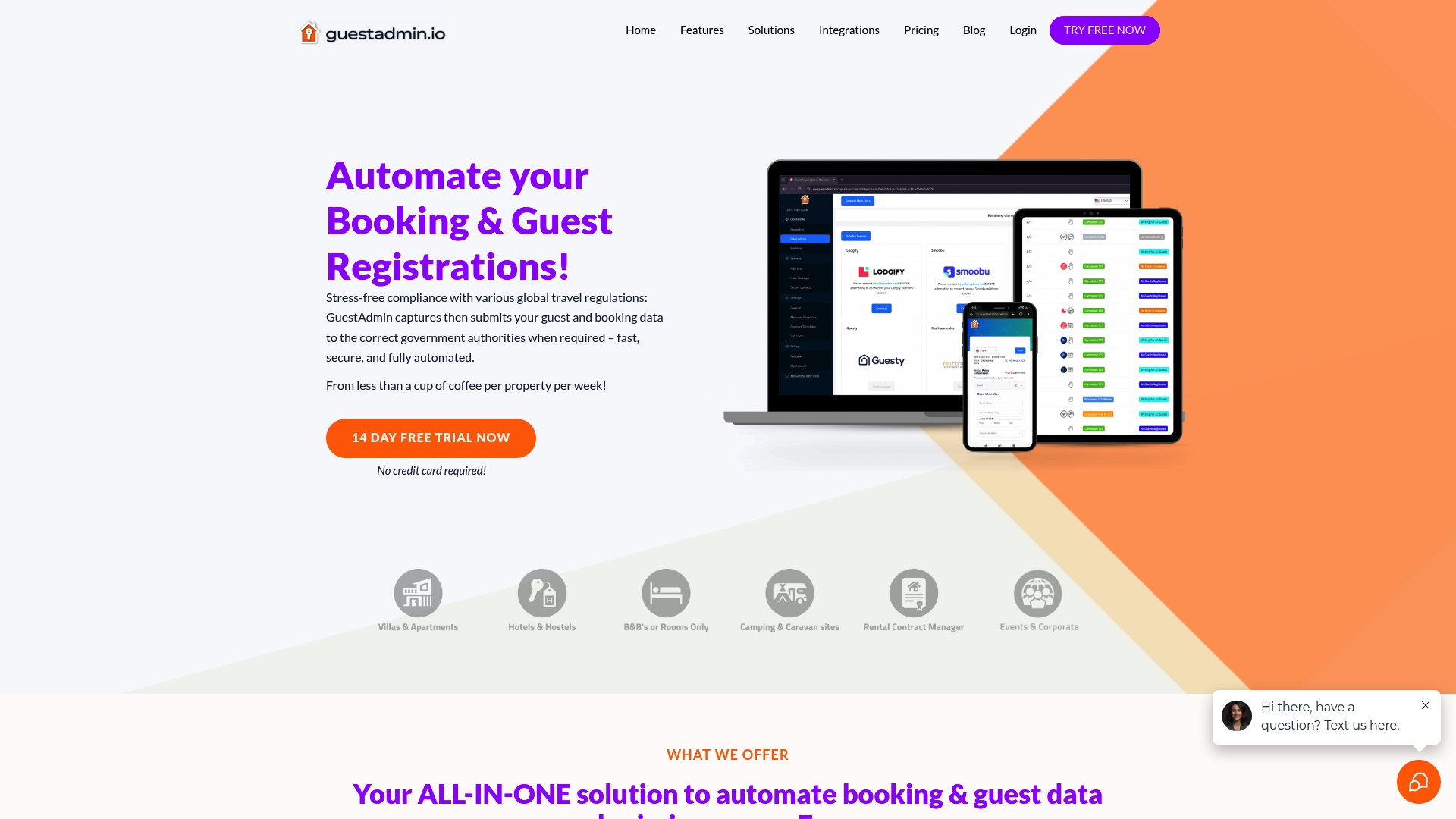
From AI-powered data processing to multi-property dashboards and direct SDEP-ready submissions, GuestAdmin makes hospitality compliance straightforward and scalable. Whether you manage a single property or a large portfolio, our platform grows with you. Explore multi-property management tools designed to keep every listing compliant across jurisdictions, and discover how automation in rentals compliance can transform the way your business operates. Start automating your compliance today with confidence.
Frequently asked questions
What data must be submitted for EU short-term rental compliance automation?
Key data includes property address, registration number, listing URL, nights rented, and number of guests, as required for SDEP submissions759356_EN.pdf) to public authorities across EU member states.
How do automated compliance tools handle booking validation exceptions?
Automated systems trigger instant alerts and route exceptions to a dedicated resolution workflow, so managers can correct data errors quickly before the next submission window closes. Ensuring your stack can handle SDEP exceptions759356_EN.pdf) is a core requirement of any compliant automation setup.
Can booking platforms restrict access based on automated compliance checks?
Airbnb’s automated processes analyse account activity and can restrict or suspend listings if compliance risks are detected, though hosts are able to challenge those decisions if the system has acted incorrectly.
Is automation enough for guaranteed compliance?
Automation significantly reduces errors and manual effort, but it must be paired with regular audits, process reviews, and proactive monitoring to ensure compliance remains consistent over time.