

TL;DR:
- European short-term rental operators must adopt SaaS solutions to meet new EU digital data reporting regulations effectively. SaaS platforms automate guest data collection, validation, and submission, reducing errors, saving time, and ensuring compliance across multiple properties. Early implementation offers operational, security, and strategic advantages, making automation the industry standard for scalable, compliant rental management.
European short-term rental operators are navigating a fast-shifting regulatory environment, and the margin for error is shrinking. EU Regulation 2024/1028 is establishing a harmonised digital data reporting framework across member states, which means manual guest registration systems are becoming an increasing liability. This guide explains exactly how SaaS solutions address these pressures, reduce administrative burden, and ensure your properties remain compliant without tying up staff in time-consuming paperwork.
Table of Contents
- The new face of guest registration in Europe
- How SaaS solutions transform guest registration
- Comparing SaaS vs manual registration: Compliance and efficiency
- Real-world impact: SaaS in day-to-day guest management
- What most owners overlook about SaaS guest registration
- Streamline guest registration and compliance with the right SaaS solution
- Frequently asked questions
Key Takeaways
| Point | Details |
|---|---|
| Stay ahead with compliance | SaaS guest registration solutions help properties meet new EU digital data requirements without stress. |
| Reduce errors and save time | Automated guest registration cuts manual steps, minimises mistakes and improves the guest experience. |
| Scale with confidence | SaaS platforms adapt as regulations change and properties grow, ensuring ongoing security and compliance. |
| Operational efficiencies | Switching to SaaS boosts productivity and lets managers focus on service, not paperwork. |
The new face of guest registration in Europe
Regulatory compliance has changed significantly for short-term rental operators across Europe. Not so long ago, most property owners could manage guest records with a spreadsheet, a filing cabinet, and the occasional government portal login. That approach is rapidly becoming inadequate.
Regulation (EU) 2024/1028 is creating a common transparency and data-sharing framework starting 20 May 2026. This is not a regulation banning short-term rentals. It is a requirement for standardised digital data exchange between rental platforms, property owners, and government authorities. The scope covers platforms like online travel agencies and extends to individual hosts who rent properties even occasionally.
What does this mean practically? Operators must submit accurate guest data digitally, on time, and in a format that local authorities can integrate with national and EU-level systems. Getting this wrong carries real consequences, including financial penalties and potential suspension of operating licences.
Manual registration makes this extremely difficult to get right consistently. Here are the core risks associated with relying on paper-based or ad hoc digital methods:
- Human error in transcribing passport numbers, dates, or nationality fields
- Missed deadlines when submissions depend on a single staff member being available
- Inconsistent formatting that fails to meet authority specifications
- Poor record keeping that leaves you exposed during audits
- Inability to scale across multiple properties without increasing staff headcount
Understanding booking data regulations is no longer optional for anyone operating in the European short-term rental market. Operators who understand this early have a clear advantage.
“The shift to mandatory digital reporting is not a burden on well-prepared operators. It is an opportunity to replace unreliable manual processes with systems that work consistently, around the clock, without human intervention.”
SaaS guest registration platforms were built precisely for this environment. They sit between your booking data and the compliance requirement, automating the transfer of information with audit trails, validation checks, and submission logs that manual systems simply cannot replicate.
How SaaS solutions transform guest registration
SaaS, or Software as a Service, refers to cloud-based software delivered via a subscription model and accessed through a web browser. For guest registration, this means you log in to a platform, connect your booking channels, and let the system handle data capture, validation, and submission automatically.
The operational improvements are substantial. A property management SaaS platform centralises everything that was previously scattered across email inboxes, spreadsheets, and local portals. Guest information flows in from your booking channels, gets validated automatically, and is submitted to the relevant authorities without manual intervention.
Here is what a well-designed SaaS guest registration system actually does for you:
- Automated data capture: Guest details are pulled directly from bookings via integrations with popular OTA and PMS platforms, eliminating re-keying entirely
- Real-time validation: The system checks that mandatory fields are complete and correctly formatted before submission, catching errors that a tired staff member might miss
- Scheduled submissions: Compliance deadlines are built into the system, so submissions happen automatically within required timeframes
- Multi-property dashboards: All your properties appear in a single interface, with compliance status visible at a glance
- GDPR-compliant data storage: Guest records are stored securely, with access controls and retention policies that meet EU privacy law requirements
- Audit trails: Every submission is logged with timestamps, making it straightforward to demonstrate compliance during an inspection
The operational value of SaaS increases as integration capabilities keep up with changing compliance requirements in Europe. This is the critical point that many operators miss when evaluating whether to invest in a platform. The software does not just solve today’s compliance requirements. It evolves alongside regulatory changes, so your team does not need to monitor government updates and adapt manual workflows every time a rule changes.
Choosing SaaS for effortless compliance is increasingly considered best practice among larger property management companies, and smaller operators are following suit as the regulatory environment tightens.
Pro Tip: When evaluating SaaS platforms for guest registration, look specifically for providers with demonstrated knowledge of local compliance requirements in your operating country. A platform that supports generic data capture is far less valuable than one that knows exactly which fields Spanish, Italian, or Portuguese authorities require and in which format.
You should also look at how quickly the provider has historically updated its platform when regulations changed. Fast, responsive updates are a sign that the team understands the compliance environment deeply. The ability to automate guest data collection is just the starting point; the real differentiator is whether the platform keeps pace with evolving legal requirements.
Comparing SaaS vs manual registration: Compliance and efficiency
Now that you understand the SaaS benefits, a direct comparison reveals what you gain versus traditional processes.
| Factor | Manual registration | SaaS registration |
|---|---|---|
| Setup time | Days to weeks per property | Hours to days for multiple properties |
| Error risk | High, due to manual data entry | Low, with automated validation |
| Compliance confidence | Variable, dependent on staff diligence | Consistently high, with automated checks |
| Cost per check-in | High staff time allocation | Low, once integration is established |
| Scalability | Poor, requires proportional staff increases | Excellent, scales to multiple properties |
| Regulatory updates | Manual, relies on owner awareness | Automatic, built into platform updates |
| Audit trail quality | Inconsistent, often incomplete | Comprehensive, timestamped records |
The differences compound quickly when you manage more than a handful of properties. A management company with 30 properties using manual registration might employ two or three people just to handle guest data submissions. With a well-configured SaaS platform, that same workload can be handled in a fraction of the time, freeing staff for guest relations and operational tasks that genuinely require human judgement.
Data security in Europe is another area where SaaS outperforms manual processes significantly. Storing guest passport details in a spreadsheet, or even in a locally hosted database, creates real risks around unauthorised access, data loss, and GDPR compliance. SaaS platforms designed for the hospitality sector encrypt data at rest and in transit, operate on servers with appropriate security certifications, and maintain access logs that demonstrate proper data governance.
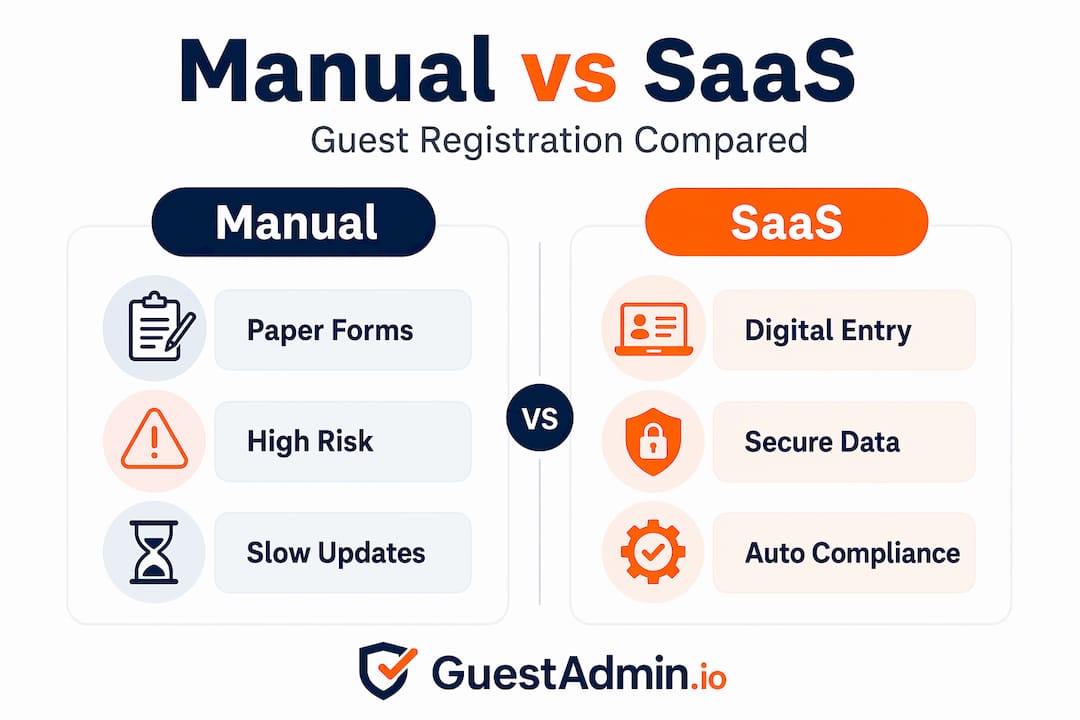
The value of SaaS grows as regulatory frameworks become more unified and digital, making flexible integration essential for rental managers. As EU member states align their systems with the 2024/1028 framework, operators who have already adopted SaaS will find the transition straightforward. Those still relying on manual methods will face a significant catch-up challenge.
Understanding data privacy in hospitality requirements is foundational to making a sound technology decision here. Operators who treat compliance as a technical afterthought tend to find it catches up with them at the worst possible moment, typically during peak season or an audit.
Pro Tip: If you are new to SaaS for guest registration, start with a single property. Configure the platform fully, run it through a complete month of bookings, and confirm that submissions are landing correctly with local authorities before rolling it out across your portfolio. This approach builds confidence and identifies any local quirks before they become widespread issues.
Real-world impact: SaaS in day-to-day guest management
Let’s translate these advantages into what your staff, guests, and compliance officers will actually notice.
Consider a property management company operating 15 apartments across two European cities. Previously, their office administrator spent roughly 90 minutes per day logging guest details, checking submission portals, and chasing incomplete booking information from guests who had not provided passport numbers before arrival. Errors were common. Corrections required additional time and occasionally triggered queries from local authorities.

After implementing a SaaS guest registration platform, the same company reported the following changes:
| Metric | Before SaaS | After SaaS |
|---|---|---|
| Average check-in processing time | 12 minutes per guest | Under 3 minutes per guest |
| Data accuracy rate | Approximately 84% | 99%+ with automated validation |
| Compliance submission success rate | 91% on time | 100% automated on time |
| Weekly staff hours on registration admin | 9 hours | Under 2 hours |
These figures are representative of the improvements operators consistently report after adopting dedicated SaaS for compliance success. The time saved is not just convenient. It translates directly into operational cost savings and a reduced risk of penalties.
SaaS systems offer ongoing value as they enable integration with compliance platforms and adapt to periodic regulatory change in Europe. This adaptability is what makes them genuinely useful over a multi-year period, not just during initial implementation.
Here is a step-by-step view of how SaaS transforms the typical check-in and compliance process:
- Booking confirmed: Your OTA or PMS sends booking data to the SaaS platform automatically via an integration or webhook
- Guest data request sent: The platform messages guests ahead of arrival, requesting any missing identification details through a secure digital link
- Data validated: Submitted information is checked against required field formats for the relevant local authority
- Submission prepared: A compliant registration record is generated and queued for submission within the required reporting window
- Authority submission: The platform submits data to the relevant local authority portal, with a confirmation logged in your dashboard
- Record archived: Guest data is stored securely in your account, accessible for audits but protected from unauthorised access under GDPR guidelines
This process runs without any manual intervention once configured. Staff receive alerts only when something requires their attention, such as a guest who has not responded to a data request before check-in. Everything else happens automatically, reliably, and on time.
What most owners overlook about SaaS guest registration
Most discussions about SaaS guest registration focus on process efficiency and regulatory compliance. Both matter enormously. But there is a broader strategic dimension that tends to get overlooked, and it is worth examining directly.
The data your guest registration system collects is genuinely valuable beyond its compliance function. Patterns in booking behaviour, nationality trends, length-of-stay data, and seasonal demand signals are all embedded in the information you are already legally required to capture. Manual processes bury this data in files and portals. A SaaS platform with a proper dashboard surfaces it in a form you can actually use.
Operators who treat compliance data as a business intelligence asset tend to make better pricing decisions, identify underperforming properties earlier, and provide a more personalised guest experience. This is a genuine competitive advantage, not a theoretical one. Your competitors who have already adopted SaaS are likely already benefiting from this kind of insight.
There is also a reputational dimension to consider. Guest data errors do not just create regulatory problems. They create guest problems. A guest who arrives and finds their registration was not properly submitted, or whose data was mishandled, is unlikely to return or recommend your property. The professional, frictionless check-in experience that good SaaS enables is part of your guest experience, not separate from it.
Why SaaS is the industry standard for progressive property managers is becoming clearer every year. The operators who adopted early are now running leaner, more compliant, and more guest-friendly operations than those still relying on spreadsheets and manual portals.
The uncomfortable truth is that manual processes do not just create compliance risk. They create a ceiling on how professional and scalable your operation can become. Every hour spent on manual data entry is an hour not spent improving your properties, building guest relationships, or growing your portfolio.
Streamline guest registration and compliance with the right SaaS solution
Understanding the regulatory landscape and the practical value of SaaS is an important first step. Acting on that understanding is what separates well-run, compliant operations from those that will struggle as EU frameworks tighten further through 2026 and beyond.
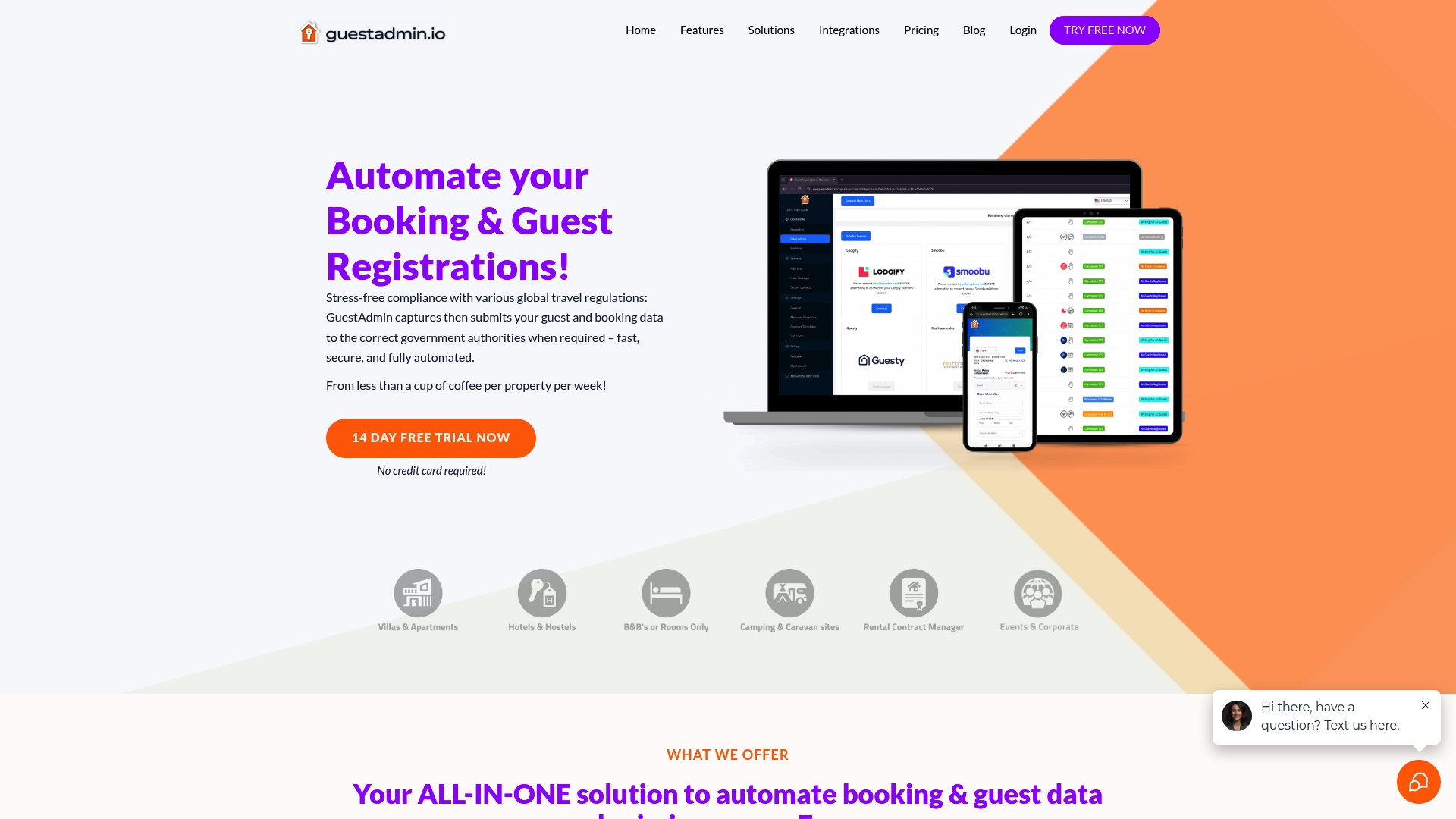
GuestAdmin.io is built specifically for property owners and management companies navigating the European short-term rental compliance environment. From automated guest registration to multi-property dashboards and AI-powered data processing, the platform handles the full compliance workflow so your team can focus on what matters. Explore the rental compliance essentials that apply to your properties, or see how seamless automation works in practice. A trial account gets you operational in hours, not weeks, with onboarding support from a team that knows European compliance requirements in depth.
Frequently asked questions
How does SaaS help short-term rentals comply with new EU regulations?
SaaS systems keep guest registration digital, accurate, and automatically updated to meet the evolving EU data reporting rules introduced under frameworks like Regulation 2024/1028, reducing the burden on operators to monitor and implement each regulatory change manually.
How does SaaS guest registration save time compared to manual systems?
Automated SaaS systems reduce check-in processing times and eliminate repetitive paperwork by instantly collecting, validating, and storing guest information, with integration capabilities that keep pace with changing compliance requirements so your processes never fall behind.
Are SaaS guest registration platforms secure under EU law?
Yes. Leading SaaS platforms provide encrypted data storage, role-based access controls, and regular updates to align with GDPR and regional privacy guidelines, ensuring that flexible integration remains compliant as frameworks evolve across member states.
Will SaaS solutions adapt to changing regulations automatically?
Modern SaaS platforms are built to update in line with regulatory changes, and as EU directives evolve through the 2026 implementation period and beyond, well-maintained systems will adapt automatically, keeping your guest registration process compliant without requiring manual intervention from your team.