

TL;DR:
- Digital transformation in hospitality integrates technologies like cloud systems, AI, IoT, and APIs to improve efficiency and guest experiences. It reduces operating costs by 20–30%, mitigates staff shortages, and enhances compliance through automated data management. Success relies on proper sequencing, staff training, and fostering a supportive culture that values technology as an aid to human service.
Hospitality industry digitalization is the comprehensive integration of digital technologies into every layer of hotel and property management operations, from guest check-in to regulatory compliance. The shift goes far beyond installing new software. It reshapes how properties collect data, serve guests, manage staff, and meet legal obligations. The industry term for this process is “digital transformation in hospitality,” and it covers cloud infrastructure, AI-powered tools, Internet of Things devices, and API-driven data architectures. Property managers who understand this transformation gain a measurable edge: digitally enabled operations reduce total operating costs by 20–30% and can cut staff workload by up to 70% through AI automation.
What technologies power digital transformation in hospitality?
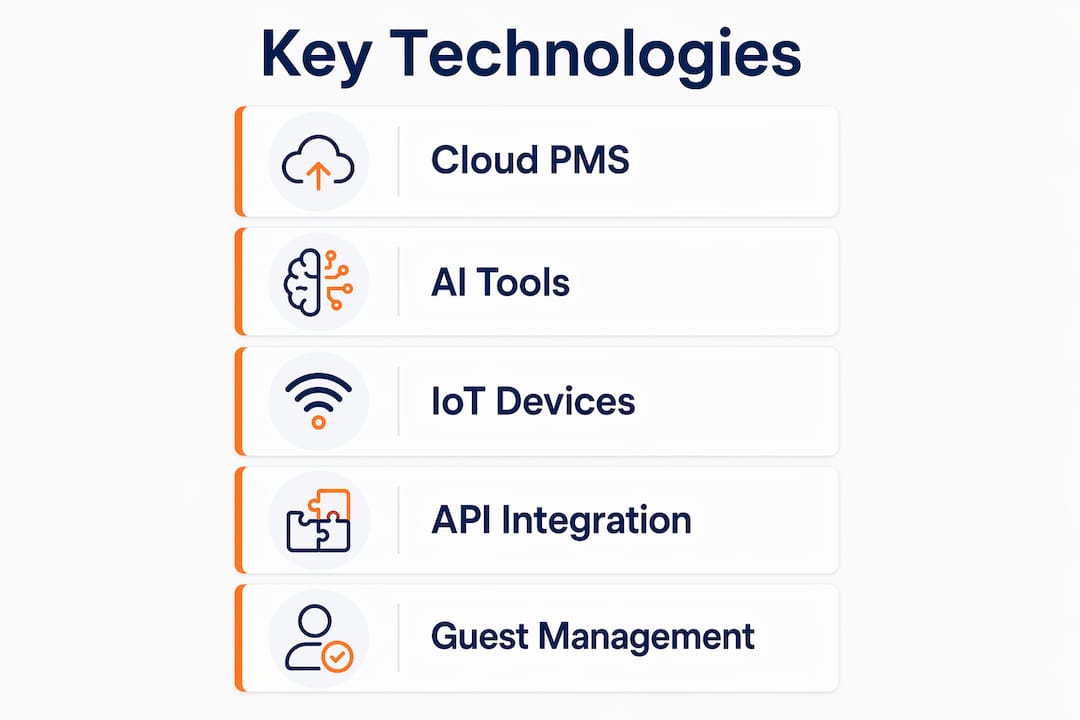
Digital transformation in hospitality runs on four core technology layers. Each layer solves a distinct operational problem, and together they create a property that runs with far less manual effort.
- Cloud-based Property Management Systems (PMS). A cloud PMS replaces on-premise servers with a web-accessible platform. Property managers gain real-time visibility across bookings, housekeeping, and billing from any device. Cloud PMS adoption boosts operational efficiency by up to 30%, making it the single most impactful first step for most properties.
- AI applications. AI chatbots handle routine guest queries around the clock, freeing front-desk staff for complex interactions. AI-driven revenue management systems analyse demand signals and adjust pricing automatically. Hotels using these systems have achieved over 15% RevPAR growth, a result that manual pricing rarely matches.
- Internet of Things (IoT). Smart room controls let guests adjust lighting, temperature, and entertainment from a single app. IoT sensors also monitor energy consumption in real time, cutting utility costs without requiring staff intervention.
- Integration APIs. Open APIs connect the PMS to CRM platforms, point-of-sale systems, loyalty programmes, and OTA channels. Without this connectivity, data sits in silos and managers make decisions on incomplete information.
Pro Tip: Before purchasing any new tool, map your existing tech stack and identify which systems lack API connectivity. Gaps here are the most common cause of failed digital projects.
How does digitalization improve operational efficiency and staff productivity?

Staff shortages are the defining operational pressure of the current period. 65% of hotels reported staffing shortages in 2025, alongside an 11.2% year-on-year rise in labour costs. That combination makes automation not a luxury but a financial necessity.
Digital tools address this in four concrete ways:
- Automated scheduling. AI scheduling tools analyse occupancy forecasts, historical patterns, and staff availability to generate rotas automatically. Managers spend minutes reviewing rather than hours building schedules from scratch.
- Automated housekeeping workflows. Room status updates from the PMS trigger housekeeping tasks in real time. Staff receive assignments on mobile devices, removing the need for paper lists and radio coordination.
- Hybrid hospitality. The hybrid hospitality model assigns predictable, repetitive tasks to technology and reserves human staff for empathetic, complex guest interactions. This is not about reducing headcount. It is about deploying people where they create the most value.
- Data-driven decision-making. Unified dashboards pull data from PMS, POS, and CRM into a single view. Managers spot occupancy trends, revenue anomalies, and maintenance patterns without pulling reports from multiple systems.
The operational result is significant. Properties that fully integrate their platforms achieve total property visibility and consistent service delivery across every shift, not just when experienced managers are on duty.
In what ways does digitalization enhance the guest experience?
Guest expectations have shifted permanently. Travellers now arrive with assumptions shaped by app-based banking, same-day delivery, and AI assistants. Hospitality tech innovations must meet those expectations or guests will notice the gap.
- Contactless check-in and mobile keys. Guests complete check-in on their smartphones before arrival and go straight to their room. The front desk becomes a concierge point rather than an administrative bottleneck.
- AI-powered digital concierges. Conversational AI handles restaurant recommendations, local transport queries, and room service orders at any hour. These tools also surface personalised offers based on a guest’s booking history and stated preferences.
- IoT-connected rooms. Guests control room environment through a single interface. Properties can also pre-set rooms to a returning guest’s preferred temperature and lighting profile, creating a personalised arrival without any staff effort.
- Generative Engine Optimisation (GEO). 37% of travellers now use AI assistants to plan and book trips rather than traditional search engines or OTAs. This means properties must optimise their content for AI discovery, not just Google rankings. GEO is the emerging standard that replaces conventional SEO for hospitality marketing.
Pro Tip: Update your property descriptions with structured, factual content that AI assistants can cite directly. Vague marketing copy performs poorly in AI-generated travel recommendations.
What are the data management and compliance challenges in hospitality digitalization?
Data is the foundation of every digital tool in hospitality. When data is fragmented, every system built on top of it underperforms.
The core problem is siloed systems. A property might hold guest profiles in its CRM, payment records in its POS, booking data in its PMS, and compliance records in a separate spreadsheet. None of these talk to each other automatically. Managers then spend time reconciling information manually, which introduces errors and delays.
API-driven architectures solve this by connecting every system through a shared data layer. The PMS becomes the central hub, and all other platforms read from and write to it in real time. This prevents duplication, reduces errors, and makes compliance reporting far simpler.
Security is the second major challenge. Embedding security into system architecture from the design stage is the only reliable approach. Adding security as an afterthought, once systems are already connected, leaves gaps that are difficult and expensive to close. For European property managers, GDPR compliance adds a further layer: guest data must be collected lawfully, stored securely, and submitted to authorities accurately and on time.
| Challenge | Root cause | Digital solution |
|---|---|---|
| Fragmented guest data | Siloed PMS, CRM, and POS systems | Open API integration across platforms |
| Manual compliance reporting | No automated data submission workflow | Automated guest data capture and filing |
| Security vulnerabilities | Connectivity added without security design | Security embedded at architecture stage |
| Inconsistent service delivery | Staff relying on incomplete information | Unified real-time dashboards |
Platforms like Guestadmin address the compliance dimension directly. Guestadmin captures guest and booking data automatically, processes it with AI, and submits it to the relevant government authorities within 24 hours, removing the manual burden from property managers entirely.
What best practices enable successful digital transformation in hospitality?
Most digital transformation projects in hospitality fail not because of the technology but because of poor sequencing. AI strategy must precede tooling. Data must be consolidated before deploying AI-based revenue management or guest engagement systems. Skipping this order produces expensive tools that produce unreliable outputs.
- Audit your tech debt first. List every system currently in use, identify which lack API connectivity, and calculate the cost of maintaining legacy tools. This audit reveals where migration to a cloud PMS will deliver the fastest return.
- Prioritise integration over features. A PMS with fewer features but open API connectivity outperforms a feature-rich system that cannot share data. Integration is the multiplier that makes every other tool more effective.
- Plan staff talent migration in parallel. Automating routine tasks must coincide with retraining staff as experience-builders and guest curators. Skipping this step creates cultural resistance that undermines adoption.
- Structure AI adoption in layers. Effective implementation follows three layers: routine backend automation first, then intelligent service layers such as revenue management, then guest engagement tools. This sequence, drawn from layered AI adoption frameworks, prevents integration failures.
Pro Tip: Run a 90-day pilot on one property before rolling out any new platform across your portfolio. Real-world data from a controlled pilot is worth more than any vendor demonstration.
Key takeaways
Digital transformation in hospitality delivers measurable gains in cost, efficiency, and guest satisfaction only when data architecture, staff training, and security are treated as foundations rather than afterthoughts.
| Point | Details |
|---|---|
| Cost reduction is proven | Digitally enabled operations cut total operating costs by 20–30% across properties. |
| Cloud PMS is the starting point | Migrating to a cloud PMS with open API connectivity unlocks every subsequent digital gain. |
| Staff shortages accelerate automation | With 65% of hotels reporting shortages, workflow automation is now a financial necessity, not an option. |
| Compliance needs built-in automation | Manual guest data submission creates errors and legal risk; automated platforms remove both. |
| AI adoption requires sequencing | Data consolidation must come before AI deployment, or outputs will be unreliable and costly to fix. |
Why the human element still decides whether digitalization succeeds
Property managers often ask me whether digitalization will eventually replace the hospitality professional entirely. My honest answer is no, and the evidence supports that view clearly.
The hybrid hospitality model is not a transitional phase on the way to full automation. It is the destination. Technology handles logistics with consistency that humans cannot match at scale. Humans handle the moments that matter most: a guest who has had a difficult journey, a family celebrating a milestone, a business traveller who needs a problem solved quickly and personally. No AI concierge replicates that reliably.
What I have seen fail repeatedly is the assumption that deploying technology is the hard part. The harder part is cultural change. Staff who feel replaced rather than supported will resist new tools, find workarounds, and undermine adoption. The properties that succeed treat digital transformation as a people project that happens to involve technology, not the other way around.
Digital transformation should amplify human teams rather than replace them. That framing, from Deloitte Digital, is the most useful I have encountered. It gives staff a clear role in the new model and gives managers a clear mandate: invest in training as seriously as you invest in software.
The future of hospitality technology is not a single project with a completion date. It is an ongoing capability that properties build over time. The managers who treat it that way will stay ahead. Those who treat it as a one-time installation will find themselves repeating the process every three years at greater cost.
— Alex
How Guestadmin helps property managers stay compliant and efficient
Managing compliance across multiple properties is one of the most time-consuming parts of running a short-term rental portfolio in Europe. Regulations vary by country, submission deadlines are strict, and the cost of errors is real.
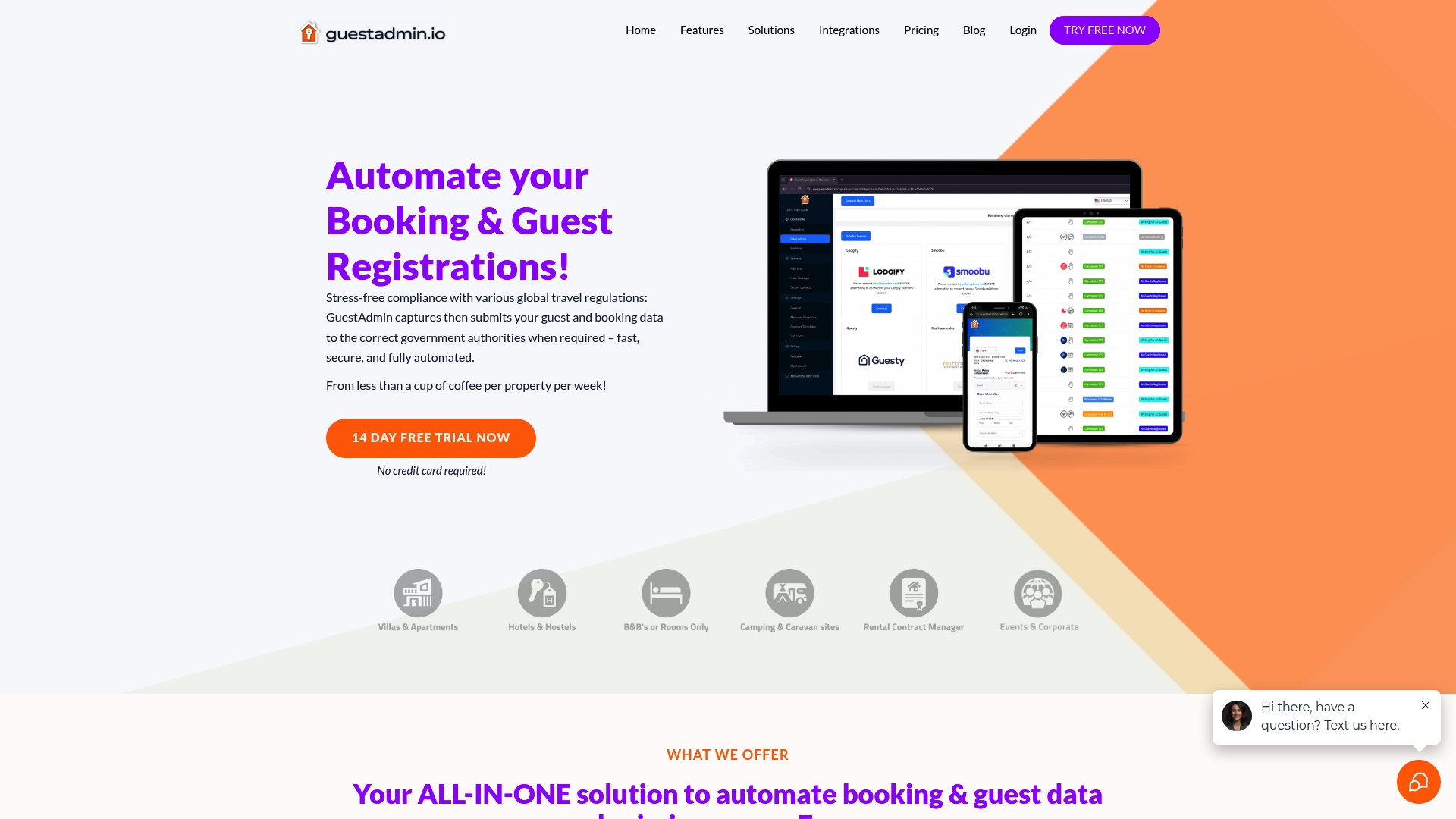
Guestadmin is built specifically for this challenge. The platform integrates directly with your existing PMS and OTA channels, captures guest data automatically, and submits it to the relevant authorities within 24 hours. Property managers gain a real-time dashboard across their entire portfolio, with GDPR-compliant data storage and no manual filing. For those managing several properties, the multi-property management tips on the Guestadmin site offer practical guidance on keeping compliance consistent at scale. You can also explore short-term rental compliance guidance to understand exactly what your obligations are and how automation removes the risk.
FAQ
What is hospitality industry digitalization?
Hospitality industry digitalization is the integration of digital technologies, including cloud PMS, AI tools, IoT devices, and open APIs, into hotel and property management operations to improve efficiency, guest experience, and compliance.
How much can digitalization reduce operating costs?
Digitally enabled operations reduce total operating costs by 20–30%, with cloud PMS adoption boosting efficiency by up to 30% and AI chatbots cutting staff workload by up to 70%.
What is hybrid hospitality?
Hybrid hospitality is a model that assigns repetitive, predictable tasks to technology while directing human staff towards complex, empathetic guest interactions that require personal judgement.
Why is data integration critical for digital transformation?
Siloed systems produce incomplete data, which causes errors in reporting, compliance failures, and poor AI outputs. Open API integration connects PMS, CRM, and POS into a single data layer that all tools can use reliably.
How does digitalization affect compliance for European property managers?
European property managers must collect, store, and submit guest data in line with GDPR and local travel regulations. Automated platforms like Guestadmin handle capture and submission within 24 hours, removing the risk of manual errors and missed deadlines.