

TL;DR:
- Webhooks automate real-time data transfer between hospitality applications and improve operational efficiency. They send instant HTTP POST requests triggered by specific events, reducing latency and server load compared to polling methods. Proper implementation involves security, payload handling, and retry logic to ensure reliable, compliant workflows.
Webhooks are automated HTTP callbacks that push real-time data between hospitality applications the moment a specific event occurs. Understanding how webhooks work in hospitality is the difference between a property management stack that reacts instantly and one that lags behind guest expectations. These event-driven mechanisms connect property management systems (PMS), channel managers, CRM tools, and compliance platforms without manual intervention. For property managers running short-term rentals across Europe, that real-time connectivity is not a luxury. It is the foundation of efficient, compliant operations.
How webhooks work in hospitality platforms
Webhooks operate on a push model. When a defined event occurs inside a hospitality platform, the system immediately sends an HTTP POST request to a pre-configured URL on your server. No waiting, no polling, no scheduled checks. The data arrives the moment the event fires.
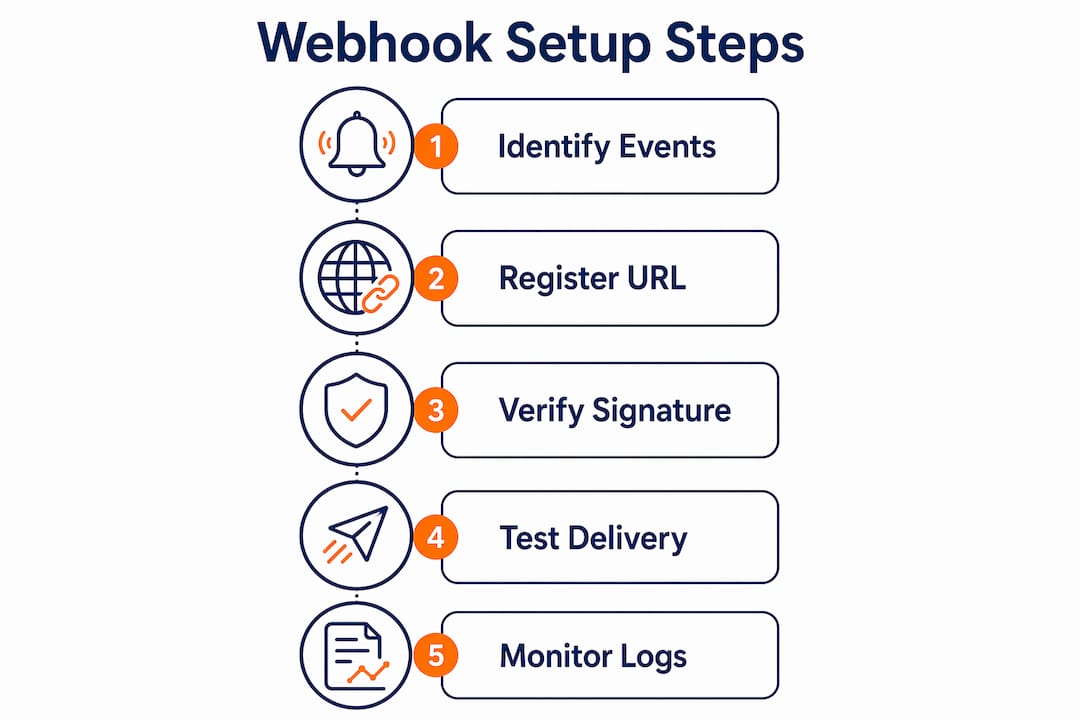
The standard setup in hospitality platforms follows five steps:
- Access the developer or integrations dashboard in your PMS or booking platform.
- Register a secure HTTPS endpoint on your server to receive incoming POST requests.
- Select the events you want to monitor. Common triggers include
booking_created,stay_checked_out, andstay_cancelled. - Obtain a secret key from the platform, which your server uses to verify incoming payloads.
- Configure your server to validate the signature, return a
200 OKresponse, and process the data.
One detail that surprises many developers: webhook payloads are minimal. The initial POST typically contains only the event type, a timestamp, and a unique identifier. Your application then calls back via a REST API to fetch the full reservation or guest record. This two-step pattern keeps webhook delivery fast and lightweight.
Security is non-negotiable. Platforms require cryptographic signature verification, typically using HMAC-SHA256, to confirm that incoming requests genuinely originate from the platform and have not been tampered with. Relying on an obscured URL alone is not sufficient protection.

Pro Tip: Register only the specific event types your application needs. Subscribing to every available event generates unnecessary traffic and forces your server to filter out irrelevant payloads, adding latency and complexity.
Webhooks vs. API polling: which is better for hospitality?
Traditional API polling requires your system to repeatedly ask a platform, “Has anything changed?” at fixed intervals. Webhooks flip that model entirely. The platform tells your system, “Something just changed,” the instant it happens.
| Feature | API polling | Webhooks |
|---|---|---|
| Data delivery | Periodic, scheduled requests | Instant push on event trigger |
| Server load | High, due to repeated calls | Low, only fires on events |
| Latency | Minutes to hours, depending on interval | Near zero |
| Manual error risk | Higher, due to missed poll cycles | Lower, automated delivery |
| Implementation complexity | Lower initial setup | Requires endpoint and signature handling |
The practical difference for hospitality is significant. A booking created at 11:45 PM on a Friday reaches your smart lock system, your revenue tool, and your compliance platform within seconds via webhooks. With polling set to run every 30 minutes, that same booking might not propagate until 12:15 AM. For a guest arriving at midnight, that gap causes real problems.
Webhooks reduce latency by pushing data instantly, whereas traditional APIs poll periodically. That reduction in latency also reduces server costs. Your infrastructure stops making hundreds of redundant API calls per hour and only processes requests when genuine events occur. For property managers running hospitality automation across multiple properties, that efficiency compounds quickly.
Webhooks also reduce manual data entry and the human errors that come with it. When booking data flows automatically into every connected system, there is no staff member copying reservation details between portals or spreadsheets.
Practical uses of webhooks in short-term rental management
Webhooks act as connective tissue in hospitality technology, linking PMS platforms, channel managers, and CRM systems in real time. The practical applications for short-term rental managers are wide-ranging and immediately valuable.
- Smart lock synchronisation. When a
booking_createdevent fires, a webhook can instantly push access credentials to a smart lock system. The guest receives a unique entry code before they even read their confirmation email. No manual key handover required. - Revenue management updates. A
stay_cancelledevent triggers an automatic update in your revenue management tool, freeing up the dates for repricing and redistribution across channels without staff involvement. - Automated compliance reporting. Webhooks automate compliance reporting by pushing guest data to regulatory platforms within 24 hours of a booking event, reducing manual data entry to zero for these tasks. For European property managers, this is critical for meeting local authority submission deadlines.
- Guest communication workflows. A
booking_confirmedevent can trigger a personalised welcome message, a pre-arrival checklist, or a digital check-in link, all sent automatically without staff action. - Damage deposit and payment processing. A
stay_checked_outevent can trigger deposit release workflows or flag damage reports for review, keeping financial processes moving without manual prompts.
The common thread across all these use cases is the elimination of manual processing. Each webhook event replaces a task that would otherwise require a staff member to log in, check, copy, and act. Across dozens of properties and hundreds of bookings per month, that adds up to substantial time savings.
Pro Tip: When building webhook-driven workflows for compliance reporting, pair your webhook receiver with a property compliance guide to confirm which guest data fields each jurisdiction requires. Capturing the wrong fields at the point of booking wastes the automation entirely.
Common challenges when implementing webhooks in hospitality
Webhook integrations fail in predictable ways. Knowing the failure modes before you build saves significant debugging time later.
- Failed deliveries without retry logic. Systems must implement retry logic with exponential backoff to protect data integrity when receiving servers experience downtime. Without it, a booking event that fires during a server restart simply disappears.
- Slow endpoint responses causing duplicates. Webhook endpoints must return a 200 OK status almost instantly. If your server takes too long processing the payload before responding, the sending platform assumes delivery failed and retries. The result is duplicate events and corrupted data. Decouple receipt from processing: accept the payload, return
200 OKimmediately, then process asynchronously. - Over-subscribing to event types. Developers must select data elements carefully when subscribing to webhook events. Subscribing to every available event type generates header-only notifications that force additional API calls to retrieve useful data, negating much of the efficiency gain.
- Insufficient signature verification. Accepting webhook payloads without verifying the HMAC-SHA256 signature opens your system to spoofed requests. Always validate the signature against your secret key before processing any payload.
- No idempotency handling. Retry logic means the same event can arrive more than once. Your processing logic must handle duplicate event IDs gracefully, typically by checking whether the event has already been processed before acting on it.
Addressing these five points before go-live produces a webhook integration that is reliable, secure, and genuinely reduces operational load rather than creating new maintenance burdens. For developers building on hospitality platforms, a developer’s guide to property tech webhooks provides a solid technical reference for each of these patterns.
Key takeaways
Webhooks are the most efficient mechanism for real-time data integration in hospitality, and implementing them correctly requires attention to security, payload handling, and retry logic.
| Point | Details |
|---|---|
| Push over polling | Webhooks deliver data instantly on events, eliminating the latency and server load of periodic API polling. |
| Minimal payloads | Initial webhook payloads contain only event type, timestamp, and ID; full data requires a follow-up REST API call. |
| Security is mandatory | HMAC-SHA256 signature verification must be implemented; obscured URLs alone do not protect your endpoint. |
| Decouple receipt and processing | Return a 200 OK immediately on receipt, then process the payload asynchronously to prevent retries and duplicates. |
| Compliance automation | Webhooks can push guest data to regulatory platforms within 24 hours of a booking event, removing manual reporting entirely. |
Why webhooks deserve more attention than they get
Alex’s perspective
Most hospitality professionals I speak with treat webhooks as a developer concern, something to hand off to a technical team and forget about. That is a strategic mistake. The architecture of your integrations determines how fast your operation can respond to real-world events, and webhooks are the fastest architecture available.
What I find genuinely underappreciated is the compliance angle. Property managers across Europe face submission deadlines that are measured in hours, not days. A webhook-driven compliance workflow that fires the moment a booking is confirmed is categorically different from a nightly batch job or a manual export. The difference is not just speed. It is the elimination of an entire category of human error.
The platforms that get this right share one characteristic: they treat webhook architecture as a first-class feature, not an afterthought. When evaluating any PMS or booking platform, I now look at webhook documentation quality before I look at the feature list. Poor documentation signals poor implementation. And a poorly implemented webhook is worse than no webhook at all, because it creates the illusion of automation while silently dropping data.
The hospitality sector is moving toward fully automated, event-driven operations. Property managers who understand how these integrations work at a technical level will make better decisions about their tech stacks, ask better questions of their vendors, and build operations that scale without proportionally scaling their headcount.
— Alex
How Guestadmin uses webhooks for compliance automation
Guestadmin is built around the principle that compliance should happen automatically, not manually. The platform uses webhook-driven integration to capture booking and guest data the moment it is created in your PMS or OTA, then processes and submits it to the relevant European authorities within 24 hours.
For property managers handling multiple short-term rentals, that means no manual data exports, no portal logins for each jurisdiction, and no missed submission deadlines. Guestadmin’s property management automation approach connects directly to your existing booking workflows via webhooks and APIs, so compliance runs in the background while you focus on guests. If you want to see how that works in practice for your portfolio, the Guestadmin team offers a walkthrough tailored to your property setup and the specific regulatory requirements of your market.
FAQ
What is a webhook in hospitality?
A webhook is an automated HTTP POST request sent by a hospitality platform to a pre-configured URL whenever a specific event occurs, such as a booking being created or a guest checking out. It delivers data in real time without requiring your system to repeatedly query the platform.
How do webhooks differ from REST APIs in hotel management?
REST APIs use a pull model where your system requests data on a schedule. Webhooks use a push model where the platform sends data instantly when an event fires, reducing latency and server load significantly.
What events can trigger a webhook in a booking system?
Common triggers include booking_created, stay_checked_out, and stay_cancelled. The available event types depend on the platform, and developers should subscribe only to the events their application actually needs.
How do you secure a webhook endpoint?
Secure webhook endpoints by verifying the cryptographic signature included in each request, typically using HMAC-SHA256, and by requiring HTTPS. Signature verification confirms the request genuinely originates from the platform and has not been altered in transit.
Can webhooks automate compliance reporting for short-term rentals?
Yes. Webhooks can push guest and booking data to compliance platforms automatically within 24 hours of a booking event, removing the need for manual data entry and reducing the risk of missed regulatory submissions.