

TL;DR:
- Automated guest data compliance reduces manual workload and improves operational efficiency for short-term rental managers. It strengthens data security through role-based access controls and automated data deletion, ensuring GDPR adherence. Automation provides verifiable audit trails and supports regulatory compliance, enhancing guest trust and protecting rental businesses.
Automated guest data compliance is the process of using software to capture, validate, and submit guest information to government authorities without manual intervention. For short-term rental managers across Europe, the benefits of automated guest data compliance are immediate and measurable: fewer errors, less administrative time, and stronger protection against regulatory fines. Platforms like Guestadmin and property management systems with built-in reporting tools have made this shift accessible to operators of all sizes. This article sets out the core advantages, from operational efficiency to guest trust, so you can make an informed decision about adopting automation for your rental business.
1. How does automation reduce operational burden in guest data management?

Manual guest data management consumes significant staff time every single day. Automated data capture at booking or check-in, combined with API submission to government portals, replaces clerical work that consumes 30 to 90 minutes per shift. That is time your team can redirect to guest experience rather than paperwork.
The difference between manual and automated workflows becomes clear when you map out the steps involved:
- Manual workflow: Staff collect paper or digital forms, re-enter data into a portal, check for formatting errors, and submit before a deadline. Any missed submission requires a manual follow-up.
- Automated workflow: Guest data is captured once at booking or check-in, validated automatically for formatting, and submitted via API without staff involvement.
Daily reconciliation queues in automated systems also prevent audit backlogs from forming. The system flags any unacknowledged submissions and queues them for resubmission, removing the most common failure point in manual compliance. Your team no longer needs to remember submission deadlines or chase confirmation receipts.
Pro Tip: Set your automated system to run a daily reconciliation sweep at a fixed time, such as 06:00, so any overnight gaps are resolved before your front desk opens.
2. In what ways does automation strengthen data security and limit internal exposure?
Data security in short-term rentals is not just about external threats. Internal exposure, where staff access guest data beyond what their role requires, is a significant and often overlooked risk. Role-based access controls in property management systems restrict each staff member to only the guest information they need to do their job. A housekeeping coordinator, for example, does not need access to passport numbers or payment details.
Unprotected spreadsheets and paper records are the most common source of internal data leaks in hospitality. Automated systems remove these entirely by centralising data in a controlled environment with audit logs. Compliance embedded in workflows structurally limits access, reducing reliance on staff memory or goodwill to protect sensitive information.
Automated systems also enforce data retention and deletion policies consistently. Sensitive guest data is purged exactly when required by law, with no manual intervention needed. This removes the risk of retaining data beyond its legal limit, which is a common GDPR violation in smaller rental operations.
- Role-based permissions prevent over-access to passport, payment, and contact data
- Centralised digital records replace vulnerable paper files and shared spreadsheets
- Automated deletion schedules meet GDPR retention requirements without manual tracking
- Audit logs record every access event, creating accountability across your team
Pro Tip: Review your access control settings every quarter. Remove permissions for staff who have changed roles, and confirm that no generic login credentials are shared across your team.
3. How does automation improve audit readiness and regulatory compliance?
Regulatory inspections in European short-term rentals can arrive with little notice. Being unprepared carries real financial and reputational consequences. Automated submission systems create inspection-ready audit trails that include timestamped acknowledgements from government portals, giving inspectors verifiable proof of compliance within seconds.
The contrast between manual and automated audit preparedness is significant:
| Area | Manual approach | Automated approach |
|---|---|---|
| Submission records | Stored in spreadsheets or email folders | Centralised with timestamps and portal acknowledgements |
| Missing submissions | Discovered during inspection | Flagged and resubmitted automatically |
| Retention compliance | Relies on staff remembering deletion dates | Enforced by system policy |
| Inspection response time | Minutes to locate records | Seconds via dashboard search |
| Audit trail completeness | Inconsistent, prone to gaps | Complete and verifiable |
Automated systems also handle the most common audit failure point: unacknowledged records. When a government portal does not confirm receipt of a submission, the system resubmits unacknowledged records automatically, preventing cumulative backlogs. Real-time monitoring of data transactions further improves risk management by giving you a live view of submission status across all properties.
Maintaining a physical or digital inspection binder with recent submission summaries, regulatory contacts, and audit scripts also strengthens your position during inspections. Automated systems generate these summaries on demand, so your binder is always current.
Pro Tip: Keep a 90-day rolling archive of submission confirmations accessible from your front desk. Inspectors frequently request records from the past three months, and having them ready avoids delays.
4. What customer trust and business advantages arise from automating guest data compliance?
Guest trust is a direct commercial asset. Transparent data privacy practices influence repeat bookings and online reputation, particularly as guests become more aware of how their personal data is handled. Automation makes it straightforward to communicate clear, accurate privacy policies because your actual data handling matches what you promise.
Transparency in data privacy is a competitive advantage that drives stronger guest loyalty. Rental managers who can demonstrate GDPR-compliant processes, secure data handling, and clear retention policies stand apart from competitors still relying on manual methods. This is increasingly relevant as online review platforms give guests a direct channel to comment on their experience, including how their data was managed.
The business outcomes from compliance automation extend beyond guest relations:
- Reduced risk of data breach fines, which under GDPR can reach significant sums
- Lower administrative costs as staff time shifts from data entry to guest-facing tasks
- Stronger online reputation through consistent, professional data handling
- Faster onboarding for new properties, as automated systems replicate compliance workflows without additional setup time
- Reduced staff turnover stress, as compliance tasks no longer fall on individual memory
Data security and compliance are distinct disciplines that complement each other. Automation produces the evidence regulators require while simultaneously protecting guests, which means you are building trust on two fronts at once.
5. What are practical tips for implementing automated guest data compliance systems?
Choosing the right system is the first and most consequential decision. Cloud-based property management systems with API integrations for hospitality connect directly to government portals and OTA platforms, removing the need for manual data transfer between systems. Guestadmin, for example, supports integrations via APIs and webhooks, covering multiple European jurisdictions from a single dashboard.
Once your system is in place, build a regular compliance review into your operations calendar. Relationships with local regulators matter too. Knowing your regional contact at the relevant authority means you can resolve submission queries quickly rather than waiting for formal correspondence.
- Select a cloud-based PMS with API connectivity to government portals and major OTA platforms such as Airbnb and Booking.com.
- Configure role-based access controls before your first guest checks in, not after a problem arises.
- Set up a digital inspection binder with submission summaries, regulatory contacts, and your compliance schedule.
- Train staff on system use, not on memorising compliance rules. The system handles the rules; staff need to know how to use the dashboard.
- Schedule monthly compliance checks to review submission logs, confirm deletion policies are running, and update access permissions.
- Use dashboard monitoring to track data workflow health across all properties in real time.
Staff training deserves particular attention. The goal is not to make every team member a compliance expert. The goal is to make the system so straightforward that compliance happens as a natural part of the check-in process.
Pro Tip: Use your booking dashboard to set up automated alerts for any submission that has not received a portal acknowledgement within 24 hours. Early alerts prevent small gaps from becoming inspection problems.
Key takeaways
Automated guest data compliance reduces manual workload, strengthens data security, and produces verifiable audit trails that protect your rental business from regulatory penalties.
| Point | Details |
|---|---|
| Operational time savings | Automation replaces 30 to 90 minutes of manual clerical work per shift with instant API submissions. |
| Data security improvement | Role-based access controls and automated deletion policies reduce internal exposure and GDPR risk. |
| Audit readiness | Timestamped submission records and automatic resubmission prevent inspection backlogs. |
| Guest trust advantage | Transparent, automated data handling supports repeat bookings and a stronger online reputation. |
| Implementation priority | Choose a cloud-based system with API integrations and configure access controls before go-live. |
Why I think most rental managers underestimate this shift
Most rental managers I speak with treat compliance as a box-ticking exercise. They set up a spreadsheet, assign one staff member to handle submissions, and assume the problem is solved. The problem is not solved. It is deferred.
The real risk is not a single missed submission. It is the cumulative effect of inconsistent processes across multiple properties, staff changes, and evolving regulations. Manual compliance is fragile by design. It depends on one person remembering the right steps at the right time, every day, without fail. Automation removes that fragility entirely.
What I find most compelling about the shift to automated compliance is that it does not replace human judgement. It removes the tasks where human error is most likely: data re-entry, deadline tracking, and format validation. Your team’s judgement is still needed for guest relations, dispute resolution, and property decisions. Automation simply handles the parts that should never have required human attention in the first place.
The managers who will be best positioned in three years are those who treat compliance automation as infrastructure, not as a feature. Regulations across Europe are becoming more detailed, not less. Building a system that adapts automatically to new requirements is far less costly than retrofitting a manual process every time the rules change.
— Alex
Guestadmin: built for European rental compliance
Short-term rental compliance across Europe is complex, and the administrative burden only grows as you add properties. Guestadmin is designed specifically for property owners and managers who need reliable, automated guest data submission across multiple European jurisdictions.
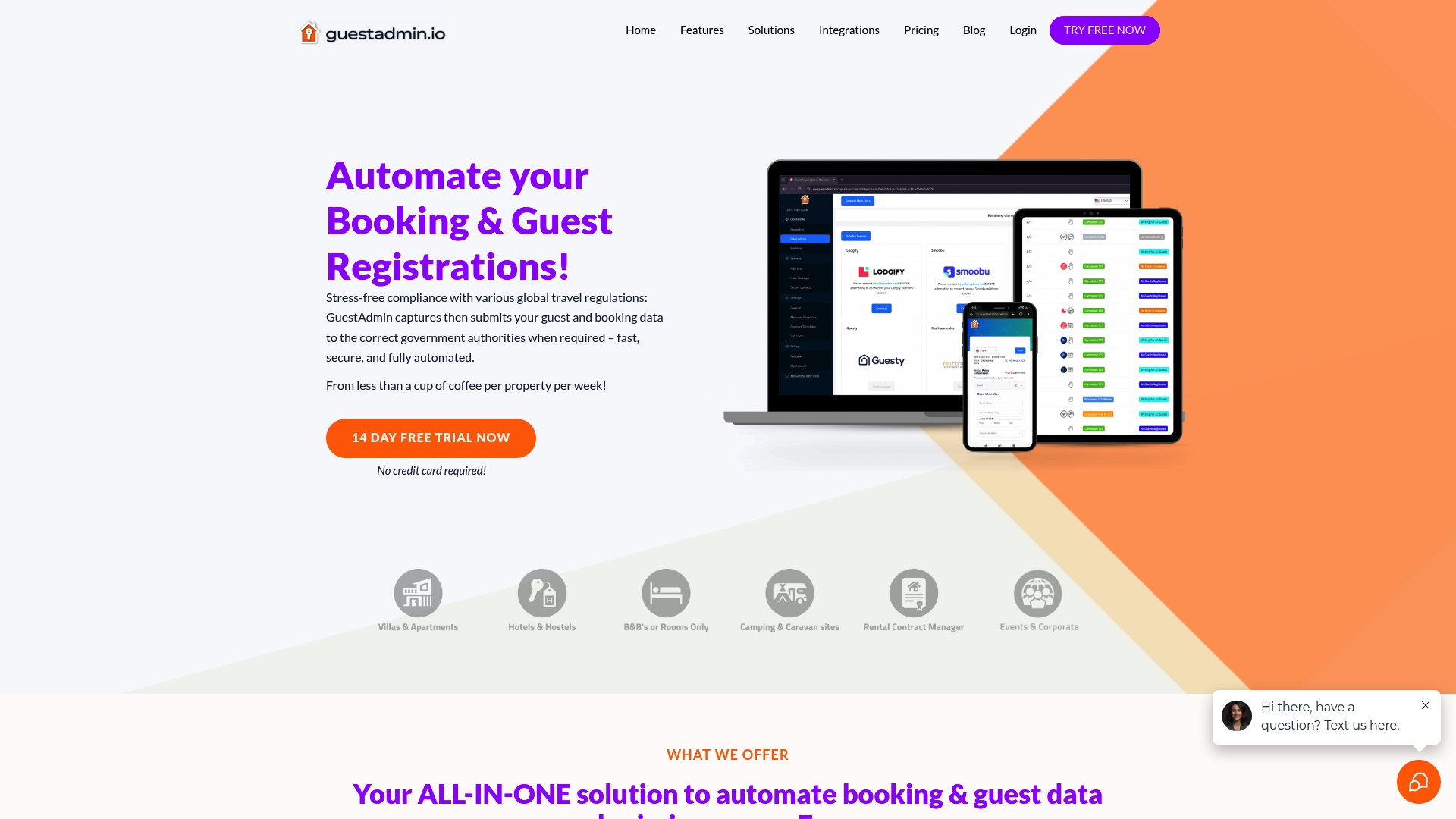
The platform captures guest data at booking or check-in, validates it automatically, and submits it to the relevant government authorities within 24 hours. It integrates with major OTA platforms and PMS systems via API, so your existing workflows remain intact. If you are ready to move beyond spreadsheets and manual portals, the step-by-step compliance guide on the Guestadmin site walks you through the full implementation process. For a broader view of what automation delivers for your business, the efficiency and risk reduction page covers the operational case in detail.
FAQ
What is automated guest data compliance?
Automated guest data compliance is the use of software to capture, validate, and submit guest information to government authorities without manual data entry. It replaces paper forms and manual portal submissions with API-connected systems that run automatically.
How does automation improve data management for rental managers?
Automation captures data once at the point of booking or check-in and submits it directly to the relevant authority, eliminating re-entry errors and missed deadlines. Real-time dashboards give managers a live view of submission status across all properties.
Is automated compliance GDPR-compliant for European rentals?
Yes. Automated systems enforce data retention and deletion policies that align with GDPR requirements, and role-based access controls limit staff exposure to sensitive guest data. This makes GDPR compliance a built-in feature rather than a separate task.
How quickly can an automated system produce audit evidence?
Automated audit trails include timestamped acknowledgements from government portals, making verifiable compliance records available in seconds during an inspection.
What happens if a submission is not acknowledged by the government portal?
Automated systems detect unacknowledged submissions and resubmit them without manual intervention, preventing the audit backlogs that are the most common failure point in manual compliance workflows.
One Comment
What is automated data submission: a clear guide
[…] property managers handling guest data compliance across multiple European jurisdictions, these benefits are not abstract. They translate directly […]