

TL;DR:
- Property owners must follow strict procedures to collect and submit guest data in Europe. Automating the process with integrated tools ensures accuracy, timely submissions, and compliance.
A guest data submission workflow is the structured process property owners and managers use to collect, organise, and submit guest information to comply with local and national regulations. Across Europe, this process carries real legal weight. Fines for non-compliance can run from hundreds to thousands of euros, and authorities audit accommodation providers regularly. Getting your guest data submission workflow right is not optional. It is a core part of running a compliant, professional short-term rental operation.
What does a guest data submission workflow require legally?

European property owners face a patchwork of national and local regulations, but the core requirements follow a consistent pattern. Authorities need specific guest details submitted within tight timeframes. Missing a deadline or submitting incomplete data triggers penalties that can disrupt your entire operation.
The guest data required by most jurisdictions includes:
- Full name and date of birth
- Personal identification number or passport number
- Reason for stay and length of stay
- Accommodation address
Submission deadlines are strict. Many jurisdictions require submission before 11 PM on the day of arrival, or by 8 AM the following morning at the latest. That window is shorter than most property managers expect. A guest who checks in at 10 PM leaves very little time to complete the process manually.
Regulations also vary between countries and even between municipalities. Spain’s Guardia Civil portal, Italy’s Alloggiati Web system, and Portugal’s SEF reporting requirements each have their own formats and submission rules. What works in one country will not automatically transfer to another. Property managers operating across borders must map each jurisdiction’s requirements separately and build those rules into their data submission process for guests.
The consequences of late or incorrect submissions go beyond fines. Repeated non-compliance can result in licence suspension or removal from booking platforms. Treating the guest information collection process as a back-office afterthought is a risk no serious operator can afford.
Which digital tools support optimising guest data workflows?
Automation is the most reliable way to keep submissions accurate and on time. Platforms that integrate directly with Property Management Systems (PMS) and Online Travel Agencies (OTAs) remove the need for manual data re-entry, which is the single largest source of submission errors.
The table below compares the main approaches property managers use:
| Approach | Key benefit | Main limitation |
|---|---|---|
| Manual entry via government portal | No software cost | Slow, error-prone, time-consuming |
| Spreadsheet with manual upload | Familiar format | No automation, high risk of delays |
| PMS with built-in reporting | Centralised data | Coverage varies by jurisdiction |
| Dedicated compliance platform (e.g. Guestadmin) | Automated submission, multi-jurisdiction | Requires initial setup and integration |
| Digital government apps (e.g. VNeID) | Direct official channel | Limited to specific countries or regions |
Dedicated compliance platforms offer the clearest advantage for managers with multiple properties or cross-border portfolios. Automated reporting tools connect directly to your booking data, verify guest details, and submit to the relevant authority without manual intervention. That removes the 11 PM deadline pressure entirely.
Integration with OTAs such as Airbnb, Booking.com, and Vrbo means guest data flows directly from the booking into the submission platform. There is no copy-pasting between systems. For managers running ten or more properties, that difference in time and accuracy is significant.
Pro Tip: Choose a compliance tool that explicitly lists the countries and portals it supports before you commit. A platform that covers Spain but not Portugal is not a solution if you manage properties in both.
How to execute a guest data submission workflow step by step
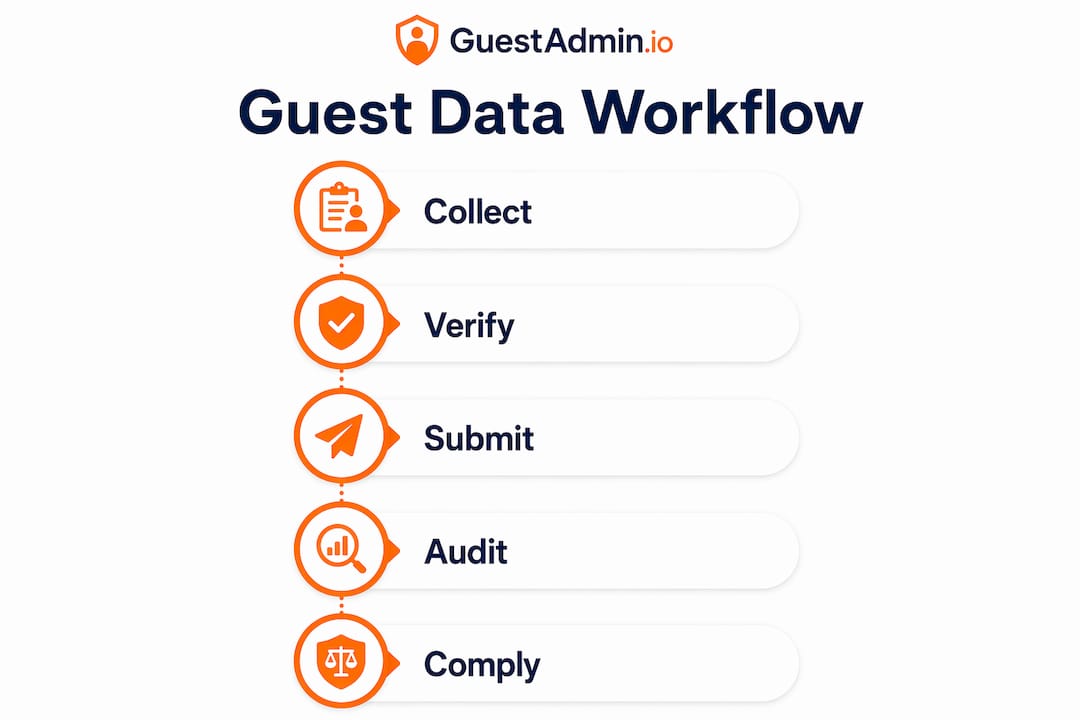
A reliable data submission process for guests follows five clear steps. Each step has a specific purpose, and skipping any one of them creates risk downstream.
-
Collect guest data at check-in. Gather all required details before or at the point of arrival. Online pre-check-in forms sent via email or booking confirmation work well for this. They give guests time to provide accurate information and reduce pressure at the physical check-in moment.
-
Verify guest identity accurately. Cross-reference the details provided against the guest’s passport or national ID. Combining data collection with ID verification at check-in ensures completeness and reduces the risk of submitting incorrect data to authorities. A mismatched name or wrong document number can invalidate an entire submission.
-
Input data into your submission platform. Enter verified guest details into your chosen digital platform. If you use a PMS or dedicated compliance tool, this step may be fully automated once the booking is confirmed. Manual entry should only be a fallback, not the standard process.
-
Submit data to the relevant authority within the required timeframe. Most jurisdictions require submission before 11 PM on the arrival day. Digital platforms such as the VNeID app allow property owners to submit via digital portals by selecting the residence declaration option and following the on-screen steps. Automated platforms handle this without any manual trigger.
-
Confirm receipt and log the submission for audit. Always save the confirmation reference from the authority’s portal. Digital platforms provide submission records and alerts that serve as your audit trail. If an inspector queries a submission six months later, that log is your evidence of compliance.
The most common pitfall at step one is relying on guests to provide complete information at the door. Guests arrive tired, distracted, or in a hurry. A pre-arrival digital form, sent 24 hours before check-in, resolves this. The most common pitfall at step five is assuming submission equals confirmation. Always check that the portal has accepted the data, not just received it.
What are the most common mistakes in guest data submission?
Manual processes produce predictable errors. Common causes of submission failures include manual data entry mistakes, incomplete guest details, and staff who have not been trained on the current requirements. Each of these is preventable.
The most frequent errors property managers encounter are:
- Transcription mistakes. A single digit wrong in a passport number invalidates the submission. Manual re-entry from a paper form or email is the most common source of this error.
- Incomplete guest records. Missing a date of birth or reason for stay causes the submission to be rejected. Guests who fill in forms quickly often skip optional-looking fields that are actually mandatory.
- Late submissions. Process inefficiencies, such as waiting until the end of the day to batch-submit, push managers past the deadline. A single busy check-in evening can result in multiple late filings.
- Unclear staff responsibilities. When no one person owns the submission task, it falls through the gaps. This is especially common in properties managed by small teams or remote owners.
- Outdated portal credentials. Government portals change passwords, update interfaces, or require periodic re-registration. Discovering this at 10:45 PM on a busy Friday is a genuine operational crisis.
The fix for most of these issues is the same: automate as much of the process as possible and assign clear ownership for what remains manual. A guest data compliance checklist gives your team a consistent reference point for every arrival.
Pro Tip: Audit your submission logs monthly. Look for any rejected submissions, late confirmations, or missing records. Catching a pattern early is far cheaper than responding to a regulatory inspection.
Key takeaways
A well-executed guest data submission workflow is the difference between a compliant, fine-free operation and one that faces regulatory disruption, financial penalties, and reputational damage.
| Point | Details |
|---|---|
| Know your deadlines | Most European jurisdictions require submission before 11 PM on the arrival day. |
| Collect data before arrival | Pre-check-in digital forms reduce errors and remove last-minute pressure. |
| Automate where possible | Platforms integrated with PMS and OTA systems eliminate manual re-entry errors. |
| Log every submission | Confirmation receipts and audit logs protect you during regulatory inspections. |
| Assign clear ownership | One named person or system must own each submission to prevent it being missed. |
Why I think most property managers underestimate this process
Working with property owners across Europe, I have seen the same pattern repeat itself. Managers who run their properties well, who keep their listings polished and their guests happy, treat guest data submission as a box-ticking exercise. They set up a spreadsheet, note the portal login somewhere in a shared drive, and assume the process will hold. It holds, until it does not.
The regulations are not static. Jurisdictions update their requirements, portals change their interfaces, and new rules come into force with surprisingly short notice periods. A manager who built their process around one country’s requirements in 2023 may find it no longer fits the current rules. The guest registration requirements for short-term rentals in Europe have evolved considerably, and they will continue to do so.
What I have found genuinely useful is treating the submission workflow as a system, not a task. A system has documented steps, assigned owners, and a regular review cycle. A task is something you do when you remember. The difference shows up in your compliance record.
Technology removes most of the friction, but it does not remove the need for oversight. Automated platforms handle the submission, but someone still needs to check that the integration is working, that credentials are current, and that rejected submissions are caught and resubmitted. The managers who stay compliant long-term are the ones who combine good tools with clear accountability.
— Alex
How Guestadmin makes guest data compliance straightforward
Guestadmin is built specifically for European property owners and managers who need a reliable, automated way to handle guest data compliance across multiple jurisdictions.
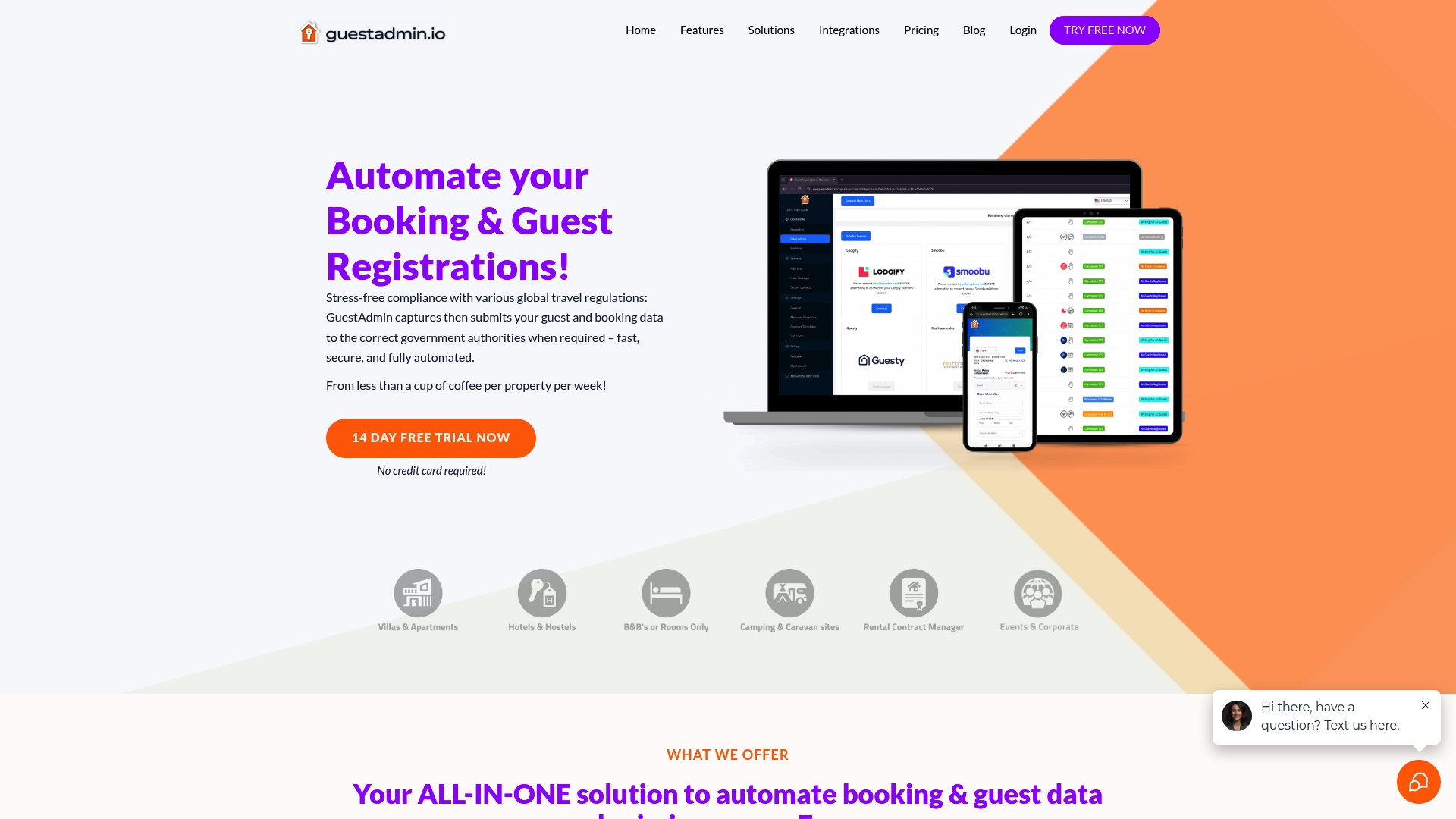
The platform connects directly with leading PMS and OTA systems, pulling booking data automatically and submitting it to the relevant government authorities within 24 hours. There is no manual re-entry, no juggling separate portals, and no risk of missing an 11 PM deadline. For managers with multiple properties, the multi-property compliance workflow gives a single dashboard view across every listing. If you are comparing your options, the top property management software comparison for 2026 sets out exactly what to look for in a compliance-ready platform.
FAQ
What is a guest data submission workflow?
A guest data submission workflow is the end-to-end process of collecting, verifying, and submitting guest information to government authorities. It covers everything from pre-arrival data collection to confirmation logging after submission.
How quickly must guest data be submitted in Europe?
Most European jurisdictions require submission before 11 PM on the day of arrival, with some allowing submission by 8 AM the following morning. Deadlines vary by country, so always check the specific rules for each jurisdiction where you operate.
What guest information is typically required for submission?
Authorities typically require the guest’s full name, date of birth, passport or ID number, reason for stay, length of stay, and the accommodation address. Incomplete submissions are rejected and may trigger penalties.
How does automation improve the data submission process for guests?
Automation removes manual re-entry by pulling data directly from PMS and OTA platforms and submitting it to the relevant authority without human intervention. This reduces transcription errors and eliminates the risk of missing submission deadlines.
What happens if a guest data submission is late or incorrect?
Late or incorrect submissions can result in fines ranging from hundreds to thousands of euros, and repeated non-compliance may lead to licence suspension. Authorities conduct audits and cross-reference submission records against booking data.