

TL;DR:
- Travel compliance requires property managers to collect and report guest data to government authorities accurately and timely. Automation platforms like Guestadmin simplify this process, reducing errors and ensuring adherence across multiple jurisdictions. Building compliance into standard operations safeguards licenses, avoids fines, and streamlines property management.
Travel compliance is defined as the legal obligation for property owners and managers to collect, record, and report guest data to the relevant government authorities in line with local and national regulations. In the short-term rental market, this means gathering accurate guest identification details, duration of stay, and nationality, then submitting that information within prescribed deadlines. Failure to comply carries real consequences: fines, licence revocations, and reputational damage. Regulations such as GDPR and local tourism registration laws make this a multi-layered responsibility. Platforms like Guestadmin exist specifically to help property managers meet these obligations without the administrative burden of doing it manually.
What are the key travel compliance requirements for short-term rental managers?
Travel compliance requirements vary significantly by country and region, but the core obligations follow a consistent pattern across Europe. Property managers must collect specific guest data at check-in, submit it to the relevant authority within a set timeframe, and retain records for audit purposes. Understanding what these rules cover is the starting point for any compliant operation.
The data you are typically required to collect includes:
- Full name and date of birth for every adult guest
- Nationality and country of residence
- Passport or national ID number, including document type and expiry date
- Arrival and departure dates
- Purpose of visit, in jurisdictions where this is required
- Contact details, including address of permanent residence
Reporting obligations differ by jurisdiction. In Spain, for example, property managers must submit guest data to the Guardia Civil within 24 hours of check-in. Italy requires submission to the Alloggiati Web portal before midnight on the day of arrival. Portugal mandates registration through SEF. Each system has its own format, login credentials, and submission rules.
Compliance failures can trigger tax, payroll, immigration, and legal liabilities even from a single guest crossing a national border. That risk scales quickly when you manage multiple properties across different jurisdictions. Penalties for non-compliance range from fixed fines to criminal liability in some European countries, making this an area where precision matters.

Regulatory requirements also change. New EU short-term rental rules introduced under the European Data Act and the EU Short-Term Rental Regulation are reshaping reporting obligations across member states. Staying current with 2026 hospitality regulations is not optional.
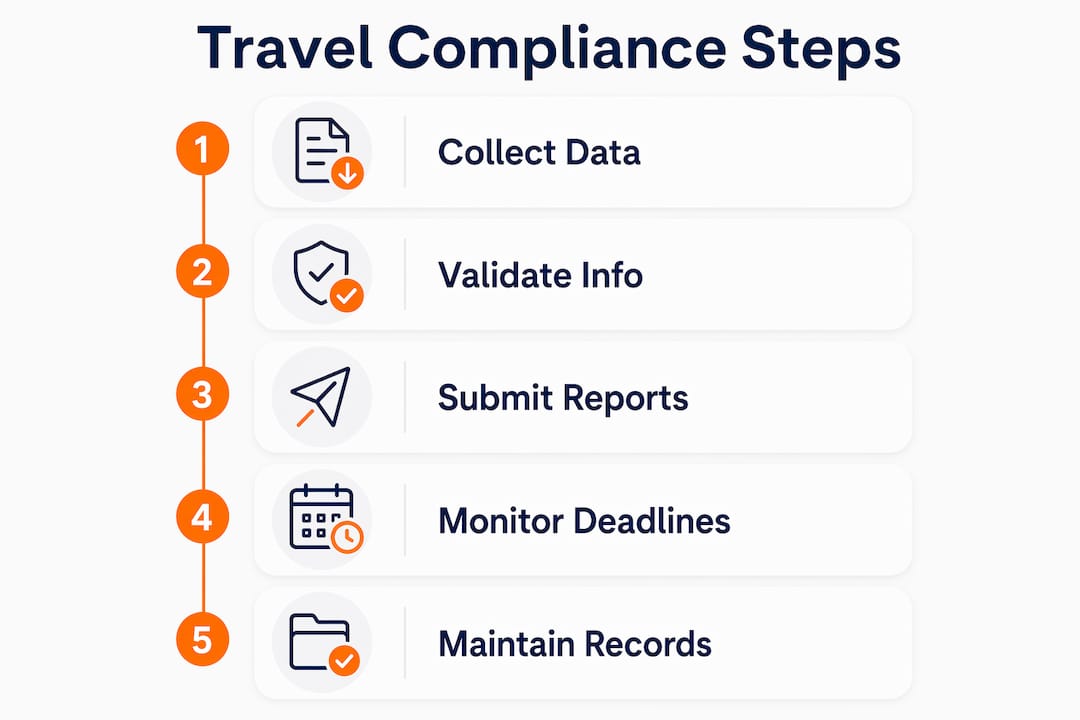
How can property owners implement travel compliance policies effectively?
Effective compliance does not happen by accident. It requires deliberate process design, written policies, and consistent staff training. Most compliance failures stem from process design challenges, not poor policy writing. The lesson is clear: making compliance the easiest path is more effective than making non-compliance the hardest.
Follow these steps to build a reliable compliance process:
- Write a clear compliance policy. Document exactly which guest data you collect, how you store it, who submits it, and when. A written policy removes ambiguity and gives your team a reference point.
- Train every team member from day one. Visible policies from onboarding improve adoption and reduce the perception of compliance as micromanagement. Make it part of the induction, not an afterthought.
- Design the process around the guest journey. Collect data at the point of booking or digital check-in, not retrospectively. Chasing guests for ID after arrival creates errors and delays.
- Assign clear ownership. Designate one person or role responsible for submissions in each property or region. Shared responsibility without named accountability leads to gaps.
- Build in a verification step. Before submission, verify that all required fields are complete and accurate. A simple checklist reduces the risk of rejected submissions.
- Schedule regular policy reviews. Regulations change. Set a quarterly calendar reminder to check for updates from local tourism boards or government portals.
Pro Tip: Use a compliance calendar that maps each property’s submission deadlines by jurisdiction. A single missed deadline in Spain or Italy can trigger an immediate fine, so visibility across all properties is critical.
Policies that guide behaviour rather than simply restrict it achieve better long-term results. Guardrail-style enforcement, which steers staff towards compliant actions rather than blocking them outright, produces measurably higher compliance rates than rigid bans.
What role does automation play in managing travel compliance?
Automation is the most reliable way to manage travel compliance at scale. Manual processes introduce human error, miss deadlines, and create inconsistent records. Modern travel platforms automate expense audits and compliance reviews to manage risk and simplify regulatory adherence. The same principle applies directly to guest registration in short-term rentals.
The core benefits of compliance automation include:
- Elimination of manual data entry errors through validated digital forms that reject incomplete or inconsistent information before submission
- Timely submissions via automated scheduling that triggers reports within the required window, regardless of staff availability
- Audit-ready records stored securely and retrievable on demand, reducing the time spent preparing for inspections
- Multi-property management from a single dashboard, removing the need to log into separate government portals for each jurisdiction
- GDPR-compliant data handling, with access controls, encryption, and automatic data retention policies built in
| Feature | Manual process | Automated process |
|---|---|---|
| Data entry accuracy | Prone to errors | Validated at input |
| Submission timing | Dependent on staff | Scheduled automatically |
| Audit trail | Paper-based or fragmented | Centralised and searchable |
| Multi-jurisdiction support | Requires separate logins | Managed from one platform |
| GDPR compliance | Manual controls | Built-in by design |
Compliance automation reduces both the cost and the risk of managing guest registration across multiple properties. Programmes using embedded compliance tooling save an average of 12.8% per managed trip and achieve compliance rates of 85–95%. That level of consistency is not achievable through manual processes alone.
Pro Tip: When evaluating automation tools, check whether the platform submits directly to government portals via API or simply generates a file for you to upload manually. Direct API submission removes the final manual step and the risk of forgetting to send it.
Guestadmin processes guest data with AI-powered validation and submits records to the relevant authorities within 24 hours of check-in. The platform integrates with major property management systems and online travel agencies, so data flows automatically from booking to submission without manual intervention.
What are common travel compliance challenges and how do you overcome them?
Even well-intentioned property managers run into compliance problems. The most common issues are predictable, and most are avoidable with the right systems in place.
- GDPR and data privacy obligations. Collecting guest ID data creates a legal responsibility to store it securely, limit access, and delete it after the required retention period. Guest data privacy is a critical consideration for property managers across Europe. A breach can result in fines under GDPR that far exceed any non-compliance penalty from a tourism authority.
- Managing multiple jurisdictions. Each country, and sometimes each region, has different portals, formats, and deadlines. Property managers with listings in Spain, Italy, and Portugal simultaneously face three separate systems with different rules. Without automation, this becomes unmanageable quickly.
- Regulatory updates catching managers off guard. Governments change requirements with limited notice. The UK introduced its Electronic Travel Authorisation scheme, and EU member states are progressively implementing new short-term rental reporting rules. Managers who rely on memory rather than monitored update channels miss these changes.
- Unintentional non-compliance from manual processes. Approximately 25% of trips fall outside approved channels even in well-resourced corporate travel programmes. In short-term rentals, the equivalent is guest records submitted late, incomplete, or to the wrong authority. The cause is almost always process failure, not deliberate evasion.
- Inconsistent data quality from guests. Guests sometimes provide incomplete or inaccurate information. Without a validation layer at the point of collection, errors pass through to submission and create rejected records or compliance flags.
The solution to all of these challenges follows the same logic: build systems that make compliance automatic, not optional. Monitoring EU compliance trends and integrating updates into your process as they happen keeps you ahead of regulatory changes rather than scrambling to catch up.
Key takeaways
Travel compliance for short-term rental managers means collecting accurate guest data, submitting it to the correct authority on time, and maintaining GDPR-compliant records across every property and jurisdiction you operate in.
| Point | Details |
|---|---|
| Compliance is legally mandatory | Property managers must collect and report guest data to government authorities under local and EU law. |
| Requirements vary by jurisdiction | Spain, Italy, Portugal, and other EU countries each have separate portals, formats, and submission deadlines. |
| Process design drives compliance | Most failures come from poor process design, not bad intentions; make compliance the easiest path for your team. |
| Automation removes the risk | Automated platforms validate data, submit records on time, and maintain audit trails without manual intervention. |
| GDPR adds a second layer | Collecting guest ID data creates data privacy obligations that run alongside tourism registration requirements. |
Why compliance should be built in, not bolted on
The property managers I see struggle most with compliance share one trait: they treat it as a separate task rather than part of their standard operating process. They collect guest data in one place, submit it somewhere else, and rely on a staff member remembering to do it. That approach works until it doesn’t, and when it fails, the consequences arrive quickly.
The shift that makes the biggest difference is treating compliance as infrastructure, not administration. When guest data flows automatically from booking to submission, compliance stops being a risk and starts being a byproduct of normal operations. You do not need to think about it because the system handles it.
There is also a strategic argument that most managers overlook. Consistent, auditable compliance records are an asset. When local authorities tighten regulations, as they are doing across Europe right now, operators with clean records face far less scrutiny than those with gaps. Compliance history becomes a competitive advantage in markets where licences are being restricted or capped.
My honest advice is to invest in automation before you feel the pressure to. The managers who wait until they receive a fine or a warning letter spend far more time and money fixing the problem than those who built the right process from the start. The regulatory direction across Europe is clear: reporting requirements are increasing, not decreasing. Getting ahead of that curve now is the most practical decision you can make.
— Alex
Guestadmin: compliance automation built for rental managers
Property managers operating across Europe need a compliance system that keeps pace with changing regulations without adding to their workload.
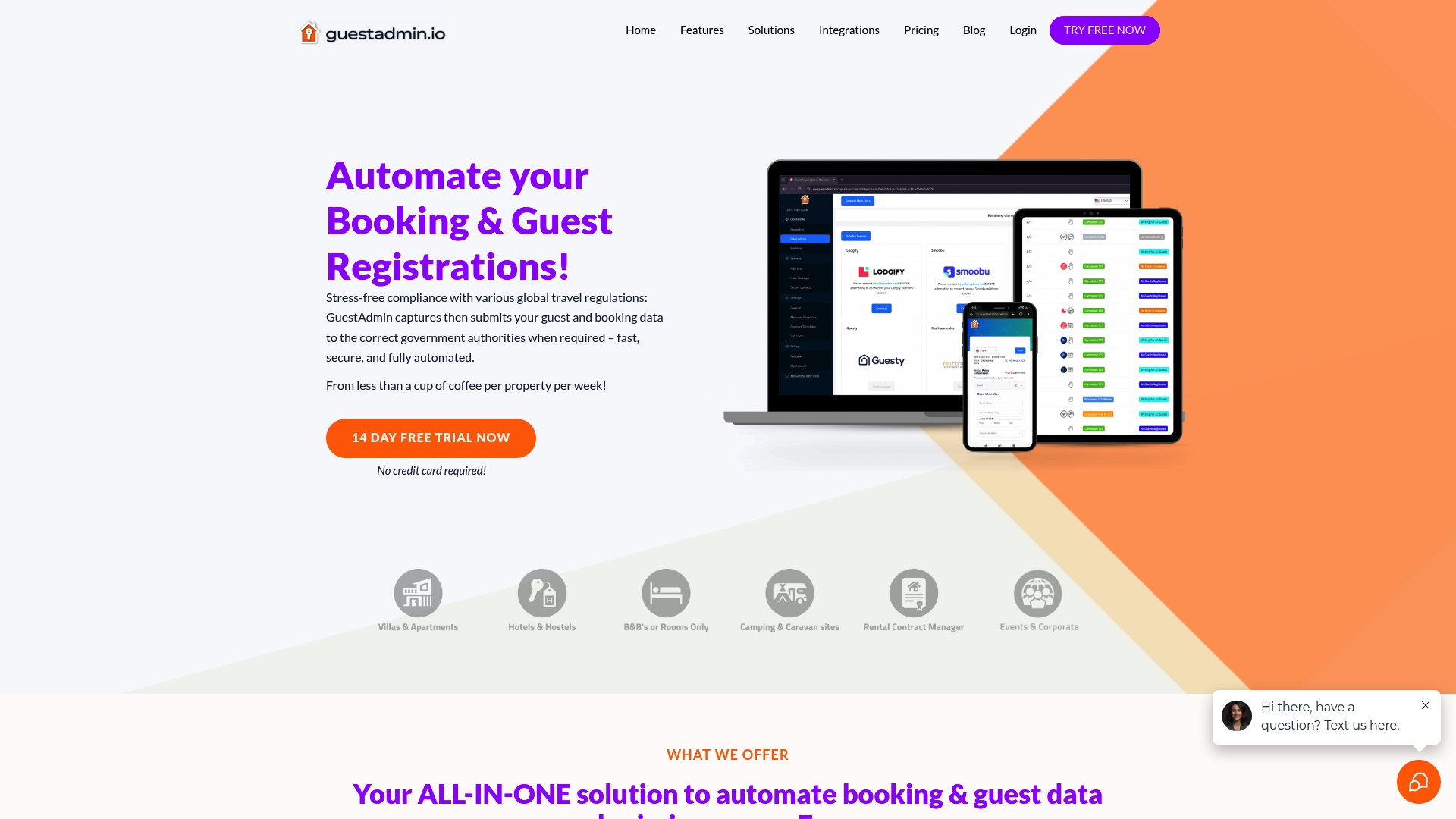
Guestadmin is a SaaS platform built specifically for short-term rental compliance. It captures guest data at check-in, validates it automatically, and submits records to the relevant government authorities within 24 hours. The platform manages multiple properties from a single dashboard, integrates with major property management systems and online travel agencies, and stores all records in a GDPR-compliant archive. For managers who want to understand exactly how the process works, the step-by-step automation guide covers every stage from data capture to submission. You can also protect your rental business by automating the entire compliance workflow today.
FAQ
What is travel compliance in short-term rentals?
Travel compliance is the legal requirement for property managers to collect guest identification data and report it to government authorities within prescribed deadlines. In the short-term rental sector, this includes name, nationality, document number, and dates of stay.
What guest data do I need to collect for compliance?
Most European jurisdictions require full name, date of birth, nationality, passport or ID number, and arrival and departure dates for every adult guest. Requirements vary by country, so check the specific rules for each jurisdiction where you operate.
What happens if I fail to comply with guest registration rules?
Non-compliance can result in fixed fines, licence suspension, or criminal liability depending on the country. In Spain and Italy, fines for late or missing submissions are issued automatically by the relevant authority.
How does GDPR affect guest data collection?
GDPR requires that guest data is collected lawfully, stored securely, accessed only by authorised personnel, and deleted after the required retention period. Property managers who collect ID data for compliance purposes must have a documented data processing policy in place.
Can automation handle compliance across multiple countries?
Yes. Platforms like Guestadmin manage submissions to multiple government portals from a single dashboard, applying the correct format and deadline rules for each jurisdiction automatically. This removes the need to log into separate systems for each country or region.