

TL;DR:
- Webhooks are real-time, event-driven HTTP callbacks that push data instantly when property events occur, enhancing system responsiveness. They outperform polling by reducing server load and eliminating missed events, making them essential for property tech workflows like lead routing and calendar updates. Reliable webhook implementation relies on fast responses, asynchronous processing, signature verification, idempotency, and proper data governance to ensure secure, scalable operations.
Webhooks are HTTP POST callbacks that fire instantly when a property event occurs, making them the primary mechanism for real-time, event-driven integration in property tech ecosystems. Unlike scheduled API polling, a webhook pushes data to your endpoint the moment something changes, whether that is a new tenancy created in Reapit Foundations, a booking confirmed on an OTA, or a guest check-in logged in your property management system. Platforms like Reapit Foundations and Hookdeck have built their integration models around this pattern precisely because the role of webhooks in property tech is not optional infrastructure. It is the foundation of any system that needs to react to events rather than discover them late.
How do webhooks differ from polling in property tech?
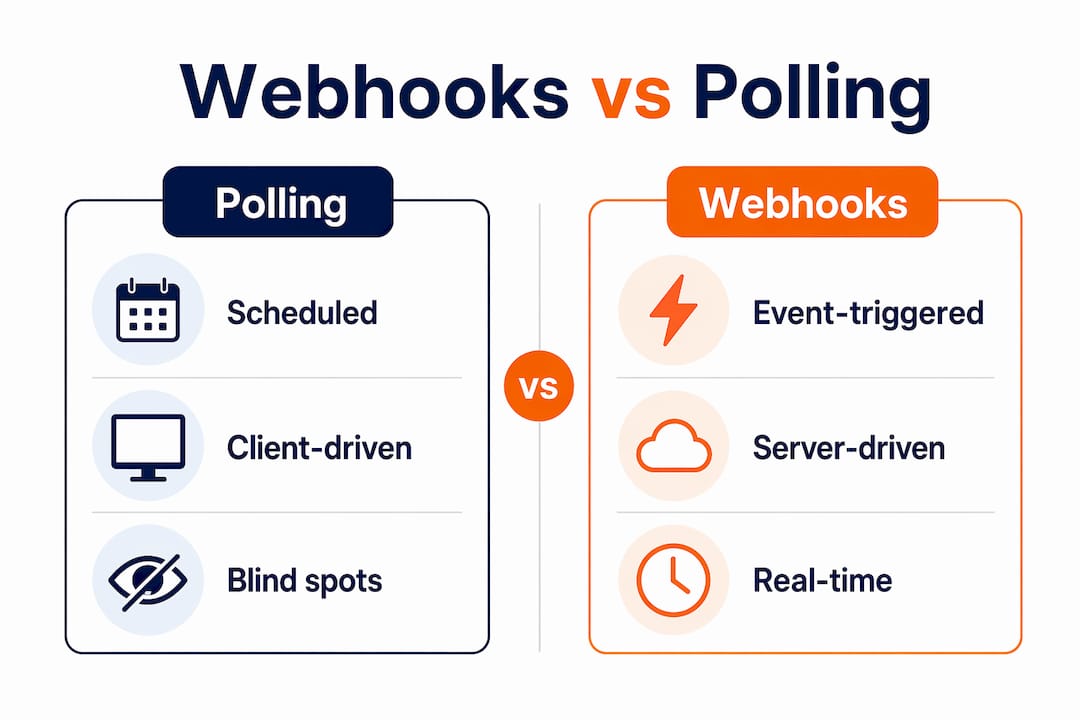
Polling is the practice of a client repeatedly asking a server, “Has anything changed?” on a fixed schedule. Webhooks invert this entirely. The server tells the client the moment something happens, with no request required. This distinction matters enormously in property tech, where events like price changes, lead submissions, and booking cancellations carry time-sensitive consequences.

Webhook-based listing alerts reduce server load by 70 to 80% compared to polling equivalents. That reduction is not just a cost saving. It means your infrastructure scales with actual event volume rather than with the frequency of your polling interval, which is a fundamentally more efficient design.
Polling also creates blind spots. If a booking is created and cancelled between two poll cycles, your system never sees it. Webhooks eliminate that gap entirely because every event triggers a notification the moment it is committed, giving you a complete and accurate event log.
| Attribute | Polling | Webhooks |
|---|---|---|
| Trigger mechanism | Client-initiated, scheduled | Server-initiated, event-driven |
| Latency | Minutes to hours | Sub-10 seconds |
| Server load | High (constant requests) | Low (event-proportional) |
| Missed events | Possible between cycles | None, if delivery is confirmed |
| Infrastructure cost | Scales with poll frequency | Scales with event volume |
Pro Tip: Set your polling interval no shorter than five minutes if you must use it as a fallback. Anything tighter and you are paying for requests that return empty responses the vast majority of the time.
What are the best architectural practices for implementing webhooks securely?
Reliable webhook integration in property tech depends on four non-negotiable design decisions: fast response handling, asynchronous processing, idempotency, and signature verification. Get any one of these wrong and you will face retry storms, duplicate records, or security vulnerabilities.
-
Respond immediately with 202 Accepted. Your endpoint should acknowledge receipt within a few seconds and return a 202 status. Reapit recommends responding within around 10 seconds and delegating all processing to an asynchronous worker. If your endpoint blocks on database writes or downstream API calls, the sender will time out and retry, creating duplicate processing.
-
Process events asynchronously. Push the raw payload to a queue (AWS SQS, RabbitMQ, or Redis Streams are common choices) and let a background worker handle the business logic. This decouples receipt from processing and lets you scale each independently.
-
Implement idempotency keyed by event ID. Property tech systems emit the same event more than once during retries. Store processed event IDs and check against them before executing any state-changing logic. This prevents a booking confirmation from triggering two guest notification emails or two compliance submissions.
-
Verify HMAC signatures on the raw request body. Secure webhook handling requires HMAC verification before any parsing occurs. Middleware that deserialises JSON before signature checking will break validation because re-serialisation changes byte order. Read the raw bytes, compute the HMAC, compare using a constant-time function, then parse. Add timestamp or nonce checks to block replay attacks where an attacker resends a valid but stale payload.
-
Use a fan-out event gateway for multi-destination delivery. Hookdeck’s fan-out pattern routes a single inbound webhook to multiple downstream systems, isolating failures so that a CRM outage does not block a simultaneous calendar update. Each destination gets its own retry queue, and a failure in one does not cascade to others.
Pro Tip: Design your webhook receiver to handle bursty traffic from the start. Property events cluster around business hours and listing publication windows. A receiver that handles 10 events per second in testing may face 200 per second during a portal sync. Use autoscaling worker pools and set queue depth alerts.
How do webhooks integrate with common property tech workflows?
The practical value of webhook integrations for real estate becomes clearest when you map them to specific operational workflows. A webhook is not just a data transfer mechanism. It is the trigger that sets an entire chain of automated actions in motion.
Consider a lead capture workflow built on Google Forms and an AI agent, as documented by Hookdeck. Webhooks enable lead routing, CRM updates, and messaging notifications by firing the moment a form is submitted. The AI agent receives the payload, qualifies the lead, and then emits its own webhook calls to a CRM, a calendar system, a Slack channel, and an email service, all within seconds of the original submission. No human touches the data between capture and routing.
Reapit Foundations takes this further by emitting structured payloads on events like "properties.createdandapplicants.modified`. Each payload is self-contained, meaning downstream systems rarely need to make additional API calls to fetch context. That design choice alone reduces integration complexity and latency significantly.
Common workflow automations enabled by webhooks in property tech include:
- Real-time lead routing: New enquiries from portals trigger immediate assignment to the correct agent based on geography or property type, with no manual triage.
- CRM record synchronisation: Tenancy status changes in a PMS fire webhooks that update contact records, pipeline stages, and task lists in CRM platforms like Salesforce or HubSpot.
- Booking and calendar updates: Confirmed reservations on OTA platforms push availability blocks to connected calendars within seconds, preventing double bookings.
- Compliance data submission: Guest check-in events trigger automated data capture and submission to government authorities, a workflow that Guestadmin uses to automate regulatory compliance for short-term rentals across European jurisdictions.
- Analytics and reporting: Property event streams feed data warehouses in real time, enabling dashboards that reflect current occupancy, revenue, and maintenance status without batch imports.
The common thread across all these patterns is that webhooks maintain a single source of truth by propagating changes the moment they occur, rather than relying on scheduled reconciliation jobs that introduce lag and inconsistency.
What are the common challenges of using webhooks in property tech?
Connecting systems via webhooks does not automatically produce coherent data. Integrating APIs without authoritative data governance leads to webhook-driven workflows where the same property record exists in three systems with three different statuses. The webhook delivered the event correctly. The problem is that no one defined which system owns the canonical version of that record.
Scaling is a second constraint that catches teams off guard. Microsoft’s guidance on webhooks notes that webhook scaling is bounded by receiver capacity, unlike queue-based messaging systems that buffer events independently of consumer throughput. If your receiver goes down during a high-volume period, you depend entirely on the sender’s retry policy to recover. Queue-based systems like Azure Service Bus or Amazon SQS decouple this entirely.
Key challenges to plan for before going live with property management webhooks:
- Observability gaps: Without structured logging and alerting on your webhook endpoints, silent failures go undetected for hours. Use tools like Datadog, Grafana, or Hookdeck’s built-in event inspector to monitor delivery rates and error patterns.
- Partial delivery failures: A webhook that reaches your endpoint but fails during processing leaves your system in an inconsistent state. Idempotent retry logic is the only reliable fix.
- Security drift: HMAC secrets rotate infrequently in practice, but raw body verification must be enforced consistently. A single middleware update that parses JSON before verification can silently break your entire security model.
- Fallback reconciliation: Treat webhooks as your primary data channel, but run a nightly reconciliation poll as a safety net. This catches any events that were dropped due to network failures or sender-side bugs.
Addressing these challenges requires treating webhook infrastructure with the same rigour you would apply to any critical data pipeline, not as a lightweight integration shortcut.
Key takeaways
Webhooks are the most efficient mechanism for real-time data propagation in property tech, but reliability depends equally on asynchronous design, HMAC security, idempotency, and strong data governance.
| Point | Details |
|---|---|
| Webhooks outperform polling | Event-driven push reduces server load by 70 to 80% and eliminates missed events between cycles. |
| Respond fast, process async | Return 202 Accepted immediately and delegate all logic to a background worker to prevent retry storms. |
| HMAC on raw bytes | Verify signatures before parsing to maintain security; middleware that parses first breaks validation silently. |
| Fan-out for resilience | Route webhooks through a centralised gateway to isolate downstream failures and enable targeted retries. |
| Governance is non-negotiable | Define authoritative data sources before connecting systems, or webhook delivery will propagate inconsistencies at speed. |
Why I think most property tech teams underestimate webhook infrastructure
After working across property tech integrations, the pattern I see most often is teams treating webhooks as a simple feature rather than a distributed systems problem. They wire up an endpoint, confirm it receives payloads in staging, and ship it. Then production arrives with bursty traffic, a downstream CRM that times out, and no replay tooling to recover dropped events.
The reliability of any lead handoff or compliance workflow depends more on the webhook infrastructure surrounding it than on the business logic inside it. An AI agent that qualifies leads brilliantly is worthless if the webhook delivering the lead payload is silently failing at 2 AM with no alert configured.
My strongest recommendation is to invest in observability before you invest in features. Hookdeck’s event inspector, Datadog webhook monitors, or even a simple dead-letter queue with alerting will save you more debugging time than any amount of upfront architecture planning. You cannot fix what you cannot see.
The second thing I would stress is that 2026 property tech stacks are increasingly expected to deliver real-time booking data to managers and guests alike. That expectation is only achievable if your webhook layer is treated as production-grade infrastructure, with retry policies, signature verification, and fallback reconciliation built in from day one. Teams that get this right early find that adding new integrations becomes genuinely straightforward. Teams that skip it spend months untangling inconsistent data and silent failures.
— Alex
How Guestadmin automates property compliance with webhooks
Guestadmin is built on the same event-driven principles this article describes. When a booking is confirmed or a guest checks in, Guestadmin’s webhook integrations capture that event and trigger automated compliance submissions to the relevant government authorities, all within 24 hours and without manual intervention. For property managers operating across multiple European jurisdictions, that automation removes one of the most time-consuming and error-prone parts of the job. If you are managing several properties and want to see how webhook-driven automation applies directly to compliance and multi-property operations, the multi-property management guide is a practical starting point.
FAQ
What is a webhook in property tech?
A webhook is an HTTP POST callback that a system sends to a registered URL the moment a specific event occurs, such as a new booking, a property status change, or a guest check-in. It enables real-time, event-driven integration between property management platforms without requiring the receiving system to poll for updates.
How do webhooks reduce server load in real estate systems?
Webhook-based architectures reduce server load by 70 to 80% compared to polling because requests only occur when events happen, not on a fixed schedule. This means infrastructure scales with actual event volume rather than with polling frequency.
What security measures are required for webhook endpoints?
Webhook endpoints must verify HMAC signatures on the raw request body before parsing, implement timestamp or nonce-based replay protection, and process events idempotently using unique event IDs. Skipping any of these steps exposes your system to spoofed payloads or duplicate processing.
When should you use a queue instead of a direct webhook receiver?
Use a queue when your receiver cannot guarantee uptime or when event volume exceeds your processing capacity. Queue-based systems like AWS SQS or Azure Service Bus buffer events independently of consumer throughput, whereas webhook scaling is bounded by receiver capacity alone.
How does Guestadmin use webhooks for compliance automation?
Guestadmin uses webhook integrations to capture booking and guest check-in events from connected PMS and OTA platforms, then automatically processes and submits the required guest data to government authorities. This removes the need for manual data entry and reduces the risk of missed or late compliance submissions.