

TL;DR:
- Guest data security is essential for hospitality to prevent costly breaches, regulatory penalties, and reputational damage.
- Implementing layered technical controls, staff training, and automated workflows helps protect guest information while maintaining operational efficiency.
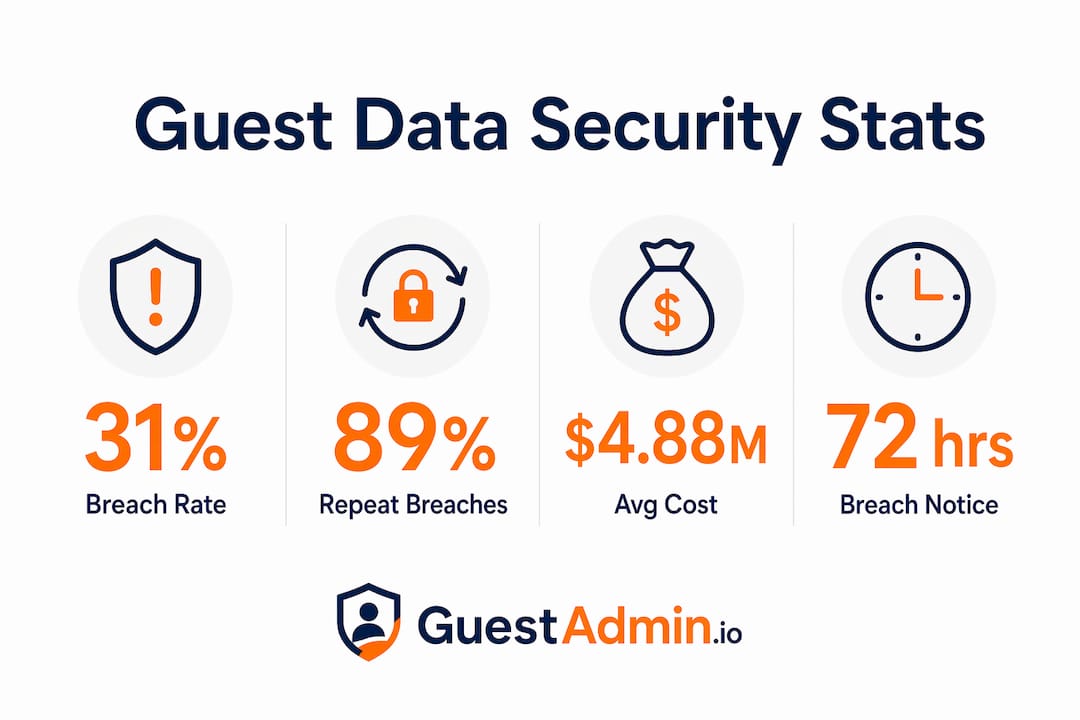
Guest data security is the practice of protecting personal, financial, and identity information collected from guests during the booking and stay process. In hospitality, this means safeguarding passport numbers, payment details, email addresses, and travel history from unauthorised access, misuse, or loss. The global average cost of a data breach reached $4.88 million in 2024, a figure that makes the importance of guest data protection impossible to ignore. For property owners and managers operating across Europe, the stakes are compounded by GDPR obligations, repeat breach patterns, and guests who will simply book elsewhere if they do not trust you with their data.
Why is guest data security important for hospitality managers?
Guest data security is important because it directly determines whether your property survives a breach, retains guest loyalty, and avoids regulatory penalties. The hospitality sector holds some of the most sensitive personal data of any industry: full legal names, passport scans, credit card numbers, and travel itineraries. When that data is mishandled, the consequences reach far beyond a single incident.

31% of hospitality organisations have experienced a data breach, and 89% of those were hit multiple times within a year. That repeat-breach statistic reveals a structural problem: most properties patch the symptom rather than fix the underlying vulnerability. A single breach is often a warning sign that access controls, staff training, or data governance are insufficient.
The benefits of data security extend beyond avoiding fines. Properties that handle guest information responsibly build a reputation that directly influences booking decisions. Privacy excellence creates competitive advantage, increasing direct bookings and enabling superior personalisation. Guests who trust you with their data are more likely to return, leave positive reviews, and recommend your property to others.
For property managers overseeing multiple short-term rentals across Europe, understanding data security in hospitality is not optional. It is the operational foundation on which compliant, profitable management is built.
What are the risks of poor guest data security?
Poor guest data security exposes property managers to financial loss, regulatory action, and lasting reputational damage. These are not theoretical risks. They are documented outcomes that hospitality businesses across Europe face every year.
The financial exposure is substantial. Beyond the average breach cost cited above, property managers must account for incident response fees, legal counsel, regulatory investigation costs, and potential compensation to affected guests. Smaller properties often lack the reserves to absorb these costs, making a single breach existential rather than merely disruptive.
Reputational damage is frequently more costly than the breach itself. Negative press coverage, one-star reviews citing data mishandling, and loss of OTA ranking can reduce bookings for months after an incident is resolved.
Guest trust erosion is a particularly serious guest privacy risk. When guests discover their data was compromised, they do not simply complain. They cancel future reservations, dispute charges, and share their experience publicly. The Cathay Pacific breach, which exposed the personal data of 9.4 million passengers and resulted in a £500,000 fine from the UK Information Commissioner’s Office, illustrated how swiftly regulatory bodies act and how long reputational recovery takes.
The most common breach vectors in hospitality are not sophisticated cyberattacks. They include:
- Phishing emails targeting front-desk or reservations staff
- Shared login credentials across multiple team members
- Unencrypted guest data sent via email between departments
- Third-party integrations with excessive data access permissions
- Former employees retaining system access after leaving
Each of these is preventable with the right policies and tools. The challenge is that many property managers treat these as IT problems rather than operational priorities, which is precisely why breaches recur.
How do data protection regulations shape your compliance responsibilities?
Data protection law defines the minimum standard of care you owe to every guest whose information you collect. For property managers operating in Europe, the General Data Protection Regulation (GDPR) and the UK GDPR are the primary frameworks. Both carry significant enforcement powers and apply to any property collecting data from EU or UK residents.
The table below summarises the key obligations most relevant to hospitality operations:
| Obligation | What it means for your property |
|---|---|
| Data minimisation | Collect only the guest data you genuinely need for the booking or legal requirement |
| Retention limits | Delete or anonymise personal data once the retention period expires |
| Breach notification | Report breaches to the relevant authority within 72 hours of discovery |
| Lawful basis | Have a documented legal reason for every category of data you process |
| Data subject rights | Respond to guest access, deletion, or correction requests within one month |
GDPR fines for violations can reach €20 million or 4% of global annual turnover, whichever is higher. For a property management company with revenues across multiple European markets, 4% of turnover can be a far larger number than the flat cap. Regulators apply the higher figure precisely to ensure the penalty is proportionate to the business.
One provision that catches many managers off guard is the breach notification requirement. Failure to notify data breaches promptly is treated as an independent violation, compounding the penalties from the original incident. This means a breach you discover on a Monday and report on a Friday could result in two separate enforcement actions rather than one.
Loyalty programme data, AI-generated guest profiles, and cross-border data transfers each introduce additional complexity. If your property uses a channel manager that routes booking data through servers outside the European Economic Area, you need a transfer mechanism such as Standard Contractual Clauses in place. For detailed guidance on meeting these requirements, the GDPR compliance guide for short-term rentals covers the specific obligations relevant to rental properties.
What technical practices secure guest information effectively?
Securing guest information requires a layered approach that addresses both technical infrastructure and human behaviour. No single tool or policy is sufficient on its own.
The foundational technical measures are encryption and access control. Encryption and role-based access controls are industry best practices for protecting guest data at rest and in transit. Encryption renders intercepted data unreadable without the correct key. Role-based access controls mean a housekeeping manager cannot view payment card data, and a reservations agent cannot access financial reports.
A practical implementation sequence for property managers looks like this:
- Audit every system that touches guest data: your PMS, channel manager, payment processor, and any third-party integrations.
- Apply the least-privilege principle: grant each staff member access only to the data their role requires.
- Enable multi-factor authentication on all systems, particularly those accessible remotely. MFA is the most effective defence against phishing and credential theft.
- Restrict system access by IP address where possible, so staff can only log in from approved locations.
- Implement automated data retention policies that purge personally identifiable information 180 days after checkout, aligning with GDPR storage limitation principles.
- Enable audit logging on all systems so you have a timestamped record of who accessed what data and when.
Most off-the-shelf PMS platforms lack granular permissions, exposing more data than necessary to more users than required. A custom secure data gateway integrated with your PMS can isolate sensitive data and enforce stricter access rules without replacing your existing system entirely.
Pro Tip: Adopt a “never trust, always verify” zero trust approach across all your systems. This means every access request, whether from a staff member inside your network or a third-party integration, is authenticated and authorised before data is shared.
Staff training is as important as any technical control. Social engineering attacks succeed because they target people, not software. Quarterly phishing simulations, clear policies on handling guest data via email, and a defined incident reporting process reduce the human error component of breach risk significantly.
How can property managers protect guest data without losing efficiency?
The most common objection to tightening data security is that it slows operations down. In practice, the opposite is true when security is built into automated workflows rather than bolted on as a manual checklist.
Cloud-based compliance platforms with built-in security certifications remove the burden of managing infrastructure security yourself. When your guest data is processed through a system that is already GDPR-compliant by design, you are not adding a compliance layer on top of your operations. You are replacing a manual, error-prone process with one that is auditable and consistent.
Key measures for guest data safety that also improve operational efficiency include:
- Automated guest identity verification at check-in, which captures and validates data once rather than relying on staff to transcribe documents manually
- Centralised data storage with a single audit trail, replacing the fragmented approach of spreadsheets, email attachments, and paper forms
- Automated submission of guest registration data to government authorities, eliminating the manual portal-by-portal process that many European property managers still use
- Scheduled data deletion workflows that remove PII after the required retention period without requiring manual intervention
Pro Tip: Never send guest passport scans or payment details via email, even internally. Email is not a secure channel for personally identifiable information. Use your PMS or a dedicated compliance platform to transfer sensitive data between team members.
Transparency with guests also builds trust without adding friction. A clear, plain-language privacy notice at the point of data collection, combined with a simple process for guests to request their data or ask for deletion, demonstrates that your property takes privacy seriously. Properties that handle data transparently see measurably higher rates of direct bookings because guests feel confident sharing their information without an intermediary. For step-by-step guidance on collecting guest data compliantly, the guest data collection guide from Guestadmin covers the full process.
Key takeaways
Guest data security is the single most important compliance and trust obligation a property manager carries, and neglecting it creates financial, legal, and reputational consequences that compound over time.
| Point | Details |
|---|---|
| Financial exposure is real | The global average breach cost reached $4.88 million in 2024, with hospitality among the most targeted sectors. |
| Repeat breaches are the norm | 89% of hospitality organisations that suffer one breach are hit again within the same year. |
| GDPR fines are proportionate | Penalties reach €20 million or 4% of global turnover, whichever is higher, making compliance non-negotiable. |
| MFA is your strongest technical control | Multi-factor authentication prevents the majority of credential-based attacks across frontline systems. |
| Automation reduces risk and effort | Automated retention, verification, and submission workflows remove the human error that drives most breaches. |
The uncomfortable truth about data security in hospitality
From working closely with property managers across Europe, the pattern I see most often is this: security is treated as something to address after a problem occurs rather than before one does. Managers invest in new booking software, channel managers, and dynamic pricing tools, but leave their guest data sitting in shared inboxes and unlocked spreadsheets. The assumption is that breaches happen to large hotel chains, not to a portfolio of twelve apartments in Lisbon or a boutique villa in Tuscany.
That assumption is wrong, and the data confirms it. Smaller properties are attractive targets precisely because they tend to have weaker controls and less incident response capability. A breach that a large chain absorbs with a dedicated legal team and a PR budget can permanently close a small operation.
What I find genuinely encouraging is that the gap between good security and poor security is not as wide as most managers assume. The properties I see handling this well are not running enterprise-grade security operations. They are using cloud platforms that handle encryption and access control by default, training their staff twice a year on phishing, and automating their data retention. That is not a large investment. It is a decision to treat guest data as a professional responsibility rather than an administrative inconvenience.
AI increases both value and vulnerabilities in guest data, and that tension will only grow as more properties adopt AI-powered tools for pricing, personalisation, and guest communication. The properties that treat cybersecurity as a foundational service rather than overhead will be the ones that benefit from these tools without being exposed by them. The others will learn the hard way.
— Alex
How Guestadmin helps you protect guest data and stay compliant

Guestadmin is built specifically for property owners and managers who need to handle guest data securely and submit it to government authorities without the manual overhead. The platform automates the capture, processing, and secure transmission of guest registration data, with GDPR-compliant storage and access controls built in from the ground up. Whether you manage one property or fifty, Guestadmin’s multi-property management tools give you a single dashboard for compliance across jurisdictions. For managers ready to remove the risk from their data workflows entirely, the guide to automating compliance walks through exactly how to get started.
FAQ
What personal data do hospitality managers typically collect from guests?
Property managers typically collect full legal names, passport or identity document numbers, nationality, date of birth, contact details, and payment information. Under GDPR, each category requires a documented lawful basis for processing.
How quickly must a data breach be reported under GDPR?
GDPR requires notification to the relevant supervisory authority within 72 hours of becoming aware of a breach. Delayed reporting is treated as a separate violation and can result in additional fines on top of those for the breach itself.
Is multi-factor authentication mandatory for hospitality systems?
MFA is not explicitly mandated by GDPR, but it is widely recognised as a required technical measure under the regulation’s obligation to implement “appropriate security.” Regulators have cited its absence as evidence of inadequate protection in enforcement decisions.
How long should guest data be retained after checkout?
Retention periods depend on the legal basis for processing and local regulations. A common practice aligned with GDPR storage limitation principles is to purge personally identifiable information 180 days after checkout, though tax and legal obligations may require retaining certain records for longer.
Can small property managers realistically meet GDPR requirements?
Yes. GDPR obligations scale with the volume and sensitivity of data processed, not the size of the organisation. Cloud-based platforms with built-in compliance features make it practical for individual hosts and small portfolios to meet their obligations without dedicated legal or IT teams.
2 Comments
Examples of hospitality compliance rules for European rentals
[…] Guest data security is a practical daily obligation, not a one-time setup task. Best practices for guest data collection and protection include: […]
Top hospitality data security practices for Europe 2026
[…] managers and hosts across Europe, the stakes are high. GDPR and PCI DSS set strict obligations, and guest data security breaches carry fines, reputational damage, and loss of guest trust. The top hospitality data […]