

TL;DR:
- Hospitality data security involves controls that protect guest and operational data from unauthorized access and theft. Implementing multi-factor authentication and network segmentation are vital practices to prevent breaches and lateral movement within systems. Proper staff training, data encryption, vendor assessment, and automated data retention further strengthen compliance and security.
Hospitality data security is defined as the set of technical, procedural, and regulatory controls that protect guest and operational data from unauthorised access, theft, or loss. For property managers and hosts across Europe, the stakes are high. GDPR and PCI DSS set strict obligations, and guest data security breaches carry fines, reputational damage, and loss of guest trust. The top hospitality data security practices covered here address the full threat picture, from compromised staff credentials and AI-powered phishing to supply chain vulnerabilities and indefinite data retention.
1. Why multi-factor authentication is the cornerstone of hotel data security

Multi-factor authentication (MFA) is the single most effective control against breaches caused by compromised employee credentials. When a staff member’s password is stolen through phishing, MFA stops the attacker from going further. Every property management system (PMS), email account, and cloud service should require MFA without exception.
The cost barrier is lower than most property managers expect. MFA and password management for a 10-staff property costs between EUR 500 and EUR 1,000 annually. That figure is a fraction of the legal fees, fines, and remediation costs following a single breach.
Properties that adopted MFA early report a consistent pattern: attempted credential attacks fail at the authentication stage, leaving no foothold for attackers. The lesson is straightforward. MFA is not optional for any property handling guest data.
- Enforce MFA on all PMS logins, email accounts, and cloud storage.
- Require MFA for remote access, including VPN and booking platform dashboards.
- Pair MFA with a password manager to eliminate weak or reused passwords across staff accounts.
- Review MFA logs monthly to catch failed attempts and unusual access patterns.
Pro Tip: Use an authenticator app rather than SMS-based MFA. SMS codes can be intercepted through SIM-swapping attacks, while app-based codes are generated locally and are far harder to compromise.
2. Network segmentation and endpoint protection
Network segmentation is mandatory for any property that handles payment card data or stores guest personal information. The principle is simple: guest Wi-Fi, the PMS, IoT devices such as smart locks and thermostats, and administrative systems must operate on separate logical networks. If an attacker compromises the guest Wi-Fi, network segmentation prevents lateral movement into the PMS or payment infrastructure.
PCI DSS v4.0 requires quarterly external vulnerability scans by an Approved Scanning Vendor (ASV) and annual completion of a Self-Assessment Questionnaire (SAQ-A). These scans and assessments cost between EUR 800 and EUR 2,500 annually. That investment identifies weaknesses before attackers do.
The table below outlines the four network zones every property should maintain and the key controls for each.
| Network zone | Devices included | Key controls |
|---|---|---|
| Guest Wi-Fi | Guest laptops, phones, tablets | Isolated VLAN, no access to internal systems |
| PMS and booking systems | Front desk terminals, reservation servers | Firewall rules, MFA, encrypted connections |
| IoT and building systems | Smart locks, HVAC, CCTV | Separate VLAN, firmware update schedule |
| Administrative systems | HR, finance, management email | Strict access control, endpoint security software |
Business-grade endpoint security software must cover every device that touches guest data. Consumer antivirus products do not meet the threat level facing hospitality businesses in 2026. Conduct a quarterly review of segmentation rules to catch configuration drift, which is the gradual erosion of security boundaries as new devices and services are added without proper controls.
3. Staff training and combating social engineering
Staff training is the most underinvested area in hospitality data protection. Technical controls stop automated attacks. Human judgement stops social engineering. AI-powered phishing and voice phishing attacks are growing rapidly, with attackers cloning the voices of senior management to trick front desk staff into transferring funds or revealing credentials. Annual training with realistic scenarios is the minimum standard.
Training content must go beyond basic red-flag spotting. Behavioural anomaly recognition teaches staff to question unusual access requests, unexpected instructions from management, and any communication that creates urgency around financial transfers or system access. These are the hallmarks of social engineering, whether delivered by email, phone, or AI-cloned voice.
- Run at least one realistic phishing simulation per quarter, not just annual classroom sessions.
- Establish a verbal-only verification protocol for any request involving fund transfers or credential resets. Staff must call back on a known number, not the one provided in the suspicious message.
- Create a clear, no-blame reporting channel so staff feel safe flagging suspicious contacts immediately.
- Update training content every six months as threat tactics evolve.
Building a security-conscious culture takes time, but it pays off. Properties where staff feel responsible for data protection catch incidents earlier and respond faster.
Pro Tip: After each phishing simulation, share anonymised results with the whole team. Showing that even experienced staff can be caught builds empathy rather than blame and keeps engagement high.
4. Data encryption, access control, and GDPR compliance
Encryption protects guest data whether it is moving across a network or sitting in a database. All data in transit must use TLS 1.2 or higher. All data at rest must be encrypted using AES-256 or an equivalent standard. Key management is as important as the encryption itself. Encryption keys stored alongside the data they protect offer no real security.
Role-based access control (RBAC) limits which staff members can view or edit specific categories of guest data. A housekeeping supervisor has no legitimate reason to access payment records. Audit logs must record every access event, including who accessed what data, when, and from which device. These logs are your primary evidence in the event of a breach investigation.
GDPR compliance requires more than encryption. Many hotels violate GDPR by retaining reservation data indefinitely without a documented retention policy. Automated deletion workflows remove data once the retention period expires, satisfying GDPR’s data minimisation principle without relying on manual processes that are easily forgotten.
The table below compares key compliance obligations under GDPR and PCI DSS for European hospitality operators.
| Requirement | GDPR | PCI DSS v4.0 |
|---|---|---|
| Breach notification | 72-hour notification to supervisory authority | Notify card brands and acquirers promptly |
| Data retention | Minimum necessary; documented policy required | Cardholder data deleted when no longer needed |
| Encryption | Required for personal data in transit and at rest | Required for cardholder data in transit and at rest |
| Access control | Role-based; audit logs required | Least privilege; access logs required |
| Scope reduction | Data minimisation principle | Tokenisation removes card data from scope |
Tokenised payment processors keep raw card data off the property network entirely. This approach eliminates the majority of PCI DSS regulatory burden and reduces the attack surface for payment data theft. For most independent properties, tokenisation is the single highest-return compliance investment available.
5. Vendor management and third-party security assessments
Third-party integrations are one of the most common entry points for hospitality data breaches. Channel managers, OTA connections, PMS plugins, and payment gateways all represent potential weak links. A vendor with poor security practices can expose your guest data even when your own systems are well protected.
Vendor security maturity assessments should include reviewing penetration test results, checking for certifications such as ISO 27001, and confirming that the vendor maintains its own incident response plan. Contracts must specify encryption standards, breach notification timelines, and the vendor’s obligations if guest data is compromised through their systems.
- Maintain a vendor register listing every third-party system that touches guest data.
- Reassess each vendor’s security posture at least annually, or after any significant change to their platform.
- Require vendors to notify you of any security incident within 24 hours of detection.
- Confirm that vendors do not pass guest data to sub-processors without your knowledge and consent.
Supply chain attacks targeting PMS integrations are a documented threat in 2026. Attackers compromise a widely used plugin or integration, then use that access to reach multiple properties simultaneously. Vetting vendors before onboarding and maintaining contractual SLAs for incident response are the primary defences against this attack pattern. For a broader view of hospitality compliance trends shaping vendor obligations in Europe, the regulatory picture is shifting quickly.
6. Incident response planning and breach notification
An incident response plan is a documented, tested procedure for detecting, containing, and reporting a data breach. Without one, properties waste critical hours deciding who does what, and that delay increases both the damage and the regulatory exposure.
The GDPR breach response timeline is fixed. Detection and containment should occur within 0–4 hours of discovery. Impact assessment follows within 4–24 hours. Legal notification to the national supervisory authority must happen within 72 hours of becoming aware of the breach. Missing that window is itself a GDPR violation, separate from the breach itself.
Assign clear roles before an incident occurs. One person owns communication with the supervisory authority. One person owns technical containment. One person owns communication with affected guests. Test the plan with a tabletop exercise at least once per year. A plan that has never been practised will not hold up under real pressure.
7. Data minimisation and automated retention policies
Data minimisation is a GDPR principle, not a suggestion. Collect only the guest data you need for the specific purpose stated at collection. Do not collect date of birth if your check-in process has no legitimate use for it. Do not retain reservation history beyond the period required by law or your documented business need.
Indefinite storage of reservation data violates GDPR’s data minimisation principle. Automated retention and deletion workflows are the practical solution. Set retention periods for each data category, then let the system enforce deletion without manual intervention. This removes the risk of human error and creates an auditable record of compliance.
Automated workflows also reduce the workload on property managers who are already managing bookings, guest communications, and regulatory submissions. The data privacy guide for European hosts covers retention periods and deletion obligations in detail for the most common European jurisdictions.
Key takeaways
The most effective hospitality data protection strategy combines MFA, network segmentation, staff training, encryption, vendor vetting, and automated data retention into a single, auditable programme.
| Point | Details |
|---|---|
| MFA is non-negotiable | Enforce multi-factor authentication on every system that holds guest or payment data. |
| Segment every network | Separate guest Wi-Fi, PMS, IoT, and admin systems to stop lateral movement after a breach. |
| Train staff on AI threats | Include voice phishing and behavioural anomaly recognition in regular training sessions. |
| Automate data deletion | Use automated workflows to enforce GDPR retention limits and avoid indefinite data storage. |
| Vet every vendor | Assess security maturity, require ISO 27001 or equivalent, and set contractual breach notification timelines. |
The uncomfortable truth about hospitality data security
The biggest gap I see is not technical. Properties invest in firewalls and encryption, then store five years of reservation data they have no legal basis to keep. GDPR’s data minimisation principle is violated quietly, every day, across thousands of properties in Europe. The risk is not theoretical. Supervisory authorities are actively auditing retention practices, and the fines are proportionate to the scale of the violation.
The second gap is staff engagement. Annual training sessions do not build security habits. Quarterly simulations, short briefings after real-world incidents in the industry, and a genuine no-blame reporting culture do. I have seen properties where front desk staff caught a vishing attempt because they had practised the verbal verification protocol three months earlier. That is what good training looks like in practice.
The third gap is vendor complacency. Property managers often assume that a well-known PMS or channel manager handles security on their behalf. It does not. You remain the data controller under GDPR. Vendor contracts must reflect that, with explicit obligations on encryption, incident notification, and sub-processor disclosure.
The emerging direction is zero-trust security, meaning every access request is verified regardless of where it originates. Zero-trust is not a product you buy. It is a principle you apply across authentication, network design, and access control. Properties that build toward zero-trust now will be significantly better positioned as threats continue to evolve.
Transparency about data protection is also becoming a genuine competitive advantage. Guests increasingly ask what data is collected and how it is protected. Properties that answer clearly and confidently build loyalty that goes beyond price and location.
— Alex
How Guestadmin supports compliant guest data management
Guestadmin is built for European property managers who need to handle guest data correctly from the moment of booking to the moment of deletion. The platform automates guest data capture, GDPR-compliant archiving, and regulatory submissions, removing the manual steps where errors and compliance gaps most often occur.
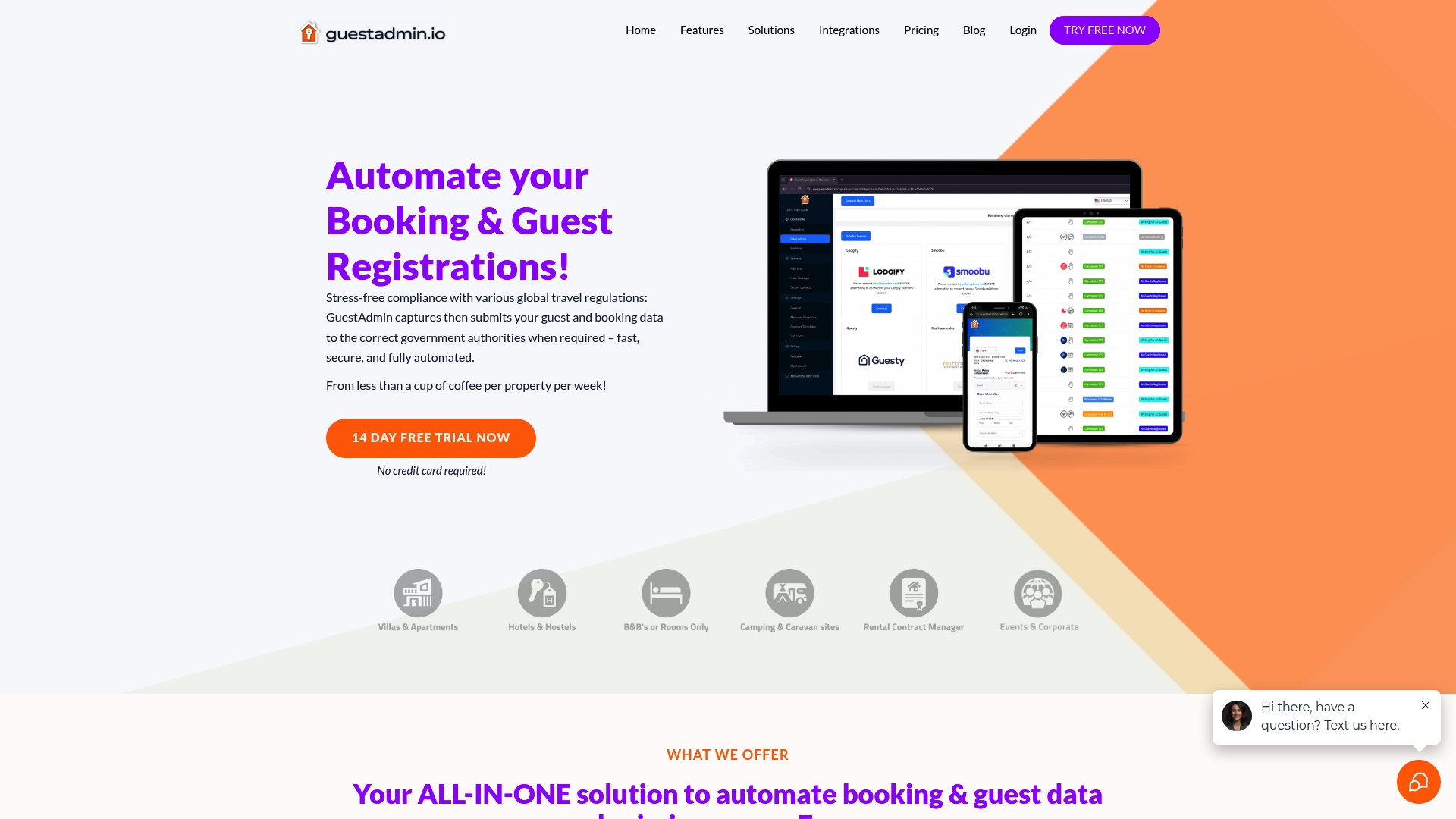
Guestadmin enforces role-based access controls and provides a full audit trail of every data access event, giving property managers the documentation they need for GDPR accountability. Automated retention workflows delete guest records when the retention period expires, without requiring manual intervention. For managers who want to see how this works in practice, the property compliance checklist covers the full automation workflow for European regulatory requirements. You can also explore secure guest data access practices tailored specifically for hosts operating across multiple European jurisdictions.
FAQ
What is the 72-hour GDPR breach notification rule?
Under GDPR, a qualifying personal data breach must be reported to the national supervisory authority within 72 hours of the property becoming aware of it. Missing this deadline is a separate regulatory violation from the breach itself.
How does tokenisation reduce PCI DSS compliance burden?
Tokenised payment processors replace raw card data with a non-sensitive token before it reaches the property network. This keeps card data off your systems entirely, eliminating the majority of PCI DSS scope and associated security requirements.
What is the most effective defence against vishing attacks?
A verbal-only verification protocol is the most effective non-technical defence. Staff must call back on a known, pre-registered number before acting on any request involving fund transfers or credential access, regardless of how convincing the caller sounds.
How often should hospitality staff receive security training?
Annual classroom training is the minimum, but quarterly phishing simulations and short briefings after industry incidents are the standard that actually changes behaviour. Training content should be updated every six months as attack tactics evolve.
What does data minimisation mean for hotel reservation records?
Data minimisation means collecting only the guest information needed for a specific, documented purpose and deleting it once that purpose is fulfilled. Retaining reservation history indefinitely without a documented policy violates GDPR and exposes the property to regulatory action.
One Comment
Why secure guest data matters for property managers
[…] most effective guest data protection strategies combine technical controls with staff behaviour and process discipline. No single measure is […]