

TL;DR:
- Guest data reporting is essential for legal compliance and operational efficiency in hospitality. Properly capturing, organizing, and submitting guest information helps property managers avoid fines and gain valuable insights. Using automated systems like Guestadmin ensures timely, accurate submissions across all booking channels.
Guest data reporting is the systematic process of collecting, organising, and submitting guest information to meet legal obligations and improve operational efficiency in hospitality. Property owners and managers across Europe are legally required to handle this process correctly under GDPR and national tourism legislation. Every hotelier, regardless of size, is classified as a data controller and must process guest data on a lawful basis. Getting this right protects your business from fines, supports audit readiness, and gives you the operational visibility to run your properties well. Guestadmin was built specifically to make this process manageable for short-term rental operators across Europe.
What is guest data reporting and why does it matter?
Guest data reporting is the structured practice of capturing, recording, and submitting guest information for compliance and business purposes. The industry term for the broader process is “guest data management,” which covers collection, processing, storage, and reporting as distinct but connected stages. Property managers who treat these stages as separate tasks tend to create gaps that regulators notice.

The legal stakes are real. GDPR and national tourism laws require hospitality businesses to process guest data on a documented lawful basis, retain it only as long as necessary, and protect it from unauthorised access. Failing to meet these obligations risks administrative penalties that can be significant for small operators. Beyond compliance, structured reporting gives managers a clear record of who stayed, when, and under what booking terms, which is the foundation for any meaningful guest insights reporting.
Operational efficiency is the second major benefit. When guest records are well-organised, teams spend less time searching for information and more time acting on it. A property manager handling ten or more units cannot rely on spreadsheets and email threads to stay compliant. Structured guest data reporting replaces that fragmentation with a single, auditable record.
What types of guest data are collected and reported?
Guest data falls into two broad categories: personal data and operational data. Personal data identifies the individual. Operational data describes the stay. Both categories carry compliance obligations, but they serve different purposes in your reporting workflows.
Guest data includes identification details, booking information, payment records, loyalty profiles, and behavioural insights gathered over multiple stays. Loyalty programmes are particularly data-rich, often holding years of stay history and AI-generated preference profiles. That depth of data requires a correspondingly careful approach to storage and access controls.
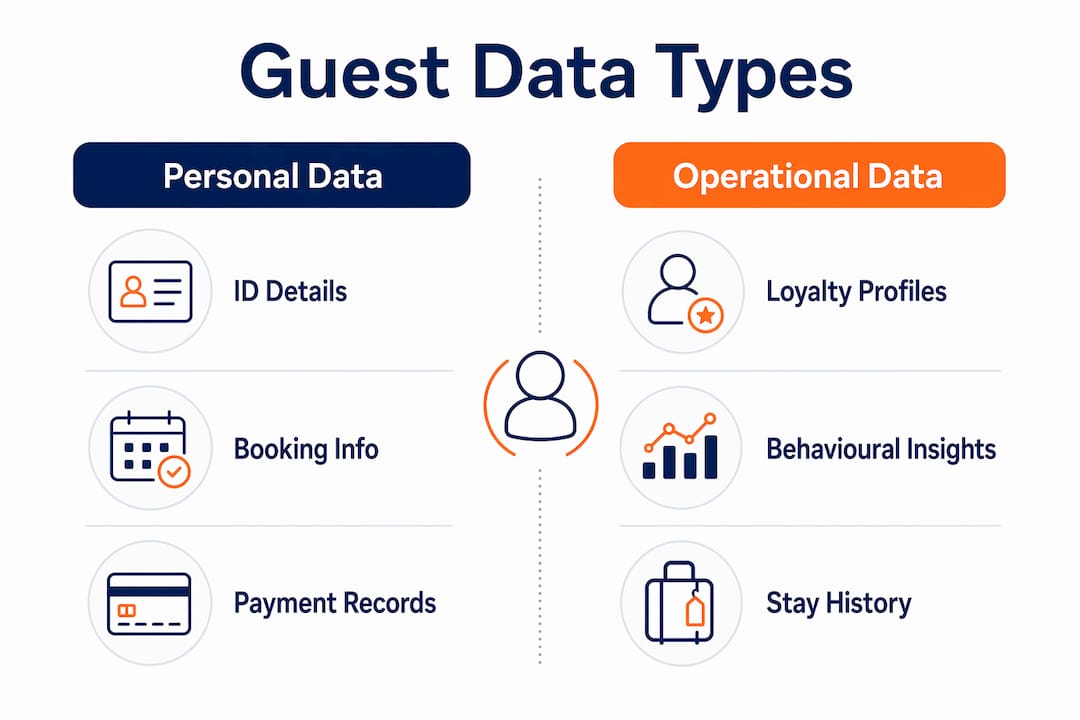
| Data category | Examples | Primary purpose |
|---|---|---|
| Identification | Passport number, full name, nationality | Government reporting, identity verification |
| Booking details | Arrival and departure dates, room type, OTA source | Operational records, revenue analysis |
| Payment information | Transaction references, payment method | Financial compliance, fraud prevention |
| Stay history | Previous visits, length of stay, preferences | Loyalty programmes, guest experience |
| Behavioural data | Communication logs, maintenance requests | Staff workload, service quality |
Understanding which category each data point belongs to helps you apply the correct lawful basis under GDPR. Identification data submitted to tourism authorities typically relies on a legal obligation basis. Loyalty profile data relies on consent or legitimate interests, depending on how it is used.
Pro Tip: Map each data category to its lawful basis before you build your reporting templates. This single step makes GDPR audits significantly faster and reduces the risk of processing data without a valid legal ground.
How does guest data reporting support legal compliance?
GDPR sets the baseline for guest data processing across Europe, but sector-specific tourism laws add a second layer of obligation. In several European countries, property owners must submit guest identification data to local police or tourism authorities within a set timeframe after check-in. These submissions are mandatory, not optional, and failure to comply can result in fines or loss of operating licences.
The core GDPR obligations relevant to hospitality reporting are:
- Lawful basis: Every processing activity must have a documented legal ground, whether that is legal obligation, legitimate interests, or consent.
- Data minimisation: Collect only the data you genuinely need for the stated purpose. Collecting passport numbers for a marketing list is not lawful.
- Retention limits: GDPR Article 5(1)(e) requires storage periods to be justifiable and purpose-specific. Tax records, fraud logs, and customer service histories each carry different retention timelines.
- Access controls: Limit who can view guest data within your organisation. Recent ICO enforcement actions in the UK targeted operators who lacked multi-factor authentication and adequate supplier governance.
- Audit readiness: Maintain records of processing activities so you can demonstrate compliance to regulators on request.
Non-compliance is not a theoretical risk. Enforcement cases in the hospitality sector frequently involve excessive data retention, weak access controls, and failure to protect guest records from third-party system breaches. Structured reporting, with clear retention schedules and access logs, is your primary defence.
Pro Tip: Retention periods vary significantly depending on purpose. Tax records may need to be kept for seven years in some jurisdictions, while guest communication logs for customer service purposes may only require twelve months. Document each retention period separately and review them annually.
For a detailed breakdown of your obligations, the GDPR in hospitality guide from Guestadmin covers the key legal bases and practical steps for property owners.
What are the operational benefits of effective guest data reporting?
Compliance is the minimum requirement. The real value of well-organised guest data reporting shows up in how efficiently your properties run day to day. Structured data reporting helps teams reduce search time and act faster by consolidating bookings, communications, forms, and maintenance notes into a single accessible record. That consolidation directly reduces the administrative burden on staff.
The operational gains compound when you connect reporting to analytics. Occupancy trends, average length of stay, booking source performance, and revenue per property all become visible when your guest data is structured correctly. These metrics inform pricing decisions, staffing levels, and marketing spend in ways that gut instinct cannot match.
Reports on guest message response rates and maintenance request completion give managers a live view of service quality. A property with a pattern of slow maintenance responses shows up in the data before it shows up in guest reviews. That early visibility is worth more than any post-review damage limitation.
Deriving operational insights from guest data follows a clear sequence:
- Collect consistently. Use a single intake process for all guest data, whether bookings arrive via OTA, direct website, or phone. Inconsistent collection creates gaps that undermine every downstream report.
- Categorise on entry. Tag each data point by category (identification, booking, payment, behavioural) at the point of collection. Retroactive categorisation is time-consuming and error-prone.
- Connect to your PMS. Integrated PMS platforms with AI-powered analytics eliminate manual errors and surface insights automatically. Manual data entry into separate systems multiplies the risk of inaccuracies.
- Set reporting schedules. Define when reports run, who receives them, and what decisions they inform. Ad hoc reporting produces ad hoc decisions.
- Review and act. Assign ownership for each report type. Occupancy data belongs with the revenue manager. Maintenance logs belong with the operations lead. Data without an owner does not drive change.
What are the common challenges in guest data reporting?
The most common problem property managers face is fragmented data. Guest information arrives from multiple sources: OTA platforms, direct booking engines, check-in forms, and communication tools. Without a unified system, the same guest may appear as three separate records with inconsistent details across each. That fragmentation makes compliance reporting unreliable and operational analysis meaningless.
Manual processes compound the problem. Copying guest data between systems introduces errors. Errors in government submissions cause rejections. Government reporting templates exist precisely because custom field formats lead to rejected submissions in countries like the Czech Republic, Finland, and Turkey. Using the correct template for each jurisdiction removes a significant source of compliance failure.
Best practices for reliable guest data reporting include:
- Unify your data sources. Connect all booking channels to a single system of record. Every guest record should exist in one place, not several.
- Automate government submissions. Manual submission to tourism authorities is slow and error-prone. Automated tools submit within required timeframes and flag failures immediately.
- Train staff on data handling. GDPR obligations apply to every team member who touches guest data. A front-of-house team that does not understand data minimisation is a compliance risk.
- Implement role-based access controls. Not every staff member needs access to payment data or passport numbers. Restrict access by role and log who views what.
- Map your data flows. Document where guest data enters your systems, how it moves between them, and where it is stored. This mapping is a GDPR requirement and a practical audit tool.
Pro Tip: Use pre-built government reporting templates wherever they are available for your jurisdiction. Templates prevent the formatting errors that cause submissions to be rejected, saving you the time and reputational risk of resubmission.
The balance between data richness and guest privacy is a genuine tension. Loyalty programmes benefit from detailed stay histories, but guests have the right to request deletion of their data. Building deletion workflows into your reporting system from the start is far easier than retrofitting them later. For a practical checklist, the EU rental compliance checklist from Guestadmin covers the key steps.
Key takeaways
Guest data reporting is a legal requirement and an operational tool. Property managers who treat it as both will outperform those who treat it as a box-ticking exercise.
| Point | Details |
|---|---|
| Legal obligation applies to all | Every property owner processing guest data is a GDPR data controller, regardless of portfolio size. |
| Data categories determine lawful basis | Identification, booking, payment, and behavioural data each require a documented legal ground for processing. |
| Retention periods must be purpose-specific | Tax, fraud, and customer service records carry different retention timelines; document each one separately. |
| Fragmented data creates compliance risk | Unifying all booking channels into one system of record is the single most effective way to reduce reporting errors. |
| Automation reduces submission failures | Government reporting templates and automated tools prevent the formatting errors that cause rejected submissions. |
Why guest data reporting is more than a compliance checkbox
I have worked with property managers who treat guest data reporting as something they do once a year when a regulator asks. That approach is the most expensive way to handle it. The ICO and its European equivalents are not waiting for annual reviews. Enforcement actions happen when a data breach exposes a gap, and gaps are almost always the result of manual processes and fragmented systems.
What I find genuinely interesting about this area is how much operational value sits inside the compliance data. The same guest records you submit to tourism authorities contain the occupancy patterns, booking source data, and stay duration trends that should be driving your pricing decisions. Most property managers never connect those two uses. They file the compliance report and ignore the analytics.
The shift from manual to automated reporting is where I see the biggest practical gains. Property managers who automate government submissions stop worrying about deadlines and start using the time they recover to review the data itself. That shift in attention, from administration to analysis, is where the real competitive advantage lies. Technology like Guestadmin makes that shift accessible even for single-property owners who do not have a dedicated compliance team.
Regulatory requirements will continue to tighten across Europe, particularly for short-term rentals. The EU’s short-term rental regulation framework is already pushing member states toward more structured data reporting obligations. Property managers who build good data habits now will adapt to those changes with far less disruption than those who are still relying on spreadsheets.
— Alex
How Guestadmin supports guest data reporting for property managers
Guestadmin is built for property owners and managers who need to meet European compliance obligations without building a compliance team from scratch.
The platform captures guest data at check-in, processes it with AI, and submits it to the relevant government authorities within 24 hours. It connects with major PMS and OTA platforms, so your guest records stay unified across all booking channels. GDPR-compliant archiving, role-based access controls, and real-time dashboards are included as standard. For managers handling multiple properties, the multi-property management tools give you a single view across your entire portfolio. If you want to see how it works in practice, the short-term rental compliance guide is a good starting point for understanding what Guestadmin covers and how it fits your obligations.
FAQ
What is guest data reporting in hospitality?
Guest data reporting is the process of collecting, organising, and submitting guest information to meet legal and operational requirements. It covers identification data, booking details, payment records, and behavioural insights, each processed under a documented lawful basis.
What types of guest data must property managers collect?
Property managers typically collect identification data (such as passport numbers and nationality), booking details, payment references, and stay history. In many European jurisdictions, identification data must be submitted to tourism authorities or police within a set timeframe after check-in.
How long must guest data be retained under GDPR?
GDPR Article 5(1)(e) requires retention periods to be purpose-specific and justifiable. Tax records, fraud logs, and customer service histories each carry different timelines, and property managers must document each one separately.
What are the consequences of poor guest data reporting?
Poor reporting risks administrative fines under GDPR, rejected government submissions, and loss of operating licences in jurisdictions with mandatory tourism authority reporting. Recent ICO enforcement actions have targeted operators with inadequate access controls and excessive data retention.
How can property managers improve their guest data reporting?
The most effective steps are unifying all booking channels into a single system, using government-approved reporting templates, automating submissions, and implementing role-based access controls. Platforms like Guestadmin automate these processes and submit data to authorities within 24 hours.