

TL;DR:
- AI in hospitality compliance automates guest data processing, reporting, and risk detection to ensure regulatory adherence. Implementing proper governance frameworks and data architecture significantly reduces errors and legal risks for property managers operating in Europe.
AI in hospitality compliance is defined as the use of automated systems, predictive analytics, and governed decision-making to meet regulatory obligations across guest data processing, reporting, and risk management. For short-term rental property owners operating across Europe, this is no longer optional. The EU AI Act and GDPR together create a layered regulatory environment where non-compliance carries fines up to €35 million or 7% of worldwide annual turnover. That financial exposure makes AI governance a business-critical priority, not a technology experiment. Guestadmin exists precisely to help property managers meet these obligations without the administrative burden.
How does AI automate hospitality compliance processes?
AI automates hospitality compliance by replacing manual, error-prone tasks with systems that capture, validate, and submit data in real time. For short-term rental managers handling multiple properties across different jurisdictions, this shift removes the single biggest source of compliance failure: human inconsistency.
The practical applications are specific and measurable:
- Automated guest data processing. AI captures guest identity information at check-in and matches it against booking records, then submits it to the relevant government authority within the required window. Guestadmin does this within 24 hours, with GDPR-compliant consent records created automatically.
- Conversational AI with transparency disclosures. Guest-facing chatbots must inform users they are interacting with AI before the conversation begins. Article 50 of the EU AI Act requires this disclosure to be upfront and obvious, not buried in terms and conditions. Any property using an AI chat tool without this disclosure is already in breach.
- Anomaly detection for pre-emptive risk management. AI-driven anomaly detection predicts compliance failures before they occur by analysing inspection records, incident data, and historical asset metrics. This means you identify a reporting gap before a regulator does.
- Real-time audit trails. Every AI-assisted action is logged with a timestamp, user record, and outcome. Regulators increasingly expect this level of documentation during inspections.
The most effective model for regulated environments is the human-in-the-loop architecture. AI handles routine tasks automatically, but sensitive decisions, such as disputed guest identity or a data subject access request, escalate to a human supervisor. This keeps the system auditable and defensible.
Pro Tip: Set your human escalation triggers in writing before deploying any AI compliance tool. Regulators will ask to see your escalation policy, and “we handle it case by case” is not an acceptable answer.

What governance frameworks ensure responsible AI use?
Governance is the difference between AI that protects your business and AI that creates liability. Property managers who treat AI as a plug-and-play tool, without reviewing vendor contracts or testing for errors, are taking on risk they cannot see.
The HSMAI AI Advisory Board recommends treating AI adoption as a commercial shift requiring cross-departmental alignment, not an IT project. That framing matters because compliance failures rarely originate in the technology. They originate in the gap between what the AI does and what the operations team expects it to do.
Four governance practices every property manager should implement:
- Secure audit rights in vendor contracts. Contracts with AI vendors should function as governance documents, securing ongoing audit rights, model transparency, and subprocessor disclosures. A vendor who refuses audit rights is a compliance red flag.
- Conduct adversarial testing. Adversarial testing, known as red teaming, is legally required for high-risk AI systems under the EU AI Act. Deployers, not just model developers, bear responsibility for testing their own applications, including chatbots and pricing automation tools.
- Ground AI responses in verified property data. AI systems that generate responses without a factual anchor hallucinate. Grounding outputs in your actual property policies, pricing, and guest records eliminates this risk.
- Implement orchestration layers. Orchestration frameworks coordinate independent AI agents working across guest journey workflows under defined guardrails. Without this layer, AI agents operating in isolation can contradict each other or breach compliance boundaries.
“Property owners should view AI governance not as a burden but as fundamental to building guest trust and managing compliance risk effectively. The governance framework is where AI risk becomes competitive advantage.”
Hospitality Net
Many property owners also underestimate the scope of the EU AI Act. Marketing-driven AI tools are frequently assumed to fall outside its scope. They often do not. Proactively verifying the risk classification of every AI tool you deploy is a legal obligation, not a best practice.
How does data architecture affect AI compliance effectiveness?
AI compliance tools are only as reliable as the data they run on. Fragmented data across property management systems (PMS), customer relationship management platforms (CRM), central reservation systems (CRS), and messaging tools produces inconsistent outputs and increases hallucination risk.
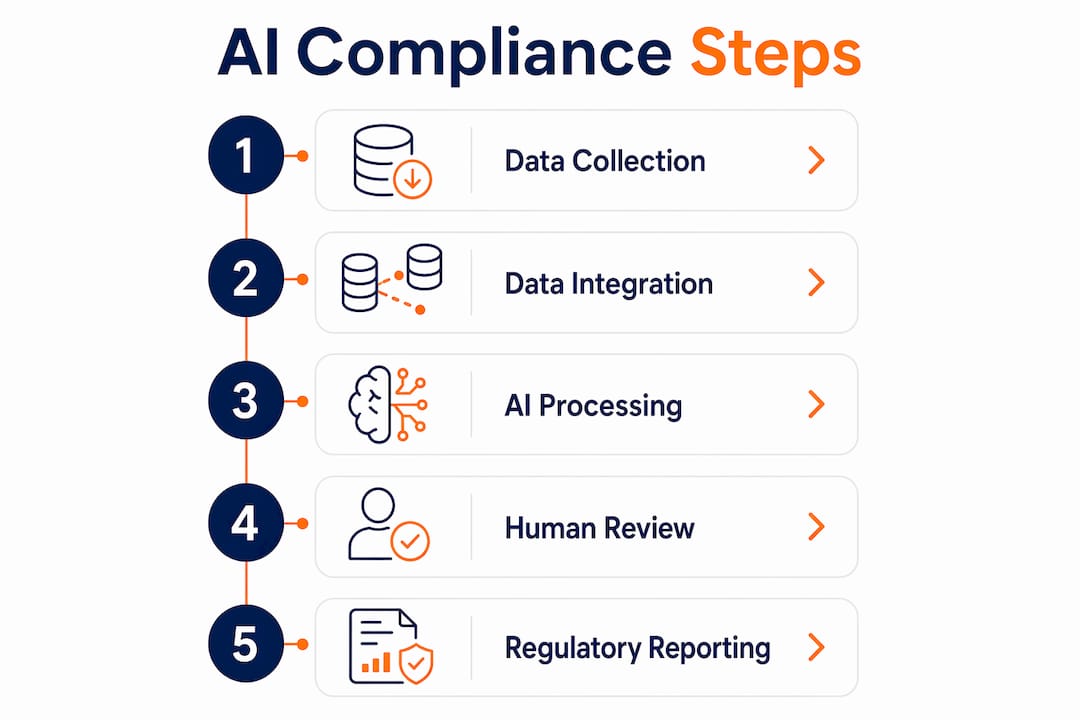
Data silos and poor data quality are the largest barriers to effective AI implementation in hospitality. Customer Data Platform (CDP) projects typically run for 8–16 weeks before AI deployment to deduplicate records and standardise data formats. Skipping this step means your AI compliance tool is working from incomplete or contradictory information.
The table below shows how data architecture choices affect AI compliance performance:
| Data architecture approach | Effect on AI compliance output |
|---|---|
| Fragmented PMS, CRM, and CRS with no integration | High error rate in guest data submissions; audit trail gaps |
| Centralised CDP with deduplication | Consistent guest records; reliable automated reporting |
| API-accessible, machine-readable systems | Supports Retrieval-Augmented Generation (RAG) for factual accuracy |
| Unified property, guest, and price memory | AI responses grounded in verified data; hallucination risk reduced |
Retrieval-Augmented Generation (RAG) is the technical standard that makes this work in practice. RAG fetches exact facts from a unified data store and uses them to generate AI responses, rather than relying on the model’s general training. For compliance purposes, this means your AI tool cites your actual guest records, not a plausible approximation of them.
Property managers with API integrations across their key platforms are significantly better positioned to deploy reliable AI compliance tools. The investment in data infrastructure pays back in reduced error rates and faster regulatory reporting.
What practical steps should property owners take to implement AI for compliance?
Implementation without a plan produces compliance gaps. The following steps give property managers a structured path from AI interest to AI readiness.
- Map every AI touchpoint. List every system on your property that uses AI, including booking engines, guest messaging tools, pricing software, and check-in kiosks. Each one carries regulatory obligations under the EU AI Act.
- Verify EU AI Act risk classifications. Work with your vendors to confirm how each tool is classified under the EU AI Act risk tiers. High-risk classifications carry mandatory requirements for documentation, testing, and human oversight.
- Conduct Data Protection Impact Assessments (DPIAs). Any AI system processing guest personal data requires a DPIA under GDPR. This is not optional. Document the assessment and retain it for regulatory review.
- Build human oversight workflows. Define which decisions require human review and create escalation protocols. Assign named individuals to oversight roles and document their responsibilities.
- Implement transparency disclosures for guest-facing AI. Every guest interaction with an AI system must begin with a clear disclosure. Review all guest-facing tools and add disclosures where they are absent.
- Schedule continuous adversarial testing. Red teaming is not a one-off exercise. Build it into your compliance calendar at least quarterly, and retain documentation of every test and its outcomes.
- Use a specialist hospitality compliance platform. Guestadmin automates guest data capture, submission, and archiving with GDPR-compliant workflows built in. This removes the manual steps most likely to produce errors.
Pro Tip: When onboarding a new AI vendor, ask specifically for their EU AI Act conformity documentation and their subprocessor list. If they cannot produce both within 48 hours, treat that as a governance failure.
The step-by-step guide to automating hospitality compliance on the Guestadmin site covers the operational detail behind each of these steps for European short-term rental managers.
Key takeaways
AI in hospitality compliance requires governance, clean data architecture, and human oversight to deliver reliable regulatory adherence across short-term rental operations.
| Point | Details |
|---|---|
| Fines for non-compliance are severe | EU AI Act breaches can cost up to €35 million or 7% of global annual turnover. |
| Human-in-the-loop models are the standard | AI handles routine tasks; humans review sensitive escalations to keep audit trails defensible. |
| Data architecture determines AI reliability | CDP projects and API integrations must precede AI deployment to avoid hallucinations and errors. |
| Vendor contracts are governance documents | Audit rights, model transparency, and subprocessor disclosures must be secured in writing. |
| Adversarial testing is a legal obligation | Deployers must red-team their own AI applications under the EU AI Act, not just rely on vendors. |
Why AI governance is the real competitive edge in hospitality
The property managers I see struggling with AI compliance share one trait: they adopted AI tools reactively, chasing efficiency gains without asking who is responsible when the system gets something wrong. That question matters enormously when a regulator asks for your audit trail.
The HSMAI commercial framework frames AI as a commercial shift requiring cross-departmental ownership. I agree with that framing, but I would go further. The owners who will win in the next three years are not the ones with the most AI tools. They are the ones who have built the governance infrastructure to use those tools safely.
Data architecture is where most operators underinvest. A well-governed AI compliance system built on fragmented data will still fail. The CDP work, the API integrations, the deduplication projects: these are unglamorous, but they are the foundation everything else rests on.
The shift I want property managers to make is from passive AI adopters to active AI stewards. That means owning your vendor contracts, scheduling your red-teaming, and treating every guest data submission as a governed process, not an automated afterthought. The regulatory environment will only tighten. The managers who build governance habits now will find future compliance updates far less disruptive than those who do not.
— Alex
Guestadmin’s AI-powered compliance platform for short-term rentals
Short-term rental compliance across Europe involves multiple jurisdictions, tight submission deadlines, and GDPR obligations that change as regulations evolve. Guestadmin addresses all of this in one platform.
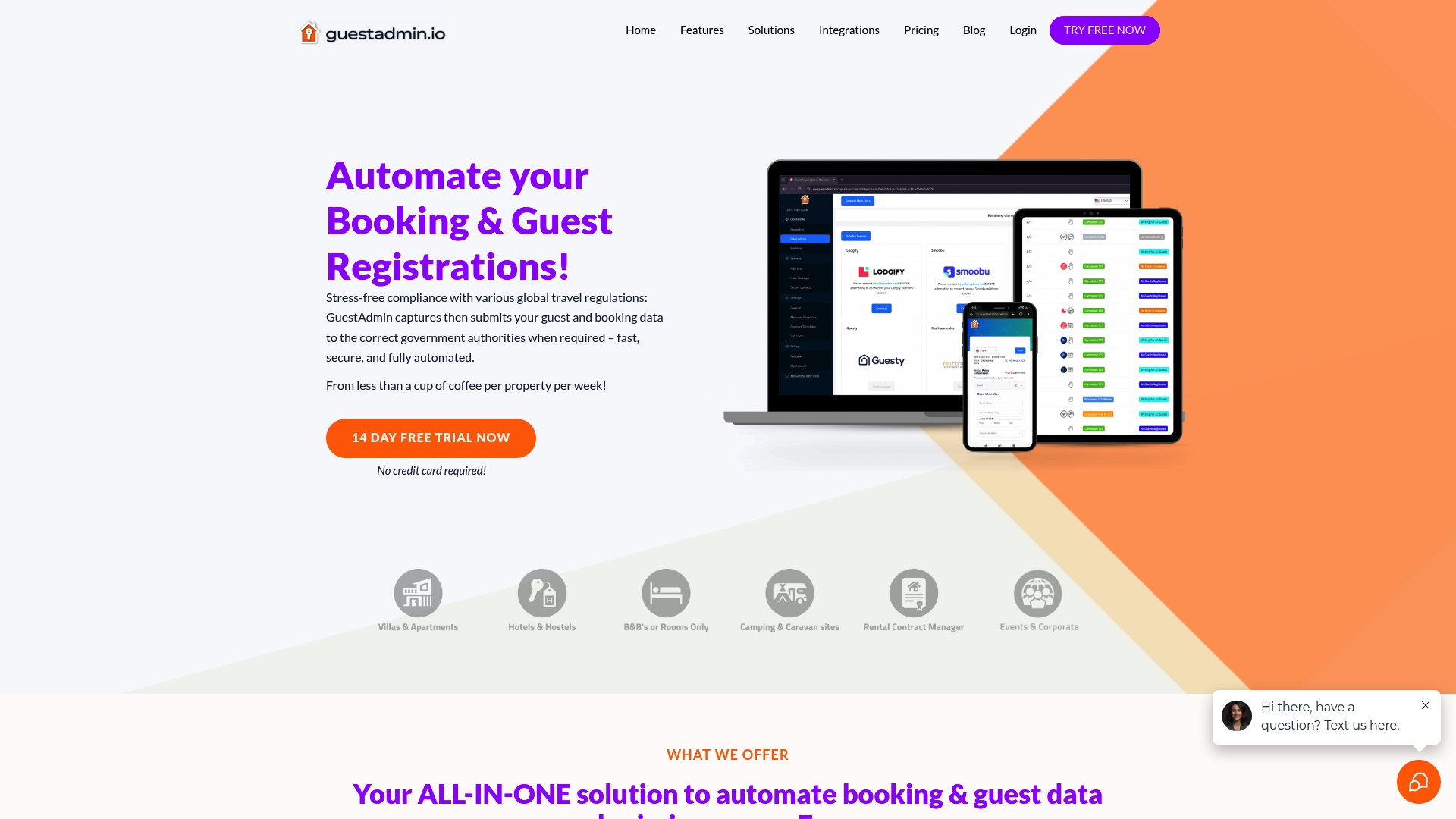
Guestadmin automates guest data processing from capture through to secure government submission, with every step logged for audit readiness. The platform integrates with leading PMS and OTA systems via API, supports multi-property management from a single dashboard, and delivers submissions within 24 hours. Human-in-the-loop workflows are built in, so sensitive cases receive the oversight regulators expect. For property managers who want to reduce compliance risk without adding administrative overhead, Guestadmin is the practical next step. Explore rental compliance solutions built specifically for the European market.
FAQ
What is the role of AI in hospitality compliance?
AI in hospitality compliance automates guest data capture, regulatory reporting, and risk detection, replacing manual processes that are prone to error. It also supports audit trail creation and human oversight workflows required under the EU AI Act and GDPR.
What fines apply for AI compliance failures in hospitality?
Non-compliance with the EU AI Act can result in fines of up to €35 million or 7% of worldwide annual turnover for high-risk failures. General transparency breaches carry fines of up to €15 million or 3% of turnover.
What is a human-in-the-loop model in hospitality AI?
A human-in-the-loop model automates routine compliance tasks while routing sensitive decisions, such as disputed guest data or access requests, to a human supervisor. This approach keeps AI systems auditable and defensible under current European regulations.
Do short-term rental properties need to conduct DPIAs for AI tools?
Any AI system processing guest personal data requires a Data Protection Impact Assessment under GDPR. Property managers must document the assessment and retain it for potential regulatory review.
How does data quality affect AI compliance accuracy?
Poor data quality across fragmented PMS, CRM, and CRS systems produces inconsistent AI outputs and increases the risk of incorrect regulatory submissions. A centralised Customer Data Platform with deduplication is the standard prerequisite before deploying AI compliance tools.