

TL;DR:
- Data security in 2026 centers on continuous controls, governance, and architectural strategies to defend organizational data. Implementing Zero Trust, regular audits, strong encryption, and role-based access ensures effective protection against expanding threats. Cultivating a security-aware culture under leadership is vital to closing gaps between policies and daily practices.
Data security best practices in 2026 are defined as the foundational controls, governance processes, and architectural decisions that protect sensitive organisational data from unauthorised access, breach, and regulatory penalty. The frameworks driving these practices include GDPR, ISO 27001, and the NIST Cybersecurity Framework, each of which treats security as a continuous operating discipline rather than a periodic compliance task. Zero Trust architecture and least-privilege access have become the primary paradigms for organisations managing distributed workforces, cloud environments, and AI-integrated systems. The attack surface has expanded significantly as more data moves across cloud platforms, third-party tools, and remote endpoints, making passive perimeter defences insufficient for 2026.
What are the core data security best practices in 2026?

Zero Trust architecture operates on a single principle: never trust, always verify. Every user and device must be continuously validated, regardless of whether they sit inside or outside the corporate network. This approach directly reduces the impact of compromised accounts because no single identity carries blanket trust.
Least-privilege access and role-based access control (RBAC) sit at the heart of this model. Each user receives only the permissions required for their specific role, and those permissions are reviewed regularly. When a team member changes role or leaves the organisation, their access profile changes immediately rather than accumulating over time.
Encryption is non-negotiable for both data at rest and data in transit. Encryption without governance is a common failure point. Organisations that deploy encryption without audited key management and documented implementation procedures create a false sense of security. Strong cryptographic standards must be paired with clear ownership of encryption keys and scheduled key rotation.
Continuous monitoring and behavioural analytics complete the picture. Session risk scoring flags anomalous activity in real time, such as a user downloading large volumes of data outside normal working hours. This layer catches threats that static rules miss.
- Zero Trust: Validate every identity and device on every request, not just at login.
- RBAC: Assign permissions by role and remove them automatically when roles change.
- Encryption: Apply strong cryptographic standards to data at rest and in transit, with audited key management.
- Continuous monitoring: Use behavioural analytics and session risk scoring to detect anomalies in real time.
- Regulatory alignment: Map controls to GDPR, ISO 27001, and NIST to demonstrate measurable security maturity.
Pro Tip: Start your Zero Trust rollout by mapping every identity, device, and workload in your environment before enforcing any policy. Skipping this mapping step is the single most common reason implementations stall.
How to assess and audit your data security posture regularly
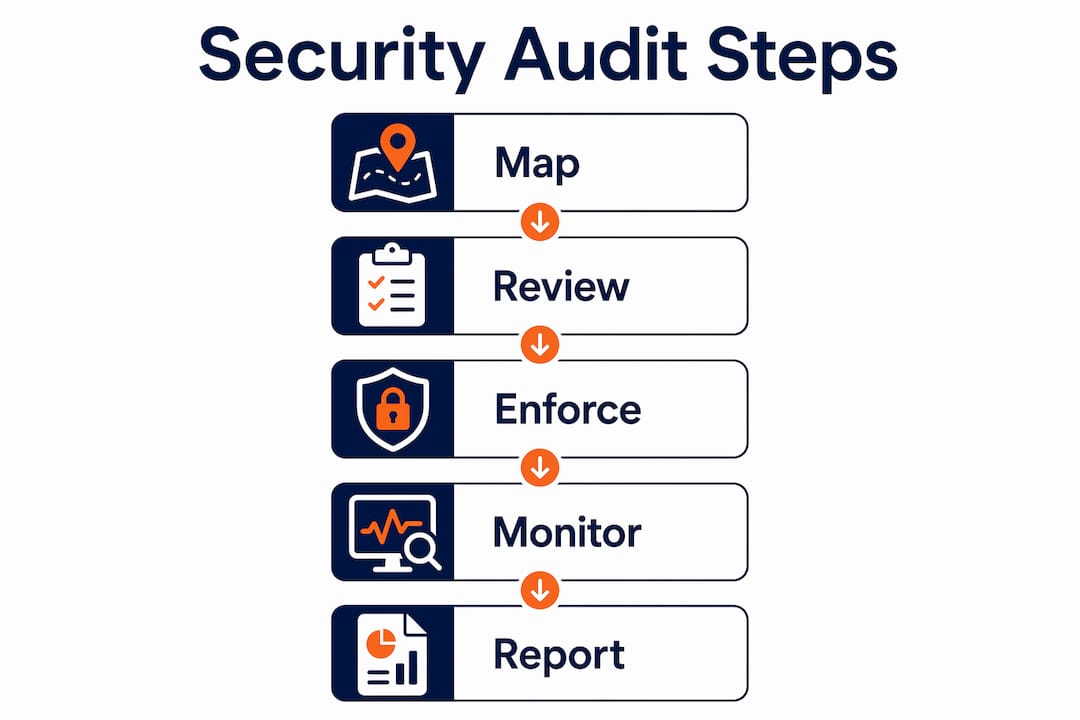
Quarterly security audits are necessary because cloud provider policies, application permission updates, and personnel changes occur continuously. An annual review leaves months of undetected exposure. Quarterly cycles align with the pace at which your risk environment actually changes.
A structured audit follows a clear sequence:
- Pull access reports. Generate reports of every account with access to sensitive data. Flag accounts unused for 90 days or longer as dormant.
- Identify excessive permissions. Compare each account’s actual activity against its assigned permissions. Revoke anything that exceeds operational need.
- Audit shared accounts. Shared credentials make attribution impossible after an incident. Replace them with individual accounts and audit trails.
- Review stale credentials. Expired passwords, inactive service accounts, and orphaned API keys are common entry points. Remove them systematically.
- Verify data retention policies. Confirm that data is deleted or archived according to your documented retention schedule and regulatory obligations.
- Document findings. Record every change made during the audit. Feed results into your security governance cycle so patterns are visible over time.
Pro Tip: Conducting a data sprawl audit by revoking dormant access reduces your attack surface faster than purchasing new security software. Prioritise access hygiene before adding new tools.
The table below shows the key audit activities, their frequency, and the primary risk each one addresses.
| Audit activity | Recommended frequency | Risk addressed |
|---|---|---|
| Dormant account review | Quarterly | Unauthorised access via unused credentials |
| Excessive permission check | Quarterly | Privilege escalation and data exfiltration |
| Shared account removal | Quarterly | Lack of attribution after incidents |
| Data retention verification | Quarterly | Regulatory non-compliance and data hoarding |
| Encryption key rotation | Bi-annually | Key compromise and cryptographic weakness |
Which MFA methods provide the best protection in 2026?
SMS-based multi-factor authentication (MFA) is no longer adequate. SIM-swapping attacks rose 400% between 2021 and 2024, according to the FBI Internet Crime Complaint Center. That figure means attackers have refined and scaled the technique to the point where SMS codes are routinely intercepted before they reach the legitimate user.
The replacement options are well established:
- Authenticator apps (such as Google Authenticator or Microsoft Authenticator) generate time-based one-time passwords locally on the device, removing the SMS interception risk.
- FIDO2 hardware security keys provide phishing-resistant authentication by binding the authentication to the physical key and the registered domain. A phishing site cannot capture a FIDO2 response because the key validates the origin.
- Certificate-based smart cards are the standard in high-security environments such as government and financial services. They combine strong cryptography with physical possession requirements.
Organisational policy must enforce phishing-resistant MFA for all accounts with access to sensitive data. Allowing users to choose their own MFA method creates a weakest-link problem. Rollout should begin with privileged accounts and system administrators, then extend to all staff within a defined timeline.
User experience matters during rollout. Hardware keys require a brief enrolment session and a small adjustment to daily login habits. Communicating this clearly before deployment reduces resistance and support requests significantly.
How to build an effective data access governance framework
Data classification is the prerequisite for every access control decision. You cannot apply the right level of protection to data you have not categorised. A practical classification scheme uses four tiers: public, internal, confidential, and restricted. Each tier carries defined handling rules, storage requirements, and access policies.
Building the framework follows a logical sequence:
- Appoint data owners. Each data set needs a named owner responsible for classification decisions and access approvals. Without ownership, governance becomes diffuse and unenforceable.
- Apply role-based and attribute-based controls. RBAC assigns permissions by job function. Attribute-based access control (ABAC) adds contextual conditions such as device health, location, and time of access. Combining both gives you precise, auditable control.
- Automate de-provisioning. When an employee changes role or leaves, their access must change immediately. Manual de-provisioning introduces delays that create exposure windows. Integrate your identity management system with your HR platform so changes propagate automatically.
- Manage vendor risk. Third-party tools that access your data carry their own security posture. Require vendors to demonstrate compliance with ISO 27001 or equivalent standards. Review their access permissions on the same quarterly cycle as internal accounts.
- Segment sensitive systems. Containing sensitive data within segmented environments means a single compromised account cannot reach your entire database. Segmentation limits the blast radius of any incident and supports faster recovery.
Pro Tip: Map your data flows before building access controls. Knowing exactly where sensitive data travels, including through third-party integrations, reveals access points that role-based policies alone will miss.
For property managers handling guest data in European markets, GDPR adds specific obligations around data minimisation and purpose limitation that must be built into your classification and access framework from the outset.
What are common data security mistakes to avoid in 2026?
The most costly mistake organisations make is treating Zero Trust as a product purchase. Zero Trust requires mapping every identity, device, and workload, then enforcing context-aware policies at every layer. Installing a single vendor tool and calling it Zero Trust leaves the underlying architecture unchanged and the risk unaddressed.
The second major error is ignoring access sprawl. Permissions accumulate silently over time as people change roles, join projects, and gain temporary access that never gets revoked. Pulling a report of accounts with sensitive data access and identifying those unused for 90 days is the fastest way to reduce exposure without any new technology investment.
A third pitfall is relying on documentation rather than demonstrated resilience. Security maturity measurement is shifting from annual audit reports to real-time evidence of control effectiveness aligned with frameworks like NIST and NIS2. A policy document that no one tests is not a control.
“Security embedded into daily workflows protects organisations. Security confined to policy documents does not.”
Troubleshooting common implementation problems follows a consistent pattern. If Zero Trust enforcement creates friction for legitimate users, the cause is almost always incomplete identity mapping at the start. If access reviews keep surfacing the same stale accounts, the de-provisioning process is not connected to the HR system. Fix the process before adding more tooling.
Top organisations treat security as a business capability, investing in governance and employee training alongside technical controls. Human error remains a leading cause of breaches, and no technical control fully compensates for an untrained workforce.
Key takeaways
Effective data security in 2026 requires Zero Trust architecture, quarterly access auditing, phishing-resistant MFA, and data classification as interconnected controls, not isolated projects.
| Point | Details |
|---|---|
| Zero Trust is an architecture | Map identities, devices, and workloads before enforcing any policy. |
| Quarterly audits reduce exposure | Revoke dormant and excessive permissions every 90 days to shrink your attack surface. |
| Replace SMS MFA immediately | Adopt FIDO2 keys or authenticator apps to counter the 400% rise in SIM-swapping attacks. |
| Classify data before applying controls | Assign ownership and handling rules to each data tier before building access policies. |
| Embed security in workflows | Documented policies without tested controls do not constitute real resilience. |
Why security culture matters as much as security technology
I have spent years watching organisations invest heavily in security tooling and still suffer avoidable breaches. The pattern is consistent. The technology works. The culture does not keep pace with it.
The most effective security programmes I have seen share one characteristic: leadership treats security as a business function, not an IT cost centre. When the board asks for evidence of control effectiveness rather than just a compliance certificate, the whole organisation responds differently. Teams start reporting anomalies instead of hiding mistakes. Procurement starts asking vendors for security documentation before signing contracts.
Identity management is the primary control point in distributed and AI-integrated environments. That means the human decisions around who gets access, when, and under what conditions matter as much as the technical enforcement. Training staff to recognise phishing attempts, question unusual access requests, and report incidents without fear of blame reduces breach risk in ways that no firewall can replicate.
My honest view is that the organisations struggling most with data security in 2026 are not under-tooled. They are under-governed. The gap between their written policies and their actual daily practices is where breaches happen. Closing that gap requires leadership commitment, regular testing, and a willingness to treat security failures as learning opportunities rather than embarrassments to be managed quietly.
— Alex
How Guestadmin supports data security for property managers
Property managers operating across European markets face a specific version of this challenge. Guest data flows through multiple systems, crosses jurisdictions, and must meet GDPR requirements at every step.
Guestadmin is built to handle exactly this complexity. The platform automates the capture, processing, and secure submission of guest and booking data to government authorities, with GDPR-compliant access controls and encrypted data handling built in. For managers with multiple properties, Guestadmin’s guest data processing tools centralise compliance across all locations, removing the manual burden of tracking regulatory requirements property by property. If you want to see how automated compliance fits your operation, the EU rental compliance checklist is a practical starting point.
FAQ
What is Zero Trust architecture in data security?
Zero Trust is a security model that requires continuous verification of every user and device on every request, regardless of network location. It is an architecture built on identity mapping and context-aware policy enforcement, not a single product.
Why is SMS-based MFA no longer considered secure?
SIM-swapping attacks rose 400% between 2021 and 2024, making SMS codes vulnerable to interception before they reach the legitimate user. FIDO2 hardware keys and authenticator apps are the recommended replacements.
How often should organisations conduct security audits?
Quarterly audits are the current standard because cloud policies, application permissions, and personnel change continuously. Annual reviews leave too large a gap between assessments.
What does GDPR require for data access governance?
GDPR requires data minimisation, purpose limitation, and documented access controls for any personal data processed within the EU. Organisations must be able to demonstrate who has access to personal data and why.
How does data classification improve security?
Classifying data into tiers such as public, internal, confidential, and restricted allows organisations to apply proportionate controls to each category. Without classification, access policies are applied inconsistently and sensitive data is routinely under-protected.