

TL;DR:
- Web-based compliance uses automated tools to ensure property owners meet ongoing legal and regulatory standards. It reduces manual workload, prevents costly fines, and broadens market access by maintaining continuous adherence.
Web-based compliance is the systematic use of policies, tools, and processes to ensure property owners and managers meet legal, regulatory, and digital standards continuously. It is not a one-time checklist. It is an ongoing operational function that runs in the background of your rental business, keeping you on the right side of regulations like GDPR, local registration laws, and accessibility requirements. For property managers across Europe, understanding this distinction is the difference between staying protected and facing costly penalties.
The industry term most professionals use is compliance management, and web-based compliance is its digital delivery model. Platforms built for this purpose replace manual spreadsheets and fragmented portals with a single, automated system. Cross-framework mapping can reduce compliance workload by 40–60%, which means less time on administration and more time managing your properties.

What is web-based compliance and how does it work in practice?
Web-based compliance platforms automate the monitoring, recording, and reporting tasks that property managers would otherwise handle manually. The core mechanism is continuous scanning. Rather than running a quarterly audit, the system checks your data, processes, and submissions around the clock.
Modern platforms deploy in as little as 30 minutes and support over 150 global regulations simultaneously. That breadth matters for European property managers operating across multiple jurisdictions, where Spanish tourist registration rules differ entirely from Italian or French requirements.
Key features you will find in a capable web-based compliance platform include:
- Centralised dashboards that display the compliance status of all your properties in one view
- Real-time alerts that notify you when a submission deadline is approaching or a data issue is detected
- Audit trails that log every action taken, creating a documented record for legal defence
- Automated guest data capture and submission to relevant government authorities within required timeframes
- GDPR-compliant data storage with access controls that protect guest information
Pro Tip: Look for a platform that generates audit trails automatically. Courts respond more favourably to defendants who can demonstrate continuous testing, remediation, and documented compliance efforts rather than ad hoc responses.
Automated monitoring delivers continuous compliance at a scale that manual auditing simply cannot match. For a manager overseeing ten or more properties, this is not a convenience. It is a necessity.
What are the key benefits of web-based compliance for property owners?
The benefits of web-based compliance fall into three categories: financial protection, operational efficiency, and market access. Each one has a direct impact on your bottom line.
-
Reduced administrative workload. Compliance workload drops by 40–60% when cross-framework mapping is applied through an automated system. That time goes back into managing bookings and guests.
-
Avoidance of costly fines. Non-compliance lawsuits in digital accessibility alone cost between £20,000 and £60,000 per incident on average. Proactive automated monitoring is far cheaper than reactive legal defence.
-
Access to a broader market. The global population of people with disabilities numbers 1.3 billion. Properties that meet accessibility standards reach guests that non-compliant properties cannot serve.
-
Stronger legal standing. Documented, ongoing compliance efforts improve your position significantly in any legal dispute. A platform that logs every submission and remediation step builds that record automatically.
-
Better guest experience and SEO. Compliance with accessibility and data standards improves how your property listings perform in search results and how guests interact with your booking process.
Compliance is better understood as a performance multiplier than a legal cost. Properties that meet regulatory standards consistently attract more guests, face fewer disputes, and operate with greater confidence.
What challenges and misconceptions do property managers face?
The most damaging misconception is that compliance is a project with a finish line. Property managers often complete an initial audit, tick the boxes, and move on. Regulations change. Content changes. Guest data requirements evolve. A property that was compliant in january may not be compliant by june without ongoing monitoring.
A second common mistake is relying on accessibility overlay plugins as a shortcut. Overlays frequently conflict with screen readers and create a false sense of security. True compliance requires fixes at the infrastructure level, including semantic HTML structure and proper keyboard navigation. An overlay does not fix the underlying code.
Common pitfalls to avoid:
- Treating a single annual audit as sufficient for ongoing compliance
- Using overlay plugins instead of genuine technical remediation
- Relying entirely on automated scans without any human review
- Failing to document remediation steps, which weakens your legal position
- Managing compliance separately from your guest data and booking workflows
Pro Tip: Combine automated scanning with periodic human expert review. Many sites pass automated scans but remain unusable for assistive technology users. Human testing catches what algorithms miss.
Manual auditing also fails at scale. A property manager handling 20 listings across three countries cannot manually track submission deadlines, data formats, and regulatory updates for each jurisdiction. Automation delivers the accuracy and continuity that manual processes cannot.
How can property owners implement effective web-based compliance?
Implementation works best when compliance is built into your regular operations from the start, rather than added as an afterthought. The industry calls this the shift-left approach: embedding compliance checks early and continuously rather than retrofitting them after problems arise.
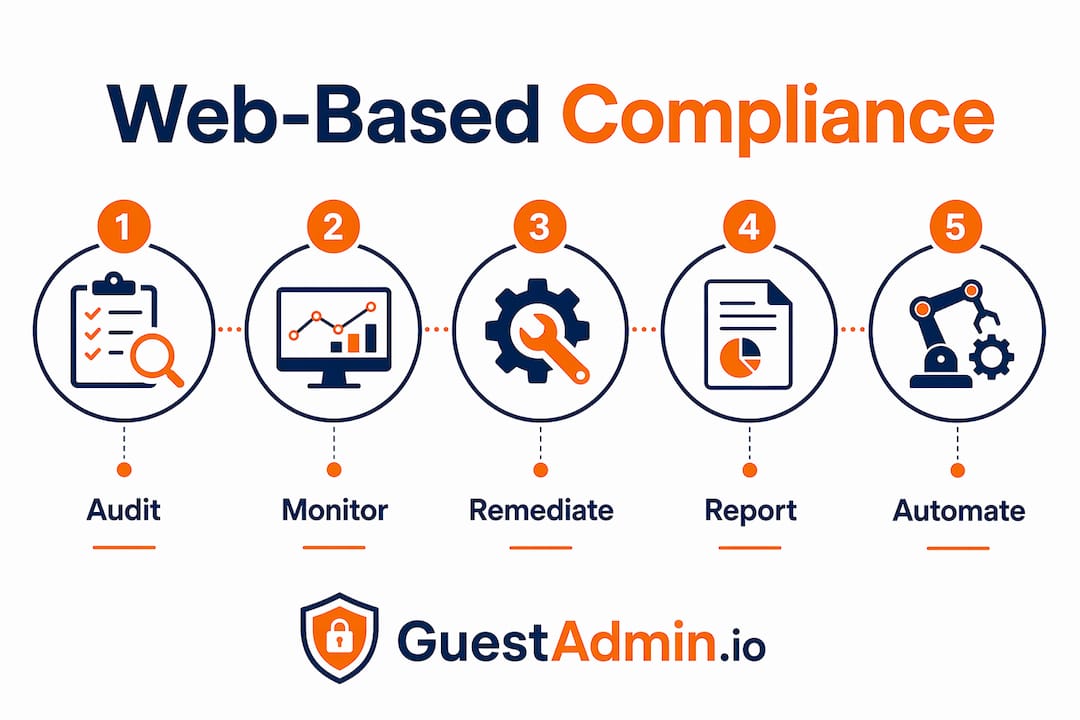
A practical implementation roadmap looks like this:
-
Run a comprehensive audit. Use an automated tool to scan your current processes, data handling practices, and digital touchpoints. Follow this with a human expert review to catch gaps the scan misses.
-
Prioritise remediation. Not every issue carries equal risk. Address data submission failures and GDPR gaps first, then move to accessibility and documentation issues.
-
Select a platform with broad regulation coverage. Choose a web-based compliance tool that covers the specific regulations relevant to your properties, including local tourist registration requirements, GDPR, and any applicable accessibility standards. Guestadmin, for example, covers multiple European jurisdictions and submits guest data to government authorities within 24 hours.
-
Embed compliance in your booking workflow. Guest data capture, verification, and submission should happen automatically at the point of booking or check-in. This removes the manual step entirely and reduces the risk of missed submissions.
-
Maintain continuous monitoring and documentation. Set up real-time alerts for deadline breaches or data anomalies. Ensure every submission and remediation action is logged in an audit trail.
| Implementation stage | Manual approach | Automated platform |
|---|---|---|
| Initial audit | Time-intensive, error-prone | Fast, consistent, repeatable |
| Regulatory updates | Requires manual research | Pushed automatically |
| Guest data submission | Risk of missed deadlines | Submitted within 24 hours |
| Documentation | Spreadsheets, fragmented | Centralised audit trail |
| Multi-property coverage | Difficult to scale | Managed from one dashboard |
A strategic compliance roadmap includes audit, prioritised remediation, and embedding compliance checks into your development and operational workflows. For short-term rental managers, that means connecting your compliance platform directly to your property management system and booking channels. You can read a detailed walkthrough in this guide to automating hospitality compliance.
Understanding how GDPR applies specifically to your guest data is a foundational step. This practical GDPR guide for hospitality covers the key obligations for property managers in plain language.
Key takeaways
Web-based compliance is an ongoing operational system, not a one-time task, and automating it is the only reliable way to manage multiple properties across European jurisdictions.
| Point | Details |
|---|---|
| Compliance is continuous | Regulations and content change; a single audit is never sufficient for sustained adherence. |
| Automation reduces workload | Cross-framework mapping cuts compliance workload by 40–60%, freeing time for property management. |
| Financial risk is real | Non-compliance incidents can cost between £20,000 and £60,000 per case in legal settlements. |
| Overlays are not a fix | Accessibility overlay plugins conflict with assistive technologies and do not replace code-level remediation. |
| Documentation protects you | Logged audit trails and continuous remediation records improve your legal standing in any dispute. |
Why compliance is the smartest investment you will make this year
Property managers often ask me whether compliance is worth the cost. My honest answer is that the question is framed the wrong way. Compliance is not a cost you absorb. It is a risk you eliminate and a capability you build.
I have seen managers lose months of revenue to a single regulatory dispute that proper documentation would have resolved in days. The audit trail that a good platform generates automatically is worth more than any legal retainer when a government authority comes asking questions. That is not a hypothetical. It happens regularly across European markets where tourist registration enforcement is tightening.
The shift-left mindset changes everything. When compliance is embedded in your booking workflow rather than bolted on afterwards, it stops feeling like a burden. Guest data flows to the right authorities automatically. Deadlines are met without anyone checking a calendar. Your attention goes to growing your portfolio, not managing paperwork.
The managers who treat compliance as a performance function rather than a legal obligation are the ones who scale without drama. They have cleaner data, faster audits, and fewer surprises. That is the competitive advantage that web-based compliance actually delivers.
— Alex
How Guestadmin makes compliance manageable for property managers
Property managers handling multiple listings across Europe face a specific problem: every jurisdiction has different rules, different deadlines, and different submission formats.
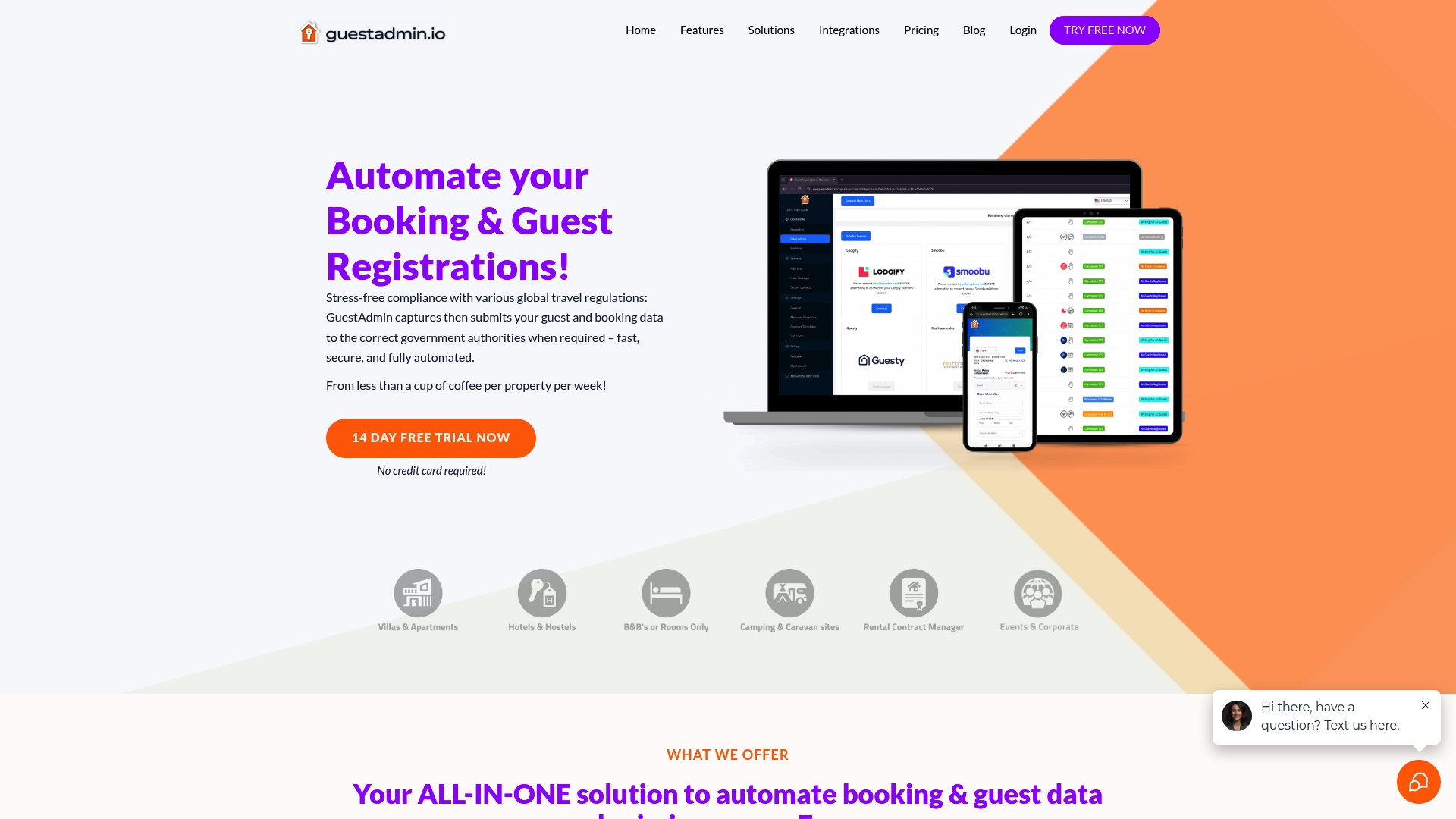
Guestadmin is built to solve exactly that. The platform captures guest data at check-in, processes it with AI, and submits it to the relevant government authorities within 24 hours. It connects with your existing property management system and booking channels via API, so there is no duplicate data entry. A single dashboard shows the compliance status of every property you manage, with real-time alerts when action is needed. For managers ready to move away from manual processes, the multi-property compliance workflow page explains how the platform handles submissions at scale. You can also explore the full short-term rental compliance guide to understand exactly which obligations apply to your properties.
FAQ
What is web-based compliance in simple terms?
Web-based compliance is the use of digital tools and automated processes to meet legal and regulatory requirements continuously. It replaces manual audits and spreadsheets with a platform that monitors, records, and submits data on your behalf.
How does GDPR affect short-term rental compliance?
GDPR requires property managers to collect, store, and process guest data lawfully and securely. This includes obtaining consent, limiting data retention, and submitting guest information to authorities only through secure, compliant channels.
Is automated compliance monitoring really necessary?
Automated monitoring is a necessity for any manager handling multiple properties. Manual processes are error-prone and cannot keep pace with changing regulations or submission deadlines across different jurisdictions.
What is compliance as a service?
Compliance as a service is a subscription model where a third-party platform handles your compliance monitoring, reporting, and documentation. Guestadmin operates on this model, managing guest data submissions and audit trails on behalf of property managers.
How quickly can a web-based compliance platform be deployed?
Modern platforms can be deployed in approximately 30 minutes and begin scanning and monitoring immediately. Guestadmin connects to existing property management systems via API, which reduces setup time further.