

Many property owners across Europe still believe that on-premise or custom-built software is the more reliable choice for managing rental compliance. That assumption is costing them time, money, and peace of mind. SaaS (Software as a Service) platforms have matured significantly, and for short-term rental operators navigating Europe’s patchwork of travel regulations, they now offer clear advantages: lower entry costs, automatic updates, remote access, and built-in compliance automation. This guide breaks down exactly why SaaS outperforms traditional software for rental management, and how to choose the right platform for your portfolio.
Table of Contents
- The challenge of compliance and guest data management
- Why SaaS outperforms traditional software for rentals
- Automating compliance: Real benefits for property managers
- Choosing the right SaaS solution for your rental business
- A fresh perspective: What most property managers miss about SaaS
- How GuestAdmin streamlines compliance and guest management
- Frequently asked questions
Key Takeaways
| Point | Details |
|---|---|
| Automated compliance | SaaS solutions handle guest data and regulatory submissions automatically, minimising errors and effort. |
| Lower costs, higher flexibility | SaaS platforms reduce upfront expenses and easily scale for any property portfolio size. |
| Reduced vendor lock-in | EU regulations now support easy data portability between SaaS providers, protecting your business flexibility. |
| Real-world efficiency gains | Property managers report up to 30% less compliance workload using SaaS automation tools. |
The challenge of compliance and guest data management
Managing a short-term rental in Europe is no longer simply about keeping rooms clean and guests happy. Regulatory requirements have grown considerably. Across countries such as Spain, Italy, Portugal, France, and Greece, local and national authorities now require property owners to register guests, submit traveller data within strict timeframes, and retain records for inspection. Failure to comply can result in fines, licence suspension, or worse.
The practical reality is that many property managers are still relying on manual processes to meet these obligations. Spreadsheets, printed forms, and email submissions are common. Even those using older desktop-based software types for rentals often find themselves dealing with systems that require manual updates, lack remote access, and struggle to keep pace with changing regulations.
Here is what that looks like in practice:
- Guest registration forms filled out by hand or copy-pasted between systems
- Data submitted late because staff are not on-site or the system is inaccessible remotely
- Errors in guest records that trigger compliance queries from authorities
- No audit trail, making it difficult to prove submissions were made
- Time lost chasing missing passport details or correcting formatting errors
The risks compound quickly. A single missed submission can trigger a fine. Multiple errors across a portfolio can attract regulatory scrutiny.
“On-premise software requires high upfront costs, manual updates, and limited remote access. It is suitable only for highly customised needs, but carries a higher total cost of ownership for most businesses.”
Legacy systems were built for a different era of property management. They were not designed to handle real-time data submission to government portals, multi-jurisdiction compliance rules, or the volume of guest turnover that modern short-term rentals generate. Understanding SaaS for hospitality compliance is therefore not just a technical consideration. It is a business-critical one.
The good news is that the tools available today are vastly more capable, accessible, and affordable than they were even five years ago.
Why SaaS outperforms traditional software for rentals
SaaS platforms are delivered entirely via the internet. There is nothing to install, no server to maintain, and no IT department required. For property managers, this means you can log in from any device, anywhere, and access the same functionality whether you are at your desk or on-site at a property.

The software feature comparison between SaaS and on-premise solutions makes the case clearly. SaaS is preferred for speed of deployment and its low entry barrier, particularly for small to medium rental businesses.
| Feature | SaaS | On-premise / custom |
|---|---|---|
| Upfront cost | Low (subscription) | High (licence + hardware) |
| Updates | Automatic | Manual, often costly |
| Remote access | Full, any device | Limited or VPN required |
| Scalability | Instant, add users/properties | Requires new infrastructure |
| Compliance automation | Built-in, regularly updated | Requires custom development |
| Total cost of ownership | Lower for most businesses | Higher over time |
For rental businesses managing anywhere from two to two hundred properties, the subscription model removes the financial barrier to accessing professional-grade tools. You pay for what you use, and the platform scales as your portfolio grows.
Pro Tip: If you are evaluating SaaS platforms, ask specifically about how compliance rules are updated when regulations change in your target market. A good SaaS provider handles this automatically, so you never have to worry about being caught out by a rule change.
The ability to scale with SaaS is particularly valuable for property managers who are growing their portfolios. Adding a new property to a SaaS system typically takes minutes, not days. There is no need to purchase additional licences or configure new hardware.
For those managing multiple rental properties, the operational savings are significant. Remote access alone eliminates the need for on-site staff to handle compliance tasks, which reduces labour costs and the risk of human error.
Automating compliance: Real benefits for property managers
Understanding the theory is one thing. Seeing the practical impact is another. SaaS platforms designed for short-term rental compliance can automate the entire guest registration and data submission workflow, from the moment a booking is confirmed to the point where traveller data is securely submitted to the relevant authority.
Here is how a typical automated compliance workflow operates:
- Guest booking is confirmed via your OTA (Online Travel Agency) or PMS (Property Management System)
- The SaaS platform automatically pulls booking and guest details
- Guests receive a digital check-in link to submit their own identification details
- AI-powered processing validates the data for accuracy and completeness
- Compliant guest records are submitted to the relevant government portal within the required timeframe
- A full audit trail is stored securely, accessible at any time
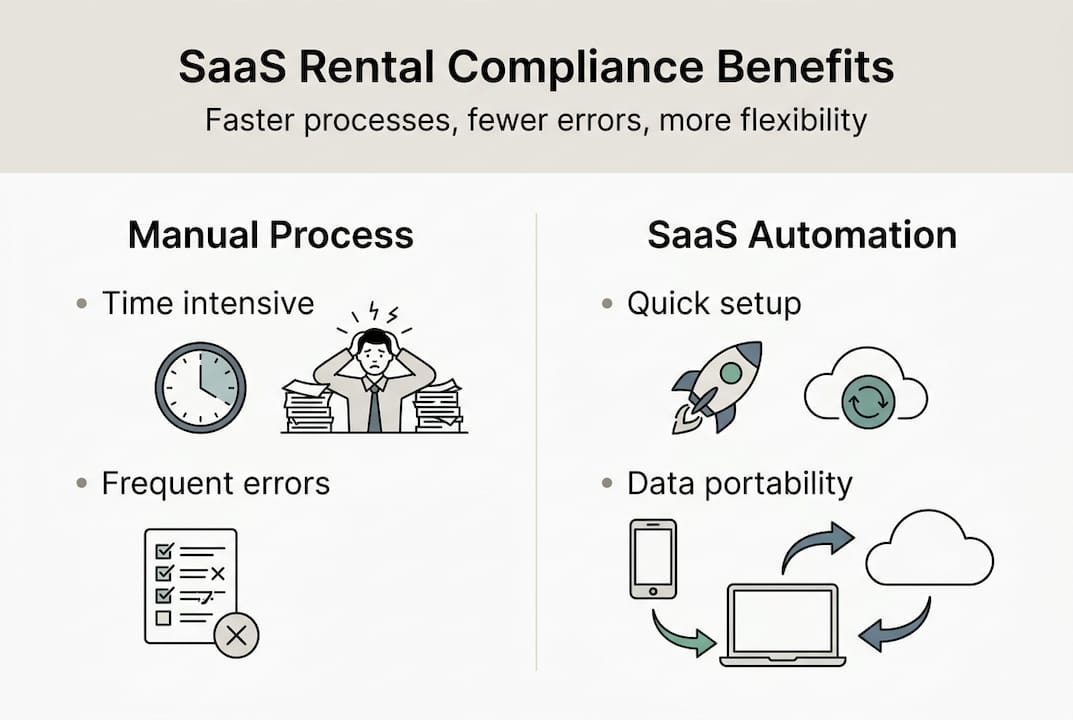
This workflow eliminates the need for manual data entry at almost every stage. Managers who have adopted this approach report cutting compliance-related admin tasks by as much as 30%, freeing up significant time for guest experience and portfolio growth.
The EU Data Act also has important implications here. Custom SaaS solutions built for large portfolios carry maintenance and development risks, while off-the-shelf platforms scale efficiently and benefit from shared development investment. This means compliance features are continuously improved without additional cost to you.
Data portability is another practical benefit. You are not locked into a single vendor’s data format, which means you can switch platforms if your needs change without losing historical records.
| Compliance task | Manual process time | Automated SaaS time |
|---|---|---|
| Guest data collection | 10-15 minutes per guest | Under 2 minutes (guest self-service) |
| Data validation | Manual review, error-prone | Instant, AI-assisted |
| Submission to authority | 15-30 minutes per submission | Automatic, within 24 hours |
| Audit trail creation | Manual filing | Automatic, searchable |
You can explore automation case studies to see how property managers across Europe have reduced their compliance workload. For those looking to act immediately, practical automation tips provide a clear starting point.
The reduction in errors is equally important. Manual data entry introduces mistakes that can delay submissions or trigger compliance queries. Automated systems validate data at the point of entry, catching issues before they become problems.
Choosing the right SaaS solution for your rental business
Not every SaaS platform is built with rental compliance in mind. Many general-purpose property management tools offer booking and payment features but lack the specific functionality needed to meet European travel regulations. Choosing the wrong platform means you could still be handling compliance manually, just with a more expensive tool.
Here is what to look for when evaluating a SaaS solution for your rental business:
- Compliance coverage: Does the platform support the specific regulatory requirements in your operating countries? Check whether it covers guest registration, data submission, and local authority integrations.
- Ease of use: Can your team and your guests navigate the platform without extensive training? Complicated onboarding reduces adoption and increases the risk of errors.
- Remote access: Is the platform fully web-based, accessible from any device without a VPN or local installation?
- Scalability: Can you add new properties, users, or markets without a significant cost increase or technical reconfiguration?
- Integration capability: Does it connect with the OTA and PMS platforms you already use, via APIs or webhooks?
- Support and updates: How frequently is the platform updated? Is compliance-related functionality kept current as regulations change?
- Data portability: Can you export your data in standard formats? This is increasingly important given EU Data Act portability requirements, which reduce the risk of vendor lock-in.
Avoid custom SaaS builds unless you have highly specialised needs that off-the-shelf platforms genuinely cannot meet. The maintenance burden and development costs of custom solutions quickly outweigh any perceived advantages.
Pro Tip: Before committing to a platform, test the guest-facing check-in flow yourself. If it takes more than two minutes to complete, your guests will struggle with it, and incomplete submissions will follow.
For those managing vacation rental properties, the compliance landscape varies significantly by country and even by municipality. A platform that keeps its regulatory database current is worth far more than one with a longer feature list but outdated compliance rules. You can also review multi-property management advice and best practices for rentals to build a stronger operational foundation alongside your technology choices.
A fresh perspective: What most property managers miss about SaaS
There is a persistent view in the rental industry that SaaS platforms are generic tools, built for the masses and lacking the depth needed for serious compliance work. That view is outdated and, frankly, expensive to hold.
The most capable SaaS platforms today are purpose-built for specific industries, including short-term rentals. They encode regulatory knowledge directly into their workflows, so compliance is not an add-on feature. It is the core function. When you use a platform like this, you are not just accessing software. You are accessing continuously updated regulatory expertise.
The operational gains from remote management are still undervalued by many managers. Being able to oversee compliance for twenty properties from a single dashboard, without being physically present at any of them, is a genuine competitive advantage. It means faster response times, fewer errors, and a more professional guest experience.
Data portability, as shaped by evolving EU regulation, also changes the strategic calculus. You are no longer locked into a vendor’s ecosystem. As explored in SaaS for hospitality compliance, the flexibility to move data and switch providers keeps the market competitive and keeps your options open.
SaaS is not simply a cost-saving measure. It is a strategic asset that positions your rental business for the regulatory environment of the next decade.
How GuestAdmin streamlines compliance and guest management
Managing compliance across multiple properties in different European markets does not have to mean juggling portals, spreadsheets, and paperwork.
GuestAdmin is built specifically for property owners and management companies who need reliable, automated compliance without the administrative burden. The platform automates compliance from guest data capture through to authority submission, all within 24 hours. With automated guest management features including AI-powered data validation, multi-property dashboards, and seamless OTA integrations, GuestAdmin removes the guesswork from regulatory obligations. Whether you manage two properties or two hundred, the compliance automation guide can help you understand exactly how GuestAdmin fits your operational needs.
Frequently asked questions
How does SaaS help with rental compliance regulations?
SaaS platforms automate guest data registration and submission, ensuring timely, accurate data delivery to European authorities without manual intervention.
Are SaaS solutions secure for managing guest data?
Modern SaaS platforms use advanced encryption, regular security updates, and GDPR-compliant data handling to keep guest information protected and legally compliant at all times.
Can SaaS be scaled for managing multiple rental properties?
Yes, SaaS solutions are designed to scale easily. Off-the-shelf platforms scale efficiently, accommodating everything from a single unit to large multi-property portfolios with minimal configuration.
What are the risks of vendor lock-in with SaaS?
Vendor lock-in is significantly reduced by EU Data Act portability rules, which give managers the legal right to move their data between platforms in standardised formats.