

TL;DR:
- EU Regulation 2024/1028 mandates standardized, digital guest data reporting across Europe by May 2026.
- Automating guest registration ensures compliance, reduces errors, and provides verifiable audit trails.
- Choosing integrated SaaS platforms with API connections is essential for efficient, future-proof compliance management.
Managing short-term rentals across Europe has never carried more regulatory weight. Property owners and management companies now face a patchwork of national rules, local authority reporting requirements, and, from May 2026, a sweeping new EU regulation that fundamentally changes how guest data must be collected and submitted. Manual processes cannot keep pace. Errors creep in, deadlines get missed, and the resulting penalties can be severe. Automating guest registration is no longer a nice-to-have feature; it is a practical necessity for anyone serious about running a compliant, efficient rental operation in Europe today.
Table of Contents
- Understanding guest registration requirements and EU regulations
- Choosing the right tools and systems for automation
- Step-by-step guide: Automating guest registration
- Troubleshooting and verifying compliance
- A fresh look at guest registration automation
- Streamline compliance with professional automation
- Frequently asked questions
Key Takeaways
| Point | Details |
|---|---|
| EU automation mandate | New regulations require automated guest registration for short-term rentals from May 2026. |
| Choose secure platforms | Select tools with proven compliance and strong data protection features. |
| Verify compliance regularly | Continuous monitoring and monthly audits help avoid costly mistakes. |
| Time-saving workflow | Automated systems simplify guest registration and free up your resources. |
Understanding guest registration requirements and EU regulations
Having introduced the regulatory problem, let us clarify what guest registration actually requires and how new EU standards affect the process.
Guest registration for short-term rentals means capturing specific personal data from every arriving guest and submitting it to the relevant national or local authority, often within a strict timeframe. Depending on the country, this may mean reporting to police databases, tourism registries, tax authorities, or all three simultaneously. In Italy, for example, hosts must submit data to the Alloggiati Web portal within 24 hours of arrival. Portugal requires registration through the SEF system, now managed by AIMA. Spain operates through regional platforms that vary by autonomous community. Each system has its own format, login, and deadline, which makes manual compliance across multiple properties extraordinarily difficult.
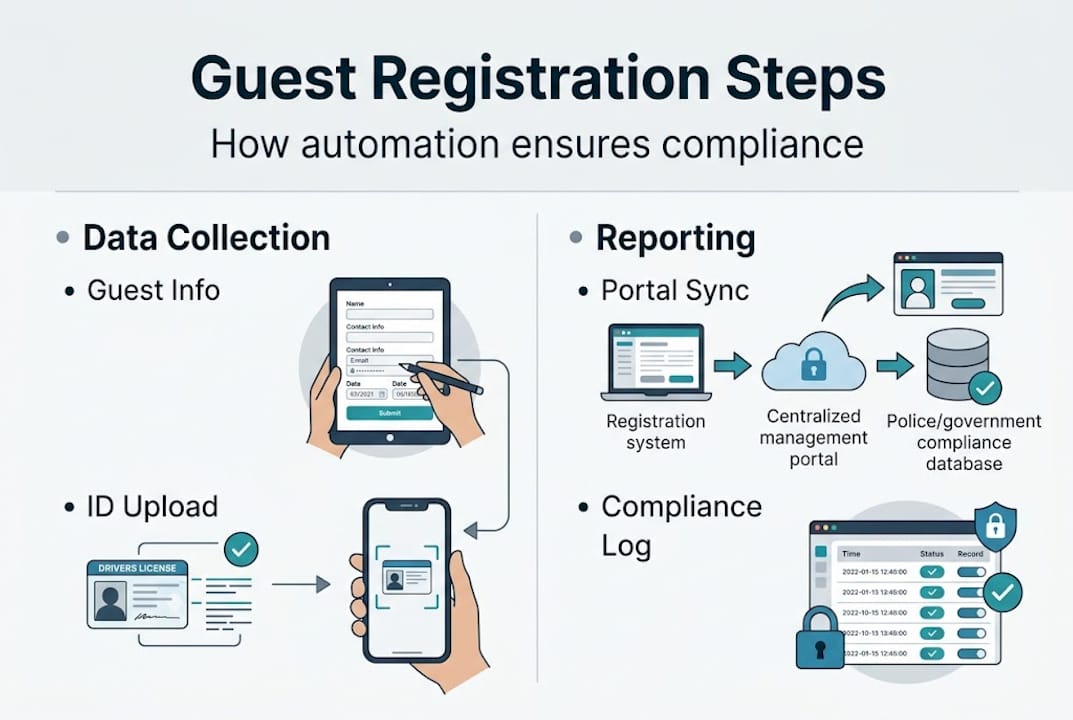
Understanding guest registration compliance in this context means recognising that the data requirements are already demanding, and they are about to become more standardised and strictly enforced.
The single most significant regulatory development is EU Regulation (EU) 2024/1028, which harmonises data collection and sharing for short-term rental activity through standardised channels, including Single Digital Entry Points, with applicability from 20 May 2026. This means that instead of each EU member state running its own fragmented reporting system, there will be a common framework that platforms and property managers must connect to digitally.
Here is a summary of the common requirements property managers already face across EU countries, and what the new regulation adds:
| Requirement | Current practice | From May 2026 |
|---|---|---|
| Guest data capture | Paper forms or manual entry | Digital, standardised fields |
| Submission method | Portal logins, emails, fax | System-to-system data pipelines |
| Submission deadline | Varies (1 to 24 hours) | Harmonised, near-real-time |
| Audit trail | Manual records | Automated, verifiable logs |
| Cross-border sharing | Inconsistent | Standardised via Single Digital Entry Points |
Common data fields required across most EU jurisdictions include:
- Full name and nationality of each guest
- Passport or national identity card number and expiry date
- Date of birth
- Country of residence
- Check-in and check-out dates
- Number of accompanying guests
“EU Regulation (EU) 2024/1028 establishes a common framework for short-term rental data collection and reporting, replacing fragmented national systems with standardised digital submissions via Single Digital Entry Points from 20 May 2026.”
The practical implication is clear. If you are currently handling these submissions manually, you are already managing a significant administrative burden. After May 2026, manual methods will simply not be fit for purpose. The regulation is explicit: reporting must flow through approved digital channels, not through ad hoc spreadsheets or manual portal uploads. The window to prepare is now, and automation is the only realistic path forward.
Choosing the right tools and systems for automation
Now that you know what is expected, let us look at how to select software and systems that make automation easy and compliant.
Not all guest registration automation platforms are created equal. The market includes everything from basic digital guest books that collect signatures to full-service SaaS platforms that integrate with your property management system (PMS), submit data to authorities automatically, and archive records securely. Understanding the differences will help you make the right choice for your operation.
There are three broad categories of tools available. First, standalone digital guest books handle check-in forms and document scanning but typically require manual export and submission of data to authorities. Second, integrated PMS modules extend your existing property management software with compliance features, though these vary widely in their regulatory coverage by country. Third, dedicated compliance SaaS platforms are purpose-built to automate the full journey from data capture to government submission, and they are updated when regulations change.
As EU authorities move to system-to-system data pipelines for registration, moving away from manual transfers, the only tools that will reliably remain compliant are those with direct API connections to regulatory portals and the ability to adapt to new Single Digital Entry Point requirements.
When evaluating platforms, here is a comparison of the features that matter most:
| Feature | Basic digital guest book | Integrated PMS module | Dedicated compliance SaaS |
|---|---|---|---|
| Document capture | Yes | Sometimes | Yes |
| Automated submission | No | Partial | Yes |
| Multi-country support | No | Varies | Yes |
| Regulatory updates | Manual | Slow | Automatic |
| GDPR-compliant archiving | Sometimes | Sometimes | Yes |
| API and webhook integration | Rarely | Sometimes | Yes |
Key features to look for in any platform you consider include:
- Automatic data submission to national and local authority portals without manual intervention
- Real-time regulatory updates so your workflows stay compliant as rules change
- Multi-property dashboards that give you a single view across all your listings
- Secure, GDPR-compliant data storage with clear retention and deletion policies
- Integration with your existing OTA or PMS via APIs or webhooks to avoid double data entry
- Audit logs that prove compliance if you face an inspection
Exploring guest registration services and comparing digital guest books against full compliance platforms will help you identify the right fit. For those just starting out, reviewing resources such as the become a host overview can also provide useful context on what authorities expect from new operators.
Pro Tip: When trialling any platform, ask specifically which regulatory portals it connects to in your operating country, and request evidence that it will be updated for the May 2026 Single Digital Entry Point requirements. A platform that cannot confirm this is a liability, not an asset.
Step-by-step guide: Automating guest registration
With the right tools at hand, here is how you can automate guest registration step by step and stay ahead of compliance deadlines.
Approaching automation as a project rather than a single decision makes it far more manageable. Breaking it into clear phases reduces the risk of errors and ensures you are fully operational well before the May 2026 regulatory deadline.
Step 1: Gather your compliance requirements
Before touching any software, document what your specific obligations are. List every property you manage, the country and municipality it sits in, and the relevant authority you must report to. Note the required data fields, submission deadlines, and any registration numbers or licences you already hold. This baseline document will guide your platform configuration later.
Step 2: Select and configure your automation platform
Choose a platform that covers all your jurisdictions. Once selected, configure it with your property details, including address, registration number, and the local authority portal credentials. Most dedicated platforms walk you through this setup with guided onboarding, though you should set aside two to three hours per property for initial configuration.

Step 3: Connect to regulatory digital portals
This is where automation delivers its greatest value. Your platform should connect directly to each country’s reporting portal via a secure API connection. For post-May 2026 compliance, confirm that your platform is already developing or has completed integration with the relevant Single Digital Entry Points. Review your compliance workflow guide to understand exactly how these connections should be set up and verified.
Step 4: Integrate with your booking channels
Connect the platform to your OTA listings (Airbnb, Booking.com, and others) or your PMS via API or webhook. This ensures that when a booking is confirmed, guest data flows automatically into the registration system without any manual re-entry. Learning to automate guest management effectively at this stage eliminates the most common source of compliance errors.
Step 5: Test data transfer end to end
Run a test booking through the full pipeline. Confirm that guest data is captured correctly, submitted to the relevant authority within the required timeframe, and archived securely. Check that any mandatory fields are flagged if incomplete, so the system prevents partial submissions rather than sending incorrect data.
Step 6: Monitor and verify compliance continuously
Set up automated alerts for failed submissions, missing data, or regulatory changes. Schedule a review every time you add a new property or expand into a new country. To automate booking compliance reliably, continuous monitoring is just as important as the initial setup.
EU authorities will verify activity data directly via system-to-system reporting, making manual or delayed transfers risky from May 2026. Failing to submit on time through approved digital channels will be immediately visible to enforcement bodies.
Pro Tip: Mark your calendar for Q1 2026 as a full compliance review date. Use it to test your regulatory connections, update any platform configurations, and confirm that your platform provider has completed its Single Digital Entry Point integrations ahead of the May deadline.
Troubleshooting and verifying compliance
After automation is set up, it is crucial to monitor compliance and address errors. Here is how to stay proactive.
Even well-configured automation systems encounter issues. Understanding the most common failure points allows you to catch and resolve them before they become regulatory problems. The good news is that most issues are predictable and correctable with the right verification protocols in place.
The most frequent pitfalls include:
- Missing or incomplete guest data — often caused by guests not completing pre-arrival forms, or OTA integrations failing to pass all required fields
- Mismatched records — discrepancies between the name on a booking and the identity document presented at check-in, which can invalidate a submission
- Manual overrides — staff bypassing the automated system to “fix” a record manually, introducing errors that the system cannot track or verify
- Portal credential expiry — authority portal passwords or API keys expiring without notification, causing silent submission failures
- Regulatory changes not yet reflected — a rule change in one jurisdiction that the platform has not yet updated for, resulting in submissions that miss new mandatory fields
The impact of these errors can be significant. Harmonised data pipelines mean missed or incorrect entries will be flagged directly by EU authorities, necessitating regular verification. Under the new framework, there is no ambiguity: either your data arrived correctly through the right channel, or it did not.
Reviewing common guest data mistakes is an excellent starting point for understanding exactly where manual and automated processes tend to break down.
Effective verification protocols should include:
- Automated submission alerts that notify you immediately if a submission fails or is rejected
- Daily dashboard reviews to confirm all expected submissions for check-ins that day have completed successfully
- Monthly audit checks comparing your booking records against your submission logs to identify any gaps
- Quarterly review of regulatory requirements in each of your operating countries to ensure the platform is still correctly configured
- Annual platform audit to verify that your provider’s security certifications and GDPR compliance documentation are current
Pro Tip: Schedule a monthly 30-minute compliance check into your calendar. Pull a report from your platform covering all submissions in the previous month, cross-reference it against your booking data, and flag any discrepancies for immediate investigation. This small investment of time can prevent significant regulatory penalties.
A fresh look at guest registration automation
There is a common misconception that automation is primarily about saving time. Time savings are real and valuable, but they are a secondary benefit. The primary value of automating guest registration is certainty. When a submission goes through an approved digital pipeline with a verified timestamp and a secure audit log, you have evidence that you complied. When it goes through a manual process, you have a spreadsheet and a hope.
Experienced property managers who have explored expert automation overviews consistently report that the biggest shift is psychological. The stress of wondering whether last night’s check-in was properly reported simply disappears. Regulatory inspections become straightforward rather than alarming, because the data is there and verifiable.
There is also a broader business case that is often overlooked. As EU enforcement intensifies and adoption rates rise, non-automated operators will stand out to authorities as higher-risk entities. Conversely, operators with clean, consistent digital submission records build a reputation for reliability. That matters when licensing renewals come around, when local authorities have discretion over operating permissions, and when larger property management contracts are on the table. Automation is not just compliance management. It is business infrastructure.
Streamline compliance with professional automation
If the steps above feel like a substantial project, you do not need to navigate them alone. GuestAdmin.io offers purpose-built automation for property owners and management companies across Europe, covering everything from secure guest data capture to direct submission to national authorities.
Understanding rental compliance explained is the first step, and GuestAdmin makes it straightforward with clear guides, a real-time compliance dashboard, and multi-property management built in. Whether you manage a single apartment or a portfolio of dozens, the platform scales to your operation and keeps pace with regulatory changes automatically. Ready to take the next step? Explore how to automate guest management effortlessly and book a demo to see the platform in action.
Frequently asked questions
What does EU Regulation (EU) 2024/1028 require for guest registration automation?
It mandates standardised data collection and reporting through digital entry points from 20 May 2026, replacing manual transfers with system-to-system reporting to Single Digital Entry Points across the EU.
Can I still use manual guest registration after May 2026?
Manual methods will likely be non-compliant after May 2026, as EU authorities rely on digital pipelines for enforcement, and property managers who cannot demonstrate automated system-to-system reporting face direct regulatory exposure.
Is automation secure for guest data and privacy?
Reputable compliance platforms feature robust encryption, GDPR-compliant data handling, and strict access controls, but you should always request evidence of security certifications and data retention policies before committing to any provider.
How soon should I start automating guest registration?
Start immediately. The regulation applies from 20 May 2026, and allowing adequate time for platform selection, configuration, testing, and staff training is essential to avoid a last-minute scramble that risks compliance gaps.
2 Comments
How SaaS guest registration simplifies rental compliance
[…] on what matters. Explore the rental compliance essentials that apply to your properties, or see how seamless automation works in practice. A trial account gets you operational in hours, not weeks, with onboarding […]
Step-by-step guide to automating hospitality compliance
[…] Automate guest registration for effortless compliance […]