

TL;DR:
- Regulation (EU) 2024/1028 mandates short-term rental registration and monthly data reporting across EU nations, starting May 2026. Property owners must ensure registration numbers match national records, and platforms verify and display these numbers to enforce compliance. Local rules like night caps remain under municipal jurisdiction, requiring proactive management of metadata, registration, and data submission to avoid enforcement actions.
Regulation (EU) 2024/1028 is the EU law that standardises short-term rental (STR) registration and data reporting across all Member States, entering full application on 20 May 2026. This european rental regulation guide covers every obligation that matters to you as a property owner or manager: obtaining valid registration numbers, displaying them on platforms, and submitting monthly rental activity data through national Single Digital Entry Points (SDEPs). The regulation does not decide whether your property can legally operate. That remains a local matter. What it does is give authorities the data infrastructure to enforce local rules with precision, making compliance non-negotiable for any host active on Airbnb, Booking.com, or any other major platform.
What are the key obligations under EU Regulation 2024/1028?
Regulation (EU) 2024/1028 mandates that every short-term rental listing in the EU carries a valid registration number issued by the relevant national or local authority. That number is the operative identifier for your property across every platform and every data submission. Without it, your listing cannot legally appear on a major platform after 20 May 2026.
The data reporting requirements are specific and non-negotiable. Platforms transmit standardised rental activity data monthly to national SDEPs, covering the following mandatory fields:
- Registration number tied to the specific listing
- Listing URL on the platform
- Full property address as registered with the authority
- Number of nights rented in the reporting period
- Guest count per booking or period
- Host identity data as submitted at registration
The SDEP is not simply a data warehouse. The SDEP ingests rental activity data and provides it directly to competent authorities for monitoring and cross-border enforcement cooperation. Think of it as the live connection between platform data and regulatory oversight. Authorities no longer wait for complaints. They query the data.
Pro Tip: Register your property with the exact address format used in official land or municipal records. Any discrepancy between your registration address and your platform listing address is one of the most common triggers for enforcement action.
The enforcement mechanism is direct. Authorities can order platforms to remove or disable non-compliant listings based on data matched against registration records and local night caps. This means a listing can be taken down without a formal complaint from a neighbour or a local inspection. The data does the work.
| Obligation | Who is responsible | Frequency |
|---|---|---|
| Obtain and maintain registration number | Host / property owner | Once, then ongoing renewal per local rules |
| Display registration number on listing | Platform and host | Continuous |
| Submit rental activity data to SDEP | Platform (large platforms) | Monthly |
| Verify registration number validity | Platform | Periodic checks |
| Respond to authority delisting orders | Platform | On demand |
How do local rules affect your compliance obligations?
The EU regulation harmonises the data infrastructure but leaves legality, zoning, and night caps as local authority prerogatives. This is the most misunderstood aspect of the framework. Passing the EU compliance check does not mean you are compliant in your municipality.

Consider the practical reality for a manager operating properties in Lisbon, Amsterdam, and Barcelona simultaneously. Each city applies its own night cap, its own zoning restrictions, and its own registration procedure. The EU regulation creates a shared data language, but the rules being enforced are entirely local. A property in Amsterdam’s historic centre faces a 30-night annual cap. A property in a rural Portuguese municipality may face no cap at all. Your compliance programme must account for both layers.
The staggered roll-out of national SDEPs adds further complexity. Operational readiness varies among Member States, meaning that even after 20 May 2026, some national portals may not yet have live data pipelines. This creates a window where you could be technically compliant yet still face platform friction or enforcement inconsistency. Monitoring national portal readiness dates is not optional for multi-jurisdictional operators.
Pro Tip: Build a jurisdiction register for every property you manage. Record the local night cap, registration renewal date, and the status of that country’s SDEP. Review it quarterly. Regulations shift faster than most property managers expect.
The key implication for EU rental laws compliance is this: your registration number must align precisely with the local database entry. If your municipality updates its register and your platform listing still carries an old identifier, the mismatch is visible to authorities in real time.
What operational steps ensure full compliance across your portfolio?
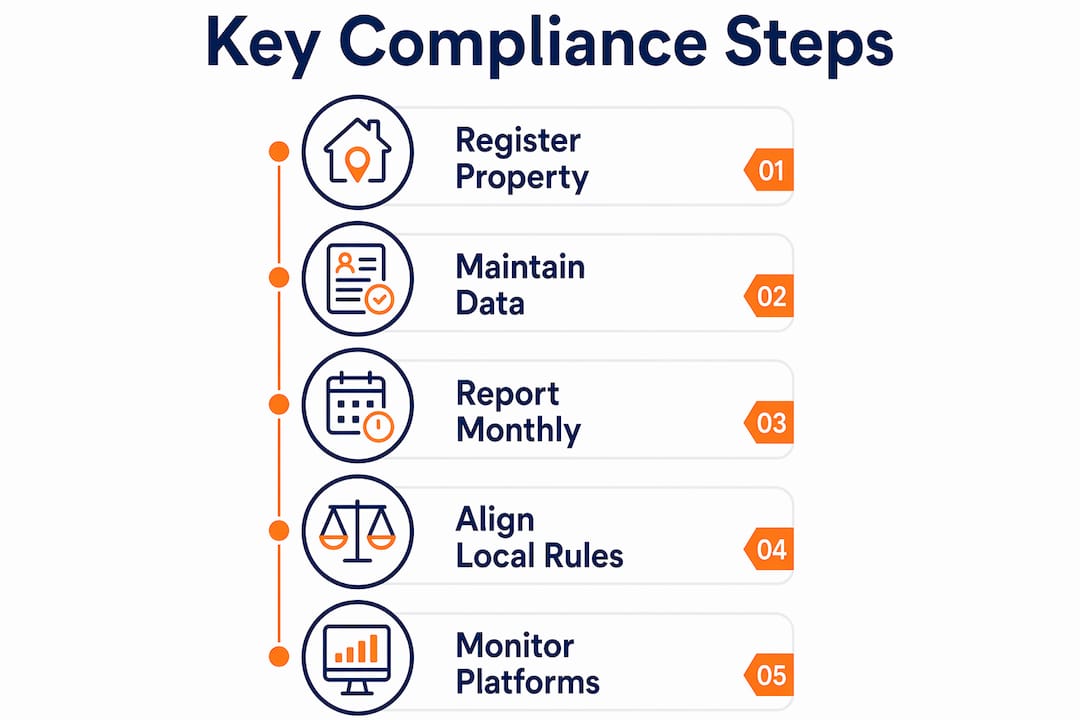
Property managers operating across multiple European markets need a structured compliance process, not a checklist reviewed once a year. The following steps reflect what full compliance actually requires in 2026.
-
Confirm registration requirements per jurisdiction. Not every Member State has identical procedures. Check the national SDEP portal or competent authority website for each country where you operate. Some municipalities require separate local registration on top of a national one.
-
Obtain valid registration numbers for every listing. A single property with multiple listings on different platforms still uses one registration number. That number must appear identically on Airbnb, Booking.com, Vrbo, and any direct booking channel you operate.
-
Synchronise listing metadata across all platforms. The address, host name, and registration number on every platform must match the entry in the national register exactly. Registration number mismatches between host identity and listing address are the primary enforcement trigger.
-
Implement a centralised data management system. Whether you use a property management system (PMS), a dedicated compliance platform like Guestadmin, or a structured spreadsheet, all booking data must be consolidated in one place. Fragmented records across platforms make monthly reconciliation impossible.
-
Set up monthly night-cap reconciliation. Track booked nights per property against the local limit. If you manage 40 properties in three countries, this process must be automated or delegated with clear accountability.
-
Maintain audit-ready documentation. Keep registration certificates, listing screenshots with registration numbers displayed, tax filings, and safety compliance records. Authorities can request these at any time, and platforms may require them during periodic validity checks.
-
Subscribe to SDEP and authority updates. National portals publish guidance changes. Assign someone in your team to monitor these and act within 48 hours of any material update.
Pro Tip: When you contract with a property manager or co-host, specify in writing who holds responsibility for registration accuracy and platform listing data. Platforms enforce compliance based on metadata correctness, and ambiguity in contracts creates liability gaps.
| Compliance area | Recommended action | Risk if neglected |
|---|---|---|
| Registration number accuracy | Verify against national register quarterly | Listing suspension or removal |
| Night-cap monitoring | Monthly reconciliation per property | Fines and authority enforcement |
| Platform metadata consistency | Audit all listings after any registration update | Data mismatch triggers enforcement |
| Audit documentation | Maintain rolling 24-month archive | Inability to respond to authority requests |
| SDEP readiness monitoring | Track national portal go-live dates | Unexpected enforcement friction |
How do Airbnb and Booking.com fulfil their regulatory responsibilities?
Platforms such as Airbnb and Booking.com are no longer passive intermediaries under this framework. Platforms must verify and display registration numbers, report rental data monthly, and comply with authority requests for delisting non-compliant properties. This shift in accountability changes the relationship between hosts and platforms in a meaningful way.
The platform’s obligations under EU rental laws include:
- Collecting registration numbers from hosts before a listing goes live
- Conducting periodic validity checks against national registers to confirm numbers remain active
- Displaying registration numbers visibly on every listing page
- Reporting monthly rental activity data to the relevant national SDEP for all active listings
- Executing authority delisting orders promptly when non-compliance is confirmed
The Digital Services Act reinforces this accountability. Platforms that fail to act on authority orders face their own regulatory exposure, which means they have a direct commercial incentive to enforce host compliance. If your registration number fails a validity check, your listing can be suspended without prior notice from the platform.
Pro Tip: Do not wait for a platform to flag a registration issue. Run your own validity check against the national register every time you renew a registration or update listing details. Platforms check periodically, not continuously, so you may have a window of exposure between their checks.
The practical implication for property owners is that your relationship with platforms now includes a compliance dimension. Keeping your registration data current and accurate is as important as your pricing strategy or your review score.
What are the most common compliance risks and how do you resolve them?
The most frequent compliance failure in European short-term rental management is a mismatch between the registration number, the host identity on the platform, and the property address in the national register. Multi-property managers must prioritise metadata accuracy across all platforms to avoid triggering enforcement.
Common risk scenarios include:
- Address formatting differences between the national register and the platform listing (e.g., “Calle Mayor 12, 3B” vs “Calle Mayor 12 3B”)
- Expired registration numbers that have not been renewed after a local authority’s annual cycle
- Multiple platforms carrying different versions of the same registration data after an update was applied on one platform but not others
- Ownership or management changes where the new operator has not updated the registration to reflect the correct host entity
“Compliance operations must be treated as a competitive moat, involving dedicated personnel and centralised monitoring across all jurisdictions.” Source: Minut
The consequences of incomplete or outdated registration data are direct: listing suspension, fines from local authorities, or permanent removal from a platform. Recovering a suspended listing requires engaging both the platform’s trust and safety team and the relevant national authority, a process that can take weeks and result in lost revenue.
Pro Tip: Create a single source of truth for every property’s registration data. When a registration is renewed or updated, trigger an immediate audit of every platform listing for that property. One update workflow prevents the majority of mismatch errors.
Key takeaways
Compliance with Regulation (EU) 2024/1028 requires accurate registration numbers, consistent platform metadata, and monthly data reporting to national SDEPs, with local rules determining the substantive legality of each listing.
| Point | Details |
|---|---|
| Registration number is the foundation | Every listing must carry a valid, current number that matches the national register exactly. |
| Local rules still govern legality | Night caps, zoning, and occupancy limits are set locally; EU regulation enables their enforcement. |
| Platforms are active compliance gatekeepers | Airbnb and Booking.com verify, display, and report registration data; non-compliance triggers delisting. |
| Metadata accuracy prevents enforcement | Mismatches between address, host identity, and registration number are the primary enforcement trigger. |
| Staggered SDEP readiness creates risk | Monitor national portal go-live dates to avoid enforcement friction during the transition period. |
Why registration data is your most underestimated operational asset
I have worked with property managers who treat registration as a one-off administrative task. Get the number, paste it into the listing, move on. That approach was always risky, but under Regulation (EU) 2024/1028 it is genuinely dangerous.
What I have come to understand is that your registration number is dynamic operational data. It has a renewal cycle. It is tied to a specific address format. It is linked to a host entity that may change when you bring in a co-host or restructure your management company. Every one of those variables is a potential mismatch point, and mismatches now surface automatically through the SDEP data pipeline.
The operators who will thrive under these EU rental laws are not the ones with the best lawyers. They are the ones who have built data governance into their daily operations. That means a centralised register of all property identifiers, a defined process for updating platform listings when any registration detail changes, and a named person accountable for each jurisdiction.
I also think the industry underestimates how much the platform relationship has changed. Airbnb and Booking.com are now compliance partners whether they want to be or not. Building a direct line of communication with your platform account manager, and keeping them informed of registration updates before they run their periodic checks, reduces the risk of unexpected suspensions significantly.
The regulation shifts enforcement from reactive to proactive. Authorities no longer need a complaint. They have the data. The property managers who treat STR compliance as a continuous process rather than a periodic task will find that the new framework actually rewards them. Their listings stay live. Their audits are clean. Their competitors who cut corners face delisting.
— Alex
How Guestadmin supports your compliance under EU rental regulations
Managing registration numbers, platform metadata, and monthly SDEP reporting across multiple properties and jurisdictions is a significant operational burden. Guestadmin is built specifically to reduce that burden for property owners and managers operating in the European short-term rental market.

Guestadmin centralises registration number tracking, synchronises listing data across platforms, and automates monthly rental activity reconciliation against local night caps. Its dashboard gives you a real-time view of compliance status across your entire portfolio, with alerts triggered when registration renewals are due or when data inconsistencies are detected. For managers seeking full regulatory compliance without building a dedicated compliance team, Guestadmin provides the infrastructure to stay audit-ready at all times. You can also explore Guestadmin’s registration compliance tools to get started with the specific requirements under Regulation (EU) 2024/1028.
FAQ
What is Regulation (EU) 2024/1028 and when does it apply?
Regulation (EU) 2024/1028 is the EU law standardising short-term rental registration and data reporting across all Member States, entering full application on 20 May 2026. It requires hosts to hold valid registration numbers and platforms to report rental activity data monthly to national Single Digital Entry Points.
Do I need a separate registration number for each platform I use?
No. One registration number is issued per property by the relevant national or local authority and must be displayed identically across all platforms, including Airbnb, Booking.com, and any direct booking channels.
What happens if my registration number is incorrect or expired on a platform?
Mismatches between registration data and national register entries are the primary enforcement trigger, and authorities can order platforms to suspend or remove the listing without prior warning to the host.
Does the EU regulation set night caps or zoning rules for my property?
No. The EU regulation harmonises data infrastructure but leaves night caps, zoning, and occupancy limits entirely under local and national authority control. You must check the specific rules for each municipality where you operate.
Are all EU Member States ready to enforce the regulation from May 2026?
Operational readiness is staggered among Member States, meaning some national SDEP systems may not be fully live on day one. Operators should monitor national portal readiness dates and maintain compliance documentation regardless of local system status.