

TL;DR:
- A property management system is essential for short-term rental operators to ensure regulatory compliance and reliable data reporting. From May 2026, operators must display registration numbers, perform monthly data submissions, and maintain accurate records within their PMS to meet EU requirements. Proper configuration with immutable logs, data validation, and scheduled reconciliation transforms a PMS into an audit-ready evidence generator, reducing compliance risks.
A property management system (PMS) is the central technology that enables short-term rental owners and managers across Europe to meet regulatory compliance requirements by centralising, validating, and automating data workflows. The term PMS can cause confusion: in medical devices, PMS refers to post-market surveillance under EU MDR Article 83, a strictly regulated lifecycle obligation. For short-term rental operators, PMS means property management software. Understanding the role of PMS in compliance matters more than ever in 2026, as EU Regulation 2024/1028 introduces mandatory registration number display, digital reporting, and platform verification obligations that no spreadsheet can reliably handle.
What compliance obligations must short-term rental owners meet?
EU Regulation 2024/1028 mandates that every short-term rental listing displays a valid registration number, and that platforms verify those numbers before publishing any listing. This is not a voluntary transparency measure. It is a legal requirement with direct consequences for hosts whose data does not pass platform checks.
From May 2026, monthly SDEP reporting of nights booked and guest counts becomes obligatory across EU member states. Single Digital Entry Points are the government-designated data exchange channels through which platforms like Airbnb and Booking.com must submit activity data to national authorities. Your PMS must capture and store data in formats that align precisely with SDEP field specifications.
The specific data fields your PMS must hold and maintain include:
- Registration number in the exact format required by the relevant national or municipal authority
- Property address standardised to match the registered address on file with authorities
- Guest count per booking recorded at the time of check-in, not estimated retrospectively
- Nights booked per calendar month, reconciled against platform records
- Host identity data linked to the registration, including tax identification where required
Beyond data capture, platforms have shifted from passive intermediaries to active compliance gatekeepers. Airbnb and Booking.com now reject listings with missing or incorrectly formatted registration numbers. This means a PMS that stores your registration number in the wrong format does not just create an administrative inconvenience. It can result in your listing being taken down entirely.
| Compliance requirement | PMS data responsibility |
|---|---|
| Registration number display | Store and push verified number to all connected platforms |
| Monthly SDEP reporting | Aggregate nightly and guest data in SDEP-compatible format |
| Platform verification | Validate number format before submission to OTA channels |
| Audit trail | Maintain immutable logs of all data submissions and changes |
| Address consistency | Standardise address fields across all connected systems |
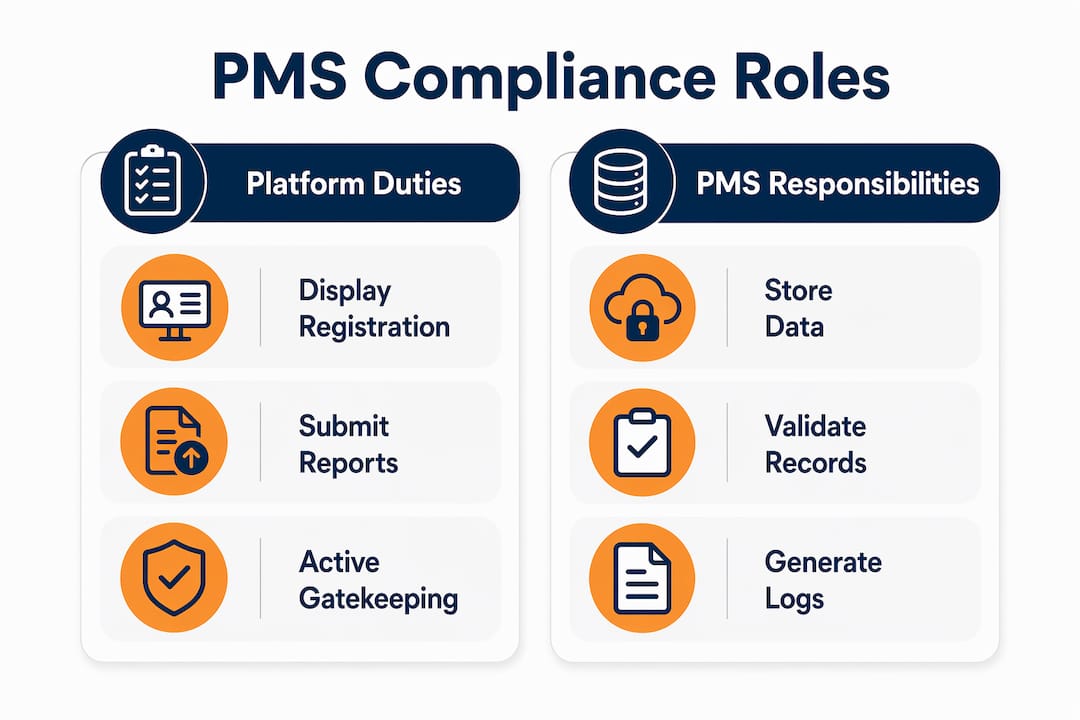
A PMS that fulfils these obligations does not simply store records. It acts as the single source of truth for every data point that authorities and platforms will scrutinise.
How does a PMS ensure continuous and auditable compliance?
Continuous compliance is not a status you achieve once and retain passively. It is a demonstrable, ongoing state where current, traceable records show that all regulatory obligations have been met within each reporting cycle. For short-term rental operators, this means your PMS must generate evidence, not just store data.
The practical architecture of auditable compliance within a PMS rests on four capabilities:
- Immutable logs. Every change to a registration number, address field, or booking record must be time-stamped and preserved. Overwriting data without a version history destroys the evidence chain that authorities require during an audit.
- Versioned records. When a registration number is updated because a property moves to a new municipality or a licence is renewed, the PMS must retain the previous version alongside the effective dates of each version. This proves continuity of compliance across periods.
- Compliance event linking. When a discrepancy is flagged, such as a guest count mismatch between the PMS and a platform report, the PMS must log the event, the corrective action taken, and the resolution date. This creates a traceable evidence chain from finding to fix.
- Scheduled reconciliation. Cadence-based checks embedded in the PMS, running daily or weekly, catch data gaps before monthly reporting deadlines arrive. Treating compliance as a monthly task rather than a continuous workflow is the single most common reason operators fail audits.
Pro Tip: Set your PMS reconciliation cadence to run every Monday morning. A weekly check gives you three to four correction windows before any monthly SDEP submission deadline, which is far safer than a single end-of-month review.
Compliance is not just having processes in place. It is the ability to produce on-demand records that connect PMS activities directly to regulatory artefacts. If an authority requests evidence of your reporting for Q1 2026, your PMS should generate that dossier in minutes, not days.

What are common PMS compliance pitfalls to avoid?
Field drift is the most underestimated risk in PMS compliance management. It occurs when the registration number stored in your PMS does not precisely match the format expected by the SDEP or platform. The formatting inconsistencies that cause rejection include spacing differences, capitalisation variations, and the presence or absence of unit identifiers. Your internal records may look correct while the submitted data fails validation silently.
The consequences extend beyond a rejected submission. Mismatched data across your PMS, channel manager, and OTA platforms creates conflicting records that are difficult to reconcile under audit pressure. When Airbnb holds one version of your registration number and your PMS holds another, neither record is definitively correct in the eyes of an authority reviewing your compliance history.
The most effective mitigation strategies are:
- Data normalisation at ingestion. When a registration number enters your PMS, apply a validation rule that strips extra spaces, enforces the correct casing, and checks the number against the expected format for that jurisdiction before saving.
- Real-time alerts for field mismatches. Configure your PMS to flag any discrepancy between the registration number held centrally and the version pushed to connected platforms or channel managers.
- Weekly cross-platform reconciliation. Export your registration data from your PMS and compare it against what each connected OTA displays. A compliance workflow built around this check prevents drift from accumulating undetected.
- Single source of truth discipline. Never allow platform portals or channel managers to hold the authoritative version of your registration data. The PMS must be the origin, and all other systems must pull from it.
Pro Tip: Build a simple validation rule in your PMS that rejects any registration number entry that does not match the exact character count and format for your country. Spain’s VT numbers, Portugal’s AL numbers, and France’s SIRET-linked codes all have distinct structures. A format check at entry costs nothing and prevents months of downstream errors.
How to configure your PMS for best compliance practice
Configuring a PMS for compliance is not a one-time setup task. It is an ongoing operational discipline. The following steps reflect what well-managed short-term rental operations across Europe have embedded into their standard workflows.
- Centralise all registration data in the PMS first. Before connecting any OTA or channel manager, enter and validate every property’s registration number, address, and host identity data within the PMS. This establishes the PMS as the authoritative source from day one.
- Set up automated platform verification triggers. Configure your PMS to push registration number updates to Airbnb, Booking.com, and any connected channel manager automatically whenever a change is saved. Manual updates across multiple portals are a reliable source of field drift.
- Create a compliance dossier per property. Each property record in your PMS should contain the registration certificate, safety inspection records, and a log of all SDEP submissions. Guestadmin’s automated guest registration feature supports this by linking guest data submissions directly to the property record.
- Schedule recurring reconciliation alerts. Use your PMS’s notification system to trigger a weekly data review task. The alert should prompt a check of registration number consistency, guest count accuracy, and pending SDEP submission status.
- Leverage API integrations for data exchange. APIs for rental compliance allow your PMS to exchange validated data with platforms and authorities without manual re-entry. This removes the human error risk that manual data transfer introduces at every step.
For operators managing multiple properties, the configuration challenge scales quickly. A comparison of single-property versus multi-property compliance workflows illustrates where PMS automation delivers the greatest return.
| Workflow element | Single property | Multi-property |
|---|---|---|
| Registration data entry | Manual, low risk | Automated ingestion required |
| SDEP reporting | Monthly manual export | Scheduled batch submission |
| Platform verification | Single push per update | Bulk validation across all listings |
| Audit dossier | One property folder | Per-property dossier with central index |
| Reconciliation cadence | Weekly manual check | Automated daily alerts per property |
The multi-property compliance workflow challenge is where a well-configured PMS separates operators who stay compliant from those who accumulate undetected errors across their portfolio.
Key takeaways
A PMS is the operational backbone of short-term rental compliance, and its value is measured by the quality of the evidence it produces, not just the data it stores.
| Point | Details |
|---|---|
| PMS as compliance backbone | A PMS must centralise, validate, and push registration data to all connected platforms automatically. |
| EU 2026 obligations | Monthly SDEP reporting and registration number display are mandatory under EU Regulation 2024/1028 from May 2026. |
| Continuous compliance | Scheduled daily or weekly reconciliation within the PMS prevents data gaps before reporting deadlines. |
| Field drift risk | Formatting inconsistencies in registration numbers cause silent SDEP rejections and must be caught at data ingestion. |
| Audit readiness | Immutable logs, versioned records, and per-property compliance dossiers are the minimum standard for audit-ready PMS management. |
Why I think most operators are underestimating their PMS compliance gap
Having worked closely with property managers across Europe navigating the shift to digital regulatory reporting, I have observed a consistent pattern: operators who believe they are compliant because they have a PMS are often the least prepared for an actual audit. The PMS is in place, but the compliance architecture within it is not.
The operators who fare best are those who treat their PMS not as a booking tool with a compliance tab, but as a regulatory evidence system that happens to manage bookings. That mental shift changes how they configure alerts, how they structure property records, and how frequently they run reconciliations. Automation and audit-grade record-keeping are becoming a genuine competitive advantage in markets where authorities are beginning to cross-reference SDEP data with platform listings at scale.
My strongest recommendation is to invest in PMS compliance features before you receive a request for information from an authority, not after. Reactive fixes under audit pressure are expensive, stressful, and often incomplete. The compliance checklist for Europe 2026 is a practical starting point for assessing where your current PMS configuration falls short. Build the evidence chain now, and the audit becomes a formality rather than a crisis.
— Alex
How Guestadmin helps you meet your PMS compliance obligations
Guestadmin is built specifically for short-term rental operators who need more than a booking system. The platform automates registration number management, guest data capture, and SDEP-compatible reporting, with AI-powered processing that submits data to authorities within 24 hours of a booking.

Every property record in Guestadmin holds a full compliance dossier, with immutable submission logs, versioned registration data, and real-time alerts for field mismatches across connected OTA platforms. For operators managing multiple properties across different EU jurisdictions, Guestadmin’s step-by-step compliance automation guide walks you through configuring each workflow element for your specific regulatory context. If you are ready to move from manual compliance management to a system that generates audit-ready evidence automatically, Guestadmin is the platform built for that purpose.
FAQ
What does PMS mean in the context of short-term rentals?
In short-term rentals, PMS stands for Property Management System, the software used to manage bookings, guest data, and regulatory compliance. This is distinct from the medical device meaning of PMS, which refers to post-market surveillance under EU MDR.
What compliance obligations apply to EU short-term rental owners from 2026?
Under EU Regulation 2024/1028, property owners must display a valid registration number on all listings and submit monthly activity data via Single Digital Entry Points from May 2026. Platforms including Airbnb and Booking.com are required to verify registration numbers before publishing listings.
What is field drift and why does it matter for PMS compliance?
Field drift occurs when the registration number or address data in your PMS does not match the format expected by platforms or SDEP systems, causing silent data rejection. Normalising data at the point of entry into your PMS is the most reliable way to prevent it.
How often should a PMS run compliance reconciliations?
A PMS should run data reconciliations at least weekly, not just before monthly reporting deadlines. Weekly cadence checks catch discrepancies early and give operators multiple correction windows before submissions are due.
Can a PMS generate audit-ready records automatically?
Yes, provided it is configured with immutable logs, versioned records, and per-property compliance dossiers. A well-configured PMS should be able to produce a complete evidence trail for any reporting period on demand, without manual document assembly.